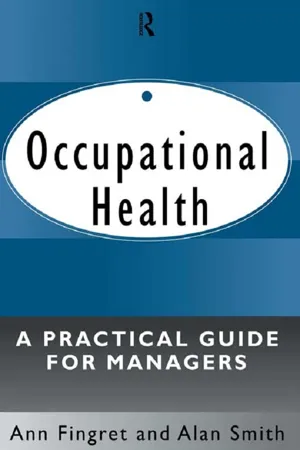
New legislation and recommended working practices demand that every organisation considers carefully the health of its workforce. Occupational Health: A Practical Guide for Managers offers a comprehensive view of health and safety issues at work. The range of people it aims to appeal to reflects the interdisciplinary nature of this subject. Personnel professionals, managers and occupational health practitioners alike will find it an invaluable resource.
- 240 pages
- English
- ePUB (mobile friendly)
- Available on iOS & Android
eBook - ePub
Occupational Health: A Practical Guide for Managers
About this book
Information
Part I
Chapter 1
Organisational and legal considerations
In three to four years’ time, half as many people will be paid twice as much for working three times as hard.
(Charles Handy, Understanding Organisations, 1992)
To ensure survival organisations and individuals have experienced, and continue to experience, major changes in the workplace. Technological and cultural advances have led to significant alterations in the nature of work and the demography of the workforce. Leaner, more flexible organisations need new structures and cultures. This chapter details these changes and the driving factors which have led to them. It considers the need for a healthy and effective workforce to meet the challenge of these changes, and discusses organisation structures, cultures, contractual arrangements and the role of the personnel function in relation to these issues.
The changing nature of work
The Concise Oxford Dictionary (sixth edition 1976) defines work as ‘Expenditure of energy, striving, application of effort or exertion to a purpose’. The eighth edition (1990) changes the definition to ‘The application of mental or physical effort to a purpose’. The recognition by the compilers of the increasing importance of mental effort in the world of work in just 15 years reflects the fundamental and rapid changes that have occurred in Britain.
Not only has there been an increase in the non-manufacturing workforce, there has been a significant decrease in the numbers working in the ‘making’ sector of the economy. Department of Employment statistics show that from a figure of 7 million people employed in the manufacturing industry at the beginning of 1980, by 1992 there were only 4.5 million. Over the same period employment in non-manufacturing had risen from 16 million to 17.2 million (note the increase in unemployment). These figures are not presented in the mistaken view that manual jobs only occur in manufacturing or that manufacturing industry does not employ people whose work is not entirely or mainly mental in its nature. They are presented to support the view that the change from physical to mental work has been rapid and substantial.
Factors driving change
Social and political factors have influenced changes in the types of need being satisfied. For example, in the area of retirement pensions the pressure to make personal provision with less reliance on the state has been a factor in the growth of the financial services sector. The two biggest factors in the change, however, have resulted from technological advances: one in the increased use of machinery to replace manual functions with the parallel increase in machine control; and the other in the availability and sophistication of electronic information processors. These changes have had a fundamental effect on work. It is no longer necessary for employees to travel into an office to carry out their tasks as electronic data interchange (EDI) has facilitated the growth of remote working. Technology has been a major influence in other changes to work. Return on capital investment considerations have influenced working patterns to the extent that shift working of the rotating kind is practised in some 12 per cent of companies in the UK (Blick Time Systems Study 1993). The same study showed that, while 75 per cent of companies had fixed hours, the other 25 per cent had some kind of flexibility.
Technology has also played a major part in removing some of the chemical and physical hazards in the workplace, although other risks have resulted; for example, the increased risk of stress-related illness brought about by the increase in machine rather than human control and the reduction in natural breaks in the working day (or night). Some physical hazards have also been introduced: for example, control equipment which monitors and automatically adjusts many manufacturing processes often contains radioactive isotopes. Operators and maintenance personnel must be badged and monitored to ensure their continued well-being.
The introduction of total quality concepts into British industry has added further impetus to the concepts of continuous improvement, life-long training and competitive edge.
There are counter pressures: one pulling in the direction of increased flexibility with the consequent increase in part-time work and a reduction in demarcation practices, the other pulling in the direction of increased specialisation. The latter has led to an increase in the amount of subcontracting which has occurred in recent years. It is not unusual for an organisation to concentrate on its core activity and contract out activities outside its specialism to other enterprises who are themselves specialists in their function. Examples of this are to be found mostly in functions such as catering, security, transport and warehousing. One of the effects of this is to have ‘mixed workforces’—parts of the workforce on any one site being responsible to two or more employers. One of the perceived benefits of such a policy is to pass on to the subcontractor the problem of coping with a reduction in need when economic activity levels drop. This in turn has led to the growth of temporary and part-time employees active in the UK economy. Political factors have amplified these trends by the requirement to seek competitive tenders to market test and to transfer functions from public to private providers.
Competitive pressures have led to ‘slimming down’. Cost reduction is not the only factor bringing about this change. Technology not only allows but in many instances requires the operator to have the information, training and authority to carry out the function, thus effectively taking layers out of organisations so that the structures become flatter.
Figures published by the Employment Gazette (see Personnel Today 1994:56) show that there has been a tremendous fall in the number of days lost through strikes in the UK. See Table 1.1.
Table 1.1 Number of days lost through strikes
| Year | Days/1000 employees |
| 1983–85 | 587 |
| 1986–89 | 150 |
| 1990–92 | 43 |
Changes in legislation since 1979 have been a factor in another aspect of work—trade union membership. In April 1993 Personnel Today (1993a:48) featured a report by the International Labour Office showing that trade union membership was declining across most industrialised economies. The UK has shown the sharpest fall, to 39 per cent from 55 per cent in 1980. An earlier study by the Employment Department showed that manual closed shops had fallen from a level of 25 per cent of workplaces in 1980 to 5 per cent in 1990 and that union membership had declined over the same period by 15 per cent (from 75 per cent to 60 per cent). There has also been a 10 per cent decline in workplaces where unions are recognised by management (65 per cent to 55 per cent).
Commenting on these changes, Personnel Today (1993b:48) said: ‘Fewer workers’ pay was [now] determined by Union agreements and industrial action was less common but dismissals were more common and managers [have] won autonomy.’
The recession, slimming down, subcontracting and other ...
Table of contents
- Cover
- Title
- Copyright
- Contents
- List of Illustrations
- Preface
- Acknowledgements
- List of Abbreviations
- Part I
- Part II
- Part III
- Part IV
- Postscript
- Bibliography
- Useful Addresses
- Index
Trusted by 375,005 students
Access to over 1.5 million titles for a fair monthly price.
Study more efficiently using our study tools.
Frequently asked questions
Yes, you can cancel anytime from the Subscription tab in your account settings on the Perlego website. Your subscription will stay active until the end of your current billing period. Learn how to cancel your subscription
No, books cannot be downloaded as external files, such as PDFs, for use outside of Perlego. However, you can download books within the Perlego app for offline reading on mobile or tablet. Learn how to download books offline
Perlego offers two plans: Essential and Complete
- Essential is ideal for learners and professionals who enjoy exploring a wide range of subjects. Access the Essential Library with 800,000+ trusted titles and best-sellers across business, personal growth, and the humanities. Includes unlimited reading time and Standard Read Aloud voice.
- Complete: Perfect for advanced learners and researchers needing full, unrestricted access. Unlock 1.5M+ books across hundreds of subjects, including academic and specialized titles. The Complete Plan also includes advanced features like Premium Read Aloud and Research Assistant.
We are an online textbook subscription service, where you can get access to an entire online library for less than the price of a single book per month. With over 1.5 million books across 990+ topics, we’ve got you covered! Learn about our mission
Look out for the read-aloud symbol on your next book to see if you can listen to it. The read-aloud tool reads text aloud for you, highlighting the text as it is being read. You can pause it, speed it up and slow it down. Learn more about Read Aloud
Yes! You can use the Perlego app on both iOS and Android devices to read anytime, anywhere — even offline. Perfect for commutes or when you’re on the go.
Please note we cannot support devices running on iOS 13 and Android 7 or earlier. Learn more about using the app
Please note we cannot support devices running on iOS 13 and Android 7 or earlier. Learn more about using the app
Yes, you can access Occupational Health: A Practical Guide for Managers by Dr. Ann Fingret,Alan Smith in PDF and/or ePUB format, as well as other popular books in Negocios y empresa & Medicina ocupacional e industrial. We have over 1.5 million books available in our catalogue for you to explore.