In a bold and brilliantly persuasive series of moves, Lorna Hutson draws upon new historicist and feminist theories to examine closely Renaissance literature and the cultural impact of the humanist project.
The Usurer's Daughter:
* provides startling new readings of Shakespeare
* takes an entirely new approach to classical scholarship
* focuses attention on the central importance of the history of the representation of women
* illuminates how social relations between men were textualised during the early modern period.
eBook - ePub
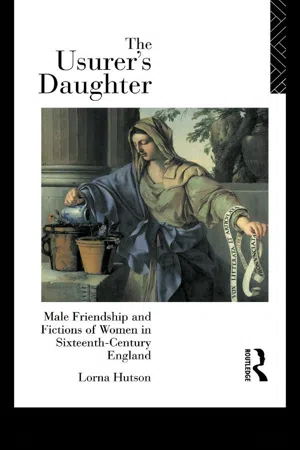
The Usurer's Daughter
Male Friendship and Fictions of Women in 16th Century England
- 308 pages
- English
- ePUB (mobile friendly)
- Available on iOS & Android
eBook - ePub
About this book
Information
Part I
MENTAL HUSBANDRY
1
THE HOUSEWIFE AND THE HUMANISTS
A painting by Quinten Metsys, now hanging in the Louvre and known as The Moneylender and his Wife (Le Prêteur et sa femme) presents a couple half-length behind a table. The man is absorbed in the task of weighing coins, while beside him a woman holds open an illuminated book. As her fingers turn the page, an image of the Virgin and Child is revealed to the viewer’s gaze; the woman’s own eyes are focused away from the book, upon the delicate balancing of the money in the scales.
Quinten Metsys, active in Antwerp at the beginning of the sixteenth century, is perhaps most famous now for his association with the great humanist Erasmus, whose friendship and scholarly correspondence with Peter Gilles he celebrated in a diptych presented as a gift to Thomas More.1 Metsys’ Moneylender and his Wife, painted three years before the Erasmus-Gilles diptych, in 1514, has not attracted much art-historical attention. As Panofsky observed, it amounts to not much more than a highly competent ‘reconstruction’ of elements from paintings by Petrus Christus and Jan Van Eyck. The paraphernalia of the moneylender’s occupation—the delicately drawn scales, flanked on the right by a convex mirror and a shiny, open-lidded box for weights, and on the left by a pile of heavy-looking coins, a scatter of nesting weights, a crystal reliquary, a roll of parchment encircled by touchstone rings—may be paralleled, item for item, in Petrus Christus’ The Legend of S.Eloy and S.Godoberta, painted in 1449 for the Corporation of Goldsmiths in Antwerp. The shelves behind the couple, holding books, papers and household objects, are compared by Panofsky to the bookfilled recess above St Jerome’s writing table in Van Eyck’s St Jerome in his Study, now in Detroit. Certain objects on the shelves—the apple, tawny against a pewter dish, and the glass rosary catching the light as it hangs down, have counterparts in Van Eyck’s famous ‘Arnolfini’ marriage portrait, which, of course, also makes significant use of reflection in a convex mirror.2
If the objects in Metsys’ painting were derivative, its theme—a glimpse into the operations of the world of trade and finance— was much imitated in the course of the sixteenth century. Versions of Metsys’ turbaned banker-figure, either counting money with his wife, or taking orders from a client, are to be found hanging in various European galleries, attributable to Marinus Van Reymerswaele. In effect, however, Van Reymerswaele’s treatment of the theme is quite different: his images are unequivocal satires on avarice and greed. The woman’s gaze, for example, becomes predatory; purses bulge, shelves are crammed, everything twists and warps, from the pages of account books to the winding-sheet that smothers an ancient candle.3 What Van Reymerswaele has sacrificed is precisely the lack of drama that seems to give meaning to the shiny, reflective or almost-legible surfaces of objects lovingly reproduced by Metsys from the paintings of Christus and Van Eyck. It is a quality which we loosely call ‘realism’, a verisimilitude which compels and satisfies attention, as if exhausting signification in the accuracy of observation. Svetlana Alpers has suggested that, in relation to seventeenth-century Dutch painting, we should understand this ‘attentiveness to descriptive presence’ as a particular mode of signifying.4 According to the logic of this mode, illusionistic virtuosity—such as that achieved by Van Eyck in the Arnolfini portrait, in which he represents himself, the painter, witnessing the marriage as event, reflected tinily in a convex mirror—serves, paradoxically, to efface itself as virtuosity. The tour de force of illusion becomes fidelity to the fact, and the artist becomes, ‘one who bears witness to or documents a reality that is prior to him’.5 That this was precisely the effect Erasmus admired in the painting of Metsys (an effect which he sought, by analogy, to accomplish rhetorically through the composition and publication of his familiar correspondence) has been vividly demonstrated by Lisa Jardine.6 What, however, might be the significance of Metsys choosing to portray in this illusionistic mode the professional activities of a dealer in finance? Raymond de Roover has explained how, in Bruges and Antwerp at the turn of the fifteenth century, a number of different kinds of merchants, bankers and dealers in valuables served as creditors to those unable to borrow from friends.7 Among these were the goldsmiths, whose profession Metsys’ figure seems (judging from his resemblance to Petrus Christus’ portrait of S.Eloy) to represent. But where Christus’ S. Eloy is depicted in the act of weighing a ring (an act of tropical significance in the saint’s legendary narrative) Metsys’ unnamed dealer in valuables is counting and weighing coins in the presence of his wife. What is meant by the invitation to us, as viewers, to behold this action in this setting? What does it mean to render the accountability of the money dealer’s activity in terms of his visibility and, in particular, the visibility of his conjugal status? What, in other words, has the controversial ethical status of the moneylender to do with the inclusion, in the picture, of his wife?
THE ABSENT DOMESTIC WOMAN
In 1541 Miles Coverdale published an English translation of the humanist Heinrich Bullinger’s guide to matrimony, Der Christlich Eestand (1540). It was to be, in English, an extremely influential text. It went through nine editions by 1575 and was the model for subsequent treatments of the subject.8 As early as 1543, Thomas Becon had reissued Coverdale’s translation under his own name, with the addition of an elaborate preface, imitative of Erasmus’ Encomium Matrimonii, included ‘for the more readie sale’. In 1591, the preacher Henry Smith remarketed it under his name, with a dedication to Lord Burghley. A most popular manual of the seventeenth century, John Dod and Robert Cleaver’s A Godlie Forme of Householde Government (1610) ‘used whole paragraphs at a time’ of Coverdale’s Bullinger, and the metaphors of the latter ‘crop up again and again’ in other guides to marriage.9
Chapter 19 of Coverdale’s Bullinger, entitled, ‘Of Covenient Carefulnes and just keping of the house lyke Christen folke’ offers what seems to us a predictable enough division of conjugal labour:
What so ever is to be done without the house, that belongeth to the man & the woman to studye for thinges within to be done, and to se saved or spent conveniently whatsoever he bringeth in. As the bird fleeth to and fro to bring to the nest, so becommeth it the man to apply his outward busines, And as the damme kepeth the nest, hatcheth the egges, & bringeth forth the frute, so let them both lern to do of the unreasonable fowles or bestes created of God naturally to observe theyr sondrye propertyes.10
There is, as John Winkler remarked in another context, ‘a lot of culture packed into this one exemplum from nature’.11 By the time of Dod and Cleaver’s Godlie Forme of Household Government, the formula had been enlarged and improved:
This is also a Dutie (not to bee forgotten) Namely, that Husbands be diligent and Carefull to make provision for their Houses…The dutie of the Husband is to get goods: and of the Wife to gather them together, and save them. The dutie of the Husband is to travell abroade, to seeke living: and the Wives dutie is to keepe the house. The dutie of the Husband is to get money and provision: and of the Wives, not vainely to spend it. The dutie of the Husband is to deale with many men: and of the Wives to talke with few. The dutie of the Husband is, to be entermedling: and of the wife, to be solitary and withdrawne. The dutie of the man is, to be skilfull in talke: and of the wife, to boast of silence. The dutie of the husband is to be a giver, and of the Wife, to be a saver. The dutie of the Man is, to Apparell himselfe as he may: and of the Woman, as it becommeth her. The dutie of the husband is, to dispatch all things without dore: and of the wife, to oversee and give order for all things within the house.12
So striking is the symmetry of the Dod and Cleaver formulation, that, in her influential article surveying sixteenth- and seventeenth-century guides to marriage, the social historian Kathleen Davies reproduced it in the form of a binary scheme:
| Husband | Wife |
| Get goods Travel, seek a living Get money and provisions Deal with many men Be ‘entermedling’ Be skilful in talk Be a giver Apparel yourself as you may Be Lord of all Dispatch all things outdoor | Gather them together and save them Keep the house Do not vainly spend it Talk with few Be solitary and withdrawn Boast of silence Be a saver Apparel yourself as it becomes you Give account of all Oversee and give order within.13 |
Yet there is, for all its predictability, a puzzle about the very symmetry of this formulation of conjugal interdependence. It is, simply, too symmetrical to be anything other than a fiction. Nancy Armstrong, contrasting Davies’ schematization of Dod and Cleaver with the discursively amplified role of the ‘domestic woman’ in eighteenth-century household literature, observes that the seventeenth-century model articulates only one gender: ‘the Puritan household consisted of a male and female who were structurally identical, positive and negative versions of the attributes.’14 Catherine Belsey, likewise, finds a contradiction between Dod and Cleaver’s explicit delineation of spheres of responsibility (outdoors for husband, indoors for wife) and the actual allocation of responsibilities that would, in practice, make the household the woman’s sphere:
The husband’s responsibilities occupy twenty-nine pages and the wife’s, with some repetition, rather less than two. In essence, the wife’s responsibilities are to provide a visible model of submission, and not to get in the way, unless her husband is absent…the attempt to find a place of authority for the wife results in the renewed insistence on her submission. She is subsumed under the will of her husband… a woman is to govern and not to govern, present as example …but absent from the place where decisions are made.15
The division comes to appear very nearly meaningless: the husband occupies both spheres after all, is both ‘indoors’ and ‘outdoors’ all at once, negotiating in the marketplace, and governing the godly household. The woman, as good wife, is merely the example of his ability to govern.
What, then, made this ‘natural history’ of the conjugal household—the model of husband as hunter-gatherer, and the wife as saver and keeper—so indispensable to humanist moral philosophy? Its provenance is not far to seek: the exemplum as Bullinger uses it derives from a text entitled Oeconomicus, written by the Socratian philosopher Xenophon, and from its derivative, a pseudo-Aristotelian text of the same name, but inferior composition.16 So popular was the Xenophonic formulation with the northern humanists that it inevitably makes an appearance whenever matters pertaining to the household or to women are being discussed in a humanist text of moral philosophy. Thus, in Richard Hyrde’s translation of Vives’ Instruccion of a Christen Woman, the section on ‘shamefastness’ requires that women should be sober and sparing in their diet, since the cultivation of habits of thrift,
‘be in householdyng the womans party as Plato and Aristotle say full well. The man getteth, the woman saveth and kepeth. Therfore he hath stomake gyven him to gether lustily & she hath hit taken from her, that she may warely kepe.17
The division of household labour according to the ‘natural’ properties of the sexes (‘stomach’ meaning courage or boldness in hunting) in turn dictates their natural properties in other contexts (the man’s courageous ‘stomach’ legitimating his stomach in its other sense as appetite for food and sex).
Versions of Xenophon’s natural history of the division of household labour according to the scheme of husband ‘outdoors’ and wife ‘indoors’ seem, then, to have been relevant to the humanist project in a variety of ways. What made the model so compelling? Nothing, surely, to do with the the production of a sphere of influence for the ‘wife’. For the cultural significance of this natural history concerns men: its function in the sixteenth century was not to legitimate a new version of femininity, but a new version of masculinity. The point of it was not, primarily, to guarantee in reality the husband’s governance of his wife, but to prove, through a persuasive fiction of the well-governed wife, the legitimate and responsible contribution of a Christian humanist education to the secular and practical spheres of masculine activity. For it was only through the definition of conjugal femininity as the symbolic boundary of ‘good husbandry’ (the displaced marker of the husband’s accountability as head of the household) that good husbandry could come to claim as its sphere nothing less than ‘out of bounds-ness’ itself—the time/space of opportunity, both for negotiation and for the production of rhetorically persuasive fictions.
XENOPHON’S SUCCESSFUL DISAPPEARING ACT: HOUSEKEEPING LITERATURE AND THE ‘BANALITY’ OF ECONOMICS
It is actually an effect of the persistence of a hierarchy of values which conforms to that established by Xenophon’s gendered division of economic labour that the cultural centrality of an ostensibly gynaecological text (Xenophon’s Oeconomicus), and its seventeenth-century ‘marriage guidance’ derivatives has not been taken seriously by critics and historians of change in economic thought. Thus, in a careful and sceptical critique of claims made for the originality of Aristotle’s economic thinking, M.I.Finley dismisses in passing the contribution of that second-rate thinker, Xenophon, arguing that although ‘the model that survived and was imitated was Xenophon’s Oikonomikos’ yet, ‘it was not from Hausvaterliteratur that modern economic thinking arose’.18 For rather different reasons, Kathleen Davies in her article on English Hausvaterliteratur or books of ‘the art of household’, likewise devalues the genre, refusing to allow it any creative cultural force. Davies is, of course, concerned to refute the argument that the Protestant, or, as it is misleadingly called, ‘Puritan’ doctrine of marriage was liberal in its effects on the position of women in society. In demonstrating the doctrine’s far from liberal implications, however, she makes the mistake of underestimating its novelty and prescriptive force, and this is simply because she, like Finley, has been duped by the hierarchizing rhetoric of a gendered division of economic labour which manages, by associating economic prudence with the penny-pinching of good housewives, to make the topic of ...
Table of contents
- COVER PAGE
- TITLE PAGE
- COPYRIGHT PAGE
- ACKNOWLEDGEMENTS
- NOTES ON TRANSCRIPTIONS, REFERENCES AND ABBREVIATIONS
- INTRODUCTION: THE SIGNS OF FRIENDSHIP
- PART I: MENTAL HUSBANDRY
- PART II: ANXIETIES OF TEXTUAL ACCESS
- PART III: THE THEATRE OF CLANDESTINE MARRIAGE
- CONCLUSION: SHYLOCK: WHY THIS USURER HAS A DAUGHTER
- NOTES
- PRIMARY SOURCES
- SECONDARY SOURCES
Trusted by 375,005 students
Access to over 1.5 million titles for a fair monthly price.
Study more efficiently using our study tools.
Frequently asked questions
Yes, you can cancel anytime from the Subscription tab in your account settings on the Perlego website. Your subscription will stay active until the end of your current billing period. Learn how to cancel your subscription
No, books cannot be downloaded as external files, such as PDFs, for use outside of Perlego. However, you can download books within the Perlego app for offline reading on mobile or tablet. Learn how to download books offline
Perlego offers two plans: Essential and Complete
- Essential is ideal for learners and professionals who enjoy exploring a wide range of subjects. Access the Essential Library with 800,000+ trusted titles and best-sellers across business, personal growth, and the humanities. Includes unlimited reading time and Standard Read Aloud voice.
- Complete: Perfect for advanced learners and researchers needing full, unrestricted access. Unlock 1.5M+ books across hundreds of subjects, including academic and specialized titles. The Complete Plan also includes advanced features like Premium Read Aloud and Research Assistant.
We are an online textbook subscription service, where you can get access to an entire online library for less than the price of a single book per month. With over 1.5 million books across 990+ topics, we’ve got you covered! Learn about our mission
Look out for the read-aloud symbol on your next book to see if you can listen to it. The read-aloud tool reads text aloud for you, highlighting the text as it is being read. You can pause it, speed it up and slow it down. Learn more about Read Aloud
Yes! You can use the Perlego app on both iOS and Android devices to read anytime, anywhere — even offline. Perfect for commutes or when you’re on the go.
Please note we cannot support devices running on iOS 13 and Android 7 or earlier. Learn more about using the app
Please note we cannot support devices running on iOS 13 and Android 7 or earlier. Learn more about using the app
Yes, you can access The Usurer's Daughter by Lorna Hutson in PDF and/or ePUB format, as well as other popular books in Literature & Feminist Literary Criticism. We have over 1.5 million books available in our catalogue for you to explore.