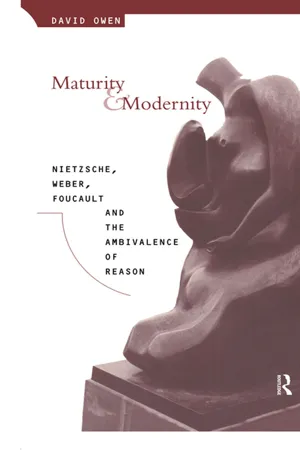
Maturity and Modernity is the first book to analyze Nietzsche, Weber and Foucault as a tradition of theorising and to chart the development of genealogy as a mode of critique. It provides clear accounts of the main ideas of Nietzsche, Weber and Foucault (as well as a useful Glossary) and illustrates the relations between these thinkers at methodological, substantive and politcal levels.
eBook - ePub
Maturity and Modernity
Nietzsche, Weber, Foucault and the Ambivalence of Reason
- 272 pages
- English
- ePUB (mobile friendly)
- Available on iOS & Android
eBook - ePub
About this book
Information
Subtopic
SociologyIndex
Social Sciences1 Kant and the Question of Maturity
Kant and Maturity as Enlightenment
Kant begins the essay 'What is Enlightenment?'1 by posing the question of enlightenment as 'man's emergence from his self-imposed immaturity [Unmündigkeit]' (Kant 1983: 41), this immaturity being defined as 'the inability to use one's understanding without guidance from another' (Kant 1983:41). For Kant, this immaturity is 'self-imposed'; as a species with the capacity for rational self-reflection, humanity has the ability to emerge from its immaturity but the majority of individuals - largely through laziness and cowardice - lack the drive to rely on their own understanding and, thereby, take responsibility for themselves, Kant, consequently, concludes his initial outline of the question of enlightenment with a positive definition of the spirit of enlightenment which functions rhetorically as an exhortation to the reader: 'Sapere Aude! "Have the courage to use your own understanding!" - that is the motto of enlightenment' (Kant 1983: 41). The question having been defined, Kant's argument moves to its main concerns, namely, the determination of the conditions of possibility of enlightenment and the relation of these conditions to the actual conditions of the present (i.e. Prussia under Frederick the Great).
kant initiates discussion of the conditions of possibility governing the emergence of enlightenment by distinguishing between the case of the individual and the case of the public. Kant suggests two grounds which render the individual's achievement of maturity problematic. Firstly, he states that laziness and cowardice result in the majority of individuals taking the path of immaturity - 'It is so easy to be immature. If I have a book to serve as my understanding, a pastor to serve as my conscience, a physician to determine my diet for me, and so on, I need not exert myself at all' (Kant 1983: 41) - and, moreover, it is this laziness and cowardice on the part of the mass of individuals that enables the few to constitute themselves as the guardians of humanity. The role of these self-appointed guardians is the focus of the second ground Kant presents; he argues that these guardians intentionally perpetuate the lack of resolve and courage that characterises the public:
The guardians who have so benevolently taken over the supervision of men have carefully seen to it that far the greatest part of them (including the entire fair sex) regard taking the step to maturity as very dangerous, not to mention difficult. Having first made their domestic livestock dumb, and carefully made sure that these docile creatures will not take a single step without the go-cart to which they are harnessed, these guardians then show them the danger that threatens them, should they attempt to walk alone. Now this danger is not actually so great, for after falling a few times they would in the end certainly learn to walk; but an example of this kind makes men timid and usually frightens them out of all further attempts.
(Kant 1983: 41)2
This combination of a certain natural timidity in the majority of humanity and its social reinforcement by humanity's 'benevolent' guardians leads Kant to suggest that, in practice, only a very few, no doubt exceptional, individuals 'have succeeded, by cultivating their own minds, in freeing themselves from immaturity and pursuing a secure course' (Kant 1983: 41). If prospects in the case of the individual are bleak, the reverse is the case in considering the public: 'that the public should enlighten itself is more likely; indeed, if it is only allowed freedom, enlightenment is almost inevitable' (Kant 1983:41-2). The ground for Kant's claim lies in a conception of the force of reason manifest in the catalytic role played by the few individuals who have reached maturity (including even certain guardians) given the condition of freedom of discussion within the public arena. In specifying the nature of this freedom, Kant introduces a significant and curious distinction between the public use of reason and the private use of reason:3
By the public use of one's own reason I understand the use that anyone as a scholar makes of reason before the entire literate world. I call the private use of reason that which a person may make in a civic post or office that has been entrusted to him.
(Kant 1983: 42)
Enlightenment, for Kant, requires only that the public use of reason be free; indeed, not only does the restriction of the private use of reason not hinder enlightenment, such restriction may be in the public interest. As Kant notes:
in many affairs conducted in the interests of a community, a certain mechanism is required by means of which some ofits members must conduct themselves in an entirely passive manner so that through an artificial unanimity the government may guide them to public ends, or at least prevent them from destroying such ends. Here one certainly must not argue, instead one must obey.
(Kant 1983: 42)
Within a civic post, it appears, the individual must be conceived simply as an instrument for the achievement of public goals.4 Stressing this feature of civic life, Kant gives an example which has sombre resonances for our age:
it would be disastrous if an officer on duty who was given a command by his superior were to question the appropriateness or utility of the order He must obey. But as a scholar he cannot be justly constrained from making comments about errors in military service, or from placing them before the public for its judgement.
(Kant 1983: 42-3)
Having specified the conditions under which enlightenment is possible, Kant turns to the relationship between the conditions requisite for enlightenment (i.e. a few enlightened individuals and freedom of public debate) and the actual conditions of his time.
Kant begins with a question: Do we presently live in an enlightened age?" ' and an answer: ' "No, but we do live in an age of enlightenment" ' (Kant 1983: 44). The distinction between these two states lies, for Kant, in the form of legislation each embodies. That Prussia under Frederick II is an age of enlightenment is established by the freedom to reason publically set out in the formula' "Argue as much as you want and about what you want, but obey!" ' (Kant 1983: 45); this, Kant asserts, is the primary principle of Frederick the Great's rule. Being both himself enlightened and possessing 'a well-disciplined, numerous army to guarantee public peace' (Kant 1983: 45), Frederick II is able to both encourage public enlightenment through freedom of discussion and to ensure obedience to the legislation he enacts. This form of rule, Kant suggests, is a prerequisite for the historical emergence of an enlightened age, for it is within the restrictions of their civil freedom occurring under an enlightened monarchy that individuals acquire 'the inclination to and vocation for free thinking' (Kant 1983: 46). Once acquired, this vocation
gradually reacts upon a people's mentality (whereby they become increasingly able to act freely), and it finally even influences the principles of government, which finds that it can profit by treating men, who are now more than machines, in accord with their dignity.
(Kant 1983: 46)
Although Kant does not, in this essay, go further than this general statement in characterising an enlightened polity, it is possible from his other political writings to determine the features of such a polity. Principal among these is the rational concordance of the public will and the legislative will. Following Rousseau, Kant constructs a contractarian model in which the legitimacy of a law resides in its expression of the public will (although, for Kant, this does not require the active participatory consent of the citizens; rather, it merely requires that the law in question be rationally worthy of consent).5 Consequently, Kant provides the following formula:' Whatever a people cannot decree for itself cannot be decreed for it by the legislator' (Kant 1983: 83), A polity in which the legislative will and the public will are identical expresses the existence of an enlightened age, for Kant, simply in that such an identity presupposes the existence of an enlightened public which embodies the recognition of individuals as ends in themselves. An enlightened age, in other words, is an age in which the realm of the political is consonant with the moral law. The age of Frederick marks, Kant argues, a necessary step towards such a 'kingdom of ends'.
At this stage, we may pause and reflect on this essay. Three questions immediately arise. What claims are involved in this identification of maturity with enlightenment? Why does Kant regard it as necessary that the public use of reason be free but not the private use of reason? On what grounds does Kant situate the potential concord of the political and moral realms? The issues raised here may be addressed by focusing on the theme of autonomy.
Autonomy, Reason and History
Kant's essay begins, as we have noted, by identifying enlightenment with maturity, with reliance on one's own understanding, and ends by identifying enlightenment with the capacity to 'act freely'. The initial definition presented by Kant links enlightenment with autonomy in a broad sense, that is, it represents enlightenment as self-determination, as a taking of responsibility for oneself. The latter identification, however, locates enlightenment in relation to autonomy in a more specific sense; enlightenment here is represented as moral autonomy, which in the context of Kant's system refers to the dutiful self-legislation of the moral law of freedom, that is, the categorical imperative. How though does Kant ground this identification of maturity (the determination of one's own will) with moral autonomy (the self-legislation of the moral law)? This crucial question for the coherence of Kant's notion of a kingdom of ends entails a brief examination of his critical philosophy.
Kant's system finds its starting point in a confrontation with what Kant termed the antinomies of pure reason and it is the third of these antinomies which provides a site of entry for this discussion.6 In explicating this antinomy, Kant sets out two arguments concerning causality which appear to be equally grounded in reason:
Thesis Causality in accordance with the laws of nature is not the only causality from which the appearances of the world can one and all be derived. To explain these appearances it is necessary to assume that there is also another causality, that of freedom.
(Kant 1963: A444/B472)
Antithesis There is no freedom; everything in the world takes place solely in accordance with the laws of nature.
(Kant 1963: A445/B473)
The thesis involves the contention that, in accordance with the principle of sufficient determination, the idea of causality itself requires the existence of a free causality (a first or final cause). The antithesis, however, embodies the claim that, in accordance with the principle of noncontradiction, the idea of a free causality undermines the idea of causality itself in which all causes are themselves already effects.7 Kant's resolution of this antinomy revolves about a positing of two distinct realms of reason, the realm of theoretical reason defined as a phenomenal realm of appearances determined by the laws of nature and the realm of practical reason identified as the noumenal realm of things-in-themselves governed by the law of freedom. The mutually exclusive positions expressed in the antinomy arise, for Kant, out of the tendency of theoretical reason to transgress its limits, to overstep the boundaries of experience within which it holds sway. In determining the parameters within which theoretical reason may legitimately make knowledge claims, however, Kant revolutionises the position of humanity. For, in contrast with the rest of nature, we know ourselves not only through the senses but also through 'pure apperception' (the faculties of understanding and reason); thus, one knows oneself both as a determined sensible (phenomenal) object and as a free intelligible (noumenal) subject.
It is on this location of the individual as constituted by both an empirical self and a transcendental self that Kant grounds his account of the individual as both natural and supra-natural, as both a being constituted by natural desires existing within the chains of cause and effect which define nature and as a being constituted by a rational will capable of initiating causal sequences within nature and, thereby, transforming nature. Our constitution as both natural and supra-natural beings emerges in the sphere of morality. This is evident, Kant argues, from
the imperatives which in all matters of conduct we impose as rules on our active powers. 'Ought' expresses a kind of necessity and of connection with grounds which is found nowhere else in the whole of nature.
(Kant 1963: A547/B575)
Thus, to act freely is, for Kant, to act morally. In a way directly analogous with the scientific laws of nature which define the phenomenal realm of theoretical reason, the noumenal realm of practical reason is governed by the moral law of freedom which Kant renders comprehensible as the maxim: 'Act always according to that maxim whose universality as a law you can at the same time will' (Kant 1981: 42). The imperative form of this maxim grounds morality in the motive of duty, in the recognition that the essence of one's humanity lies in willing the moral law for its own sake as the condition of one's freedom.
How does this relate to Kant's identification of maturity, the ability to act according to one's own understanding, with moral autonomy, the rational self-legislation of the moral law? Kant's identification of these two concepts of enlightenment is predicated on his identification of willing one's own will with willing the moral law (which is precisely the expression of one's rational will). On the one hand, immaturity as the reliance for understanding on the guidance of another indicates not a lack of knowledge concerning the character of the moral law but rather an inability to recognise this law for oneself as the ground of one's...
Table of contents
- Cover
- Title
- Copyright
- Dedication
- Contents
- Acknowledgements
- Abbreviations used in the text
- INTRODUCTION
- 1 KANT AND THE QUESTION OF MATURITY
- 2 THE TRANSFORMATION OF CRITIQUE: NIETZSCHE AND GENEALOGY
- 3 THE GENEALOGY OF MODERNITY: NIETZSCHE, ASCETICISM AND NIHILISM
- 4 THE POLITICS OF THE ÜBERMENSCH: NIETZSCHE, MATURITY AND MODERNITY
- 5 GENEALOGY AS CULTURAL SCIENCE: WEBER, METHODOLOGY AND CRITIQUE
- 6 THE GENEALOGY OF MODERNITY: WEBER, ASCETICISM, AND DISENCHANTMENT
- 7 THE POLITICS OF 'PERSONALITY": WEBER, MATURITY AND MODERNITY
- 8 GENEALOGY AS HISTORICAL ONTOLOGY: FOUCAULT, METHODOLOGY AND CRITIQUE
- 9 THE GENEALOGY OF MODERNITY: FOUCAULT, HUMANISM AND BIOPOLITICS
- 10 THE POLITICS OF CRITIQUE: FOUCAULT, MATURITY AND MODERNITY
- CONCLUSION
- Glossary
- Notes
- Bibliography
- Name index
- Subject index
Trusted by 375,005 students
Access to over 1.5 million titles for a fair monthly price.
Study more efficiently using our study tools.
Frequently asked questions
Yes, you can cancel anytime from the Subscription tab in your account settings on the Perlego website. Your subscription will stay active until the end of your current billing period. Learn how to cancel your subscription
No, books cannot be downloaded as external files, such as PDFs, for use outside of Perlego. However, you can download books within the Perlego app for offline reading on mobile or tablet. Learn how to download books offline
Perlego offers two plans: Essential and Complete
- Essential is ideal for learners and professionals who enjoy exploring a wide range of subjects. Access the Essential Library with 800,000+ trusted titles and best-sellers across business, personal growth, and the humanities. Includes unlimited reading time and Standard Read Aloud voice.
- Complete: Perfect for advanced learners and researchers needing full, unrestricted access. Unlock 1.5M+ books across hundreds of subjects, including academic and specialized titles. The Complete Plan also includes advanced features like Premium Read Aloud and Research Assistant.
We are an online textbook subscription service, where you can get access to an entire online library for less than the price of a single book per month. With over 1.5 million books across 990+ topics, we’ve got you covered! Learn about our mission
Look out for the read-aloud symbol on your next book to see if you can listen to it. The read-aloud tool reads text aloud for you, highlighting the text as it is being read. You can pause it, speed it up and slow it down. Learn more about Read Aloud
Yes! You can use the Perlego app on both iOS and Android devices to read anytime, anywhere — even offline. Perfect for commutes or when you’re on the go.
Please note we cannot support devices running on iOS 13 and Android 7 or earlier. Learn more about using the app
Please note we cannot support devices running on iOS 13 and Android 7 or earlier. Learn more about using the app
Yes, you can access Maturity and Modernity by David Owen in PDF and/or ePUB format, as well as other popular books in Social Sciences & Sociology. We have over 1.5 million books available in our catalogue for you to explore.