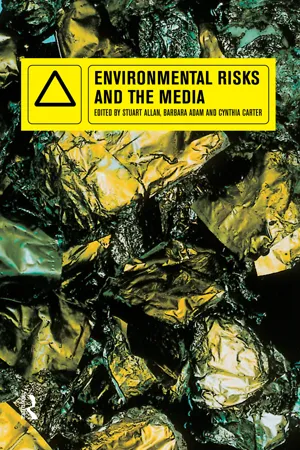
Environmental Risks and the Media explores the ways in which environmental risks, threats and hazards are represented, transformed and contested by the media. At a time when popular conceptions of the environment as a stable, natural world with which humanity interferes are being increasingly contested, the medias methods of encouraging audiences to think about environmental risks - from the BSE or 'mad cow' crisis to global climate change - are becoming more and more controversial.
Examining large-scale disasters, as well as 'everyday' hazards, the contributors consider the tensions between entertainment and information in media coverage of the environment. How do the media frame 'expert', 'counter-expert' and 'lay public' definitions of environmental risk? What role do environmental pressure groups like Greenpeace or 'eco-warriors' and 'green guerrillas' play in shaping what gets covered and how? Does the media emphasis on spectacular events at the expense of issue-sensitive reporting exacerbate the public tendency to overestimate sudden and violent risks and underestimate chronic long-term ones?
eBook - ePub
Environmental Risks and the Media
- 296 pages
- English
- ePUB (mobile friendly)
- Available on iOS & Android
eBook - ePub
Environmental Risks and the Media
About this book
Information
Part I
Mapping environmental risks
Chapter 1
TV news, lay voices and the visualisation of environmental risks
The world of television news enacts tight editorial controls, controls that do not normally permit generous conditions of access to ordinary or lay voices and viewpoints. Of course, as we shall see, ‘ordinary voices’ are routinely accessed into TV news items but rarely are they granted an opportunity to develop their arguments or points of view at length, much less directly confront and challenge political and expert authorities. The following, then, represents a rare moment in the news mediation of environmental risks and, for that matter, TV news broadcasts more generally. In the excerpt below from BBC2’s Newsnight programme, Frances Hall (the mother of Peter Hall, one of the first victims to die from Creutzfeldt-Jakob Disease, the human equivalent of Bovine Spongiform Encephalopathy) is ceded a degree of editorial control and narrates her own film report before participating in a live studio debate.
Our son Peter was ill for more than a year. During that time I wrote to request that someone from the government would come and sit with me at his bedside and see what this devastating illness was doing to our strong, handsome young man. No one came…. Given the mounting evidence of a possible link between BSE and CJD can anyone offer me a logical explanation of how my son contracted this disease other than by eating BSE infected meat? Since Peter died I’ve taken a job in a local café; I see people confused about what’s safe to eat. We’ve been told consistently that British beef is safe and that the most infected parts have been removed, but even if the red meat carries no infection we still see evidence of incorrectly butchered cattle with possibly infected parts still attached entering the human food chain, and offal being recycled into animal feed. Surely as Health Secretary, Stephen Dorrell, your only duty is to the nation’s health? Can you assure me that no one else will be exposed to the dangers of BSE? Are precautions being enforced and will this really protect the public? Mr Dorrell I want you to watch the pictures of my son growing up, do they look much different to the pictures you have of your children? Does Peter show any signs of the tragically short span that he would have? I hold the government responsible for his death and their total incompetence and mismanagement of a manmade disease.… Will the government now accept that the scientific advice it chose to follow, namely, that there was no conceivable risk from eating British beef, was wrong? Are the experts still the same? Is the government still being selective on the advice that it takes on behalf of the nation or is it now willing to err on the side of caution? These past months have been, and continue to be, a living nightmare for my family. We have been unable to come to terms with Peter’s death because we know that if BSE had been treated with sufficient caution he and many others would not have suffered this terrible illness.
(BBC2 Newsnight 20 June 1996)
The words spoken present an anguished plea and articulate challenge to the government Health Secretary of the day, Stephen Dorrell MP, requesting both information about and an acceptance of responsibility for the (mis)management of the BSE crisis in the UK, and her son’s death. By tragic force of circumstance an ordinary person has won a rare opportunity to convey her feelings, develop her argument and directly confront the ‘responsible’ Secretary of State, sitting (uncomfortably) in the Newsnight studio. The opportunity, I think, was not wasted. Her intervention into the world of public discourse, a world generally framed in the impersonal terms and analytical rhetoric of officials, professionals and experts, is arguably all the more forceful for being grounded, in part at least, in the private realm of lived experience, familial relationships and emotions, and everyday concerns.
More theoretically, Frances Hall represents what Ulrich Beck in Risk Society (1992a) has termed ‘the voices of the “side effects”’. Her tragic experience of the consequences of an invisible risk leads her to articulate a form of ‘social rationality’ (in contrast to ‘scientific rationality’) and confront the administrative failure of politicians to manage hazards as well as the technocratic failures of scientists to ‘know’ and therefore to be able to quantify, predict and control ‘risks’—Beck’s so-called ‘manufactured uncertainties’.
What scientists call ‘latent side effects’ and ‘unproven connections’ are for them their ‘coughing children’ who turn blue in the foggy weather and gasp for air, with a rattle in their throat. On their side of the fence, ‘side effects’ have voices, faces, ears and tears.… Therefore people themselves become small, private alternative experts in risks of modernization.… The parents begin to collect data and arguments. The ‘blank spots’ of modernization risks, which remain ‘unseen’ and ‘unproven’ for the experts, very quickly take form under their cognitive approach.
(Beck 1992a:61, original emphasis).
Modern environmental risks (radioactivity, biogenetic releases, toxic chemicals, industrial pollution), according to Beck, are historically unprecedented in so far as they are manufactured, often invisible and potentially catastrophic in terms of their spatial and temporal reach—capable of circumnavigating the globe and wreaking havoc across generations. No wonder, then, that risks produce contested claims and deepen our dependency upon scientists and experts, even when those same scientists and experts cannot agree on the nature, extent and probable consequences of the risks produced by the science and technologies of modern civilisation.
The growing awareness of risks must be reconstructed as a struggle among rationality claims, some competing and some overlapping. One cannot impute a hierarchy of credibility and rationality, but must ask how, in the example of risk perception, ‘rationality’ arises socially.
(Beck 1992a:59)
The mass media provide an important public arena where ‘“rationality” arises socially’, since it is in and through the mass media that risks are ‘defined and evaluated socially’ (Beck 1992a:112).
Ulrich Beck, then, has helped to raise important questions about the social evaluation of environmental risks, the nature of competing rationality claims and the part played in all this by the mass media (for a detailed critique see Cottle 1998a). With respect to his ideas on competing social and scientific rationalities, and especially his comments on ‘the voices of the “side effects”’, however, we need to know more about the actual representations of the mass media. We need to empirically map, for example, the extent and forms of lay access and how, if at all, the news media condition the public elaboration of ‘social rationality’ and the engagement with technocratic and scientific claims of scientists, politicians and experts. In the example above, Frances Hall helps to problematise the category of the ‘expert’ and ‘expertise’ and redefines both in more socially proximate ways. But to what extent and in what sense, exactly, have lay voices in television news been able to do likewise? Do the news media help to sustain forms of emergent ‘social rationality’ through the accessing of lay voices in the field of environmental risks?
This chapter sets out to explore such questions. With the help of findings from a systematic examination of news access, we can first chart the extent and nature of lay or ordinary involvement within and across TV news about the environment and environmental risks. Based on these findings, however, it soon becomes apparent that if we are to better understand the patterns and forms of lay access we need to go beneath the ‘rational’ veneer of news access. Often positioned by the news media to symbolise the ‘human face’ and consequences of a widespread perception of nature and the environment as ‘under threat’, these voices in fact rarely find an opportunity to advance rational claims—whether ‘social’ or ‘scientific’. Television news positions ordinary people to symbolise or (literally) ‘stand for’ ordinary feelings and responses to the consequences of environmental risks, not to articulate a form of ‘social rationality’ much less discursively challenge ‘scientific rationality’. With too few exceptions the discursive play of difference and contending rational accounts is preserved for other, non-ordinary, voices. Television news does, however, routinely help to visualise a deep-seated cultural sensibility towards the environment widely felt to be under threat from advancing industrialism and despoliation.1 The roots of this environmental sensibility, of course, are historically long and culturally deep. They go back to the period of Romanticism if not earlier, and resonate with the change from traditional to modern, rural to urban societies and the pessimism towards industrialism that this spawned—a sensibility often premised upon a romanticised image of a rural idyll and a more communal and less alienated way of life. This environmental sensibility continues to surface across a number of cultural representations and practices. Urry, for example, observes how a ‘romantic tourist gaze’ continues to position physical landscapes as a site of visual consumption and concern (Urry 1992). The news media also trade in cultural views, and through selection and juxtaposition of scenes visualise the environment and environmental risks often in spectacular ways—ways, that is, which help to culturally position us as spectators viewing/sensing both the ‘wonders’ of nature as well as the awesome nature of environmental threats.
News visualisation of the environment, therefore, reflects much more than the inherent televisual nature of the television medium and its appetite for ‘good’ background pictures, or even the genre conventions of TV news proclaiming immediacy, factuality and objectivity supported through the authenticating power of visuals (Brunsdon and Morley 1978; Fiske 1987; Graddol 1994). On closer examination, TV news scenes both symbolise and aestheticise cultural views of nature. As with accessed lay voices, in so far as these scenes ‘work’ representationally at a symbolic, aesthetic and affective level so they are not best captured within the formalised ideas of ‘social rationality’ and/or competing ‘rationality claims’. To assume that they are is arguably to operate with an overly rationalist, language-based and/or discursive approach to mediated communication, and to underestimate its more imagistic, symbolic and ritualistic dimension and appeals (Carey 1989; Dayan and Katz 1992; Liebes and Curran 1998).
The focus of this chapter, then, is more on the cultural politics of TV news representation, and the role played in this by the journalistic positioning and packaging of news actors and the symbolic visualisation of the environment and environmental risks, rather than with the strategic politics of environmental sources struggling for media entry and their battling claims for public acceptance and legitimacy waged via the media stage. Of course both these senses of the ‘political’ inform the mediated play of environmental risks, but arguably the contribution of the former has so far received insufficient recognition and study. This chapter presents findings and arguments that suggest that the ‘cultural politics’ embedded within the forms and appeals of news presentation must now be given their due in our efforts to better understand the media politics of environmental risk.
TV news and ‘the voices of the “side effects”’
It has become something of an orthodoxy in media studies and mass communication research that the media, and the news media especially, are structurally oriented to the institutions and centres of political, economic and social power, granting access as of right to the elites of society (Hall et al. 1978). A combination of bureaucratic expediency and the professional journalistic subscription to ideas of ‘objectivity’ results, it is said, in the privileging of ‘authoritative’ voices, that is, ‘authority voices’ who thereby secure definitional advantage and become the nation’s ‘primary definers’. A number of empirical case studies provide supporting evidence for this view. During the 1990s theoretical and empirical work, however, though not discounting the weighting towards sources of institutional power by the mass media, suggests that this blanket thesis tends to cover over a number of important qualifications, complexities and contingencies (P.Schlesinger 1990; A.Anderson 1991; D.Miller 1993; Deacon and Golding 1994; Kitzinger and Reilly 1997). The strategic politics enacted by competing news sources on the ground can contribute to a more dynamic, differentiated and contingent cast of news actors than often allowed for by the blanket idea of social dominance and news closure. Also, the news media (TV news is no exception) are richly differentiated by market share and cultural appeals and this too informs the ‘cultural politics’ of news representation and helps shape the cast of news actors gaining entry (Cottle 2000).2 In so far as some social actors are routinely sought out, positioned and packaged by news producers within the conventionalised formats of news presentation to embody or symbolise a form of social experience so they do not, strictly speaking, play a definitional or claims-making role at all (Cottle 1993a, 1994). If this is so, then the complexities of news access are not exhausted with reference to definitional or claims-making activity—important though this is.
To help get a fix on all this in the context of our concern with news of the environment and environmental risk, it is useful to refer to a sub-sample of environmental TV news actors derived from a wider study of news access.3 As Table 1.1 indicates, accessed ‘ordinary voices’, that is, the voices of the institutionally, organisationally and professionally non-aligned, secure (surprisingly perhaps) the highest percentage of news involvement.
Table 1.1 TV news environmental actors

These basic findings indicate that considerable lay involvement informs environmental news. Attending to the forms of entry characte...
Table of contents
- Cover
- Title
- Copyright
- Contents
- List of figures and tables
- List of contributors
- Foreword
- Acknowledgements
- Introduction: The media politics of environmental risk
- PART I. Mapping environmental risks
- PART II. Denaturalising risk politics
- PART III. Bodies, risks and public environments
- PART IV. Globalising environments at risk
- Bibliography
- Index
Trusted by 375,005 students
Access to over 1.5 million titles for a fair monthly price.
Study more efficiently using our study tools.
Frequently asked questions
Yes, you can cancel anytime from the Subscription tab in your account settings on the Perlego website. Your subscription will stay active until the end of your current billing period. Learn how to cancel your subscription
No, books cannot be downloaded as external files, such as PDFs, for use outside of Perlego. However, you can download books within the Perlego app for offline reading on mobile or tablet. Learn how to download books offline
Perlego offers two plans: Essential and Complete
- Essential is ideal for learners and professionals who enjoy exploring a wide range of subjects. Access the Essential Library with 800,000+ trusted titles and best-sellers across business, personal growth, and the humanities. Includes unlimited reading time and Standard Read Aloud voice.
- Complete: Perfect for advanced learners and researchers needing full, unrestricted access. Unlock 1.5M+ books across hundreds of subjects, including academic and specialized titles. The Complete Plan also includes advanced features like Premium Read Aloud and Research Assistant.
We are an online textbook subscription service, where you can get access to an entire online library for less than the price of a single book per month. With over 1.5 million books across 990+ topics, we’ve got you covered! Learn about our mission
Look out for the read-aloud symbol on your next book to see if you can listen to it. The read-aloud tool reads text aloud for you, highlighting the text as it is being read. You can pause it, speed it up and slow it down. Learn more about Read Aloud
Yes! You can use the Perlego app on both iOS and Android devices to read anytime, anywhere — even offline. Perfect for commutes or when you’re on the go.
Please note we cannot support devices running on iOS 13 and Android 7 or earlier. Learn more about using the app
Please note we cannot support devices running on iOS 13 and Android 7 or earlier. Learn more about using the app
Yes, you can access Environmental Risks and the Media by Barbara Adam, Stuart Allan, Cynthia Carter, Barbara Adam,Stuart Allan,Cynthia Carter in PDF and/or ePUB format, as well as other popular books in Social Sciences & Media Studies. We have over 1.5 million books available in our catalogue for you to explore.