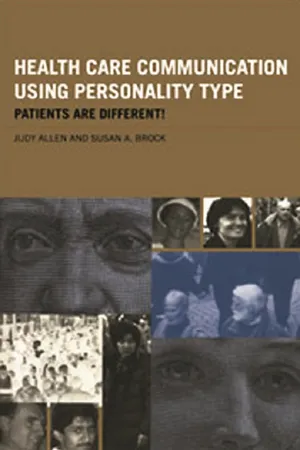
eBook - ePub
Health Care Communication Using Personality Type
Patients are Different!
- 213 pages
- English
- ePUB (mobile friendly)
- Available on iOS & Android
eBook - ePub
About this book
This groundbreaking text draws upon examples from everyday health care situations to demonstrate that the behaviour differences we all experience in others actually fit within a readily understandable framework (the MBI).
Information
1 Communication, health care and the perspective of type
Introducing the theory
Introduction
Consider the following four statements:
• People prefer to communicate in different ways.
• Most people have a preferred style of communication.
• It is easier to communicate with some people than it is with others.
• A system exists which provides a simple framework for understanding these differences.
Most of us would probably accept the first three statements with relative ease; the fourth may give more cause for thought.
It is clear that people prefer to communicate differently, as these two simple examples demonstrate:
• Some people seem to have a great deal to say spontaneously on almost any subject, while others are deep in silent contemplation before responding.
• Some people seem to speak from the heart, reflecting their values, while others are more reserved and factual in their communication.
When we spend time with others we come to recognize and even anticipate their possible reactions and may make this kind of comment to a third party:
Well, I am really excited by our new ideas but I expect that when I present them at the meeting my boss will want to examine all the details contained in our proposal. You know she never likes the idea of major change and will go over everything line by line.
This takes us to the third statement: it is easier to communicate with some people than with others. The two people involved in the previous example appear to enjoy planning and talking about change in a conceptual way, while their “boss” appears more interested in the detail. They have interpreted this difference in a particular way — “she never likes the idea of change” — and are preparing themselves for a difficult session.
The fourth statement, the one that is more likely to raise doubt in our minds, may contain the key to this dilemma, although initially it may appear overly optimistic:
A system which makes differences in communication style understandable, and it’s simple?
Is there a system available, which explains why people might respond differently in the situations outlined above? If there were, would it assist nurses and allied health professionals in communication with patients?
The answer to both questions is a resounding “yes!”
In the past, there was an assumption that people entering the health care profession knew how to communicate with patients. Communication skills did not appear on the average curriculum. Nurse training, and that of other practitioners, was based on the acquisition of theoretical knowledge and practical skills and, in fact, those who talked to patients were often labeled lazy. Nurses in particular tended to be told what to do and they in turn told their patients what to do. Everyone involved was remarkably obedient!
Much has changed in the last decades; communication skills have become an integral part of training. At the same time, the clientele has become more critical and demanding and less inclined to be obedient or “spoken down” to. In response to these changes, health care providers have needed to change their approach to patients.
As the title Healthcare Communication Using Personality Type suggests, this book is intended to introduce and put to practical use the theory and practice of psychological type. In order to do this we will be introducing an instrument known as the Myers-Briggs Type Indicator® (MBTI®). This model of psychological type preference, first explored by Swiss psychologist Carl Jung, is used internationally to improve individual and team performance throughout industry, education, counseling and many other disciplines.
In this chapter, you will be introduced to this framework for understanding differences in people and how these differences affect behaviorand communication. You will briefly explore the background of this framework. Examples from patient research will amplify the framework. Finally, using the framework, you will be able to begin to understand your own preferences and how they may have shaped your own reactions both as a professional and as a patient in health care situations.
When collecting data for this book we set out to discover how patients want to receive information and communicate with their caregiver. We asked neutral questions about how patients preferred to engage with their health care professional. For example, we asked:
“How do you prefer to be communicated with in a health care setting?”
Although there was no invitation to censure, and indeed criticism was not the intended outcome of the study, there was a great deal of adverse comment. The following statement reflects a view shared by many:
My experience is thankfully limited but I rarely feel as if I am being spoken to as an intelligent, professional person. I have found I had to assert myself and complain constructively (at times) and when using that strategy a different attitude then emanates. A lack of effective communication is evident in many health professionals, which I think adds to their stress, as they struggle to find ways of dealing with people.
There are a number of interesting points here. This respondent feels that he has to assert himself in order to receive the respect he requires. He recognizes that, when communication skills are lacking, stress increases not only for the patient but also for the staff. As the extract demonstrates, he is highly articulate and able to express his dissatisfaction in a way that few patients would.
One other respondent, having stated that she wanted as many details as possible about her treatment, ended:
Of course, it is difficult, and not everyone would want the detail that I want. But that’s what it means to be a professional and paid for being so; you’ve got to make judgments not just operate on autopilot.
These extracts highlight one of the main themes of the data:
Treat me as an intelligent individual.
It is true that we tend to notice communication only when it stands out. That is, we notice it when the communication we receive is truly poor or quite outstanding. We make a note of it to others and ourselves. It may also be true that when we are in distress, such as in medical need, we are more aware of the communication that comes our way. Our FLEX Care® data points to this sensitivity. Patients notice the communication that comes their way and it can affect how they react to, and work with, their health care professional.
The importance of positive communication was also illustrated in one reply which indicated that a level of positive connection achieved by effective conversations provided healing:
I have already said but want to say again that being fully listened to and heard is so important it feels as if it’s part of the caring and healing process. Treat me as intelligent and as if feelings, facts and treatment ALL matter.
It is important to remember that not all patients want the same kind of communication. The information gathered from respondents in the US and UK demonstrates that people have varying needs and priorities when consulting with a health professional. What may be right for one patient may not be for another. Examples of this will be seen throughout the book.
This brings us back to the issue of looking for a system that provides a simple framework for understanding these differences. The Myers-Briggs Type Indicator (MBTI) can improve understanding and communication in very practical ways. It may help to summarize the task as follows:
• People are different.
• If we can understand these differences we can increase our effectiveness.
• The Myers-Briggs Type Indicator can be used as the framework with which to understand preferences and adapt responses to complement patient differences.
Headline messages
• It is important to recognize, understand and value different styles of communication.
• If we can understand and value different approaches we may unlock qualities in both ourselves and the other person which will allow us to work more effectively and cr...
Table of contents
- Cover
- Half Title
- Full Title
- Copyright
- Contents
- List of illustrations
- Preface
- Acknowledgements
- 1 Communication, health care and the perspective of type: introducing the theory
- 2 Introducing FLEX Care
- 3 Seeing type preference in action: how can I use this framework as I work in my setting?
- 4 Using a knowledge of psychological type when breaking bad news
- 5 Adherence — encouraging patients to follow clinical advice
- 6 Working together
- 7 Type — a tool for personal and professional development
- 8 Creating committed action
- 9 Next steps
- Appendix
- Bibliography
- Index
Trusted by 375,005 students
Access to over 1.5 million titles for a fair monthly price.
Study more efficiently using our study tools.
Frequently asked questions
Yes, you can cancel anytime from the Subscription tab in your account settings on the Perlego website. Your subscription will stay active until the end of your current billing period. Learn how to cancel your subscription
No, books cannot be downloaded as external files, such as PDFs, for use outside of Perlego. However, you can download books within the Perlego app for offline reading on mobile or tablet. Learn how to download books offline
Perlego offers two plans: Essential and Complete
- Essential is ideal for learners and professionals who enjoy exploring a wide range of subjects. Access the Essential Library with 800,000+ trusted titles and best-sellers across business, personal growth, and the humanities. Includes unlimited reading time and Standard Read Aloud voice.
- Complete: Perfect for advanced learners and researchers needing full, unrestricted access. Unlock 1.5M+ books across hundreds of subjects, including academic and specialized titles. The Complete Plan also includes advanced features like Premium Read Aloud and Research Assistant.
We are an online textbook subscription service, where you can get access to an entire online library for less than the price of a single book per month. With over 1.5 million books across 990+ topics, we’ve got you covered! Learn about our mission
Look out for the read-aloud symbol on your next book to see if you can listen to it. The read-aloud tool reads text aloud for you, highlighting the text as it is being read. You can pause it, speed it up and slow it down. Learn more about Read Aloud
Yes! You can use the Perlego app on both iOS and Android devices to read anytime, anywhere — even offline. Perfect for commutes or when you’re on the go.
Please note we cannot support devices running on iOS 13 and Android 7 or earlier. Learn more about using the app
Please note we cannot support devices running on iOS 13 and Android 7 or earlier. Learn more about using the app
Yes, you can access Health Care Communication Using Personality Type by Judy Allen,Susan A. Brock in PDF and/or ePUB format, as well as other popular books in Medicine & Medical Theory, Practice & Reference. We have over 1.5 million books available in our catalogue for you to explore.