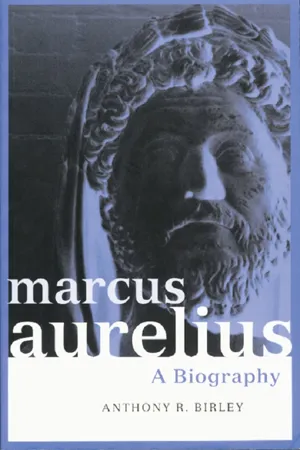
Marcus Aurelius, the philosopher-emperor who ruled the Roman Empire between AD 161 and 180, is one of the best recorded individuals from antiquity. Even his face became more than usually familiar: the imperial coinage displayed his portrait for over 40 years, from the clean-shaven young heir of Antonius to the war-weary, heavily bearded ruler who died at his post in his late fifties.
His correspondence with his tutor Fronto, and even more the private notebook he kept for his last ten years, the Meditations, provides a unique series of vivid and revealing glimpses into the character and peoccupations of this emporer who spent many years in terrible wars against northern tribes.
In this accessible and scholarly study, Professor Birley paints a portrait of an emporer who was human and just - an embodiment of the pagan virtues of Rome.
- 336 pages
- English
- ePUB (mobile friendly)
- Available on iOS & Android
eBook - ePub
About this book
• 1 •
THE AGE OF THE ANTONINES
‘IF A MAN were called to fix the period in the history of the world during which the condition of the human race was most happy and prosperous, he would, without hesitation, name that which elapsed from the death of Domitian to the accession of Commodus.’
So wrote Edward Gibbon of the ‘happy period of more than four-score years,’ from AD 96–180, during which the Roman empire was ruled by the ‘Five Good Emperors’ – Nerva, Trajan, Hadrian, Antoninus Pius and Marcus Aurelius. Marcus’ own life (121–80) spanned almost three-quarters of this epoch while his reign (161–80) occupied its last nineteen years. It was in describing Marcus’ death, and the accession of his son Commodus, that Cassius Dio, born soon after Marcus’ accession, wrote: ‘My history now descends from a kingdom of gold to a kingdom of iron and rust, as affairs did for the Romans at that time.’1
The ‘five good emperors’ were individuals of widely differing character and training. One factor linked them: none was the son of his predecessor. Hence it seemed to some contemporary observers and to many subsequent commentators, including Gibbon, that a new principle was then governing the imperial succession: ‘the adoption of the best man’. In fact there was no principle or conscious policy at work. All but Marcus had no son to succeed him, and in any case kinship linked Trajan and Hadrian, Pius and Marcus.
In his first work, the biography of his father-in-law Agricola, written at the outset of the new era, Tacitus voices the relief of the senate that their time of servitude was over: ‘Now at last our spirits revive.’ Nerva had succeeded Domitian, assassinated in 96, and had achieved the impossible: the principate and liberty could co-exist. Tacitus’ contemporary, Pliny, expatiated at far greater length, a few years later, on the change which had begun that year. It was no longer necessary to flatter the ruler as though he were a god; he contrasted the humanity, frugality, clemency, generosity, kindness, self-restraint, industriousness and bravery of Trajan, who followed Nerva in 98, with the pride, luxury, cruelty, spitefulness, lust, inactivity and cowardice of Domitian. Tacitus and Pliny were speaking for the senate. To the provincial bourgeoisie and peasantry, on the other hand, the personality of the emperor did not perhaps matter very much. The wayward general Petillius Cerialis is made by Tacitus to remind an assembly of Gallic rebels in AD 70: saevi proximis ingruunt, savage emperors vent their spleen on those closest to them – the senators at Rome – and the average inhabitant of the provinces does not suffer. Besides, bad emperors often had good advisers (as Trajan is once supposed to have remarked).
The favourable verdict of history on ‘the Golden Century of the Antonines’ depends largely on the fact that senators felt more secure when the emperor was ‘one of us’, as Pliny put it, and behaved as a fellow-senator. This was a kind of safeguard. At any rate, since most Roman historians and biographers were members of the senate or linked with that order in their sympathies, the dominant theme of Roman imperial historical writing was the relationship between the emperor and the senate.2
To understand more clearly why this was so, it is worth looking back at the origins of the imperial system. Rome had been dominated by one man before, at various stages in the history of the republic, but autocracy began with the victory of Octavian at Actium in 31 BC. Octavian cunningly and wisely concealed his powers, or at least did not flaunt them. This disarmed opposition and allowed his opponents to preserve a semblance of selfrespect. After years of civil war men were anxious for stability. His remarkable talent for survival (forty-four years’ sole rule) allowed the innovations which he had introduced gradually, at every stage appealing to ancient precedent and feeling his way, to harden.
By Augustus’ death, Rome was in effect an empire, however much his successor Tiberius tried to disguise it. Exactly when the republic had ceased and the empire had begun was not so obvious. Writing during Tiberius’ reign, Velleius Paterculus, one of the ‘new men’ favoured by the new system, felt able to say complacently that Augustus had merely ‘recalled to existence the pristine and ancient constitution of the republic’. Augustus wanted to appear as no more than primus inter pares. But the man who began life as plain C. Octavius was much more than that.
He had first changed his name to C. Julius Caesar Octavianus when posthumously adopted by the assassinated dictator Julius Caesar. Through the efforts of Antony and others, Caesar was proclaimed a god, or something very like one, and this enabled Caesar’s heir to draw attention to his unique ancestry – ‘Imperator Caesar divi filius’ (son of the deified). Imperator, once a title for all Roman commanders, had become a special title of honour, used after their names by generals whose soldiers had thus hailed them at a victory. Octavian abusively turned the title into a kind of name, giving up Gaius – and Julius too, for Caesar now became his family name. In 27 BC the senate granted him a further name by which he became generally known: Imperator Caesar divi filius Augustus. In 23 BC Augustus received the ‘tribunician power’, which gave him wide powers of interference in a multitude of spheres. Other powers and honours followed at various stages in his long life.3
Augustus recognized that he could not survive unless he allowed the senate, once the supreme arbiter of Roman destinies, to participate in his rule – indeed, he could not do without senators. The old magistracies of the republic continued. He himself held the consulship thirteen times, and one or two of his close associates whom he wished to mark out with special honour also became consul more than once. To satisfy the aspirations of ordinary senators, whose ambition remained the tenure of the fasces, he regularized the institution of the suffect consulship, established originally to replace consuls who had died or been removed from office. The consules ordinarii, who gave their names to the year, now resigned before completing their year of office to make way for suffecti. This practice greatly increased in subsequent years.
Entry into the senate (a body nominally 600 strong) was hereditary, but suitable persons with the requisite property qualification of one million sesterces could apply for the latus clavus, the broad stripe of the senator’s toga. This allowed them to enter the senate through election as quaestor at the age of twenty-four or twenty-five, after preliminary service in minor magistracies (and with the army). Thereafter they could climb the ladder of the senatorial cursus, becoming aedile or tribune of the people, praetor, and, finally, consul. Patricians, the hereditary aristocracy (enlarged by Augustus and some of his successors), could move direct from quaestor to praetor and could become consul at thirty-two, ten years earlier than the rest. The patricians had more chance of becoming consul ordinarius. But very few were consul more than once.
Alongside the old magistracies a new career developed. If they chose, senators could ignore the emperor’s existence, serve only as magistrates at Rome and as proconsuls of provinces administered in the old republican way. But Augustus and his successors governed a vast provincia, virtually all the provinces which had armies and many others besides, and could also interfere in the ‘senatorial’ provinces. The imperial provinces and armies were administered and commanded by the emperor’s deputies, legati, and a career in the emperor’s service formed the real basis of the senatorial hierarchy, with the ancient republican magistracies merely stepping-stones, formal stages of qualification for further advancement. Some provinces were not given to senators to administer, for various reasons, but to knights, members of the next highest order in the state, who had the title of procurator or prefect. Other new offices grew up in Rome – for example, prefectures of the treasuries, and of the city of Rome, for senators: of the corn-supply, the city-police and the praetorian guard for knights.4
At Rome, Augustus had to keep up ‘republican’ appearances. In the provinces, he was worshipped as king and god, and his family were sacred. ‘It is not necessary to praise political success or to idealize the men who win wealth and honours through civil war.’5 At his death in AD 14 almost everyone did – a few through fear, but most inhabitants of the empire from a sense of awe, admiration and gratitude for the stability which he had created, or allowed to form. Augustus was deified by decree of the senate. So had Julius Caesar been. But although Augustus had at first used the ‘deified Julius’ to further his own plans, the memory of the murdered dictator had not been unduly emphasised at a later stage. ‘Divus Augustus’, with his college of priests, his temple and the festivals to commemorate significant days in his earthly life, played a profound role in the subsequent history of the Roman Empire: his successors were assessed in large measure in comparison with him. All his successors (except Tiberius and Vitellius) used his three names, Imperator Caesar Augustus, as part of their official style, and with some modifications their powers were those which he had gradually built up during his long decades of ascendancy.6
Table 1 Roman Emperors from Augustus to Severus
| 31 BC | September 2: Octavian, great-nephew of Julius Caesar, gains sole power after defeat of Antony at Actium |
| 27 BC | Octavian given name AUGUSTUS |
| 23 BC | Augustus given tribunicia potestas |
| AD 4 | Augustus adopts stepson Tiberius Claudius Nero, who becomes Tiberius Julius Caesar |
| 14 | TIBERIUS succeeds to Augustus’ position on latter’s death |
| 37 | GAIUS (‘CALIGULA’), great-nephew of Tiberius, great-grandson of Augustus, succeeds Tiberius on latter’s death |
| 41 | Murder of Caligula. His uncle CLAUDIUS proclaimed emperor |
| 54 | NERO, stepson of Claudius, nephew of Caligula, great-great-grandson of Augustus, succeeds Claudius on latter’s death |
| 68 | June 6: Suicide of Nero after revolts in western provinces. GALBA recognized as emperor |
| 69 | January 2–3: VITELLIUS proclaimed emperor by Rhine armies |
| January 15: OTHO instigates murder of Galba and is proclaimed emperor at Rome | |
| April 15: Vitellius’ army defeats that of Otho in N. Italy | |
| July 1–3: VESPASIAN proclaimed emperor by eastern armies | |
| October 27–28: Defeat of Vitellius’ forces in N. Italy | |
| December 20: Vitellius killed at Rome | |
| 79 | Death of Vespasian, succeeded by elder son TITUS |
| 81 | Death of Titus, succeeded by younger brother DOMITIAN |
| 96 | September 18: Murder of Domitian at Rome. NER VA made emperor |
| 97 | October: Nerva adopts Trajan as his son |
| 98 | January 28: TRAJAN succeeds on death of Nerva |
| 117 | HADRIAN, after ostensible death-bed adoption, succeeds his cousin Trajan |
| 136 | Spring or early summer: Hadrian adopts L. Ceionius Commodus, who becomes L. Aelius Caesar |
| 138 | January 1: Death of L. Aelius Caesar |
| February 25: Hadrian adopts T. Aurelius Antoninus, who becomes T. Aelius Hadrianus Antoninus and adopts Marcus and L. Commodus junior | |
| July 10: ANTONINUS succeeds on Hadrian’s death | |
| 161 | March 7: MARCUS succeeds on death of Antoninus (Pius), jointly with L. Commodus junior who becomes L. VERUS |
| 169 | January: Death of L. Verus |
| 177 | Marcus’ only surviving son COMMODUS made joint emperor |
| 180 | March 17: Death of Marcus, COMMODUS sole emperor |
| 192 | December 31: Commodus murdered |
| 193 | January 1: PERTINAX proclaimed emperor |
| March 28: Pertinax murdered, DIDIUS JULIANUS proclaimed emperor (Rome) | |
| April 9: SEPTIMIUS SEVERUS proclaimed emperor (Danube) | |
| June 1: Julianus killed at Rome | |
| 197 | February 19: Defeat of Severus’ last rival, at Lyon |
| 211 | February 4: Death of Severus at York |
Tiberius, thanks to his stepfather Augustus’ grudging and unwilling use of him, was by far the most distinguished Roman of his day at his accession: he had been consul more often, had commanded more armies and provinces than his peers, and was son by adoption of Augustus, sharing enough of his special powers to make the succession inevitable. He lacked Augustus’ pliable qualities (the qualities of a chameleon, the emperor Julian was to call them), and was never popular with the senate, indeed by the time of his death in 37 he was generally feared and hated; and he was not deified. His successor was his grand-nephew, Augustus’ great-grandson, Gaius ‘Caligula’. Caligula had no other claim to be Princeps except his Julian blood: he was only twenty-four and had no higher rank than that of quaestor. This made the autocracy obvious; and Caligula went on to exaggerate even further the concept of ‘divine kingship’.
When Caligula was murdered in 41, there was an abortive attempt to restore the republic, but the imperial bodyguard discovered another member of the ‘divine family’, Claudius, uncle of Caligula, who was a laughing-stock to the aristocracy through his personal failings and dominated by his wives and freed slaves. Under him the autocracy and the bureaucracy increased their powers. Claudius was succeeded in 54 by his sixteen-year-old stepson Nero, who began his rule with professions of deference to the senate, sedulously instilled into him by his tutor and minister Seneca. But soon his behaviour became intolerable to the senate – saevi proximis ingruunt. Eventually Nero took fright at a rebellion in Gaul, and, deserted by the praetorian guards, committed suicide in the summer of 68.7
There was no attempt to restore the republic now, some ninety-eight years after the battle of Actium. The aim of all parties in the civil war of 68–69 seems to have been (in principle at least) to return to the harmonious state of affairs that had prevailed under Augustus. In 69, the year of the four emperors, the premium on birth fell sharply with successive occupants of the throne – and the secret had already been revealed ‘that emperors could be made elsewhere than at Rome’. Vespasian, the eventual victor, was a parvenu. Paradoxically, his having two sons was regarded by some of his supporters as a point in his favour: he could found a dynasty which would, it was thought, stabilize the succession. Opposition from senators influenced by the ideals of Stoic philosophy was stifled. Vespasian refused to allow his powers to be limited and was determined that his sons should succeed him. He was duly succeeded by Titus at his death in 79, and Titus two years later by his younger brother Domitian. Vespasian and Titus had been efficient and popular emperors, and they had cultivated the support of the senate. Domitian, who had been a youth in his late teens at his father’s accession, had a suspicious and sensitive personality. As he had never been a normal member of the senate, he had little sympathy with senatorial feeling. He was competent, even talented, as a ruler or administrator, but opposition was provoked by his behaviour (for instance, his insistence on being addressed as ‘Lord and God’, and his holding the consulship ten times as emperor out of a maximum possible of fifteen). His rule ended with a reign of terror, and he was murdered in September 96.8
His successor, Nerva, had not had a very creditable past – he had been an agent of Nero, and then had been honoured by Vespasian and Domitian, for no very obvious reason, except that he was well-connected and, surely, a useful counsellor of the Flavian emperors. In 97 opposition to Nerva became open and his position in grave danger. The situation was saved when he adopted as his son and heir the governor of Upper Germany, M. Ulpius Traianus, who became emperor in his own right on Nerva’s death early in 98.
Trajan, a provincial, had been made a patrician as a young man by Vespasian in recognition of his father’s services to the new dynasty. He had served Domitian loyally, as had others of his class like Agricola, also a neopatrician of provincial extraction, whose biography Tacitus had written to demonstrate that good men could exist and perform worthy deeds even under bad emperors. At the death of Domitian a good deal of cant had been talked about opposition to the tyranny: there had in fact been the Stoic group of senators who had suffered ‘martyrdom’ under Nero and the Flavians. But most of the senate had knuckled under. Trajan became ...
Table of contents
- Cover
- Halftitle
- Title
- Copyright
- Contents
- List of Figures
- Preface
- 1. The Age of the Antonines
- 2. Family and Early Years
- 3. Aurelius Caesar
- 4. The Education of an Heir Apparent
- 5. The Stoic Prince
- 6. The First Years as Emperor
- 7. Triumph and Crisis
- 8. The Northern Wars
- 9. The Last Years
- 10. Marcus to Himself
- 11. Epilogue
- 1. Sources
- 2. The Antonine Dynasty
- 3. The Marcomannic Wars
- 4. Christianity
- 5. The Illustrations
- References and Notes
- Select Bibliography
- Addenda to Bibliography
- Index
Trusted by 375,005 students
Access to over 1.5 million titles for a fair monthly price.
Study more efficiently using our study tools.
Frequently asked questions
Yes, you can cancel anytime from the Subscription tab in your account settings on the Perlego website. Your subscription will stay active until the end of your current billing period. Learn how to cancel your subscription
No, books cannot be downloaded as external files, such as PDFs, for use outside of Perlego. However, you can download books within the Perlego app for offline reading on mobile or tablet. Learn how to download books offline
We are an online textbook subscription service, where you can get access to an entire online library for less than the price of a single book per month. With over 1.5 million books across 990+ topics, we’ve got you covered! Learn about our mission
Look out for the read-aloud symbol on your next book to see if you can listen to it. The read-aloud tool reads text aloud for you, highlighting the text as it is being read. You can pause it, speed it up and slow it down. Learn more about Read Aloud
Yes! You can use the Perlego app on both iOS and Android devices to read anytime, anywhere — even offline. Perfect for commutes or when you’re on the go.
Please note we cannot support devices running on iOS 13 and Android 7 or earlier. Learn more about using the app
Please note we cannot support devices running on iOS 13 and Android 7 or earlier. Learn more about using the app
Yes, you can access Marcus Aurelius by Anthony R Birley in PDF and/or ePUB format, as well as other popular books in History & Ancient History. We have over 1.5 million books available in our catalogue for you to explore.