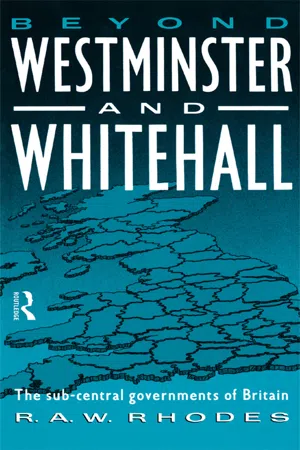
Beyond Westminster and Whitehall provides the first comprehensive account of the range of sub-central government institutions that are responsible for the delivery of services to citizens. These bodies are the warp and weft of the British system of government and yet are all too frequently ignored.
For a full understanding of British government, the study of sub-central government is of equivalent importance to that of the Prime Minister, the Cabinet, and Parliament.
Westminster and Whitehall do not always get what they want. There are a great many restraints upon the actions of the centre, and central policies all too often have unintended consequences. This book, demonstrating that Britain is not a unitary state but a differentiated polity in which sub-central governments play a key role, will be essential reading for teachers and students of British politics.
- 480 pages
- English
- ePUB (mobile friendly)
- Available on iOS & Android
eBook - ePub
Beyond Westminster & Whitehall
About this book
Information
CHAPTER 1
Introduction
The objectives. The structure of the book. Sources.
1.1 The Objectives
The study of British government is too often the study of Westminster and Whitehall. The pictures of senior politicians on television have the all too obvious implication that what they think and do matters for ordinary citizens; but does it? From the standpoint of a consumer of public services, the gallery of national figures with which we are so frequently regaled is less important than might seem to be the case. The house in which ‘Henry Dubb’ lives, the heating and other energy demands he makes, the school in which his children are educated, the hospital in which they were born, the roads on which he drives, even the tap he turns and the toilet he flushes are not provided by Westminster and Whitehall. Central government may pass a law, provide money, inspect and, on occasion, directly provide a service but, for the most part, it needs the co-operation of other bodies in order to meet its electoral promises. Its influence lies in its ability to cajole, bully and persuade (but not command), and even this ability may not call forth the desired degree of compliance.
This book rejects the fixation on Westminster and Whitehall. The antics of the Opposition as reported in Parliament Today, the prospects of a schism in the Labour Party, the aura of doom surrounding an impending Cabinet reshuffle may provide good copy but they have limited effects on the hard question of ‘Who gets what public services when and how?’ In their place, the focus falls on functional differentiation in British government; on the complex of organizations which are the warp and weft of a modern polity. But if sub-central government (SCG) is the prime vehicle for delivering services, it does not do so in total isolation from the centre. Westminster and Whitehall remain part of the analysis, only this time they are examined from the standpoint of SCG as one set of actors in the web of relationships. To employ Luhmann’s (1982, pp. 353–5, xv) provocative phrase, my concern is not with the centre but with the ‘centreless society’: the differentiated polity with no single centre.
Of course, it would be foolish to argue that the centre in British government could not intervene effectively. It can and does enact laws which are implemented in a manner consistent with the avowed intentions of the government of the day. Its relations with the other governments of Britain are not relations between equals; they are asymmetric, and the centre has a nigh total monopoly of legal resources. But the image of the directive, all-pervasive centre is widespread; it is said that we live in a unitary state in which the government of the day has the right to govern. Perhaps the work of Richard Rose is of greatest significance here. In a series of books and articles (see, for example. Rose, 1976 and 1982; Madgwick and Rose 1982; Rose and McAllister, 1982; McAllister and Rose, 1984) he has recognized the multinational, multiform character of the United Kingdom and yet insisted on the dominance of the centre or ‘Mace’:
To write a book about Scottish Nationalism…or Welsh Nationalism…is to focus upon only one part of the United Kingdom, and upon a minority party within that nation. Similarly, to write a book about the Scottish political system…is to assume what remains to be proven, namely that the things differentiating Scotland from England are politically more important than what Scotland and England have in common, such as government by Westminster. It is more accurate to speak about British government in Scotland or British government in Wales, leaving open to empirical investigation whether, and in what ways, politics in one part of the United Kingdom differs from another…Only in Northern Ireland can one properly start from the assumption that government and politics are in fundamental respects un-British.
(McAllister and Rose, 1984, p. 8, my emphasis)
The problems with this interpretation lie in the italicized passages. It is not necessary to demonstrate that the periphery is more important, only that it is important and cannot be omitted from any account of British government. It is impossible to leave that importance open to empirical investigation if it is assumed that the institutions of, and policies in, Scotland are manifestations of British government in Scotland. This assumption necessarily presupposes the unity and integration of the UK, not its differentiation. Finally, the importance of sub-central government cannot be restricted to the question of nationality. Few if any would argue that local government threatens the national integrity of the UK, but it can and does pose severe obstacles to the policies of the government of the day. For all its pioneering nature, Rose’s work presents a fundamentally centralist, integrationist, or, in his word, ‘Unionist’ picture of the UK. As with so much work on British government, reality is obscured by a focus on the centre.
Behind the easy maxims of the unitary state lie some uncomfortable truths. Central policies fail and are subverted by SCG which develops and implements policies unbeknown or unwelcome to the centre. To understand these features of British government it is necessary to reject the usual centralist perspective and to focus on the constraints both in and on the centre. The constraints in the centre reside in its fragmentation. There is no single centre but multiple centres or policy networks. Paradoxically, fragmentation and centralization can coexist. Each policy network can be centralized, but the weakness of the centre resides in its inability to co-ordinate these multiple centres. The constraints on the centres reside in their non-executant nature; they do not deliver services but are dependent on a variety of other governmental units. This book deliberately rejects the centralist perspective in an attempt to correct a persistent imbalance. It confronts the image of the unitary state with the image of the differentiated polity. The resulting argument may seem one-sided, the image of the strong centre may dissolve, but the picture is no more inaccurate than conventional portraits of British government. To comprehend British government, it is necessary to examine the contradiction of a strong executive dependent on SCG; of authority versus interdependence. My objective is to stake a claim for sub-central government, differentiation and interdependence as characteristics of British government of equivalent importance to the study of the Prime Minister, the Cabinet and Parliament.
Of course, there have been some concessions to this view of British government. It has long been recognized that local government has an important role to play in providing services—hence the preoccupation since the mid-1970s with restraining local expenditure. But this concession is scarcely an improvement. It leads to discussions of central-local relations in education, housing, etc., which imply that this phrase encompasses the relevant policy-makers; to provide ‘better’ education it is necessary to ‘improve’ the relationship between the Department of Education and Science (DES) and local education authorities (LEAs). An alternative conception of policy-making in local government emphasizes that local authorities are local political systems with the capacity to initiate and maintain distinct policies (see, for example, Dearlove, 1973, pp. 20–1). The problem with this emphasis is that it tends to underestimate the importance of ‘non-local sources of policy change’ (Dunleavy, 1980a, p. 98). This phrase does not refer solely to the influence of the centre but also to the gamut of governmental institutions, professions and the corporate economy. In short, local authorities are located in networks of organizations, both public and private (including central actors), and the gestation and implementation of policy cannot be explained by reference to the actions of any one organization. Just as this book focuses on the constraints in and on the centre, it also rejects a focus on the local political system as the source of policy innovation. In place of these foci, it seeks to establish the validity of networks of organizations as the most revealing unit of analysis. Policy-making in British government encompasses a wide variety of public sector organizations. A poor family requiring government assistance may need help with gas bills, electricity bills, housing and rate rebates (housing benefit), social work, unemployment and supplementary benefit; and although this list covers five different government bodies, it is incomplete. A thoroughgoing account of British government requires an analysis of networks and of the role of the sub-central level of government within them; a prominence warranted by their undoubted importance for citizens. There is no existing account of the British system of sub-central government in all its network configurations.1
Invoking the interests of citizens imbues the argument for the study of sub-central government with noble sentiments. More prosaic grounds support the case. Obviously, citizens should not find their government incomprehensible, but equally the governments of the day should comprehend their ‘machine’; they should know its strengths and weaknesses, its capabilities and their capacity to manipulate it. Such knowledge is in short supply. British politicians have a bureaucratic or hierarchy model of the government machine. They expect their interventions to have the intended results. Too frequently, the converse is the case. Judged by their actions, the national political élite has not grasped that the British policy-making system is fragmented and disaggregated, that problems are factorized and that the interdependence of structures and problems requires bargaining between the affected interests and generates multifarious unintended consequences in response to unilateral action. Confronted by the varieties of sub-central government, the metaphor of the government ‘machine’ is inappropriate—unless the mental image is one bequeathed by W.Heath Robinson. A maze or labyrinth is a far more apposite image (and the minatory connotations seem highly pertinent). To describe and explain sub-central government is not simply to fill a lacuna in the literature but to confront directly a major problem. The problem of sub-central government—whether it is defined as local autonomy, overspending, or inadequate service provision—is equally the problem of central government: the failure to devise or adapt policy instruments for negotiating a maze. The basic objective of this book is to provide a map of the maze that is British sub-central government.
To talk of a maze is to introduce a synonym for complexity and, it is alleged, to so describe British government is both ‘trite’ and a ‘cop-out’ (Hood, 1982b, p. 369). The focus on complexity can suggest, however, a number of hypotheses about British government. Thus, increasing scale and interdependence—i.e. complexity—generate decision-making by experts, increasing problems of co-ordination and control, a range of unintended consequences and a decline in policy effectiveness. For all their generality, these suggestions make if clear that mapping the maze is not merely to describe complexity but to focus attention on a facet of British government with manifold consequences for its operation. The following account of SCG will have a considerable amount to say on precisely these kinds of outcome.
Whatever its intrinsic merits, and however necessary, a basic description of the system will be inadequate. The system in 1945 was very different from the system in 1983. These transformations have to be documented. There are three reasons for adopting a historical perspective for even so short a period as 1945–83 (Bulpitt, 1983, pp. 54–5). First, contemporary events have to be located historically if cause and effect, continuities and discontinuities, are to be distinguished accurately. Second, interpretations of the past are part of the stuff of contemporary political debates and such interpretations need to be tested and contested. Finally, many theoretical issues require a historical perspective; for example, no analysis of the changing functions of government would be possible unless it spanned a number of decades. Incorporating a historical perspective into the study of sub-central government could take two forms: synoptic surveys of trends or detailed analyses of critical junctures—i.e. turning-points in the development of sub-central government. The second objective of this book is to provide a synoptic survey of British sub-central government in the postwar period.2
Cataloguing change is all well and good, but it is also essential that the development and crises of the system be explained. The third objective, therefore, is to explain the changing pattern of sub-central government. This aspiration is more easily stated than realized. The available theories of British government are numerous and certainly give off an air of mutual incompatibility. To interpret and explain sub-central government requires an explicit model of the system and an awareness of the potential contribution of competing models. This task has been made more difficult in recent years by a rapid increase in the theoretical literature. It is now possible to identify several models concerned specifically with central-local relations, and the major axioms and hypotheses of these models have to be appraised and their strengths and weaknesses for the study of sub-central government have to be assessed.
An alliance of description, history and theory is sufficiently daunting, but the prospectus remains incomplete. The phrase ‘sub-central government’ suggests that the focus of the study is government organizations. But it will not be possible to determine who gets what public services when and how by limiting the analysis to organizations. This perspective has to be complemented with an analysis of policies. And it is important to stress that the analyses of organizations and of policies are complementary. Policy may be shaped by numerous factors, but the types and activities of government organizations and the procedures shaping their relationships remain an important variable. Accordingly, after exploring the types of sub-central governmental organizations, these organizations are revisited in an analysis of policymaking for such services as education and social work and for such problems as structural reorganizations and intergovernmental financial transfers.
To focus on the policy process begs an important question: what difference does it make? Telling stories about bureaucratic politics can be amusing, but how does bureaucratic wheeling and dealing affect the services provided for citizens? In other words, it is necessary to explore the distributional consequences of central dependence on SCG. There can be no pretence that institutional factors provide a complete explanation of the outcomes of the policy process, but they are an important component of any such explanation. In consequence, the case studies of the various policies will examine the extent to which the interactions between the centre and SCG reflect, reinforce, or accentuate the pre-existing inequalities in the distribution of goods and services.
Finally, there is the question of evaluating SCG. In recent years, the air has been rent by the competing cries of those commentators who decry the erosion of local autonomy and the lack of accountability and those who bemoan local ‘overspending’ and the Leviathan of government. This books forswears evaluations rooted in political philosophy for an examination of the theory(ies) which underpin(s) policies for SCG. It will be argued that such policies must recognize that complexity, indeterminacy and interdependence are defining characteristics of the system. Government interventions will be judged by their strategic flexibility, procedures for institutionalizing indeterminacy and openness of communication. Bureaucratic or hierarchy models of the relationship are both widespread and inappropriate, proliferating policies distinguished by the range of unintended consequences as a result. The criteria employed here for evaluating SCG extend the discussion of accountability beyond the normal preoccupations of representative democracy to encompass accountability systems appropriate to policies rather than institutions. Obviously, they are not the only relevant criteria but they are important and conspicuous primarily for their absence in the continuing debate on SCG.
For a project of such scope, some sacrifice of depth is inevitable. The analysis of educational policy-making would comfortably fill a volume on its own. There are other costs. The study of central-local relations has burgeoned in the past decade, whilst the politics of the nationalized industries have been virtually untouched for an equivalent span of years. The restrictions on the depth of analysis coupled with the unevenness of existing coverage make it particularly important to stress that an overriding objective is to provide a synoptic account of sub-central government. A major part of British government has lingered in the nether world of academic public administration. Inchoate and incoherent, the prime need is for an integrated interpretative account of the whole system. Defects of detail and coverage take a distant second place to this need.
In short, therefore, this book has six objectives:
- to provide a map of SCG;
- to survey the development of SCG in the postwar period;
- to explain the changes in the system;
- to explore the role of SCG in the policy-making process;
- to determine the effect of SCG on policy outcomes; and
- to evaluate policy-making for and by SCG.
1.2 The Structure of the Book
The book has four major sections. The first section (Chapter 2) reviews the various theories of intergovernmental relations (IGR), including public administration, the New Right, centre-periphery relations and neo-Marxist theory. A broad definition of sub-central government is employed covering relations between central political institutions in the capital city and those sub-central political organizations and governmental bodies within the accepted boundaries of the state (cf. Bulpitt, 1983, p. 1). It concludes with a model of IGR which builds upon Rhodes (1981a, 1986a and b) and is described as ‘intergovernmental theory’. This model has three levels of analysis: the national government environment (macro), policy networks (meso) and organizations (micro). Its distinctiveness lies in the emphasis on the role of policy networks in shaping the policy process and policy outcomes. These structures of resource-dependent organizations are stable, focused on specific services and the responsible central department, but they incorporate local authorities, the professions and a select few interest groups.
The second section (Chapter 3) describes the variety of actors and relationships in the policy networks. British central government is non-executant; it is dependent upon other bodies in the public sector to provide services. The section focuses on these other bodies (or SCG) and describes the interests, resources and relationships of territorial ministries (e.g. the Northern Ireland Office); intermediate institutions (e.g. the ‘regional’ offices of the DoE); non-departmental public bodies, a term which covers public corporations, the NHS and the plethora of fringe bodies (executive, advisory and judicial bodies as well as quangos proper); local government, including the new joint boards and committees; and sub-central political organizations (e.g. ‘nationalist’ political parties, local interest groups and the professions). Although lengthy, this list vividly demonstrates that British government is disaggregated; that is, the parts are not drawn together to form a whole. Moreover, by describing the changing pattern of relationships for each type of SCG, it is possible to demonstrate that British government has grown by a process of e...
Table of contents
- Cover Page
- Title Page
- Copyright Page
- Tables and Figures
- Abbreviations
- Acknowledgements
- Chapter 1: Introduction
- Chapter 2: Concepts and Models in the Analysis of Sub-Central Government
- Chapter 3: Organizations and Actors
- Chapter 4: The Policy Networks
- Chapter 5: The Differentiated Polity: Relationships, Consequences and Contradictions
- References and Bibliography
Trusted by 375,005 students
Access to over 1.5 million titles for a fair monthly price.
Study more efficiently using our study tools.
Frequently asked questions
Yes, you can cancel anytime from the Subscription tab in your account settings on the Perlego website. Your subscription will stay active until the end of your current billing period. Learn how to cancel your subscription
No, books cannot be downloaded as external files, such as PDFs, for use outside of Perlego. However, you can download books within the Perlego app for offline reading on mobile or tablet. Learn how to download books offline
Perlego offers two plans: Essential and Complete
- Essential is ideal for learners and professionals who enjoy exploring a wide range of subjects. Access the Essential Library with 800,000+ trusted titles and best-sellers across business, personal growth, and the humanities. Includes unlimited reading time and Standard Read Aloud voice.
- Complete: Perfect for advanced learners and researchers needing full, unrestricted access. Unlock 1.5M+ books across hundreds of subjects, including academic and specialized titles. The Complete Plan also includes advanced features like Premium Read Aloud and Research Assistant.
We are an online textbook subscription service, where you can get access to an entire online library for less than the price of a single book per month. With over 1.5 million books across 990+ topics, we’ve got you covered! Learn about our mission
Look out for the read-aloud symbol on your next book to see if you can listen to it. The read-aloud tool reads text aloud for you, highlighting the text as it is being read. You can pause it, speed it up and slow it down. Learn more about Read Aloud
Yes! You can use the Perlego app on both iOS and Android devices to read anytime, anywhere — even offline. Perfect for commutes or when you’re on the go.
Please note we cannot support devices running on iOS 13 and Android 7 or earlier. Learn more about using the app
Please note we cannot support devices running on iOS 13 and Android 7 or earlier. Learn more about using the app
Yes, you can access Beyond Westminster & Whitehall by R. A. Rhodes in PDF and/or ePUB format, as well as other popular books in Politics & International Relations & Politics. We have over 1.5 million books available in our catalogue for you to explore.