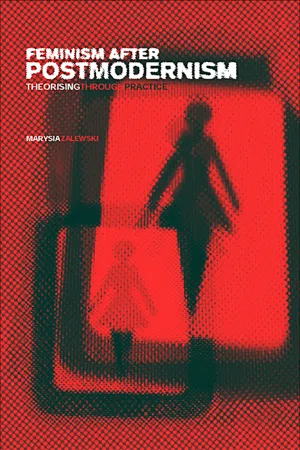
- 176 pages
- English
- ePUB (mobile friendly)
- Available on iOS & Android
eBook - ePub
About this book
Highly original and stimulating, this book provides a detailed overview of postmodern feminist theory and practice. Subjects covered include:
*the differences between the feminism of the 1970s and contemporary feminism
*liberal, radical, socialist and postmodern feminisms
*feminist reactions to the growth in reproductive technologies
*how feminism informs debates about the subject, epistemology and political action
*feminism into the new millennium
Information
1 Introduction
Different feminist theories
Imagine Andrea Dworkin and Judith Butler in conversation about feminism. Would they, could they, agree on anything? Think, for example, about a conversation between them on male violence towards women. How can we imagine the conversation going? Would Andrea Dworkin speak about a ‘war against women’? Or about a continuum of male violence from the cradle to the grave; from the bedroom to the boardroom? And would Judith Butler resist such terms and instead question the authority of those who claim that they can speak on behalf of such a disparate group called ‘women’?
Imagine a discussion between them on the question of what feminism is or what women are. Butler might speak not only of the impossibility of reaching such definitions but also of the dangers of definitional practices and instead suggest that we look at the effects of those practices. However, Dworkin might respond that, despite the difficulties, it is vital to hold on to some clear views about what women are and what they want or what the demands of feminism are. To abandon such clarity threatens to lead us into a feminist nightmare where we cannot speak of women at all or feel confident in using feminist politics to demand rights and freedoms for women.
Why imagine this conversation? Why is it important to wonder about whether Andrea Dworkin and Judith Butler might agree on feminist issues? What is at stake?
I am introducing this book through this imagined conversation between Andrea Dworkin and Judith Butler partly because these two writers seem to embody two apparently opposing bodies of feminist thought. Dworkin would for many be seen as the quintessential 1970s radical feminist, with Butler being the paradigm of a contemporary postmodern feminist. In fact both of these writers seem to stand as exemplary figures for the feminisms they are associated with – in the sense that each of these figures is frequently taken to pose as something of a ‘warning to [feminist] others’1 because of their paradigmatic status. One effect of this is that they seem to stand out as examples of the type of feminist ‘you don’t want to be’, if you happen to disagree with their theoretical positions. Of course with Dworkin, this image of her as a paradigm of radical feminism has had some rather nasty consequences. It has always struck me as suspicious that she appears to be one of the most maligned feminists of the late twentieth century, especially as she is so often represented as the antithesis of what ‘western patriarchal man’ imagines woman should be. Dworkin is not pretty, she is fat and she refuses to shut up. Additionally, her feminist theory and politics still seem very much tethered to the unfashionable foundational claims and rhetorics of western feminisms typical of the 1970s. That is to say, she still speaks the language of’universal woman’, ‘ubiquitous patriarchy’, a ‘war against women’ and a continuum of male violence.
Judith Butler, on the other hand, eloquently speaks the rhetoric of the postmodern 1990s – refusing foundational claims, refusing to accept definitions (’Is there, after all, something called postmodernism?’ [1995: 35]) and frequently resisting the form of questions put to her. Her apparent evasiveness about questions such as ‘what feminism is’ or ‘who women are’ has positioned her as a paradigm of a postmodern feminism which, for those fearful and suspicious of it, means all will be lost in the battle to demand rights on behalf of women, because women are simply a fiction. Interestingly, however, Butler too confounds ‘western patriarchal man’s’ image of what a woman should be, as she is a lesbian.
What does all this imply for western feminism as we move into the twenty-first century? Does it really matter that Dworkin and Butler might approach or think about feminism differently to each other, or that the feminisms they are taken to represent are so different? What does this mean Dworkin and Butler actually do with their views on feminism or perhaps more pertinently what others might do with their ideas? Or in other words, towards what sort of political and/or practical actions do their differing ways of thinking about feminism lead? For example, do their theoretical positions inspire us to support the rights of minority groups or join ‘reclaim the night marches’? Do they cause us to worry about the future for women? To cut to the crucial question, what do these ways of thinking about feminism allow, enable or inspire us to do?
Feminism seemed so much simpler a few decades ago! In 1983 Alison Jaggar comfortably claimed that ‘all feminists address the same problem: what constitutes the oppression of women and how can that oppression be ended?’ (1983: 124). This view seems misplaced in contemporary feminist debates. Does it matter that the consensus doesn’t exist any more? Would we want to return to it? What are the consequences of a choice either way? The proliferation of feminisms over the last few decades has simply become too frustrating for some feminists. ‘Contemporary feminist theory is a tangled and forbidding web . . . practising feminists . . . approach the proliferation of feminist theory with an acute sense of frustration’ (Nye, 1988: 1). This sense of frustration has been exacerbated for many by the belief that approaches to feminism grouped under the label ‘postmodern’ have seemingly become dominant, so much so that modernist or 1970s feminisms have been declared ‘virtually useless’ (Gatens, 1992: 120) and ‘anachronistic’ (Coole, 1994: 129). In other words, the radical feminism of someone like Andrea Dworkin is old-fashioned and of little, if any, use in this new millennium.
This is a big claim to make. Can it really be accurate to say that the feminisms typical of the 1970s – liberal, Marxist/socialist and radical – are of no contemporary use? Are the differences between the feminisms of the 1970s and the 1990s so immense? For many contemporary feminist writers, the answer to the latter question is a resounding yes! The differences between 1970s and 1990s feminisms are so huge that some speak of an apparently unbridgeable ‘gulf (Barrett and Phillips, 1992: 2). Others, less dramatically, write of a ‘theoretical shift’ within feminism since the 1960s (Alcoff, 1997: 6); or a ‘paradigm shift’ (Brooks, 1997: 8). These writers have largely considered and discussed this so-called gulf at a theoretical level. What I do in this book is reconsider and re-evaluate the claim that there is a theoretical gulf by thinking how the theoretical differences are related to practice. One of the reasons it is important to think about theoretical differences in this way is because it will allow me to address the question ‘How and in what ways do the differences between feminisms and feminists matter in the everyday?’
Thinking theory through practice
Which theories?
In order to take up my task of ‘thinking theory through practice’ and to address the issue of the everyday, I want to introduce the feminist theories that have been identified as being associated with or ‘belonging to’ the 1970s and the 1990s. As mentioned above, for the 1970s these are liberal, Marxist/socialist and radical, and for the 1990s, postmodern and poststructural. It is not my intention to reify these categories or to go through them in a boring and tedious way. However, I do need to extricate some of the key questions, issues and themes that have been identified as being part of these theories precisely in order to re-evaluate the idea that there is a huge gap between 1970s and 1990s feminisms. Anyone writing about feminism in the late 1990s has to be very reflective about the practice of categorising feminisms, a point to which I shall return to in Chapter 5. But it is the case that these categories of feminist thought have frequently and consistently been used by feminists. It is therefore important, in the first instance, to use them to help us understand why the differences between feminisms matter.
Also mentioned earlier, another way of framing this division is by calling 1970s feminisms ‘modernist’ and 1990s feminisms ‘postmodernist’. You might note that this gathering together of the four big feminisms of the 1970s under the label of ‘modernism’ seems to imply that there are minimal differences between them. This seems to be another rather grand claim. Imagine a conversation between Andrea Dworkin and a liberal feminist such as Betty Friedan. How different might their feminist ideas and politics be? The grouping together of 1970s feminisms under the generic label of’modernism’ suggests that there are significant commonalities between them, or at least sufficient commonalities such that they can be considered together in opposition to the feminisms of the 1990s. This does seem somewhat strange, given the lengthy and serious debates between them, focusing on their differences, during the 1960s, 1970s and 1980s. I shall return to all these issues in Chapter 5.
Which practice?
The area of practice I shall ‘think theory through’ is reproductive technologies. This is a good area to select for several reasons. One reason is that the feminisms of both the 1970s and 1990s have all expressed an interest in the uses, abuses and constructions of women’s bodies, especially in the arena of reproduction. This means that I can ask questions about reproductive technologies from varying feminist perspectives, which will enable me to illustrate how different ways of thinking or theorising about feminism do or do not lead to different ways of thinking about or dealing with a practical issue. For example, if I am a liberal feminist dedicated to the principle of equal rights and opportunities for women especially in the public world of work, what will I think about the use of ultrasound scans on most pregnant women in the west these days to check for abnormalities in the foetus? Will I conclude that this is a ‘good thing’, as giving birth to an abnormal baby, with all the extra time for caring that would involve, would jeopardise my chances of becoming a senior partner in the law firm in which I work? Or, if I am feminist inspired by the passion of radical feminist rhetoric on the perils of patriarchy, what will I think about ‘test-tube babies’? Unlike my ‘liberal sister’, I am not likely to think that as this provides more choice for women this is automatically a ‘good thing’. Instead I am more likely to consider this as another example of patriarchal control over women’s bodies and spend time documenting what women suffer in order to conceive a baby through in vitro fertilisation (IVF). Already we can see that different theories can lead to different stories and beliefs about practices. This matters.
A second reason why this is a good area of practice to select is that questions about the practices of reproductive technologies imply questions about women. This is very good for our purposes here because one of the key areas of division between modernist and postmodernist feminists clusters around the question of woman and women. Those feminists who favour more traditional or modernist approaches feel very unhappy about the (seeming) postmodern abandonment of the category of woman as the indisputable starting point for feminist theory and politics. If postmodern feminism cannot speak about women, as more traditional feminists might argue, how can this help women to think about and deal with a practical issue such as ultrasound screening? This question about using the category of woman has been discussed at length in theory but what does it actually mean in practice? These are the kinds of questions I shall address in this book.
In the rest of this chapter I shall introduce some of the key themes and ideas from the four large categories of feminist thought I am starting with – liberal, radical, socialist and postmodern. In Chapter 2 I shall identify the key themes that will enable me to evaluate the idea that there is a gulf between 1970s modernist feminisms and 1990s postmodern feminisms; namely the subject, epistemology and politics. In Chapter 3 I shall discuss modernist feminisms through the practices of reproductive technologies and do the same for postmodern feminisms in Chapter 4. Chapter 5 will return to the question of the gulf between feminist theories and serve as an overall conclusion to the book.
Liberal feminism
As a way to start thinking about some of the central characteristics of liberal feminism, I want to introduce six words or concepts: freedom, choice, rights, equality, rationality and control. None of these six concepts typically associated with liberal feminism sounds very subversive or unreasonable in the context of contemporary liberal democracies, such as the United Kingdom or the United States. Intuitively we might think that of course we want and should be entitled to be free, to have choices and rights, to be treated equally, and to be able to exercise rationality and have control over our lives. In a very real sense, these things are the essence of liberal democracy. However, I think it still comes as a bit of a shock to realise that only as recently as the 1960s, women in the UK were not paid the same income as men for doing exactly the same job. This is one small but powerful reminder that women have traditionally been treated rather differently to men, and this has had all kinds of effects on women’s lives. Two of the main goals of liberal feminism have been to expose old-fashioned ideas about what women are and should do, and to allow, even encourage, women to do the same things as men for the same status and rewards.
An early example of arguments made on these lines appears in Mary Wollstonecraft’s A Vindication of the Rights of Woman, first published in 1792. Wollstonecraft was deeply distressed at the way women were essentially trained to be weak and pathetic creatures. She described them as ‘the feathered race’, like birds confined to cages who have nothing to do but plume themselves and ‘stalk with mock majesty from perch to perch’ (Wollstonecraft, 1988: 55). Her passionate cry for JUSTICE (which she writes in capitals herself) for women (one half of the human race) was inspired both by her observation of women in society but also in response to one of the major political theorists at the time (and still very influential), Jean-Jacques Rousseau. Wollstonecraft’s anger was not surprising given some of the ideas he had. For example, in Entile (first published in 1762), Rousseau claimed that
the education of women should always be relative to men. To please, to be useful to us, to make us love and esteem them, to educate us when young, and take care of us when grown up, to advise us, to console us, to render our lives easy and agreeable: these are the duties of women at all times, and what they should be taught in their infancy.
(Rousseau 1955: 328)
Wollstonecraft simply could not agree with this, and was impelled to argue against it, using some of the contemporary arguments from her time, primarily ones based on natural rights. She, like many of the writers that influenced her (including Thomas Paine and John Locke), believed that individuals had natural rights and that all men were equal to each other. The main thing that differentiated men from animals was man’s rationality. Wollstonecraft simply extended these arguments to include women, and this practice of ‘including women in’ is something liberal feminists have done ever since.
In the eighteenth century, Mary Wollstonecraft argued that girls should have the same education as boys. In France around the same time, Olympe de Gouges insisted on the extension of the egalitarian principles of the French Declaration of the Rights of Man to women. In the nineteenth century, Elizabeth Cady Stanton in the United States drew up a document called the ‘Declaration of Sentiments’, based on the Declaration of Independence, claiming that both men and women were equal (Donovan, 1988: 5). Back in Britain John Stuart Mill and Harriet Taylor Mill were writing radical books suggesting that women be granted all political privileges, including the right to vote and the right to run for public office (Mill, 1970; Taylor, 19...
Table of contents
- Cover Page
- Title Page
- Copyright Page
- Dedication
- Preface
- Acknowledgements
- 1 Introduction
- 2 The gulf
- 3 Modernist feminisms and reproductive technologies
- 4 Postmodernist feminisms and reproductive technologies
- 5 ‘Recovering’ feminisms?
- Glossary of medical terms
- References
Trusted by 375,005 students
Access to over 1.5 million titles for a fair monthly price.
Study more efficiently using our study tools.
Frequently asked questions
Yes, you can cancel anytime from the Subscription tab in your account settings on the Perlego website. Your subscription will stay active until the end of your current billing period. Learn how to cancel your subscription
No, books cannot be downloaded as external files, such as PDFs, for use outside of Perlego. However, you can download books within the Perlego app for offline reading on mobile or tablet. Learn how to download books offline
Perlego offers two plans: Essential and Complete
- Essential is ideal for learners and professionals who enjoy exploring a wide range of subjects. Access the Essential Library with 800,000+ trusted titles and best-sellers across business, personal growth, and the humanities. Includes unlimited reading time and Standard Read Aloud voice.
- Complete: Perfect for advanced learners and researchers needing full, unrestricted access. Unlock 1.5M+ books across hundreds of subjects, including academic and specialized titles. The Complete Plan also includes advanced features like Premium Read Aloud and Research Assistant.
We are an online textbook subscription service, where you can get access to an entire online library for less than the price of a single book per month. With over 1.5 million books across 990+ topics, we’ve got you covered! Learn about our mission
Look out for the read-aloud symbol on your next book to see if you can listen to it. The read-aloud tool reads text aloud for you, highlighting the text as it is being read. You can pause it, speed it up and slow it down. Learn more about Read Aloud
Yes! You can use the Perlego app on both iOS and Android devices to read anytime, anywhere — even offline. Perfect for commutes or when you’re on the go.
Please note we cannot support devices running on iOS 13 and Android 7 or earlier. Learn more about using the app
Please note we cannot support devices running on iOS 13 and Android 7 or earlier. Learn more about using the app
Yes, you can access Feminism After Postmodernism? by Marysia Zalewski in PDF and/or ePUB format, as well as other popular books in Social Sciences & Political History & Theory. We have over 1.5 million books available in our catalogue for you to explore.