- 304 pages
- English
- ePUB (mobile friendly)
- Available on iOS & Android
eBook - ePub
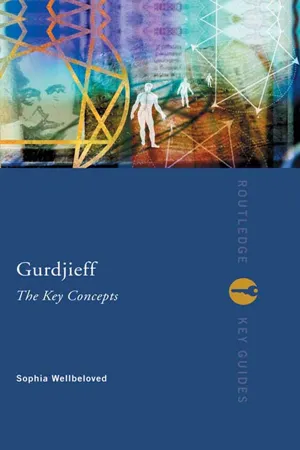
Gurdjieff: The Key Concepts
About this book
This unique book offers clear definitions of Gurdjieff's teaching terms, placing him within the political, geographic and cultural context of his time. Entries look at diverse aspects of his Work, including:
* possible sources in religious, Theosophical, occult, esoteric and literary traditions
* the integral relationships between different aspects of the teaching
* its internal contradictions and subversive aspects
* the derivation of Gurdjieff's cosmological laws and Ennegram
* the passive form of "New Work" teaching introduced by Jeanne de Salzmann.
Information
APPENDIX 1: BIOGRAPHICAL NOTES ON PUPILS
The biographical notes given below are on some of those who were taught by Gurdjieff and/or P.D. Ouspensky, A.R. Orage and J.G. Bennett, and who went on to become teachers and/or to write about the Work. In the first section are the early pupils who met Gurdjieff and formed his core group of pupils before he arrived in France. The second section contains notes on pupils who came to the Work after Gurdjieff established his Institute in France, often via Ouspensky, Orage or Bennett; the Rope Group of women pupils (see ROPE, THE), mostly writers; and the French pupils whom Gurdjieff taught during the years of World War II. Gurdjieff paid especial attention to pupils who had literary skills: Ouspensky in Russia, Orage in England, Toomer in America, and Jane Heap and the Rope Group in Paris. Each of these helped him significantly in the dissemination of his ideas: through teaching, through recording the teaching and/or through editing Tales. Pupils' own principal publications are listed in the bibliography.
1
Early pupils
Pyotr Demianovich Ouspensky (1878–1947) Ouspensky was born in Moscow. When he met Gurdjieff in 1915 he was already the successful author of Tertium Organum (1912) and a lecturer whose Theosophical interests and inner quest had led him to travels in India. He was a member, with his wife, of the earliest core group of pupils to whom Gurdjieff taught cosmological theory. Ouspensky began the process of separation from Gurdjieff in 1917 in Essentuki. He left Gurdjieff and began to teach in London in 1921; A.R. Orage was among his first pupils. Ouspensky decided that his split from Gurdjieff was final in 1924. He continued to teach in London, but he banned the mention of Gurdjieff's name. He published A New Model of the Universe in 1931, the year in which he made a last unexpected visit to Gurdjieff in France. This did not result in their reconciliation (see Moore 1991: 241). In 1935 Ouspensky acquired Lyne Place, Surrey, where pupils could take part in Work activities. In 1941, because of World War II, Ouspensky and his wife went to the United States where they led independent lives, each with their own groups of pupils. Ouspensky returned to London in 1946, leaving his pupils and wife in the United States. In September 1947 he told pupils that there was no ‘System’. He died on 2 November. Ouspensky's pupils fractured into separate groups after his death, partly because they had been told there was no ‘System’, but also because Ouspensky had been certain that Gurdjieff's teaching was not complete: he had focused on the need to contact schools, and so his pupils continued to search for other teachers. Ouspensky's In Search of the Miraculous (1987 [1949]) had been approved by Gurdjieff as a true account of his teaching. It was published after the deaths of both men and has remained a key text in the Work (Rawlinson 1997: 293–6).
Sophie Grigorievna Ouspensky (1874–1963) Known to her pupils as Madame Ouspensky, she had a daughter from an earlier marriage when she met Gurdjieff in 1915 through Ouspensky. She stayed with Gurdjieff when Ouspensky went to London in 1921 and continued to live near him, visiting England occasionally from 1927 and moving there permanently in 1931. Ouspensky stayed mostly in London while Madame Ouspensky taught at Lyne Place in Surrey. In 1941 they went to the United States together, where she taught at Franklin Farms, Mendham, while Ouspensky stayed in New York. She remained in the United States when Ouspensky returned to England. After his death, she advised his pupils, and her own, to go to Gurdjieff in Paris. Because of the longstanding ban on the mention of Gurdjieff, pupils had not realised that he was still alive. Gurdjieff visited Madame Ouspensky on his last visit to the United States in the winter of 1948–9. Although she did not write about the Work herself, she supervised the publication of her husband's The Fourth Way (1957). She died in 1963. Both Lyne Place and Franklin Farms replicated aspects of Gurdjieff's Institute: they provided a place away from everyday life where Work could be carried out through physical activities under the supervision of the teacher. This model was adhered to by other pupils (see below) and still continues as the pattern for Work. Madame Ouspensky had a reputation as a formidable teacher in her own right (see Rawlinson 1997: 296–8).
Thomas Alexandrovich de Hartmann (1886–1956)
Olga (Arkadievna de Schumacher) de Hartmann (1885–1979) Thomas de Hartmann married Olga, a singer, in 1906, the year his ballet The Pink Flower (Opus 6) was performed before Tsar Nicholas II. From 1908–11 de Hartmann studied conducting in Munich. He was a well-established composer in St Petersburg when he and his wife encountered Gurdjieff in December 1916. However, they abandoned their careers and travelled to France with Gurdjieff, staying with him until 1929 (see de Hartmann and de Hartmann 1992 [1964]). They were also part of the core group of Gurdjieff students at the Institute, where Olga became Gurdjieff's secretary and was much involved in the writing process of Tales. Gurdjieff and de Hartmann collaborated in the composition of music. Though separated from Gurdjieff after 1929, they remained faithful to his teaching and, after his death, moved to New York to support Madame Ouspensky at Franklin Farms. After Thomas died in 1956, Olga started the first Canadian group in Toronto, which later became the Gurdjieff Foundation of Canada. She died in 1979 (see Thomas C. Daly's Foreword to de Hartmann and de Hartmann 1992 [1964]: vii–xxi).
Jeanne (Allemand) de Salzmann (1889–1990) Born in Geneva, she trained as a dancer and met Gurdjieff in Tiflis in 1919. She was teaching Eurythmics and her pupils gave the first performance of Gurdjieff's sacred dances (see DANCE). She and her husband Alexandre de Salzmann, a theatre designer, travelled with Gurdjieff to France and lived at the Institute. Alexandre began to teach in Paris in 1931, gathering the first French group of Work pupils, which included the writer René Dumal. At his death in 1933, his wife took on his pupils. She moved to Sevres near Paris, where she taught her group. She sent pupils to Gurdjieff and began to take on the role of his deputy. During World War II, she was able to remain in contact with Gurdjieff, and after the war emerged as his principal pupil. At Gurdjieff's death in 1949, she was accepted as his ‘successor’ and began to set up a structure that would enable the Work to continue (see NEW WORK). Her son, Michel de Salzmann, took over the ‘leadership’ of the Work until his death in 2001 (Rawlinson 1997: 311–13; see also Ravindra 1999).
Olgivanna (Ivanova Lazovich) Lloyd Wright (1899–1985) Olgivanna was born in Montenegro and grew up in Tiflis, Georgia. In 1915 she went to Moscow to study dramatic art. She married Vladimir Hinzenbergand there, but returned to Tiflis where her daughter Svetlana was born. In 1919 she met Gurdjieff, became a dancer in Struggle of the Magicians, and travelled with him to Constantinople. When Gurdjieff moved to Europe, Olgivanna separated from her husband, who went to the United States, and sent her daughter to live with her brother and sister-in-law in New York. In 1922 she became an administrator of Gurdjieff's Institute; she was one of his principal dancers and taught movements. On Gurdjieff's advice, she moved to the United States in 1925, where she married the architect Frank Lloyd Wright; they had one daughter: Iovanna. Wright established his Taliesin Fellowship in 1932, and from then until her death Olgivanna taught movements and other aspects of the Work. She and Iovanna, who had studied movements with Gurdjieff in 1948, gave a number of dance productions based on Gurdjieff's movements and cosmological teaching.
Jessmin Howarth
Rosemary (Lillard) Nott They both met Gurdjieff in 1921, in Hellerau, near Dresden in Germany, where they were students of the Jaques-Dalcroze system of Eurythmics. Jessmin Howarth had been a choreographer at the Opera House in Paris. Both became lifelong students of Gurdjieff, and teachers of his movements and sacred dances (see Webb 1980: 187–8).
Pupils joining Gurdjieff after establishment of his Institute in France
Alfred Richard Orage (1873–1934) Born in Yorkshire, A.R. Orage moved to Leeds where he joined the Fabian Society. In 1901 he founded the Leeds Art Club with Holbrook Jackson. In 1905 he became a member of the Theosophical Society and one of their lecturers. In 1906 and 1907 he published works on Nietzsche (see Steele 1990). He made an early childless marriage to Jean Walker, from whom he separated. In 1907 Orage and Jackson moved to London where they bought The New Age, a journal that reflected Orage's interests in Nietzsche and Socialist Politics, and was the first to introduce Freudian Theory to a general English readership. Partly funded, for a while, by G.B. Shaw, The New Age supported modernist writing and gained prestige in the literary and political worlds, publishing works by established authors (G.B. Shaw, Arnold Bennett, H.G. Wells) and by as yet unknowns (Katherine Mansfield, T.S. Eliot, Ezra Pound, Richard Aldington, T.E. Hulme). However, in 1921 Orage went to Ouspensky's lectures and, after Gurdjieff's London visit in 1922, became a pupil of Gurdjieff. He gave up the literary life in which he was well established to go and live at the Institute in France. In 1923 he was sent by Gurdjieff to New York, and on Gurdjieff's visit to the United States in 1924 was given the care of the New York branch of the Institute. Through his network of literary connections in both England and the United States, Orage brought much of the English-speaking literary world into contact with Gurdjieff. From 1924 (when Gurdjieff began to write) Orage was closely involved with the editing of Tales, and later Meetings: he is credited (Meetings: viii) with making the first English translation of the text. In 1927 he married Jessie Dwight. Throughout his time in New York Orage worked tirelessly to further Gurdjieff's cause, and through his pupils and Toomer provided much of the money needed to sustain the Institute. As a result of a combination of factors, Orage's stewardship of the Work in New York ended in 1931. He returned to England with his wife and young son, resuming the life of an editor, this time of the New English Review, and of political involvement, expressed through his interest in the Douglas System of Social Credit. In August 1934 he declined to become Gurdjieff's editor for the Third Series, and having given a talk on Social Credit for the BBC on 5 November, died the next morning (see Taylor 2001).
Orage's contribution to the Work, as editor and teacher, may have been underestimated because, until now, Gurdjieff's texts have not received as much attention as other aspects of his teaching, and also because Orage's own transmission of Gurdjieff's teaching, set out in Daly King's The Oragean Version, has not been published. This is in accordance with King's own wishes; however, many copies of it have been made and these are in circulation among Work pupils, so perhaps at some stage it will be officially published and become generally available (see Taylor 2000; Steele 1990; Welch 1952; Carswell 1978; Martin 1967; Hastings 1936).
Maurice Nicoll (1884–1953) Qualified as a physician in 1910, he became interested in psychology and studied with Jung at Zurich. Nicoll served in the Royal Army Medical Corps during World War I and in 1917 pioneered psychological treatment for shell-shocked soldiers. He met Ouspensky through Orage in 1921, but after meeting Gurdjieff went to live at the Institute with his family in November 1922. He left the Institute in October 1923, returning to London to practise psychiatry, and rejoined Ouspensky. From 1931, at Ouspensky's instigation, he began to teach his own group, and in 1939 retired from his medical practice and taught full-time. He recreated the work conditions of the Institute in several large Work houses. Nicoll remained independent of Gurdjieff, and neither he nor his pupils went to Gurdjieff in Paris after Ouspensky's death. Eventually many of his pupils, though not all, became part of the Gurdjieff Society in London (see APPENDIX 2). While remaining faithful to the Work, Nicoll made Gurdjieff's teaching his own — see the five volumes of his Psychological Commentaries on the Teaching of Gurdjieff and Ouspensky (1992 [1952–6]) and the bibliography for other publications (Rawlinson 1997: 298–301; Pogson 1987 [1961]).
John Godolphin Bennett (1897–1974) Although Bennett met Ouspensky and Gurdjieff in Constantinople in 1921, where, he recounts, he was serving in the British Army, he is placed in this section of pupils because he was not a member of Gurdjieff's early core group. He visited the Institute in 1922 and, although as a result of his work t...
Table of contents
- Cover
- Half Title
- ROUTLEDGE KEY GUIDES
- Full Title
- Copyright
- CONTENTS
- Acknowledgements
- List of abbreviations
- List of concepts
- List of illustrations
- Foreword
- Introduction
- KEY CONCEPTS
- Appendix 1: Biographical notes on pupils
- Appendix 2: Gurdjieff Foundations and Work-derived groups
- Bibliography
- Index
Trusted by 375,005 students
Access to over 1.5 million titles for a fair monthly price.
Study more efficiently using our study tools.
Frequently asked questions
Yes, you can cancel anytime from the Subscription tab in your account settings on the Perlego website. Your subscription will stay active until the end of your current billing period. Learn how to cancel your subscription
No, books cannot be downloaded as external files, such as PDFs, for use outside of Perlego. However, you can download books within the Perlego app for offline reading on mobile or tablet. Learn how to download books offline
Perlego offers two plans: Essential and Complete
- Essential is ideal for learners and professionals who enjoy exploring a wide range of subjects. Access the Essential Library with 800,000+ trusted titles and best-sellers across business, personal growth, and the humanities. Includes unlimited reading time and Standard Read Aloud voice.
- Complete: Perfect for advanced learners and researchers needing full, unrestricted access. Unlock 1.5M+ books across hundreds of subjects, including academic and specialized titles. The Complete Plan also includes advanced features like Premium Read Aloud and Research Assistant.
We are an online textbook subscription service, where you can get access to an entire online library for less than the price of a single book per month. With over 1.5 million books across 990+ topics, we’ve got you covered! Learn about our mission
Look out for the read-aloud symbol on your next book to see if you can listen to it. The read-aloud tool reads text aloud for you, highlighting the text as it is being read. You can pause it, speed it up and slow it down. Learn more about Read Aloud
Yes! You can use the Perlego app on both iOS and Android devices to read anytime, anywhere — even offline. Perfect for commutes or when you’re on the go.
Please note we cannot support devices running on iOS 13 and Android 7 or earlier. Learn more about using the app
Please note we cannot support devices running on iOS 13 and Android 7 or earlier. Learn more about using the app
Yes, you can access Gurdjieff: The Key Concepts by Sophia Wellbeloved in PDF and/or ePUB format, as well as other popular books in Theology & Religion & Mysticism. We have over 1.5 million books available in our catalogue for you to explore.