- 312 pages
- English
- ePUB (mobile friendly)
- Available on iOS & Android
eBook - ePub
About this book
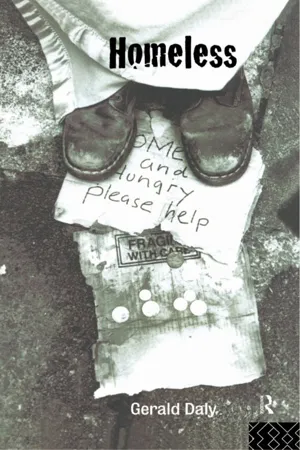
The causes of homelessness are disputed by both Right and Left. But, few would argue that life on the streets is anything other than dangerous and debilitating.
Unemployment, deinstitutionalisation, abuse in the home are among the stories the homeless tell. Voluntary organisations point to the failure of emergency shelters and food banks, the cut-backs in social programmes and the severe shortage of affordable housing. On the international scale, the changing global system has placed new demands on the economies of Europe and north America which have impacted on resources, employment and even political will.
This book is the first comprehensive international study of homelessness. The author argues that the category of the homeless must itself be broadened, to encompass those chronically without shelter to those in immediate risk of dispossession, if homelessness is to be tackled effectively (before and after it happens) by public policy, voluntary organisations and the individuals themselves.
Information
PART I
UNDERSTANDING HOMELESSNESS: A CONTEXTUAL PERSPECTIVE
Why did homelessness emerge during the 1980s as a public policy dilemma? What can be done about it, and what are the implications for Western societies? Homeless is about the nature and causes of homelessness, the policies designed to cope with this growing problem, and the responses by governments and the voluntary sector in Britain,2 the United States, and Canada. This review will focus on several key issues:
- • the relationships between central and local governments
- • the effectiveness of public policies
- • gaps between policy and practice
- • responses to homelessness and the nature of innovative projects created by public, voluntary, and self-help organizations.
Recent increases in homelessness are attributable to global economic changes, a severe shortage of affordable shelter for low-income households, and cutbacks in social programs. Among those at risk are single mothers, battered women and children, abused youths, disabled and frail elderly individuals, and the families of workers whose jobs have disappeared. The conventional response, from both the private and public sectors, was to provide emergency shelters and food banks. These expedients failed, however, to confront underlying problems of poverty, housing provision, employment, and resource allocation.
Because many people who are inadequately sheltered will lose their housing for at least a short time, homelessness must be broadly interpreted to include those at risk. As interpreted in policy and programs, definitions determine who receives assistance, the amount and type of aid provided, and by whom.If construed very narrowly it is easy to rationalize the problem as one peculiar to deviants. I have opted for a more liberal definition: people are considered homeless if they lack adequate shelter in which they are entitled to live safely. At the extreme, they are sleeping rough. Others live under a roof but their accommodation is lacking in safety, security, or basic amenities (e.g. heat, water, bathroom). Homelessness is a fluid and elusive concept. People who lack secure accommodation frequently change location, status, and living arrangements. Their deprivation depends on the extent to which the absence of shelter is combined with social isolation and economic poverty.
1
INTRODUCTION
The second half of the twentieth century may someday be recalled as the time that we became painfully aware of the social and ecological costs of industrialization... We cannot rely on normal market forces nor on people's best intentions to save their environments and themselves... In the 1960s and 1970s... the only thinkable solution to commons dilemmas was government intervention. [Now]... the same problems and the same theory trigger discussion of another solution: privatization.
(McCay and Acheson 1987: xiii-xiv)
Inevitably, government policy as well as the literature on homelessness is politically or ideologically motivated. Writers on the left evoke memories of the 1960s: severe social problems require massive government intervention and a great deal of money. Charles Murray and others on the right suggest that social problems are attributable to the existence of an "underclass of... poor people who chronically live off mainstream society (directly through welfare or indirectly through crime) without participating in it" (Murray 1984: 5).
Neither argument is persuasive. Both emanate from obdurate ideological stances. A more convincing case is made by Ellwood (1988) who proposes alternatives to welfare, including education, health care, training, and work incentives that do not stigmatize participants. Particularly in the United States, and to a growing extent in Canada and Britain as well, the resources and political will to significantly expand social spending do not exist, or will not be made available. Increased expenditures are unlikely unless they are demonstrably cost effective, socially useful, and politically acceptable.
In the past, efforts rooted in extreme ideological beliefs either were meanspirited or they equated high levels of public spending with compassion, engendering resentment on one hand and learned dependency on the other. A more balanced approach is needed; one which emphasizes public and voluntary sector programs that are sensitive to actual needs while simultaneously fostering an individual's capacity for self-help.
A CONCEPTUAL FRAMEWORK
Acknowledging the historical transformation in the debate over public policy, how does one construct an approach which links shrinking public mandates and fiscal restraint, changing conceptions of "community," and increasingly unregulated global economic forces? Whereas the response to a range of social and economic problems prior to 1980 was seen in terms of government intervention, the world has become increasingly globalized. Notions of a "community sacred trust" or a sense of political commonwealth are undermined by privatization, deregulation, and free trade; but these concepts, an outgrowth of globalization, become harder to justify when one steps off the "level playing fields" constructed by capital and global markets. One question which might be raised, then, is the extent to which the issue of homelessness is the result of a loss of community (or the public realm) as a result of these forces?
The state and a civil society
Charles Taylor argues that society can function outside the political realm; that "society is not constituted by the state but limits it" (Taylor 1995: 287). One of the concepts underlying this book is that, while much of our behavior is atomistic, the self is not entirely unencumbered but is situated as a social being; therefore, we have social obligations. More than an aggregation of individuals pursuing benefits through common action that they cannot secure individually, a civil society is based on the notion of community. It is animated by a conviction of a shared common good. In this sense, I distinguish between the civil society and the state. The former has a web of autonomous associations independent of the state. Civic humanism connotes individual freedom. But freedom is not untrammelled; it is constrained by the social responsibility to ensure that public goods are distributed in such a way that everybody has enough to live at a minimally acceptable standard. There are, indeed, what Taylor calls "irreducibly social goods" (Taylor 1995: 192).
The state exists to provide for the common good. One of its principal functions is to ensure redistributive justice (through transfer or tax payments, for example), so that social (or public) goods are equitably allocated among members of society and the disparities between haves and have-nots are minimized. But the power of the state is limited. National governments must devolve responsibility (along with funding authorization) to the local level. where there is presumably a greater appreciation of local issues. The government must also ensure that generally acceptable minimum standards are met, because of the propensity of some local officials to ignore social problems.
Certain aspects of this function may be taken on by the voluntary sector (with government financial assistance). There is clearly a role for non-profit organizations with an understanding oflocal problems and the needs of people, with low-cost programs already in place, and with a minimum of unnecessary bureaucracy. Caution must be exercised, however, to ensure that this transfer of power does not become simply a guise for privatization, absolving public authorities of all responsibility. This issue is frequently occluded by those who pursue an uncompromising agenda of rugged individualism,laissez-faire capitalism, deregulation, and obsessive privatism: "the rhetoric of increased privatization... functions as the rationalizing agent of public unaccountability and, ultimately, irresponsibility" (Williams 1991: 47).
Globalization
A central unifying concept is the nature of global economic shifts and their reflection in political decisions to limit social spending. World economic activity quintupled during the final four decades of the twentieth century, aided by support from politicians. During the 1980s and 1990s economic growth was embraced by neo-conservatives, led by Britain's Thatcher and Major, by Reagan, Bush, Gingrich, and Dole in the United States, and by Brian Mulroney, Prime Minister of Canada from 1984 to 1993. Connections among their political ideologies, globalization, deregulation, and privatization are evident. The line demarcating the public (government) and private (business) sectors is obscured. Key decision-makers move readily from one sector to another. To a significant extent, then, public policy is shaped by private interests.
"Globalization is seen to be the intensification of global connectedness, the constituting of the world as one place" (King 1995: 220). It is a multidimensional process which is transforming the economic, political, cultural, and social geography. Globalization is characterized by the concentration of economic control in multinational firms and financial institutions, worldwide networks of production, exchange, communication and knowledge, transnational capital, and a freer flow of labor, goods, services, and information (Castells 1991: 307-347). In many large cities it has ushered in a new era marked by increased immigration, high unemployment, the rise of a large service sector, and commodification or privatization of social services.
The operation of such places as London. New York, and Toronto depends on infrastructure which permits "global control capability" and includes a ready supply of low-paid service workers, mostly women, recent immigrants, and members of minority ethnic groups, whose presence in urban areas (both in terms of residence and workplace) engenders class polarization and new forms of spatial disparity (Sassen 1991: 282). Immigrants are highly concentrated in certain cities and in particular districts: over 35 per cent of New York City's population is foreign-born and the city receives one out of four immigrants to the United States; it has the highest concentration of West Indians; along with Los Angeles it has the highest concentration of Hispanics; with Los Angeles and San Francisco, it has the country's highest concentration of Asians. In Canada, the great majority of immigrants stay in Vancouver, Montreal, or Toronto: because of its attractiveness to Hong Kong flight capital. Vancouver now has the largest Chinese community outside Asia. In Britain 60 per cent of Asians and almost 75 per cent of Afro Caribbeans are found in (different districts oO the four largest conurbations (Cross and Waldinger 1992: 158-159).
Globalization is characterized by tensions, evident in the highlighting of particular ethnic divisions, fragmentation (along racial lines, for instance), and in the reinforcement of cultural and social prejudices and boundaries (King 1995: 221). Global cities are spatially stratified; inner city neighborhoods are segregated along income, class, ethnic, and color lines. The enclaves where new arrivals live and work appear on the city's topographical map as pockets of poverty in close proximity to gentrified districts adopted by well-paid professionals. This "peripheralization of the center" is exemplified by the social ecology of East London, for instance, where new office towers in the Docklands sit cheek by jowl with the most deprived boroughs of the inner city. Segmentation is manifest in the built form. The city and suburbs are characterized by single-use spatially disaggregated zones, including areas that are judged to be central and others which are peripheral or inconsequential. Urban social processes help define urban space (and its occupants), organizing, controlling, and commodifying them to suit the needs of capital (or "the market").
Race, class, gender, disability, and place define one's quality of life in these new urban centers. Minorities and migrants discover that their fortunes are tied to the future of the city. But they also find that their labor may no longer be valued. Many are unable to fill new jobs except marginal, unprotected, parttime, or temporary service sector positions, and they are locked into inner city ghettos by market and exclusionary forces (Cross 1992: 16). These processes engender widening gaps between haves and have-nots, an increasing likelihood of social conflict, displacement, poverty for those left behind by labor market changes, and, for some, homelessness. Anger fomented by social conflict is not directed at economic elites, however, but at other groups in the ghetto. Los Angeles rioters in 1992 vented their frustrations against Korean grocers and entrepreneurs. Gunnar Myrdal's observation in American Dilemma (Myrdall944: 68) was prescient: "the lower class groups will to a great extent take care of keeping each other subdued, thus relieving to that extent the higher classes of this otherwise painful task necessary to the monopolization of its power and advantages."
As the economies of world cities have become international in scope, the transnational movement of capital and goods has been followed by migratory populations. Divisions of labor are apparent-between men and women, illegal and legal immigrants, ethnic groups, and new arrivals and natives. Different ethnic minorities have gravitated to particular niches based on their skills, networks, and resources. Many have adapted by relying on the informal economy which is outside the regulatory apparatus of land use and building codes, health and safety requirements, workers' compensation legislation, and minimum wage laws. Others have drifted into illicit activities such as drug dealing. A great number, though, serve as replacement labor, filling openings generated by the exodus of whites. Other jobs for migrants have resulted from whites returning to the city: gentrifiers create a market for personal services and domestic labor. These are generally poorly paid positions; workers are typically part-time or casual employees who lack benefits and are not protected by labor legislation.
For those in the lowest income segments, the benefits of growth have not trickled down and income inequalities have intensified. Despite prosperity for those at the top of the income pyramid, roughly one quarter of the population of such global cities as London and New York are below the poverty line. Poverty and homelessness intersect with age, gender, and race, disproportionately affecting children, single mothers, and non-whites. As poverty has become identified with particular social groups, others in society have withdrawn from the public realm, closing the door on the notion of the city as commons.
The deserving and undeserving poor
Attempts to define homelessness and estimate its magnitude represent more than an academic exercise. Definitions embody political statements as well as value judgments. When reference is made to the dichotomy between the deserving and undeserving poor, for instance, an argument usually follows for increased social control and stringent limitations on government intervention. For those who are seen as undeserving (or on the periphery), the public policy response has not changed substantially over the past century. Warehouse-lik...
Table of contents
- Front Cover
- Homeless
- Title
- Copyright
- Dedication
- Contents
- List of plates
- List of tables
- Preface
- Acknowledgements
- Part I Understanding homelessness: a contextual perspective
- Part II The human dimensions of homelessness
- Part III Responses by government and the voluntary sector
- Appendices
- Notes
- Bibliography
- Index
Trusted by 375,005 students
Access to over 1.5 million titles for a fair monthly price.
Study more efficiently using our study tools.
Frequently asked questions
Yes, you can cancel anytime from the Subscription tab in your account settings on the Perlego website. Your subscription will stay active until the end of your current billing period. Learn how to cancel your subscription
No, books cannot be downloaded as external files, such as PDFs, for use outside of Perlego. However, you can download books within the Perlego app for offline reading on mobile or tablet. Learn how to download books offline
Perlego offers two plans: Essential and Complete
- Essential is ideal for learners and professionals who enjoy exploring a wide range of subjects. Access the Essential Library with 800,000+ trusted titles and best-sellers across business, personal growth, and the humanities. Includes unlimited reading time and Standard Read Aloud voice.
- Complete: Perfect for advanced learners and researchers needing full, unrestricted access. Unlock 1.5M+ books across hundreds of subjects, including academic and specialized titles. The Complete Plan also includes advanced features like Premium Read Aloud and Research Assistant.
We are an online textbook subscription service, where you can get access to an entire online library for less than the price of a single book per month. With over 1.5 million books across 990+ topics, we’ve got you covered! Learn about our mission
Look out for the read-aloud symbol on your next book to see if you can listen to it. The read-aloud tool reads text aloud for you, highlighting the text as it is being read. You can pause it, speed it up and slow it down. Learn more about Read Aloud
Yes! You can use the Perlego app on both iOS and Android devices to read anytime, anywhere — even offline. Perfect for commutes or when you’re on the go.
Please note we cannot support devices running on iOS 13 and Android 7 or earlier. Learn more about using the app
Please note we cannot support devices running on iOS 13 and Android 7 or earlier. Learn more about using the app
Yes, you can access Homeless by Gerald Daly in PDF and/or ePUB format, as well as other popular books in Social Sciences & Urban Planning & Landscaping. We have over 1.5 million books available in our catalogue for you to explore.