- 160 pages
- English
- ePUB (mobile friendly)
- Available on iOS & Android
eBook - ePub
About this book
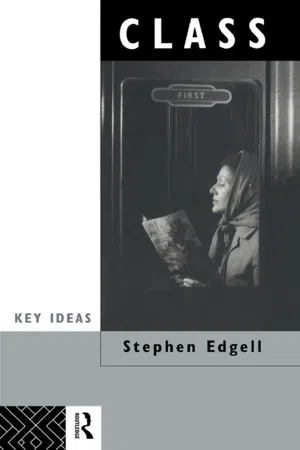
This succinct introductory text argues that class remains a key concept in sociology. The author examines the classic contributions of Marx and Weber and the recent works of Wright and Goldthorpe. The book provides students with an accessible review of class structures, social mobility, inequality, politics and the potential classlessnes of Britain and America.
Information
1 Classical theories of class: Marx and Weber
INTRODUCTION
Originally the term class referred to the division of the Roman population on the basis of property for fiscal and military purposes. This pre-modern usage was a static one in the sense that classes were regarded as ascriptive groupings of people who inherited a shared rank in society. The modern vocabulary of class is inextricably associated with the total reorganization of society that followed the industrial revolution. This change to what is nowadays called industrial capitalism or modern capitalism started in England in the late eighteenth century and spread during the following century to other western countries, notably France, Germany and America, and became a truly global phenomenon this century. Two of the major consequences of this momentous social change were the creation of new classes in a transformed class structure and the tendency for class positions to be allocated on the basis of ability rather than birth. Defining class and analysing class relationships in the context of a rapidly changing society became a central issue among founding sociologists, and controversies surrounding the concept of class have continued unabated to this day. The purpose of this chapter is to review and compare the two towering contributions of Marx (1818–83) and Weber (1864–1920) to the conceptualization and theorization of class.
MARX ON CLASS
Karl Marx was responsible for the first and one of the most important sociological theories of class. Its importance is due to its intellectual influence on subsequent theories of class and to its political influence on the revolutionary direction taken by certain societies inspired by his writings as a whole, and by his unfinished theory of class in particular (the chapter specifically on class in Capital III ‘breaks off’, 1974:886). Thus, Marx’s analysis of class represents an exercise in both theoretical and applied sociology.
However, Marx not only failed to elucidate systematically his use of the concept class and related concepts such as ruling class, he used them inconsistently—for example, middle class. In view of this, plus the tendency for Marxian ideas to be interpreted in a variety of ways, the Dictionary of Marxist Thought (Bottomore 1991) should be consulted whenever a Marxian term is encountered in this or any other text.
Marx’s theory of class was part of a much broader and more ambitious account of nothing less than the history of all human societies, with special reference to the most recent stage of economic development, namely industrial capitalism. For Marx, what is ‘new’ about this mode of production (on the problematic nature of this concept see Bottomore 1991:373–5) is its greater efficiency in creating ‘surplus-value’ or profit. In other words, it is a historically superior system of exploiting labour. Industrial capitalism is also particularly distinctive in its increasingly ‘simplified’ class system.
Our epoch, the epoch of the bourgeoisie, possesses, however, this distinctive feature: it has simplified the class antagonisms. Society as a whole is more and more splitting up into two great hostile camps, into two great classes directly facing each other: Bourgeoisie and Proletariat.(Marx and Engels 1848:49)
It was further argued that the class system of capitalism was ‘simplified’ in a second sense, namely that the relationship between dominant and subordinate classes was more instrumental and impersonal than in the past.
The bourgeoisie, wherever it has got the upper hand, has put an end to all feudal, patriarchal, idyllic relations. It has pitilessly torn asunder the motley feudal ties that bound man to his ‘natural superiors’, and has left remaining no other nexus between man and man than naked self-interest, than callous ‘cash payment.’… In one word, for exploitation, veiled by religious and political illusions, it has substituted naked, shameless, direct, brutal exploitation.(Marx and Engels 1848:52)
These two key passages are from the Manifesto of the Communist Party which was first published in a year of widespread political unrest in Europe. Allowing for the less than sober language of this essentially agitational rather than analytical tract, the pamphlet as a whole provides, as these quotes illustrate, a good guide to the basic ideas that comprise Marx’s theory of class.
The reason why Marx claims that there are only two major classes under capitalism is that since private property was now the basis of economic relations, there were logically only two possibilities; a class who own the means of production and a class who do not and hence have to sell their capacity to work (‘labour-power’ in Marx’s terminology). And the reason why relations between employers and employees are inherently ‘antagonistic’ is that in order to make a profit and survive in a competitive economic situation, the former are constrained to ‘exploit’ the latter. Moreover, in the process of extracting ‘surplus-labour’, the employer is not only concerned to keep costs as low as possible by paying the minimum necessary to attract and retain workers, but also seeks to achieve the highest attainable level of production. Hence, profits and wages are inversely related, and ‘the interests of capital and the interests of labour are diametrically opposed’ (Marx 1952:36). There is therefore an inevitable conflict between the two main social classes over the price of labour and the labour process or productive system. Marx recognized that both the bourgeoisie and the proletariat are divided by competition among themselves, but become united in their oppostion to each other. According to Marx, the effect of this structure of class relations was an increasingly large, poor, homo-genized and alienated work force compared to a smaller yet far wealthier class of employers. Marx thought that the final outcome of this polarization would be revolutionary class conflict, and that victory for the working classes was inevitable.
It is apparent from these few introductory statements that Marx’s theory of class is fundamentally a dynamic conception of class and that the motor of social change is conflict. Indeed, class conflict is the key element in Marx’s account of the history of all societies, not just of the origins, development and future of capitalism. In the case of the transition from feudalism to capitalism, the urban bourgeoisie or manufacturing middle class played the revolutionary role, pushing aside the monopolistic guild masters and eventually displacing by force the ruling landed aristocracy. Thus Marx argued that the bourgeoisie became the ruling class in the new type of society—capitalism—by combining together and engaging in revolutionary class conflict.
Marx acknowledged the achievements of the now dominant capitalist class, who had not only overthrown the feudal lords and their limited economic system of production, but went on to transform the economic and social structure of capitalism in a relatively short period of time. For example, the bourgeoisie had revolutionized the means of production, concentrated workers in large factories located in huge cities, created a world market, and above all, produced goods on a scale and of a cheapness hitherto unknown, indeed, unimaginable.
The bourgeoisie, during its rule of scarce one hundred years, has created more massive and more colossal productive forces than have all preceding generations together.(Marx and Engels 1848:57)
However, for Marx the advantages of capitalism were exceeded by its disadvantages. He claimed that the capitalist mode of production was an ‘anarchical system of competition’ characterized by ‘the most outrageous squandering of labour-power’ and periodic crises in which ‘larger capitals beat the smaller’ (Marx 1970a:530 and 626). In these circumstances, the bourgeoisie attempt to solve crises by destroying commodities (the ‘absurdity’ of overproduction), reducing staff, cutting wages and increasing the intensity of labour, and by developing new markets and exploiting old ones more thoroughly, for example via a credit system. For Marx, such solutions may restore equilibrium in the short run, but in the longer term they merely pave the way for bigger and deeper crises.
In addition to creating an inherently unstable economic system, Marx argues that the bourgeoisie have also created the class that will effect its ultimate downfall, the proletariat.
But not only has the bourgeoisie forged the weapons that bring death to itself; it has also called into existence the men who are to wield those weapons—the modern working class—the proletarians.(Marx and Engels 1848:60)
Thus, economic crises, however acute and frequent, do not guarantee the end of capitalism, they are simply the preconditions for revolutionary change. According to Marx, it is only through the class action of the proletariat that capitalist society will be transcended.
PROLETARIANIZATION, POLARIZATION AND REVOLUTIONARY CHANGE
The self-destructive nature of industrial capitalism is ensured by the important social process of proletarianization, which facilitates the historical revolutionary role that Marx assigned to the working class. For Marx, proletarianization specifically refers to a change from selfemployment to employee status, but three meanings are discernible in his writings:
- 1 the proletarianization of society
- 2 the proletarianization of work and
- 3 political proletarianization.
First, the proletarianization of society refers to the tendency for the working class to increase in size, to be concentrated in large factories in urban areas and to experience relative poverty as a result of the development of the capitalist mode of production. Marx claimed that one of the ‘laws’ of capitalist development was that the competitive nature of capitalist industrialization favoured big capital at the expense of small capital and resulted in the concentration of the ownership of capital. As a consequence, the self-employed and small-scale owners go out of business, and become increasingly impoverished wage labourers.
The lower strata of the middle class—the small tradespeople, shopkeepers, and retired tradesmen generally, the handicraftsmen and peasants—all sink gradually into the proletariat, partly because their diminutive capital does not suffice for the scale on which Modern Industry is carried on, and is swamped in the competition with the large capitalists, partly because their specialized skill is rendered worthless by the new methods of production… In proportion as capital accumulates, the lot of the labourer, be his payment high or low, must get worse.(Marx and Engels 1848:62 and Marx 1970a:645)
Second, upon becoming wage labourers (or wage slaves in Marx’s terminology), the new recruits to the proletariat become ‘enslaved’ by the production process, including the machine, the supervisor and the employer. Marx argued that under capitalism workers are treated just like any other commodity, to be bought and sold in the market place for the lowest possible price. Moreover, owing to the increased use of machinery (i.e. dead labour in Marx’s terminology), plus the specialized division of labour, work becomes deskilled and workers become degraded as they lose all autonomy and individuality. This dimension of proletarianization is part of Marx’s famous alienation thesis, which is more fully theorized in his Economic and Philosophical Manuscripts of 1844 (1970b), and described in great detail in Volume 1 of Capital (1970a). However, the neatest summary of the proletarianization of work can be found yet again in the Manifesto of the Communist Party.
[Theworker] becomes an appendage of the machine, and it is only the most simple, most monotonous, and most easily acquired knack, that is required of him… Masses of labourers, crowded into the factory are organised like soldiers. As privates of the industrial army they are placed under the command of a perfect hierarchy of officers and sergeants.(Marx and Engels 1848:60 and 61)
The third and final sense in which Marx uses the term proletarianization is to refer to the growth of working class political consciousness. This is arguably the most crucial, complex and controversial dimension of proletarianization. Marx argued that once the proletariat has increased in size, concentration and relative poverty, and experienced degradation at work, workers will join together to defend and/or improve their wages and working conditions: in other words, come into class conflict with the bourgeoisie. The collective power of workers will be enhanced by victories initially at the local level, but with the improvement of the means of communication created by industrialization, class struggles will develop on a national scale. In order for the political consciousness of the working classes to grow to the point at which they can challenge successfully the domination of the capitalist class, the proletariat has to organize at work (i.e. form trade unions) and outside of work (i.e. form a political party). Eventually, notwithstanding temporary setbacks, clashes between the proletariat and the ruling capitalist class, in their attempts to defend and/or advance their respective material interests, would reach a revolutionary pitch. Marx was confident that at this stage the proletariat would prevail and establish a new type of society which was free of exploitation and oppression, i.e. classless.
Economic conditions had first transformed the mass of the people of the country into workers. The combination of capital has created for this mass a common situation, common interests. This mass is thus already a class as against capital, but not yet for itself. In the struggle… this mass becomes united, and constitutes itself as a class for itself. The interests it defends become class interests. But the struggle of class against class is a political struggle…[Eventuallyclass] war breaks out into open revolution…the violent overthrow of the bourgeoisie lays the foundation for the sway of the proletariat… in which the free development of each is the condition for the free development of all.(Marx 1971:173 and Marx and Engels 1848:70 and 90)
This outline of Marx’s theory of class in modern capitalist societies represents a summary of his basic proletarianization-radicalization-revolution thesis, in which the class structure polarizes into two internally homogeneous classes who engage in ever increasing degrees of conflict. That Marx considered this thesis to be the essence of capitalism is not surprising.
Marx was no mere theorist. In the first place he considered that the whole purpose of his lifework was to help to change society for the better as he saw it, and not simply study it for its own sake (Marx and Engels 1970).
Second, Marx was active in radical politics all his life: he experienced the turbulence of revolt and repression in Europe, especially during the revolutions of 1848, and ended up a political refugee in England by the 1850s (Berlin, 1963).
Third, Marx’s empirical reference point for his theory of class was nineteenth-century England, the first industrial capitalist society, though he was not unaware of the capitalist development of countries such as France and America. Marx lived and worked in poverty in England for over thirty years and was impressed by the immense wealth being produced, the manner of its production, the inequality of its distribution and the extensive and extreme class conflict this situation engendered. More specifically, Marx observed, studied and was part of the great contrast and conflictual relationship between the affluence, splendour and power of the capitalist class, and the poverty, degradation and powerlessness of the working class. For example, he documented the acute poverty of the English agricultural labourer at the beginning of the nineteenth century and contrasted it with the way in which the bourgeoisie ‘had enriched themselves so extraordinarily’ during the same period (1970a:674). He concluded that this structure of inequality and related pattern of conflict was unavoidable under capitalism and that revolution was the only way to overcome it.
In view of the evidence all around him, and given his political commitment to revolutionary social change, it is little wonder that he conceptualized class in essentially dichotomous and conflictual terms.
IMPEDIMENTS TO REVOLUTIONARY CHANGE
In addition to advancing a theory about the transformation of industrial capitalism on the basis of the inherent conflict of class interests, Marx also noted that relationships within and between classes were far more complex, and therefore problematic, than his dichotomous model implied, and that they represented potential impediments to class formation, conflict and therefore total change.
The first complication that could hinder progress towards revolutionary change is that there are often more classes than the two main ones noted thus far. Marx referred to many other classes, plus factions or fractions of classes, in various works, but most notably in The Eighteenth Brumaire of Louis Bonaparte (1972). In this detailed analysis of mid-nineteenth century France, Marx discusses class fractions within the two major social classes: capital, e.g. landed, financial and industrial, and labour, e.g. lumpenproletariat and proletariat; two transitional classes: petty bourgeoisie and peasantry; plus several middle classes e.g. ‘the high dignitaries of the army, the university, the church, the bar, the academy, and of the press’ (1972:28). Elsewhere Marx also wrote about the aristocracy of labour, the bestpaid section of the working class and often mentioned other divisions within the working class based on age, sex, skill, and the contrast between rural and urban workers (1970a). He also used the terms lower middle class and middle class to refer to the self-employed and small-scale capitalists (Marx and Engels 1848). Finally, Marx was also aware of the growth of the propertyless middle classes ‘who stand between the workman on the one hand and the capitalist and landlord on the other’ (1969:573). For Marx (and Engels) it was ‘the universal competitive struggle’ that caused classes to fragment as well as coalesce: ‘Competition separates individuals from one another, not only the bourgeois but still more the workers, in spite of the fact that it brings them together’ (1970:79). Consequently, the precise structure of class relationships, at any one time and place, depends upon the circumstances. For instance, at a time of acute political conflict the class structure is likely to be highly polarized. Thus, class polarization and class fragmentation are a matter of degree. Obviously, competition and political disunity among capitalists is good news from the standpoint of the proletariat, and vice versa. In other words, Marx’s two conflicting classes theory does not rule out the possibility of the existence of many classes and fractions, and all that this implies in terms of variations in class consciousness and action.
The second important complication that could impede the process whereby a class is transformed from an economic interest group into a politically active revolutionary force concerns the integrative role of ideology. This refers to Marx’s thesis that the dominant capitalist class not only controls the means of material production (things), but also controls the means of mental production (ideas). Thus every ruling class throughout history
is compelled, merely ...
Table of contents
- Cover Page
- Title Page
- Copyright Page
- Illustrations
- Preface
- Acknowledgements
- 1 Classical Theories of Class: Marx and Weber
- 2 Contemporary Theories of Class: Neo-Marxist and Neo-Weberian
- 3 The Measurement of Class
- 4 Class Structure and Social Change
- 5 Class and Social Mobility
- 6 Class, Inequality and Politics
- 7 Classlessness and the End of Class
- References
Trusted by 375,005 students
Access to over 1.5 million titles for a fair monthly price.
Study more efficiently using our study tools.
Frequently asked questions
Yes, you can cancel anytime from the Subscription tab in your account settings on the Perlego website. Your subscription will stay active until the end of your current billing period. Learn how to cancel your subscription
No, books cannot be downloaded as external files, such as PDFs, for use outside of Perlego. However, you can download books within the Perlego app for offline reading on mobile or tablet. Learn how to download books offline
Perlego offers two plans: Essential and Complete
- Essential is ideal for learners and professionals who enjoy exploring a wide range of subjects. Access the Essential Library with 800,000+ trusted titles and best-sellers across business, personal growth, and the humanities. Includes unlimited reading time and Standard Read Aloud voice.
- Complete: Perfect for advanced learners and researchers needing full, unrestricted access. Unlock 1.5M+ books across hundreds of subjects, including academic and specialized titles. The Complete Plan also includes advanced features like Premium Read Aloud and Research Assistant.
We are an online textbook subscription service, where you can get access to an entire online library for less than the price of a single book per month. With over 1.5 million books across 990+ topics, we’ve got you covered! Learn about our mission
Look out for the read-aloud symbol on your next book to see if you can listen to it. The read-aloud tool reads text aloud for you, highlighting the text as it is being read. You can pause it, speed it up and slow it down. Learn more about Read Aloud
Yes! You can use the Perlego app on both iOS and Android devices to read anytime, anywhere — even offline. Perfect for commutes or when you’re on the go.
Please note we cannot support devices running on iOS 13 and Android 7 or earlier. Learn more about using the app
Please note we cannot support devices running on iOS 13 and Android 7 or earlier. Learn more about using the app
Yes, you can access Class by Stephen Edgell in PDF and/or ePUB format, as well as other popular books in Social Sciences & Social Classes & Economic Disparity. We have over 1.5 million books available in our catalogue for you to explore.