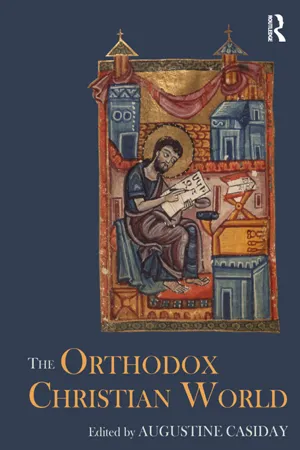
Over the last century unprecedented numbers of Christians from traditionally Orthodox societies migrated around the world. Once seen as an 'oriental' or 'eastern' phenomenon, Orthodox Christianity is now much more widely dispersed, and in many parts of the modern world one need not go far to find an Orthodox community at worship. This collection offers a compelling overview of the Orthodox world, covering the main regional traditions of Orthodox Christianity and the ways in which they have become global. The contributors are drawn from the Orthodox community worldwide and explore a rich selection of key figures and themes. The book provides an innovative and illuminating approach to the subject, ideal for students and scholars alike.
- 586 pages
- English
- ePUB (mobile friendly)
- Available on iOS & Android
eBook - ePub
The Orthodox Christian World
About this book
Information
PART I
ORTHODOX CHRISTIANITY AROUND THE WORLD

CHAPTER ONE
THE GREEK TRADITION
Andrew Louth
INTRODUCTION: CLASSICAL BACKGROUND
“Theology – study of the highest problems in the universe by means of philosophical reason – is a specifically Greek creation. It is the loftiest and most daring venture of the intellect” (Jaeger 1944: 298). Plato was the first great theologian, and he appears to be the first to use the term theologia – though the speculations of the Presocratic philosophers about the origin of everything were regarded as “theologizing” by Aristotle, who ranks their speculations with the cosmogonic notions of poets such as Hesiod and Homer, whom he called theologoi (“theologians”). For Plato, theology was the study of eternal realities, that is, the realm of the Forms or Ideas. For his pupil Aristotle, theology was the study of the highest form of reality, the “first substance,” which he seems to have regarded at different times as being the “unmoved mover” or as “being qua being.” He spoke of three theoretical, or speculative, ways of knowing: the mathematical, the physical, and the theological, theology being the “most honorable.” Such a notion of theology as the study, or contemplation (theoria), of the highest form of reality was a commonplace in the Hellenistic philosophy of the Roman world in which Christianity first emerged. But that was a world in which the quest for God had for many, besides Christians, a certain urgency: the realization of the highest contemplative exercise of the mind acquired a religious coloring. The “lower” studies of logic, ethics, and the understanding of the natural order became a sequence of preparatory training for communion with the divine, seen as fulfillment. These ideas very quickly found acceptance among Christian thinkers, so that in the third century Origen saw three stages in the Christian’s advance to communion with God, the ethical, the physical, and the “enoptic” (possibly “epoptic”) or visionary, a triad that found its classical form in the fourth century with Evagrius, the theorist of the monastic asceticism of the Egyptian desert: praktike (ascetic struggle), physike (contemplation of the natural order), and theologia (theology as contemplation of God). Such an understanding of theology as essentially prayer or contemplation, the highest exercise of the human mind or heart, the fruit of sustained ascetic struggle, quickly established itself in Geek Christianity, and is still fundamental in Orthodox theology. It is expressed succinctly in Evagrius’ oft-quoted assertion: “If you are a theologian, you will pray truly; if you pray truly, you will be a theologian” (On Prayer 60).
EARLY CHRISTIAN THEOLOGY
Alongside such an understanding of theology as a state to be attained, theology is also spoken of by Christian thinkers to mean the study of the nature of the divine, in a way very similar to the classical Greek usage. The God of the Jews and the Christians is not, however, some remote principle, but one who has revealed himself, not only through the works of nature, but also in his dealings with his chosen people, Israel, and, for Christians, pre-eminently in the incarnation of the Son or Word of God: in those events to which the writings of the Old and New Testaments bear record. As early as the Jewish philosopher, Philo (first century), we can detect a different accent in his discussion of theology from his pagan contemporaries, to whom he owed a great deal. For many of the philosophers of the period from the first century BC to the second century AD (often loosely called “Middle” Platonists), although there is interest in some single ultimate first principle (the Good or the One), and a strengthened sense of his (or its) difference from the world of change and decay, so that we may speak in connection with them of “monotheism,” the ultimate remains a principle, distinct from the multiplicity manifest in the world of everyday reality. The notion of the Logos or Nous, or some principle bridging the gulf between the realm of multiplicity and the One, becomes, first of all with Philo, a being, even a person, that communicates between the ultimate principle, God, also called the Father. (For Philo, logos means not simply reason, but is derived from God as “the one who speaks” – ho legon – as his word or communication.) Whatever its background, the Evangelist John’s ascription to Christ of the title Logos underlines the personal dimension of the intermediary of God the Father, by whom he created the universe and through whom he communicates with human kind.
There were other factors that made Platonism an attractive intellectual partner for early Christian thinkers. Not only did this late form of Platonism adopt a monotheistic stance, but it maintained a firm belief in the notion of divine providence, the notion that God (or the gods) cared for the cosmos, and also held that after this life human beings would be held responsible for their actions in this life, and be rewarded or punished. It is not surprising that many Christians found intellectual allies among thinkers who held to the notion of a moral universe, governed by a single ultimate first principle.
THE FIRST FLOWERING OF GREEK THEOLOGY
In the fourth century, with the peace of the church, we can begin to detect the main contours that came to mark our patristic and Byzantine theology. For the most part this clearer definition of theology came about as a result of controversy; indeed, the whole of the fourth century is often regarded as the period of the Arian controversy, or crisis. This way of putting it probably exaggerates the importance of Arius, but there can be no doubt that Arius sparked off a controversy that lasted throughout the century in different forms and made a lasting mark on Byzantine theology.
The emerging shape of Byzantine theology can be clearly seen in St Athanasius’ two-part work, Against the Pagans (i.e. the Greeks) and On the Incarnation, which is probably early, and bears no particular mark of the Arian controversy. Athanasius casts his presentation of Christianity in the context of creation and fall. Human beings were created in the image of God and thus able to contemplate God. Athanasius is clear that creation means creation out of nothing, with the result that there is a fundamental ontological gulf between God and the cosmos, which is now thought of as the created order. As a result of the fall, which he sees as the failure of human beings to continue in such contemplation of God, they turned to an inwardlooking contemplation of themselves, which, as beings created out of nothing, amounts to a return to nothingness, manifest in subjection of corruption and death. From this state they cannot extricate themselves, but are dependent on God’s intervention in the event of the incarnation, and especially his overthrow on the cross of death, symbolic of the diminishment and corruption unleashed on the created order by the human failure to continue in contemplation of God. The incarnation and the overthrow of death introduces into human history a new possibility, not just attainment of likeness to God, as envisaged by God in his original creation of humanity in his image, but participation in the life of God himself – deification. The Word of God, as Athanasius says, “became human that we might become divine” (Incarn. 54). This understanding of God’s engagement with the cosmos, and within that of humanity, as constituting an arc stretching from creation to deification, beneath which is a lesser arc stretching from fall to redemption, remained a fundamental characteristic of Byzantine and Orthodox theology. Other fundamental elements of Byzantine theology can also be traced back to Athanasius, even though they received further development at the hands of his successors. The doctrine of creation out of nothing, with its consequent sense of a fundamental gulf between the uncreated being of God and the created order, is seen to imply that created knowledge of God is ultimately impossible, or only possible as a result of a gift made by God for created humanity. The doctrine of the homoousios – that the Trinity consists of three persons of equal being – underlines the incomprehensibility of God’s being; there are no lesser, more comprehensible divine beings than God the Father (as Arius seemed to suggest). Athanasius is clear that the Son’s being homoousios with God the Father entails his incomprehensibility, and later theologians draw an understanding of God in his essence as being fundamentally infinite, and so beyond comprehension.
THEOLOGY AS “APOPHATIC”
As these notions are worked out in patristic and Byzantine thought, a distinction is often made between theologia and oikonomia: theologia refers to the doctrine of God Himself, and oikonomia to God’s dealings with the created order, especially in the incarnation. Theologia, in this restricted sense, means the doctrine of the Holy Trinity, and the names (or properties) of God. Within theology in this sense a distinction is further made between kataphatic and apophatic theology, that is between theology that makes affirmation (kataphasis) of what is revealed of God through the created order and scripture, and theology that points to the transcendent nature of God by denial (apophasis) of any of the concepts or images by which we seek to express an understanding of God. The idea that God is most surely approached by denial of our concepts and images of him can be traced back to the roots of both the classical tradition (e.g. Plato’s assertion that the Idea of the Good is “beyond being and knowledge”) and the Hebrew tradition (e.g. God’s riddling revelation of himself to Moses as “I am that I am”), and is strongly asserted in the fourth century by the Cappadocian fathers and St John Chrysostom. The terminology of apophatic and kataphatic, in a theological context, is first found in the Neoplatonist Proclus, and was introduced into Christian theology by Dionysius the Areopagite in the sixth century. It quickly became popular in Byzantine theology. Of the two, apophatic theology is understood to be the more fundamental, as undergirding the theology of affirmation, while appearing to undermine it. In the idea that God is most truly known, not in concepts or images that the human mind can grasp, but in a movement beyond them in which God is acknowledged in silent wonder as transcendent, theology as doctrine is united with the notion, more fundamental to the Orthodox mind, of theology as prayer.
The consequences of the conviction of the more fundamental nature of apophatic theology are profound. A realization of the ultimate inadequacy of the human intellect paves the way for a recognition of the place of poetry and imagery of the most diverse kinds in any attempt to express human understanding of the reality of God. It is no coincidence that the great theologian of apophatic theology, Dionysius the Areopagite, speaks not of predicating terms of God, but of praising him by ascribing names to him; nor is it a coincidence that the same theologian devotes much space to exploring the nature of the liturgical action in which the sacraments of the church are celebrated, seeing in this liturgical action a reflection of the heavenly liturgy of the angelic beings. Orthodox tradition grants the title theologos to only three people: John the Evangelist, Gregory of Nazianzus, and Simeon the New Theologian. John’s Gospel is the one that most aspires to the form of poetry, and the other two “theologians” were both poets. The liturgical poetry of the Orthodox Church is a vast repository of theological reflection: theology presented in the form of song. A further synchronism worth noting is that probably contemporary with the writer who composed the Areopagitical works was the greatest of Byzantine poets, Romanos the Melodist, who expressed his theology in verse sermons, called kontakia, and that, in general, the sixth century sees the beginning of various attempts to turn the theology (and often the very language) of theologians such as St Gregory into liturgical song.
THEOLOGICAL DEFINITION
The theology of the Orthodox Church, in the broader sense, including both theologia and oikonomia, is an attempt to express in terms of Greek intellectual culture the revelation of God that found its fullest form in the incarnation and to which the canonical scriptures bear witness. At its most fundamental level, theology is a sustained meditation on the scriptures, read in a “sophianic” way, that is, read as a confirmation of the witness to God found in the cosmos, created through his wisdom (sophia), and especially in the human person created in God’s image and likeness. Such an approach finds different levels of meaning in scripture, and sees in the advance through these levels to deeper forms of understanding an adumbration of the Christian life. Christian thinkers departed from such a pondering on scripture only in order to meet challenges from outside, in defending Christianity from attacks by pagan and Jewish critics, and from within, from heretics. In due course this process led to dogmatic definitions, intended not so much to define what ultimately lies beyond human understanding (in dogmatic theology, too, the apophatic principle applies) as to prevent human misunderstanding of the nature of God and his ways with humanity and the cosmos. The most important of these definitions were endorsed by church councils, or synods, especially “ecumenical” councils (that is, councils concerned with the oikoumene, the “inhabited world,” that is – with typical Byzantine hubris – the Empire), convoked in Byzantine times by the emperor. The Orthodox Church recognizes seven such ecumenical councils. The decisions of these councils represent...
Table of contents
- Cover
- Halftitle
- Title
- Copyright
- Contents
- Notes on contributors
- Editor’s introduction
- Divisions of Middle Eastern Christianity
- PART I. Orthodox Christianity around the World
- PART II. Important Figures in Orthodox Christianity
- PART III. Major Themes in Orthodox Christianity
- Index
Trusted by 375,005 students
Access to over 1.5 million titles for a fair monthly price.
Study more efficiently using our study tools.
Frequently asked questions
Yes, you can cancel anytime from the Subscription tab in your account settings on the Perlego website. Your subscription will stay active until the end of your current billing period. Learn how to cancel your subscription
No, books cannot be downloaded as external files, such as PDFs, for use outside of Perlego. However, you can download books within the Perlego app for offline reading on mobile or tablet. Learn how to download books offline
We are an online textbook subscription service, where you can get access to an entire online library for less than the price of a single book per month. With over 1.5 million books across 990+ topics, we’ve got you covered! Learn about our mission
Look out for the read-aloud symbol on your next book to see if you can listen to it. The read-aloud tool reads text aloud for you, highlighting the text as it is being read. You can pause it, speed it up and slow it down. Learn more about Read Aloud
Yes! You can use the Perlego app on both iOS and Android devices to read anytime, anywhere — even offline. Perfect for commutes or when you’re on the go.
Please note we cannot support devices running on iOS 13 and Android 7 or earlier. Learn more about using the app
Please note we cannot support devices running on iOS 13 and Android 7 or earlier. Learn more about using the app
Yes, you can access The Orthodox Christian World by Augustine Casiday in PDF and/or ePUB format, as well as other popular books in Theology & Religion & Christian Denominations. We have over 1.5 million books available in our catalogue for you to explore.