- 288 pages
- English
- ePUB (mobile friendly)
- Available on iOS & Android
eBook - ePub
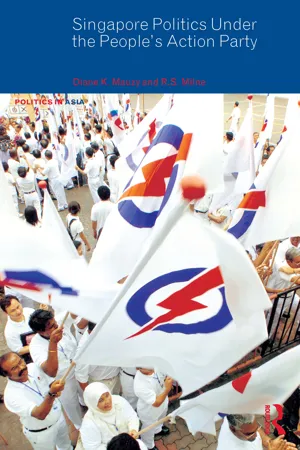
Singapore Politics Under the People's Action Party
About this book
A comprehensive overview of politics in Singapore since self-governance. The authors examine how this tiny island has developed into a global financial centre and an economic and social success under the leadership of the People's Action Party which has ruled continuously since 1959. The authors explore the nature of the Singaporean government, as well as major issues such as ethnicity, human rights and the development of civil society.
Information
1 What is remarkable about Singapore?
In 1965, the tiny, newly independent island-state of Singapore was not so different in its stage of development from much of the Third World then being de-colonized, although its prospects were perhaps less promising given its almost total lack of natural resources. Why was it that Singapore was so successful at achieving socio-economic modernization and political stability in contrast to so many others? What is remarkable or exceptional about Singapore? What have been its achievements, and its mistakes?
Images of Singapore
Singapore can mean different things to different people. This is particularly true of the scenes that its pre-Independence mental images bring to mind. There is an early twentieth-century picture of rubber being transshipped from Malaya and bound for Europe. A 1920s Singapore might suggest dinner or dalliance at the Raffles Hotel, and a later impression would be of the 1941 Japanese invasion (see p. 14) and prison camps and civilian life under Japanese rule.
Later mental pictures might be less distinct, perhaps because the focus was more on its neighbor, Malaya, where the struggle to put down a Communist insurrection (“the Emergency”, 1948–60) was more dramatic than anything that Singapore could provide. Yet there was indeed an anti-Communist struggle in Singapore, referred to in the next chapter of this book, which took the form not so much of open violence, as of intrigue, rumors and maneuvers, clandestine meetings, loyalties and defections. Singapore’s Independence from the British, followed the emergence of the People’s Action Party (PAP), led by political neophytes (see p. 38), who nevertheless used their political skills to achieve truly impressive results. After the PAP was elected to power in 1959, it governed into the next century and Singapore emerged as one of the top three or four states in income per head, not just in Asia, but in the world. Who were these people and how did they contrive to do what they did? This book tries to answer these questions.
After this introductory chapter, the sequence is: how the PAP came to power and built and maintained its political support base, the ideology and values of the elites and the socialization of the citizenry, and how it managed ethnicity and the vexing issues of language and education. The book tells how it constructed the economic “engine” which achieved prosperity – a significant achievement (see pp. 66–8) – and today emphasizes a Knowledge-Based Economy, founded on the application of ideas resulting in “value creation” rather than the production of material goods. It also relates how earlier, the PAP surmounted some of the challenges which come with affluence: housing the population; building hospitals and clinics, and providing schools that are now state-of-the-art. It further describes the services provided by the state, retirement schemes and social services, and recent plans to deliver services tailored to meet the needs and wishes of particular geographic areas.
Chapters in the latter part of the book are devoted mainly to various aspects of the relations between government and society: authoritarian aspects of government, such as control of the media and restrictions on civil and political rights, and the rule of law; democracy, elections, and the opposition; and the growth of civil society. Possible changes in the nature of the leadership are assessed, as well as foreign policy – vital because of Singapore’s vulnerability in an area which is still unstable in spite of the existence of the Association of Southeast Asian Nations, of which Singapore is a member. Finally, there is a look into the future; how far is the government’s policy towards more “openness” in tune with the changing demands of a more educated electorate, and what are the probable effects of globalization, eagerly embraced by Singapore, for better or for worse?
Singapore: old stereotypes and new
Present day Singapore is decidedly different from the old stereotypes. Modern perceptions would include the observations that “things work” – that it is an easy place to visit, a good place to shop, and, for most, a good place to live – and that there are no really ancient buildings, as there are in several other places in Southeast Asia. Singapore bears the stamp of PAP rule for over forty years. It is safe and orderly, and one of the first places to adopt new ideas that increase efficiency: the pedestrian waiting at a crossing for the traffic lights to change is informed by a digital clock telling precisely how many more seconds the wait will be.
Singapore, a former British colony, achieved self-government – but not control over its foreign policy – in 1959. In 1819, it was chosen as a settlement by the British East India Company because it was situated at a cross-roads for trade. It was essentially an “entrepot” economy (and remained so until the 1960s). It made money not by producing goods, but when goods were shipped through it in the course of trade. It was associated with the states of Malaya to the north, because both were under British rule and the administrations were linked. However, Malaya became independent in 1957.
Both Malaya and Singapore were hampered by the threat of Communism, and by the end of the 1950s, the Communists and pro-Communists in Singapore had established “bridge-heads” by winning control of some trade unions and Chinese middle schools.
When the right to vote at legislative elections was introduced in Singapore, not many people were given the franchise. Consequently, the political parties were working to win the votes of the few rather than the many. Even the Workers’ Party, although striving for Independence, did not have a very radical program. There was a political “gap” waiting to be filled after legislative changes enfranchised many more people before the 1959 election. The PAP did not quite emerge “out of the blue” to contest that election. It had put forward candidates in 4 of the 25 seats at the 1955 election, winning three of them. In 1959, however, it contested all 51 seats and won 43 of them.
In 1961, Tunku Abdul Rahman, the Prime Minister of Malaya, while visiting Singapore proposed that Malaya, Singapore, and the two sparsely-populated British territories of Sarawak and North Borneo (later called Sabah) should join to form a new state, Malaysia. There would be economic gains, through trade and investment, as well as security benefits to help fight Communist subversion. Malaysia was formed in 1963, but was followed by disillusion in Singapore. One of the main attractions for Singapore in joining the new state was the prospect of broadening Singapore’s range of exports to Malaya. However, this was not encouraged by the Malaysian government, and, combined with other sources of disagreement, resulted in Singapore being forced to leave Malaysia in 1965, and become fully independent.
A completely independent Singapore
This was not the end of the world for Singapore. It was a well-disguised blessing. After Separation, Singapore no longer had any illusions about the prospects of promoting its ideals inside a Malaysia that had shown its determination not to change its policies. It now had full responsibility for making its own way in the world. Singapore had to chart its own economic course, which it did with the help of the U.N. Technical Assistance Board, which had already been advising it for several years.
After the PAP formed the government in 1959, its initial priority was dealing with unemployment, and providing housing, two objectives which, fortunately, were mutually supportive. Industrialization was an objective for a year or so, with Malaysia in mind as a destination for exports, then, when hopes of a common market were disappointed, the idea of “leapfrogging” exports to more distant destinations – borrowed from Israel – was adopted. But industrialization was slow in taking off. The Jurong complex, although an expensive infrastructure had been constructed (see pp. 8–9), was almost unoccupied. Tourism contributed to the economy, but it was not enough.1 The first two attempts at manufacturing – paper products and ceramics – did not succeed.
Lee Kuan Yew writes in his memoirs that by the later 1960s he had resolved on two major thrusts of policy which led to Singapore’s economic success. One was to make use of technology through cooperation with Multinational Corporations (MNCs), principally from the United States. He did not agree with the prevailing left-wing view that the MNCs acted as exploiters of the natural resources of developing countries – Singapore did not have many of these resources anyway. Lee Kuan Yew and, until 1965, Hon Sui Sen, a permanent secretary and then Minister of Finance, went through the applications from MNCs to decide which applicants should be strongly urged to come to Singapore. By the late 1980s, about three-quarters of Singapore’s manufacturing output was produced by wholly- or partly-owned foreign firms. The second policy thrust was that Singapore should strive to attain the status of a First World “oasis” in a Third World region in respect of high standards in health, education, transportation, telecommunications, and services. This would help to re-educate and re-orient Singaporeans, as well as being attractive to foreigners who came to Singapore for business or pleasure. It is a corollary of the policy of encouraging the entry of MNCs: Singapore must have a competitive advantage and be attractive enough for them to locate there, or even choose it as the site of their regional headquarters.2 These goals were assisted by the efforts of Singapore’s Economic Development Board, and of UN officials, especially Dr. Albert Winsemius, who had acquired a deep knowledge of the Singapore economy over a long period.3
The two “new directions” of policy just referred to illustrate the connection between the values of the PAP leaders, examined in Chapter 5, and the economic policies pursued after the government achieved complete independence in 1965. Prime Minister Lee Kuan Yew seems to have taken a personal interest in “choosing the MNC path” as the preferred instrument in invigorating the economy. This was a significant decision – so many other Third World states chose, and stuck with, import substitution strategies.4 What was important here was not only the presence of some values, but the absence of others. Lee himself has stated that (like Goh Keng Swee) his mind was untainted by the doctrinaire distrust of MNCs which influenced some politicians elsewhere. He was confident that, on his own territory, operating in an environment where corruption was minimal, he could stand up to any attempts by MNCs to assert control. Actually, some of the earlier MNCs, such as Shell,5 were quite domesticated, and took part in local activities as well as being members of bodies such as the National Wages Council. This is an appropriate indication of the place of pragmatism in PAP decisions. If a proposed course of action conflicts with PAP values, it may be modified. If it does not, then pragmatism’s dictates can be followed with vigor.
By about 1973, Singapore’s leaders might have been excused if they felt that Singapore was well on the road to success,6 not that it was in their nature to relax easily. Economic performance was always at the top of the PAP agenda, and remains so, but after the economic lines of advance were planned and set in motion, the government was able to give some attention to other important objectives. Four instances may be cited to illustrate the trend. Housing became less utilitarian and more gracious and stylish (see p. 90). Another topic was care of the environment, including “rescue” operations, such as the cleansing of rivers. Another was the promotion of planting and greening, which both benefited the atmosphere and was pleasing to the eye.7 The fourth was the preservation of older buildings, perceiving them, somewhat belatedly, as assets and reminders of Singapore’s history, rather than as relics which made no contribution to Singapore’s “modern look”.8
Changes in types of housing are discussed on pp. 90–1. The most spectacular, almost miraculous, examples of river reclamation were probably the restoration of the Singapore River and the Kallang Basin. Moving thousands of people who lived in boats or adjacent to the water was even more difficult than moving farmers from their land (see p. 91). Lee Kuan Yew led the way in encouraging a “clean and green” movement, not only planting trees and shrubs, but also ensuring that they were kept well maintained. This was complemented by constructing a bird park in Jurong, until then a citadel of industrialization. Anti-pollution measures included bans on smoking and also restrictions on advertising tobacco products. Measures for controlling the use of firecrackers, however unwelcome to many Chinese, had the double merit of preventing injury and also checking noise pollution.
Singapore has no equivalent of the ancient buildings to be found in Cambodia, such as Angkor Wat, or Indonesia’s Borobudur. But it has some agreeable buildings, now about 150 years old, or more – the Sri Mariamman Temple, Thian Hock Keng Temple, the Armenian Church and the Ali-Abrar Mosque.9 Some official buildings, such as the new Parliament House and the old City Hall are also attractive. The area where most of these are clustered is becoming a cultural, historical and retail trade center. The policy of preserving noteworthy buildings and areas represents a change of heart by the government, symbolized by the establishment in 1971 of a Preservation of Monuments Board. The new policy applies not only to individual buildings, but also to historic areas, such as “Chinatown” and “Little India”. The contribution of the new policy to tourism is indicated by the latest arrangements for two-hour tours which depart from the airport. One of the two includes Parliament House and the Colonial district, while the other includes Chinatown, Little India and other ethnic districts.10 The achievements mentioned above were not as remarkable as the government’s economic achievements. However, they showed that the PAP had a balanced agenda and that its program was concerned about more than the single-minded pursuit of economic growth.
Lee Kuan Yew and his “Lieutenants”
To consider the role of Lee Kuan Yew in this introductory chapter is neither an automatic nor a capricious choice; it is a considered one. The authors of a recent book on “Lee’s Lieutenants”11 have rightly made the case that the other leading figures in the PAP and in the government made important contributions to what was a team, not a one-man, effort. As usual, however, when making out a case for a “primus inter pares” role, the accent must properly be on the “primus”.
History has amply demonstrated that leaders can make a difference. The most remarkable achievement of the PAP (and Singapore) was to have Lee Kuan Yew as its leader. This was not preordained. In a contest for the party leadership in 1959, Lee was elected by a single vote (Toh Chin Chye’s) over Hokkien-speaking, and populist politician, Ong Eng Guan, who almost certainly would have led Singapore in different and probably disastrous directions.12
Lee’s intellectual ability was demonstrated by his success at Raffles College, Singapore, and at Cambridge University. His entry into politics was somewhat fortuitous, arising from his meetings with other academics and professionals from Singapore and Malaya in Great Britain, when politics was discussed, pamphlets circulated, and feelings of anti-colonial nationalism were focused. The group was influenced by members of the British Labour Party, and by the Fabian Society. The meetings resumed after Lee’s return to Singapore. Lee was confident – some say arrogant – and he had a good political sense. He gave evidence of this in the Assembly after the party had won three seats at the Legislative Assembly elections of 1955. When the PAP won a majority and formed the government in 1959, Lee had not yet demonstrated his complete range of political ab...
Table of contents
- Front Cover
- Singapore Politics Under the People’s Action Party
- Politics in Asia series
- Title Page
- Copyright
- Dedication
- Contents
- Acknowledgments
- Key dates
- List of acronyms
- 1 What is remarkable about Singapore?
- 2 How Singapore became independent: Lee Kuan Yew and the People’s Action Party (PAP)
- 3 Locations of power: the state and the government
- 4 The People’s Action Party: the structure and operation of a dominant party
- 5 Ideology of the leaders and for the populace
- 6 Economic policy for an independent Singapore
- 7 Supplying social services to the people
- 8 The dictates of ethnicity: language policy, education, and self-help
- 9 The successors: leadership trends in the PAP - the search for top talent
- 10 Authoritarian aspects of PAP rule
- 11 Elections, electoral innovations, and the Opposition
- 12 The growth of civil society
- 13 Deterrence and diplomacy
- 14 Singapore in the future
- Further reading
- Notes
- Index
Trusted by 375,005 students
Access to over 1.5 million titles for a fair monthly price.
Study more efficiently using our study tools.
Frequently asked questions
Yes, you can cancel anytime from the Subscription tab in your account settings on the Perlego website. Your subscription will stay active until the end of your current billing period. Learn how to cancel your subscription
No, books cannot be downloaded as external files, such as PDFs, for use outside of Perlego. However, you can download books within the Perlego app for offline reading on mobile or tablet. Learn how to download books offline
Perlego offers two plans: Essential and Complete
- Essential is ideal for learners and professionals who enjoy exploring a wide range of subjects. Access the Essential Library with 800,000+ trusted titles and best-sellers across business, personal growth, and the humanities. Includes unlimited reading time and Standard Read Aloud voice.
- Complete: Perfect for advanced learners and researchers needing full, unrestricted access. Unlock 1.5M+ books across hundreds of subjects, including academic and specialized titles. The Complete Plan also includes advanced features like Premium Read Aloud and Research Assistant.
We are an online textbook subscription service, where you can get access to an entire online library for less than the price of a single book per month. With over 1.5 million books across 990+ topics, we’ve got you covered! Learn about our mission
Look out for the read-aloud symbol on your next book to see if you can listen to it. The read-aloud tool reads text aloud for you, highlighting the text as it is being read. You can pause it, speed it up and slow it down. Learn more about Read Aloud
Yes! You can use the Perlego app on both iOS and Android devices to read anytime, anywhere — even offline. Perfect for commutes or when you’re on the go.
Please note we cannot support devices running on iOS 13 and Android 7 or earlier. Learn more about using the app
Please note we cannot support devices running on iOS 13 and Android 7 or earlier. Learn more about using the app
Yes, you can access Singapore Politics Under the People's Action Party by Diane K. Mauzy,R. S. Milne in PDF and/or ePUB format, as well as other popular books in Politics & International Relations & Asian History. We have over 1.5 million books available in our catalogue for you to explore.