- 280 pages
- English
- ePUB (mobile friendly)
- Available on iOS & Android
eBook - ePub
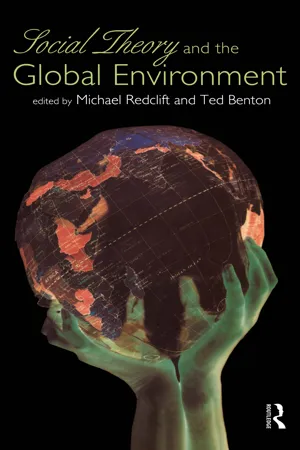
Social Theory and the Global Environment
About this book
This book marks a watershed in the social sciences. The qualitative, critical perspective of sociology and allied disciplines challenges the technocentric `managerialism' which dominates environmental policy, its discourse and its impact.
The authors explore the relationship between social theory and sustainability in an attempt to transend technical rhetoric and embrace a broader understanding of `nature'.
Information
1
INTRODUCTION
This collection of essays was stimulated by a reawakening of public anxiety about environmental dangers. The global issues of climate change, ozone depletion, deforestation and world food crisis orchestrated this anxiety. But for many individual citizens environmental concern was consolidated through personal experiences of air pollution, congestion and powerlessness in the face of unwelcome ‘development’, climatic anomalies and dietary worries. All appear at times to be global symbols. The gap between ‘lay’ perceptions of environmental crisis and official scientific, technical and policy discourses is, of course, one area for sociological exploration. Another quite commonly recognized area concerns the social, cultural and economic impacts of ecological change: what will be the effects of climate change on agricultural activity and on the economic status or political stability of the areas affected? What balance of costs and risks are incurred by alternative responses to the likelihood of lowland flooding?
However, the current phase of environmental concern has spawned among social scientists a much wider, more diverse, and more imaginative role for the social sciences in environmental debate. Above all, there is a commitment to exploring the ways in which patterns of social relationships, cultural forms, political practices, and economic institutions are all implanted in the production of environmental change. In particular this means, as Howard Newby (1991) has emphasized, challenging the ‘technological determinism’ which has dominated so much of both the environmental debate and environmental policy formation. A day conference called under the initiative of the Economic and Social Research Council’s Global Environmental Change Research Programme in March 1992 was intended as one step, among many others, towards opening out a new diversity of social scientific questions and projects in relation to the environment. Many of the chapters in this book are developed versions of presentations given on that day. Other chapters were commissioned by the editors after the meeting took place.
The emphasis is on diversity, imagination, and exploration. There is certainly no common ‘line’ presented here, although all the contributors are committed to the view that the social sciences have a more significant role to play in understanding and responding to environmental crisis than has been widely assumed in the past. But there is, equally, an acknowledgement—in some cases, an insistence—that the social sciences are not equipped to play this enlarged imaginative and practical role without a radical re-think of their own inherited assumptions. There is a two-way process. Environmental debate stands to benefit greatly from the insights of the social sciences, but, equally, the social sciences themselves have much to learn from their attempt to rise to this challenge. There is, we hope, much food for thought in these essays for social and political theorists, sociologists, economists and others irrespective of their prior commitment to the ‘environment’ as a research specialization.
There are two main reasons for this. The first is that serious attempts to come to terms with the issues posed by our environmental crisis expose to critical examination some very basic ‘settled’ assumptions of the ‘mainstream’ traditions of the social sciences. Calling into question these settled assumptions may well open up, or reopen, a research agenda for the social sciences which reaches well beyond the specifically environmental issues posed here. The second reason why these essays may be interesting to social scientists who do not see themselves as primarily concerned with environmental issues, is that these issues reflect several long-standing and unresolved disputes within social theory—between agency-centred and structuralist approaches, individualist and holist, and others. Whilst we certainly do not contend that these issues are resolved by the confrontation with environmental questions, there is no doubt that the approaches outlined in this collection add new dimensions and new ways of thinking about these troublesome questions.
The collection is by no means preoccupied with these second-order, reflective questions concerning disciplinary assumption and boundaries. We have tried to secure an appropriate balance between critical self-reflection, on the one hand, and direct demonstration of the substantive insights which can already come from the application of social scientific methods and concepts to environmental issues, on the other. The sociology of social movements, policy-analysis, ‘global systems’ sociology, sociology of science, ‘structuration’ theory and phenomenology are all put to constructive use in these wide-ranging essays.
A QUESTIONABLE HERITAGE: SOCIAL THEORY AND THE ENVIRONMENT
The prevailing approaches in social and political theory emerged and consolidated themselves in the decades around the turn of the present century. The all-pervasive influence of biological thinking at that time was countered, in the humanist traditions of social thought, by an insistence on human distinctiveness via-à-vis the order of nature. Culture, meaning, consciousness, and intentional agency differentiated the human from the animal, and effectively stemmed the ambitions of biological explanation. For Durkheim (1982), the social constituted a sui generis reality which interrupted the chain of causality linking both external physical and inner biological pressures on the individual. In one move, the opposition between nature and culture (or society) made room for social sciences as autonomous disciplines distinct from the natural sciences, and undercut what were widely seen as the unacceptable moral and political implications of biological determinism. The firm categorial opposition between nature and culture has, of course, been subsequently reinforced by the twentieth century’s continuing experience of biological determinism in practice—in eugenic projects of ‘racial hygiene’, in successive waves of resistance to women’s social and political demands, and, most infamously, in the rise of European Nazism (see Benton 1991).
Economics is a social science which has, in many respects, escaped these pressures. Many of the most basic assumptions of the dominant traditions of economic thinking are inherited from the early nineteenth and even eighteenth centuries. Moreover, the preoccupation of economics with wealth-creation, efficiency in production, and the satisfaction of human wants suggests the inescapability of a confrontation with the material conditions and setting of economic activity. It is, perhaps, surprising, therefore, that the concepts and assumptions of ‘mainstream’ economics have also been inimical to environmental concerns. Many of the nature-given conditions of economic activity have been regarded as ‘free goods’ which therefore played no role in the determination of prices or in the fluctuations of demand. Even for those goods whose scarcity could not be ignored, the economic significance of scarcity has been assumed, in general, to be adequately grasped through concepts such as the economic cost of acquisition. In general, economics has been concerned with quantitative questions about the values or prices of commodities in exchange, at the expense of qualitative questions about what kinds of things get produced, how they are produced, and with what social and ecological consequences.
So, for the social sciences to approach environmental problems is to overcome some deep-seated (and, in important respects, well-founded) inhibitions. If it is once allowed that humans may be considered sufficiently like other living organisms for us to apply to them the concepts of ecology, what is to stop us moving on to the other life sciences? Why not explain gender differences in terms of hormones, brain lateralization, or ‘parental investment’? Why not explain private property, war and racism as ‘natural’ consequences of our ‘animal’ instincts of territorialism, hierarchy and aggression (Rose et al. 1984)? Since the dominant traditions in economics assume that actors rationally pursue preferences which are determined outside economic life, these questions do not crowd in on them. This may be one reason why economics has taken the lead among the social sciences in turning its attention to environmental problems. However, as Michael Jacobs’ contribution to this collection shows, this lead is not an unproblematic one. For the rest of the social sciences the question remains: how do we open up to investigation the relationships between humans and the rest of nature, without letting in the ‘Trojan Horse’ of biological determinism?
A second ‘settled assumption’ of our contemporary social sciences also derives from the historical priorities during which the dominant approaches were formed. This is the commitment to whole societies—usually, but not in all cases, nation-states—as a primary unit of analysis. In cultural anthropology, of course, this became a fundamental methodological principle. In political science, the orientation of political action to the national state has been reflected in the dominant research traditions, with transnational political processes being understood primarily in terms of relations between nation-states. The main traditions in sociology, too, where they have dealt with large-scale social processes, have thought of these in terms of their belonging to more-or-less identifiable particular ‘societies’. In twentieth-century Marxism, the concept of ‘social formation’ as a complex articulation of ‘levels’ of social practice has served to keep the primary focus of analysis on particular societies, despite a countervailing recognition of the globalizing tendencies of capitalism.
Since the 1960s, however, Marxist-influenced ‘dependency’ theorists showed that ‘development’, or the lack of it, in Third World countries could not be understood in abstraction from the location of those countries in an increasingly integrated global economy. Since that time attempts have been made to theorize social and cultural processes at a global level. These attempts have not all been stimulated by a concern for environmental issues, but it is fair to say that such theoretical developments are increasingly relevant. Whilst there are great dangers in giving excessive attention to currently high-profile ‘global’ environmental issues it is still very clear that ecological processes do not respect national boundaries. In some cases (as, for example, acid rain resulting from UK power-stations, or the nuclear fall-out from Chernobyl) environmental damage is initiated in one country, but its effects are felt in one or more others. In other cases (such as global processes like ozone depletion and global warming) industrial or other activities which are widespread in geopolitical terms have cumulative effects at the level of the whole ecosphere. In general, where there is a mismatch between the causes of environmental change, its physical distribution, and the boundaries of nation-states there are pressures for political responses which cannot be adequately analysed in terms of the traditional orientation of political science to issue-formation and decision-making within nation-states. Transnational social, cultural and economic processes, too, must be brought into the picture.
SPACE AND TIME: RENEWING THE CHALLENGE TO A GENERALIZING SOCIAL SCIENCE
Implicit in both of these increasingly contested assumptions is a third: that, in so far as the social sciences have thought of themselves as generalizing, abstract sciences, they have tended to develop explanatory strategies which abstracted from the particularities and contingencies of space and time. This is, indeed, one way in which the social sciences distinguished themselves from the narrative character of history. Of course, both time and place have featured significantly in sociology and the other social sciences. Max Weber’s investigation of the major world religions was in part concerned with understanding the specifically cultural conditions which enabled capitalist economic development to occur in the West, but not in the East (Marshall 1982, Schroeder 1992). But, significantly, Weber set out to explain where and when economic development took place. The concepts he used to explain these spatially and temporally located processes were the general features of the different religions: their doctrinal contents, modes of organization and relations to other social and political processes. There is nothing about the location of these cultural forms in the Orient or Occident as such which is of explanatory relevance.
This space-time indifference of the main traditions of social science can be seen as, in part, a residue of the positivist legacy with its view of scientific knowledge as a deductive hierarchy of abstract laws. However, it is also sustained by the anti-positivist, ‘interpretivist’ or ‘hermeneutic’ schools of thought. For these traditions, the focus on meaning, subjectivity, and symbolic forms or ‘discourses’, tends to abstract these social processes from their physical embodiments, and, consequently from their location in time and space. Again, it could be argued that Marxism, with its concern, in the theory of imperialism and in subsequent work on development and dependency, with the geographical spread of capitalist economic, political and military forms, anticipated the later ‘spatialization’ of social science. One reason for this may have been Marxism’s status as a form of theoretically reflective historiography, rather than as an ‘abstract science’ in the positivist sense.
However, even within Marxism the integration of spatial and temporal considerations into theorizing has been largely ad hoc and inconsistent. A more sustained and self-conscious concern with space as a sociologically relevant variable came in the 1970s with a significant convergence between, on the one hand, a radical human geography and, on the other, a revitalization of urban and rural sociology (see, for example, Harvey 1973, especially Ch. 1). As geographers came to acknowledge the significance of social and political processes, sociologists became more aware of the significance of the fact that social activities had a definite, analysable pattern of distribution in physical space.
Even then, the equally significant fact that social processes have duration through time continued to be given scant attention. As with space, time was always in some sense present in social explanation and theorizing. Much of classical sociology has been either implicitly or explicitly an exercise in periodization—in defining the distinctive features of modernity and exploring their human and moral significance: witness the current intensity of sociocultural debate between advocates and opponents of the thesis of post-modernization. Again, much ‘micro’ sociological work on the ‘life-cycle’, employing biography as a method of analysis (see, for example, Sociology, special issue, vol. 27, no. 1, February 1993), cannot avoid acknowledging temporal duration as a significant dimension of the social world. Meanwhile, the structural Marxists of the 1960s and 1970s attempted to do away with economic determinism by emphasizing the differential ‘times’ of the various social practices comprising the social formation. The social theorist Anthony Giddens is notable for his explicit focus on both spatial and temporal aspects of social processes (Giddens 1979, especially ‘Introduction’; and 1981, Ch. 1), whilst a major step forward was taken by one of the contributors to this volume, Barbara Adam, in her path-breaking Time and Social Theory (1990).
Though it is arguable that recent attempts to integrate both time and space more fully into sociological analysis were not primarily motivated by environmental issues, there is no doubt that these developments are an absolutely basic necessity for any sociology to rise to the environmental challenge. As we have already noticed, the spatial distribution of environmentally relevant human social action, as well as of its ecological effects, bears no necessary relationship to the boundaries within which legal and political decision-making or authority operate. So, being able to integrate a spatial dimension into social scientific analysis is essential if these dislocations are to be analysed. Similarly, this applies to temporal duration. The spatial diffusion of air and water pollutants; the passage of chemical waste products into, and then through, food chains; the processes of radioactive decay; the advance of scientific research and technical innovation; processes of cultural change, democratic decision-making, international negotiation, legislation and regulation are all processes which take time. But the time-scales on which they operate are indefinitely variable and, again, bear no necessary connection with one another. The complexities and dislocations of these interacting time-scales would somehow have to be brought within social scientific analysis for any adequate understanding to be achieved. The implications for any environmental politics, too, are clearly immense. Finally, it should be noted that full integration of spatial and temporal aspects of social and ecological processes into social scientific analysis is actually a necessary condition for social science to go beyond its inherited nature/society dualism, and also for it to move beyond its confinement to the nation-state as its primary unit of analysis.
STRUCTURE AND AGENCY IN THE DEVELOPMENT OF ENVIRONMENTAL CONSCIOUSNESS
So much, then, for those aspects of the shared conceptual inheritance of the social sciences which must be called into question if environmental issues are to be adequately addressed. There are also several areas of long-standing and quite often acrimonious dispute in social and political theory. In some respects these issues may be rendered more tractable in the effort to engage with the environment. Even where no such benefit accrues, the relationship between social processes and their environmental conditions and consequences may at least serve to shift the terms of deba...
Table of contents
- Cover
- Title
- Copyright
- Contents
- List of Figures
- List of contributors
- 1. Introduction
- 2. Biology and Social Theory in the Environmental Debate
- 3. Sociology and the Environment: Discordant discourse?
- 4. The Limits to Neoclassicism: Towards an institutional environmental economics
- 5. Running out of Time: Global crisis and human engagement
- 6. Gender Analysis and Environmentalisms
- 7. Social Movements and Environmental Change
- 8. Scientific Knowledge and the Global Environment
- 9. Facing Global Warming: The interactions between science and policy-making in the European Community
- 10. Global Sociology and Global Environmental Change
- 11. Environmental Sociology And Global Environmental Change: A critical assessment
- 12. Sustaining Developments in Environmental Sociology
- Index
Trusted by 375,005 students
Access to over 1.5 million titles for a fair monthly price.
Study more efficiently using our study tools.
Frequently asked questions
Yes, you can cancel anytime from the Subscription tab in your account settings on the Perlego website. Your subscription will stay active until the end of your current billing period. Learn how to cancel your subscription
No, books cannot be downloaded as external files, such as PDFs, for use outside of Perlego. However, you can download books within the Perlego app for offline reading on mobile or tablet. Learn how to download books offline
Perlego offers two plans: Essential and Complete
- Essential is ideal for learners and professionals who enjoy exploring a wide range of subjects. Access the Essential Library with 800,000+ trusted titles and best-sellers across business, personal growth, and the humanities. Includes unlimited reading time and Standard Read Aloud voice.
- Complete: Perfect for advanced learners and researchers needing full, unrestricted access. Unlock 1.5M+ books across hundreds of subjects, including academic and specialized titles. The Complete Plan also includes advanced features like Premium Read Aloud and Research Assistant.
We are an online textbook subscription service, where you can get access to an entire online library for less than the price of a single book per month. With over 1.5 million books across 990+ topics, we’ve got you covered! Learn about our mission
Look out for the read-aloud symbol on your next book to see if you can listen to it. The read-aloud tool reads text aloud for you, highlighting the text as it is being read. You can pause it, speed it up and slow it down. Learn more about Read Aloud
Yes! You can use the Perlego app on both iOS and Android devices to read anytime, anywhere — even offline. Perfect for commutes or when you’re on the go.
Please note we cannot support devices running on iOS 13 and Android 7 or earlier. Learn more about using the app
Please note we cannot support devices running on iOS 13 and Android 7 or earlier. Learn more about using the app
Yes, you can access Social Theory and the Global Environment by Ted Benton,Michael Redclift in PDF and/or ePUB format, as well as other popular books in Social Sciences & Environment & Energy Policy. We have over 1.5 million books available in our catalogue for you to explore.