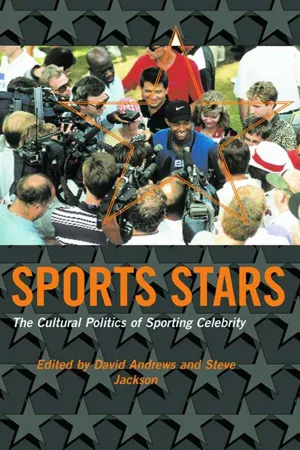
In a culture obsessed with celebrity, sportmen and women are some of the highest profile figures. We are fascinated by sport stars' lifestyles, love lives, and earning power. Sport Stars investigates the nature of contemporary sporting celebrity, examining stars' often turbulent relationships with the media, and with the sporting establishment.
Through a series of case studies of sporting stars, including Diego Maradona, Michael Jordan, Venus Williams and David Beckham, contributors examine the cultural, political, economic and technological forces which combine to produce sporting celebrity, and consider the ways in which these most public of individuals inform and influence private experience.
eBook - ePub
Sport Stars
The Cultural Politics of Sporting Celebrity
- 294 pages
- English
- ePUB (mobile friendly)
- Available on iOS & Android
eBook - ePub
About this book
Information
1
MICHAEL JORDAN
Corporate sport and postmodern celebrityhood
In a contemporary Western culture excessively saturated with media images of celebrity, no American athlete, perhaps no American has been more incessantly promoted than Michael Jordan. Jordan’s seeming ubiquitous global fame is in part built upon a dual career as a distinguished basketball player and as a celebrity endorser. Yet, in many ways Jordan’s reach goes beyond his individual status as he serves as the prototypical sport celebrity, whose US and global marketing conquests have provoked debate, admiration and emulation. Besides leading the Chicago Bulls to six National Basketball Association (NBA) championships and earning five league Most Valuable Player trophies, Jordan has also pitched such diverse products as Nike sneakers, Hanes underwear, MCI longdistance telephone service, Ball Park Franks hotdogs, Bijan cologne, McDonald’s hamburgers and Rayovac batteries. This visibility as an athlete-endorser has translated into considerable capital accumulation. In 1998, Jordan reportedly earned $45 million in endorsements ($16 million of it from Nike), a sum far greater than the $34 million salary he earned that same year for playing basketball (Einstein, 1999). In his over 15-year relationship with Nike, Jordan-related product sales have reportedly surpassed the $3 billion mark. His Space Jam movie is said to have garnered more than a half-billion dollars in box office and video sales. And one year after signing Jordan in 1991 and encouraging consumers to “be like Mike,” Gatorade’s annual revenues climbed from $681 million to over $1 billion. Gatorade’s 1998 revenues were approximately $1.5 billion, giving the company an 80 percent share of the sports nutritional-drink market (Armstrong, 1999).
Although Jordan has now retired from professional sport for the third time (twice from the NBA and once from minor league baseball), the commodification of the Jordan persona has hardly abated. Jordan’s hyperreal image continues to circulate around the globe, reaching such diverse spaces as California shopping malls, the streets of Poland, and among the diverse nations that house the Black Diaspora (Andrews et al., 1996). Indeed, Michael Jordan has become a brand unto himself, serving as a significant example of America’s transnational commodity culture, what Kellner (1995, p. 5) calls an “export to the entire world.” In a global culture increasingly dominated by the exchange of commodity signs, that is mediated objects, practices and personalities, Jordan is but one of numerous forged images engaging in “sign wars” (Goldman and Papson, 1996) seeking increased profitability for a variety of transnational and US corporations. Jordan’s celebrity sign is also incredibly malleable, highly mobile and the carrier of shifting, but important cultural meanings. His status continues to be hyperbolically promoted, as evidenced by a recent ad campaign in which marketing research supposedly discovered that “a photograph of the back of Jordan’s bald head is better recognized (at least in California shopping malls) than the faces of Bill Clinton, Newt Gingrich and Jesus Christ” (cited in Ahrens, 1999, p. C01). And a short while ago when Nike launched a new Jordan Inc. division, Steve Miller, the president of the new unit, unabashedly proclaimed: “We have the most recognized person in the world … His appeal transcends sports, gender, race and age. We think that appeal is going to continue into the future” (cited in Friedman, 1999, p. 3).
In contrast to this exaggerated statement of Jordan’s transcendence, this chapter places into crisis the shallow affective elation that characterizes the articulation and consumption of Michael Jordan’s image, by making visible the economic and political implications of wanting to be like Mike. Grounded in cultural studies, post-structuralist, and postmodern theories, this chapter provides multiple contextually specific interpretations of this most visible celebrity sign, arguing that the prototypical Jordan persona, while incredibly mobile and malleable, has material effects in shaping people’s everyday relations, experiences, and identities. Rather than transcending gender, race, class, sexuality and nationality, in this chapter we demonstrate the ways in which Jordan’s hyperreal image is embedded in a postmodern global media culture awash with endless chains of politically and emotionally meaningful signifiers related to a complex, shifting matrix of social inequalities. By offering this chapter as an alternative account we seek to disrupt the bodily inequities and systems of differentiation which circulate and are remade through the historically specific intertextual discourses of the popular print, electronic and advertising media.
In excavating the political significance of Michael Jordan, we first make discernible the ways in which Nike has helped to mobilize particular emotional and affective investments through Jordan’s hyperreal image. We argue that there is considerable evidence to suggest that Jordan’s African American heritage engages particular desires and identities (see Andrews, 1996; Andrews, 1998; Cole and Andrews, 1996; Cole, 1996 #2925; McDonald, 1996), and we discuss these in relationship to contemporary US race relations. Within the context of post-Reagan America, Jordan also serves as a particular type of masculine hard body, one that promotes conservative family values and advances the agenda of the New Right. And finally we engage “International Jordan” to illuminate the process of globalization while interrogating the reception of Jordan as an American icon within diverse global spaces including those of New Zealand, Poland and Black Britain. Through Jordan we note the global-local nexus as it pertains to the transnational manifestations of American sporting and celebrity commodities. Our aim in providing critical multi-contextual understandings of Michael Jordan is to encourage people to interrogate their own engagement with commodity and celebrity cultures as a process necessary to bringing about cultural change.
The corporate body: imagining Jordan’s postmodern celebrity
If there is one analogy repeatedly linked to Michael Jordan, it is the allusion (and illusion) of flight. As the now well-told creation story goes, under the auspices of the Los Angeles advertising agency Chiat/Day Nike first created the “Air Jordan” celebrity persona in hopes of challenging corporate rivals Converse and Reebok’s economic hold on athletic shoe sales. One of the first commercials of the 1985 campaign for the signature Air Jordan line was titled “Jordan Flight” and featured Jordan executing a slam-dunk on an urban basketball court to the sound of jet engines revving to take off at an increasingly higher pitch. The commercial concluded by asking, “who said man was not meant to fly?” This clever commercial marks Michael Jordan’s identity (re)constituted as Air Jordan, “the Nike guy who could fly” (Katz, 1994, p. 7). This depiction of Jordan as a rugged individual, an athlete whose basketball athleticism suggests an uncanny ability to remain suspended in air, as if in flight, provided a financial boon for the Air Jordan brand, which grossed $130 million in its first year (Strasser and Becklund, 1991, p. 3) while helping to elevate Nike to the status of an American corporate icon. Coke quickly followed Nike’s lead, employing intertextually resonant meanings in commercials depicting Jordan in space silhouetted against the moon, leaping for a bottle of Coke. In both cases the metaphor of flight is used to link Jordan’s sign value with the enduring American ideologies of competitive individualism (Andrews, 1998).
Against these uncritical characterizations of orbit and of flight, we offer another suggestion of swift passages and motions as particularly useful in contextualizing and criticizing corporate sport’s creation of and investment in “Air Jordan’s” postmodern celebrityhood. As a culturally created persona, Jordan’s mediated identity has been inscribed with multiple cultural and commodified meanings, none of which are essential or fixed; rather, the Jordan persona as a commodity sign must be understood as fluid, complex, and contradictory. Jordan’s hyperreal celebrity image is, therefore, a highly mobile sign that displays a lack of uniformity as well as a lack of permanent value (Andrews, 1996). Borrowing from Stuart Hall (1983) we might say that there are no necessary correspondences, or for that matter non-correspondences, between meanings and cultural symbols like Jordan. In this way Jordan’s ever changing image is unpredictable and thus signals “the absence of guarantees, the inability to know in advance the historical significance of particular practices” (Grossberg, 1986, p. 64).
Given this fluidity and uncertainty, it is misleading to view Jordan as merely an outstanding basketball player and marketing icon whose accomplishments universally speak for themselves. Nor should Jordan be seen as the sole author of the shifting cultural meanings connected to his image. Given these insights it is further ill advised to suggest any inevitability about Jordan’s prominence, as Jordan’s agent David Falk seems to suggest in proclaiming: “No one ever tried to invent Michael Jordan. We didn’t try to create something in 1984; it just evolved. When you try to create that, the public sees through it, and they think it’s insincere” (cited in Murphy, 1999, p. 1). Contrary to Falk’s claims of autonomy, authenticity and genuineness, as an elastic and empty sign (see Gilroy, 1991), there has been considerable ideological work in transforming Jordan into a signifier in the first place. Moreover, conjunctionally specific representations of Jordan not only do ideological work, but also seek to secure affective investments in mobilizing specific forms of power and authority (Andrews, 1998). Because it is impossible to separate the affective from the ideological, used here affective suggests an economy of intense, energetic and emotional response to and involvement in mediated ideological narratives which are increasingly, but not always, communicated through the electronic media (ibid.). Thus popular cultural sites are invested not only with powerful ideologies but with divergent moods, energies and intensities that anchor people “in particular experiences, practices, identities, meanings and pleasures” (Grossberg, 1992, p. 82).
Frequently, ideological and affective articulations of commodity signs attempt to rally consent for dominant alliances and their worldviews. In a hyperreal media-saturated culture, power is exercised through the means of representation, as those who have greatest access to the media set particular agendas while having the ability to frame what counts as real and significant. Given this insight, it is not surprising then that Nike has built Jordan’s image in accordance with the dominant structure of the feelings that are continuously affectively rearticulated in relationship to American consumer culture, including those of the American Dream, rugged individualism and the value of personal perseverance (Andrews, 1998). For example, one commercial features a pensive Michael Jordan dramatically assuring us of the value of hard work and dedication:
I’ve missed more than 9,000 shots in my career. I’ve lost almost 300 games. Twenty-six times I’ve been trusted to take the game-winning shot, and missed. I’ve failed over and over again in my life. That’s why I succeed.
(cited in Base, 1997, p. 20)
The basketball star’s ability to mobilize similar sentimentality is such that Phillip Knight, CEO of Nike calls Jordan “the ultimate Just Do It athlete,” restating Nike’s famous individualistic slogan (cited in Einstein, 1999 p. B1). Under the direction of agent David Falk, Jordan’s status as corporate spokesperson has consistently involved promoting an image of All-American affability not only for Nike and the NBA, but for numerous other corporations. Thus Jordan now exists within an economically lucrative intertextual scenario in which each Jordan commercial helps to promote the other commodity signs in a considerable promotional arsenal (Andrews, 1998).
With considerable capital already invested in Jordan, attention has been increasingly applied to remaking a fresh emotionally salient persona for Jordan. For example, Nike CEO Phil Knight justifies the creation of the Nike brand Jordan subdivision as:
I think that when people say his career is over, I would limit it to his basketball career. He’s very bright, he’s very competitive and when he decides to take out some of his competitive instincts on the business world, look out!
(cited in Einstein, 1999, p. B1)
This new image of CEO Jordan projects the ex-player dominating in the corporate world, and accumulating material success. According to Bob Dorfman, who rates the marketability of sports stars for the advertising agency Foote, Cone and Belding in San Francisco, Jordan is “such a super-human talent that everybody aspires to his level of performance … Everybody wants to be that good and have that much success” (cited in Einstein, 1999, p. B1). The Jordan brand has spawned a plethora of Jordan “wannabes,” a pool of aspiring young athletes/celebrities/commodity signs who now wear and endorse the Jordan brand. Jordan athletes include shortstop Derek Jeter of New York Yankees, Randy Moss, wide receiver for the Minnesota Vikings and boxer Roy Jones Jr. Additionally, six NBA athletes: the Charlotte Hornet’s Eddie Jones, Vin Baker of the Seattle Sonics, Michael Finley of the Dallas Mavericks, Ray Allen of the Milwaukee Bucks, Mike Bibby of the Vancouver Grizzlies and Cleveland’s Derek Anderson are all aligned with the Jordan logo (McKinney and Romero, 1999).
In the late 1990s Jordan’s CEO persona as a tough competitor in the business world has been made to serve as an antidote to a badly bruised Nike public image. Activism over Nike’s deplorable international labor practices, low wages and poor working conditions in certain nations where Nike shoes are produced has tarnished the carefully cultivated Nike persona. Knight downplays any sense of responsibility for the company’s poor labor record, arguing that the firm has been unfairly made the “poster boy for the global economy” (cited in Lofton, 1998, p. 1). While denying responsibility, Nike has responded to public pressure with modest initiatives including the removal of toxins in international factories. Given this context, the elevation of the Jordan brand above the over-saturated tarnished Nike swoosh logo represents an attempt to exploit the affective economy surrounding Jordan to deflect attention away from Nike’s lack of commitment to responsible labor politics.
Sign language: Michael Jordan as a floating racial signifier
Within this complex array of signs and hypersignification, it is crucial to note that Michael Jordan also serves as a “free floating” racial signifier representing a complex fluid process that both engages with and disengages from an economy of signifiers related to stereotypical and ideological depictions of Black masculinity. For example, before entering the NBA and prior to his relationship with Nike, during his collegiate career the popular media had already begun linking Jordan with lingering codes of natural athleticism thus recapturing the mind-body dualism that has dominated popular racial discourses (Andrews, 1996). This discourse of extraordinary athleticism relies upon common sense assumptions of an innate Black physicality, a racist characterization once used to justify the institution of slavery and Social Darwinist constructions of White supremacy. This narrative of alleged naturalness clearly displays aspects of the racialized history out of which Michael Jordan, the celebrity sign, was initially constructed. When Jordan helped lead the US team to the 1984 Olympic gold medal in Los Angeles, he was described within similar pseudo-scientific logic as someone who was “seemingly born to dunk” (ibid.). This narrative of innate physicality has been rearticulated throughout Jordan’s successful basketball career and undoubtedly has helped fuel the allegedly natural “Air Jordan” persona. Jordan’s repeatedly valorized sporting body thus serves as a highly visible signifier of racial Otherness (ibid.).
Given this depiction, it is also necessary to stress a post-structuralist contention that cultural meanings are also contingent upon the shifting, overlapping territory of popular culture within particular historical, geographic, and political contexts. Within the context of contemporary America Michael Jordan has been repeatedly fashioned by Nike, the NBA, other corporate sponsors, and the media in accordance with the forceful imperatives of late twentieth-century capitalism, popular racial ideologies, and often within a reactionary post-Reaganite cultural agenda (Andrews,...
Table of contents
- Front Cover
- SPORT STARS
- Title Page
- Copyright
- CONTENTS
- Notes on contributors
- Introduction: sport celebrities, public culture, and private experience
- 1 Michael Jordan: corporate sport and postmodern celebrityhood
- 2 Excursions into otherness: understanding Dennis Rodman and the limits of subversive agency
- 3 Andre Agassi and Generation X: reading white masculinity in 1990s’ America
- 4 America's new son: Tiger Woods and America’s multiculturalism
- 5 From “Child's play” to “Party crasher”: Venus Williams, racism and professional women's tennis
- 6 Postmodern blackness and the celebrity sports star: Ian Wright, “race” and English identity
- 7 Evil genie or pure genius?: the (im)moral football and public career of Paul “Gazza” Gascoigne
- 8 Punishment, redemption and celebration in the popular press: the case of David Beckham
- 9 The spectacle of a heroic life: the case of Diego Maradona
- 10 Gretzky Nation: Canada, crisis and Americanization
- 11 Hideo Nomo: pioneer or defector?
- 12 Global Hingis: flexible citizenship and the transnational celebrity
- 13 Nyandika Maiyoro and Kipchoge Keino: transgression, colonial rhetoric and the postcolonial athlete
- 14 Imran Khan: the road from cricket to politics
- 15 Brian Lara: (con)testing the Caribbean imagination
- 16 Cathy Freeman: the quest for Australian identity
- Index
Trusted by 375,005 students
Access to over 1.5 million titles for a fair monthly price.
Study more efficiently using our study tools.
Frequently asked questions
Yes, you can cancel anytime from the Subscription tab in your account settings on the Perlego website. Your subscription will stay active until the end of your current billing period. Learn how to cancel your subscription
No, books cannot be downloaded as external files, such as PDFs, for use outside of Perlego. However, you can download books within the Perlego app for offline reading on mobile or tablet. Learn how to download books offline
Perlego offers two plans: Essential and Complete
- Essential is ideal for learners and professionals who enjoy exploring a wide range of subjects. Access the Essential Library with 800,000+ trusted titles and best-sellers across business, personal growth, and the humanities. Includes unlimited reading time and Standard Read Aloud voice.
- Complete: Perfect for advanced learners and researchers needing full, unrestricted access. Unlock 1.5M+ books across hundreds of subjects, including academic and specialized titles. The Complete Plan also includes advanced features like Premium Read Aloud and Research Assistant.
We are an online textbook subscription service, where you can get access to an entire online library for less than the price of a single book per month. With over 1.5 million books across 990+ topics, we’ve got you covered! Learn about our mission
Look out for the read-aloud symbol on your next book to see if you can listen to it. The read-aloud tool reads text aloud for you, highlighting the text as it is being read. You can pause it, speed it up and slow it down. Learn more about Read Aloud
Yes! You can use the Perlego app on both iOS and Android devices to read anytime, anywhere — even offline. Perfect for commutes or when you’re on the go.
Please note we cannot support devices running on iOS 13 and Android 7 or earlier. Learn more about using the app
Please note we cannot support devices running on iOS 13 and Android 7 or earlier. Learn more about using the app
Yes, you can access Sport Stars by David L. Andrews,Steven J. Jackson in PDF and/or ePUB format, as well as other popular books in Social Sciences & Media Studies. We have over 1.5 million books available in our catalogue for you to explore.