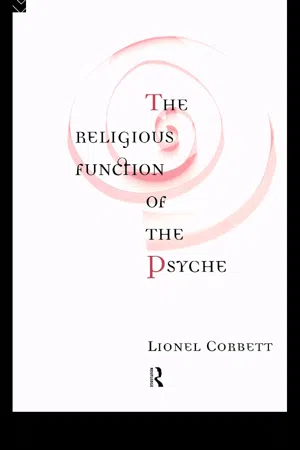
Traditional concepts of God are no longer tenable for many people who nevertheless experience a strong sense of the sacred in their lives. The Religious Function of the Psyche offers a psychological model for the understanding of such experience, using the language and interpretive methods of depth psychology, particularly those of C.G. Jung and psychoanalytic self psychology. The problems of evil and suffering, and the notion of human development as an incarnation of spirit are dealt with by means of a religious approach to the psyche that can be brought easily into psychotherapeutic practice and applied by the individual in everyday life.
The book offers an alternative approach to spirituality as well as providing an introduction to Jung and religion.
- 272 pages
- English
- ePUB (mobile friendly)
- Available on iOS & Android
eBook - ePub
The Religious Function of the Psyche
About this book
Information
1
THE RELIGIOUS ATTITUDE IN PSYCHOTHERAPY
DEPTH PSYCHOLOGY AS A SPIRITUAL PURSUIT
My intention in this book is to advocate an approach to the psyche which will lead to the development of an individual, intensely personal spirituality. I wish to illustrate the ways in which depth psychology can address those questions and experiences which have traditionally been the exclusive province of established religions. A perspective on divinity that is rooted within the psyche allows for the description and discussion of human suffering, of evil and of transpersonal experiences, without the necessity for recourse to the tenets of established doctrinal systems. I hope to show that particular life situations and experiences can form the basis of a personalized religion when they are understood by means of depth psychological methods. This requires an approach that retains, or even enhances and releases, the full religious significance of the experience. It is important to state at the outset that this approach is open to any manifestation of the divine, however novel or traditional its form. Such openness is possible because we have no preconceived idea about the form in which the divine may or may not become manifest. In Jungian psychology, these manifestations are termed ‘numinous’. This word, or its noun ‘the numinosum’, are used to refer to any such experience. (The term is discussed in detail on p.)
Because the psychological approach is receptive to the many varieties of appearances of the numinosum, certain types of religious experience or solutions to spiritual dilemmas which would be discounted by some orthodoxies are here valued as of great importance to the individual, albeit not necessarily to the collective. Since we cannot dictate the form which the numinosum may take within the individual psyche, our task is to recognize and appreciate it, even— or perhaps especially—if it appears in the form of suffering or psychopathology.
Therefore the religious attitude to the psyche regards attention to introspectively obtained material, such as dreams, visions, creative products, emotional distress, fantasy or simply reflection on personal history, as a valid spiritual pursuit if the transpersonal or archetypal underpinnings of such events are recognized. This attitude relies on a contentious axiom of the depth psychological approach, which is that the raw material for a religious approach to the psyche is mediated by levels of the psyche that extend beyond the personal. (The problem here is whether there is anything such as a God that is beyond the psyche itself.) Jung described these transpersonal levels of the psyche as objective or autonomous. They seamlessly interact with, and are the ground of, more personal material. Practically speaking, and in the consulting room, this interaction is illustrated by the following example, which shows the inherence of emotional difficulty and transpersonal experience. A young man was in the midst of considerable emotional turmoil, feeling as if he could not cope, and that he was entirely alone with his difficulties. Looking aimlessly out of his window, he suddenly saw an enormous face in the sky, looking down at him. He was terrified at this vision, which lasted only a few seconds. (Here the reader is asked to accept my clinical assessment that the event was accompanied by no other phenomena which could be interpreted as the result of psychopathology.) He was unable to understand the meaning of the event, but felt that it was of great personal significance. Soon afterwards the following powerful dream occurred:
An enormous blue UFO hovered a short distance above my head, stretching as far as I could see in all directions. From its base brilliant beams of light, as if from many high-powered search lights, shone down onto me. Looking up, I saw that the light emanated from a series of eyes on the underside of the craft which were peering at me.
These two experiences are linked together by the common theme of being seen by something or someone from out of his ordinary world. We might say that they present to him an otherness from beyond ego consciousness, to which he must relate as a Thou. In his vision, the subject is presented with many of the criteria (discussed further on pp.), which define contact with the numinosum. He feels a special type of fear that is the result of encounter with the uncanny. This has a different quality than the fear of something known. In both experiences he is awed; he realizes that he has encountered something that is at the same time amazing, mysterious, beyond understanding, in relation to which he is very small indeed, and to which he does not normally have access. Faced with the dream, the depth psychologist takes the position that, although we may not know what the physical basis of the UFO phenomenon is, we approach the dream of a UFO with an attitude that is grounded in the reality of the psyche. Jung (CW 10, 307–433) noted that, from this perspective, UFOs are psychologically important. They are part of a living myth; during dark times, there have always been rumours of intervention from the beyond. Jung points out that the UFO is mandala-shaped (see p.), that is, it is a symbol of order, containment and wholeness of a kind that tends to appear as a compensation during times of chaos. In other words, the UFO can be seen as a symbol of the transpersonal Self (see p.), that core of the personality that is a part of the Totality. In traditional language, the dreamer is seen by the eye of God.
It is typical for the numinosum to present itself in a manner that is directly relevant to the developmental history of the experiencer. In this case, our subject had never felt really seen; when he was a child, his parents were preoccupied with their own view of what they needed him to be, rather than with what he actually was. Therefore, feeling unseen and alone with his feelings was part of a long-standing complex (a neurotic difficulty) for this man, and his contact with the numinosum addresses the heart of this problem. For him, the dream UFO (not an ‘actual’ UFO) is both a healing symbol and also a personal bridge to the intrapsychic experience of the transpersonal realm. Whether or not UFOs have this meaning for other people need not be of concern to him; the experience is part of an individual revelation that speaks directly to him. Like much mystical experience, both events address an area of vulnerability. But they are at the same time helpful; they enable him to not feel so alone and isolated. These were awakening experiences; if he was in any doubt before, he is now quite certain that he exists in relation to something not of this realm that is conscious of him. The question of whether these events originate from within or from beyond the psyche is unanswerable. In the former case the psyche would be the causal agent of the experience, in the latter the psyche would be a transmitter for religious experience. The depth psychological approach cannot decide between these possibilities. The important point illustrated here is that we locate the numinosum within the deepest subjectivity of the individual, and we connect it with our psychological needs and difficulties. Because of this connection, the result of numinous experience is often a reorganization of the empirical personality. In this particular case, the subject lost his worries about being seen and about being alone with himself.
Many further examples of contact with the numinosum will be provided in the course of this book. Here I want to make the point that they are not confined to the psychotherapist’s office and they are not always related to the pathology of the individual. Coles (1990) tells the story of a young African-American girl in North Carolina in 1962, who was trying to enter her newly desegregated school. To do so she had to run the gauntlet of a racist mob screaming at her:
I was all alone…and suddenly I saw God smiling, and I smiled. A woman was standing there [near the school door], and she shouted at me, ‘Hey, you little nigger, what you smiling at?’ I looked right at her face, and I said, ‘At God.’ Then she looked up at the sky, and then she looked at me, and she didn’t call me any more names.
(Coles, 1990)
This example serves to illustrate another important area of debate that will later be taken up in detail. This girl was in a terrifying situation, but to see her experience as simply defensive, or psychodynamically motivated, rather than to accept it at face value as a direct perception of the numinosum, is reductive. There is no reason to doubt that, in some interior and personal way, she did see God. There tends to be an almost automatic assumption that such childhood experiences are illusory. But if her experience had not been genuine, I doubt that the girl’s hateful accuser would have been so satisfactorily shamed into silence. Apparently this experience was intended for both participants.
To reiterate: numinous experience arises from an autonomous level of the psyche that is either the source of, or the medium for, the transmission of religious experience; empirically, we cannot say which. We cannot know whether religious experience arises ‘beyond’ the psyche, or from within it. But having such an experience immediately implies the presence of the psyche, without which there would be no experience, or no experiencer. Therefore, for practical purposes we cannot distinguish between numinous products of the transpersonal levels of the psyche and the simultaneous intrapsychic presence of the divine. The religiously oriented depth psychologist takes these experiences at face value and eschews speculation about their possibly trans-psychic origin. The religious approach to the psyche is thus directly in accord with the mystical traditions of all world religions, in that it tries to approach the divine (or transcendent levels of reality) by locating it directly and deeply within ourselves. To this I would only add that, although the experience of the autonomous psyche can be deeply healing, in fragile personalities it can trigger severe disorganization. (The problem of psychosis is discussed on p.)
The intermingling of the transpersonal and the personal levels of the psyche which occurs in the course of religious experience makes it necessary for both to be included within the purview of those psychotherapists who choose to work within this model. Otherwise, as is tragically often the case, the totality of the individual’s inner life is subject to a process of splitting, in which either religious elements are excluded from the psychotherapeutic field, or personal material is seen as irrelevant to spiritual development. This attitude has disastrous consequences for unconsciously acting out the shadow, or the dark side of the personality. By contrast, the religious attitude to the psyche sees psychotherapeutic work on the shadow as itself an integrally religious endeavour.
I espouse the view that the production—or the transmission—of numinous experience is an intrinsic function of the psyche, and that the contents of such experience may be quite independent of the individual’s cultural conditioning. This is a fact of major importance. As Jung pointed out, mythical, that is to say religious, imagery which is unknown to the conscious personality occurs in psychopathology and in dreams. But despite the fact that it is unknown, such imagery has an uncanny relevance to the life of the dreamer, indicating the continuity of the personal and non-personal levels of the psyche. Depth psychology offers an approach to this religious function of the psyche which follows the lead of the psyche itself. Rather than a major emphasis on notions of the sacred which are imposed from the outside, which is the position of many dogmatic or doctrinal approaches, we also pay attention to sacred imagery as it arises de novo, from within the psyche. The psyche’s religious function has powerful relevance to depth psychotherapy, enabling such work to be experienced and practised as a spiritual discipline. To indicate briefly some of the ways in which these two are connected in practice, it is noteworthy that, although some transpersonal experiences speak for themselves, others require interpretive work for their meaning to become clear. It may also happen that the numinosum inspires too much terror to be managed without help. And, although sometimes an archetypal event may feel immediately and unequivocally sacred, psychodynamically motivated resistances may prevent this quality from emerging. At such times, psychotherapeutic work may release a sense of the sacredness of an experience which was previously obscure. Sometimes the therapist may only be required to point out that, despite the fact that an event (such as the UFO dream) is not understandable by reference to an established religious system, its numinosity qualifies it as authentic. Sometimes, too, the individual needs help in locating the meaning of such an experience within the total context of his or her life, and this discovery then becomes the major function of the therapist.
It has often been pointed out that psychotherapy consists not only of its standard technical aspects, but, as the etymology of the word suggests, it is also a process of our attendance on, or service to, the soul, especially in its relationship to spirit. It is typical within the depth psychological approach that terms arise such as ‘soul’ and ‘spirit’, which have an already existing theological quality and history. However, because of the increasing maturity of depth psychology, several writers have construed these terms in their intrapsychic sense. They do not need to be used to refer to metaphysical entities or to concepts about the nature of absolute or extrapsychic reality.
Unlike the traditional theological approach to religious experience, which applies the experience of a few exceptional people (such as Jesus or Mohammed) to everyone, the depth psychologist takes the position that, by and large, individual religious experience refers mainly to the person concerned. It is not at all clear that its meaning can be generalized to others, unless, when hearing of the event, such emotional resonance occurs that another person is deeply affected by it. But this is not a matter of dogmatic application to others; its relevance is given through the truth of authentic feeling.
It is also important to note at the beginning what is not being attempted here. This book is not a psychology of religion, but a religious approach to a certain dimension of individual psychology. This paradigm is not based on existing well-articulated theological considerations, nor is it grounded in the the axioms of any particular religious tradition. It is not intended to be syncretistic, nor is it a psychological comment on the question of the nature of religion. Rather, the basis of this work is Jung’s suggestion that the level of the psyche which he terms archetypal, provides that quality of experience which is synonymous with what has always been considered the religious domain. The depth psychological method is not intended to produce yet another theological system, because it is not concerned with arguments about the actual nature of divinity, but only with its personal experience. The psychological attitude is grounded in the belief that the experience of divinity is amenable to depth psychological hermeneutical methods which are totally independent of preconceived doctrinal assumptions. Of course there are other valid platforms from which to discuss the content of religious experience—the sociological, the historical and so on. My intention is not to insist on the primacy of the psychological approach. It is to emphasize the potentially religious value of subjectivity itself and to clarify the relevance of religious experience to the practice of psychotherapy and to the development of a personal spirituality. I hope that the intrapsychic approach will bypass arguments about authority and truth of the kind found among competing established religions, and will enable people not interested in or committed to predetermined systems to validate their own mode of access to the transpersonal. With this goal in mind, I would now like to elaborate on the concept of the numinosum with special reference to its appearances in the psychotherapeutic setting.
2
PERSONAL SPIRITUALITY BASED ON CONTACT WITH THE NUMINOSUM
We have been so conditioned by our western religious heritage to expect the divine to appear in prescribed ways, such as the Judaeo-Christian forms, that we may not recognize novel or highly personal appearances. Within the traditional heritage, the tendency has been to receive the sacred by means of a prescribed text, sacrament or ritual. But in fact the numinosum may take forms that are not necessarily orthodox or traditional. Therefore it is first necessary to discuss the quality of its appearance so that it may be recognized for what it is when it appears in an unexpected manner. Then, in situations where its meaning is not clear, we also need a method of amplification or interpretation that will allow us to appreciate the sacredness of the experience while at the same time linking it to the rest of the subject’s psychological life. Our approach must discern the connections between the particular form that the numinosum takes, the developmental history of the person and the future course of the personality. Finally, there must be no reduction of numinous experience by attributing it to some simple intrapsychic mechanism, such as a defence, that belies its transpersonal origin.
THE QUALITY OF THE NUMINOSUM
Jung borrowed the word ‘numinous’ from Rudolf Otto’s (1958) book The Idea of the Holy, which had a major influence on Jung’s thought (CW 11, 222 and 472). According to Otto, the essence of holiness, or religious experience, is a specific quality which remains inexpressible and ‘eludes apprehension in terms of concepts’ (Otto, 1958, p. 5). To convey its uniqueness he coined the term ‘numinous’ from the Latin numen, meaning a god, cognate with the verb nuere, to nod or beckon, indicating divine approval. Otto (a Kantian) felt that the numinous is sui generis, non-rational, irreducible—a primary datum, which cannot be defined, only evoked and experienced (1958, p. 7). For him, the presence of the numinous is the crucial element of religious experience; it is felt to be objective and outside the self (1958, p. 11).
The numinous grips or stirs the soul with a particular affective state, which Otto describes as a feeling of the ‘mysterium tremendum’. Here is his description:
The feeling of it may at times come sweeping like a gentle tide, pervading the mind with a tranquil mood of deepest worship. It may pass over into a more set and lasting attitude of the soul, continuing, as it were, thrillingly vibrant and resonant, until at last it dies away and the soul resumes its ‘profane’, non-religious mood of everyday experience. It may burst in sudden eruption up from the depths of the soul with spasms and convulsions, or lead to the strangest excitements, to intoxicated frenzy, to transport, and to ecstasy. It has its wild and demonic forms and can sink to an almost grisly horror and shuddering. It has its crude, barbaric antecedents and early manifestations, and again it may be developed into something beautiful and pure and glorious. It may become the hushed, trembling and speechless humility of the creature in the presence of— whom or what? In the presence of that which is a mystery inexpressible and above all creatures.
(Otto, 1958, p. 12)
The numinosum produces a kind of holy terror, awe or dread, commonly expressed as the paralysing fear of God, for example: ‘I will send my fear before thee’ (Exod. 23:27), or ‘let not dread of him terrify me’ (Job 9:34). It has an uncanny quality which, Otto suggests, gives rise to its objectification within myth and folklore as the presence of demons...
Table of contents
- COVER PAGE
- TITLE PAGE
- COPYRIGHT PAGE
- FIGURES
- ACKNOWLEDGEMENTS
- INTRODUCTION: THE NEW PSYCHOLOGICAL DISPENSATION
- 1. THE RELIGIOUS ATTITUDE IN PSYCHOTHERAPY
- 2. PERSONAL SPIRITUALITY BASED ON CONTACT WITH THE NUMINOSUM
- 3. THE TRANSPERSONAL SELF: A PSYCHOLOGICAL APPROACH TO THE DIVINE
- 4. THE ARCHETYPE AS SYNTHETIC PRINCIPLE: MAKING PSYCHOLOGY AND SPIRITUALITY SYNONYMOUS
- 5. MYTHICAL, SYMBOLIC AND IMAGINAL ASPECTS OF THE PSYCHE’S RELIGIOUS FUNCTION
- 6. A PSYCHOLOGICAL VIEW OF SOME TRADITIONAL RELIGIOUS IDEAS
- 7. A DEPTH PSYCHOLOGICAL APPROACH TO THE PROBLEM OF SUFFERING
- 8. SUFFERING: THE SEARCH FOR MEANING
- 9. SIN AND EVIL: A PSYCHOLOGICAL APPROACH
- 10. PSYCHOTHERAPY AND SPIRITUAL PRACTICE
- 11. THE RATIONALE FOR A CONTEMPLATIVE PSYCHOLOGY
- APPENDIX
- NOTES
- REFERENCES
Trusted by 375,005 students
Access to over 1.5 million titles for a fair monthly price.
Study more efficiently using our study tools.
Frequently asked questions
Yes, you can cancel anytime from the Subscription tab in your account settings on the Perlego website. Your subscription will stay active until the end of your current billing period. Learn how to cancel your subscription
No, books cannot be downloaded as external files, such as PDFs, for use outside of Perlego. However, you can download books within the Perlego app for offline reading on mobile or tablet. Learn how to download books offline
Perlego offers two plans: Essential and Complete
- Essential is ideal for learners and professionals who enjoy exploring a wide range of subjects. Access the Essential Library with 800,000+ trusted titles and best-sellers across business, personal growth, and the humanities. Includes unlimited reading time and Standard Read Aloud voice.
- Complete: Perfect for advanced learners and researchers needing full, unrestricted access. Unlock 1.5M+ books across hundreds of subjects, including academic and specialized titles. The Complete Plan also includes advanced features like Premium Read Aloud and Research Assistant.
We are an online textbook subscription service, where you can get access to an entire online library for less than the price of a single book per month. With over 1.5 million books across 990+ topics, we’ve got you covered! Learn about our mission
Look out for the read-aloud symbol on your next book to see if you can listen to it. The read-aloud tool reads text aloud for you, highlighting the text as it is being read. You can pause it, speed it up and slow it down. Learn more about Read Aloud
Yes! You can use the Perlego app on both iOS and Android devices to read anytime, anywhere — even offline. Perfect for commutes or when you’re on the go.
Please note we cannot support devices running on iOS 13 and Android 7 or earlier. Learn more about using the app
Please note we cannot support devices running on iOS 13 and Android 7 or earlier. Learn more about using the app
Yes, you can access The Religious Function of the Psyche by Lionel Corbett in PDF and/or ePUB format, as well as other popular books in Theology & Religion & Mental Health in Psychology. We have over 1.5 million books available in our catalogue for you to explore.