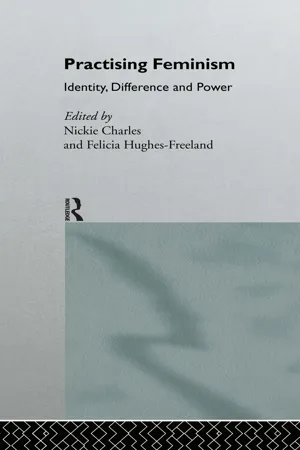
In Practising Feminism, contributors drawn from a range of backgrounds in anthropology, sociology and social psychology, explore different ways of practising feminism and their effect on gendered identities.
The contributors examine feminism and gender identities in different cultures, feminism as a politics of transformation, the call for recognition of heterosexuality as a politicised identity, the practical role of feminism in nationalist struggles, power relations and gender differences, and the methodological implications of feminist practices. They all discuss identity, difference and power and their importance to feminist political practice. Practising Feminism is an important contribution to the neglected middle ground between post-modern deconstructions of difference and identity, and continued feminist concern with grounded power relations and the validity of experience.
- 240 pages
- English
- ePUB (mobile friendly)
- Available on iOS & Android
eBook - ePub
About this book
Information
1
FEMINIST PRACTICES
Identity, difference, power
Over the past twenty years the ways in which gender and gender divisions are theorised have undergone substantial changes. Earlier assumptions of a shared oppression uniting women have given way to a recognition of difference and diversity, while the notions of human subjectivity and progress on which the political project of feminism is allegedly premised have been challenged. This book explores some of the issues raised by these changes and challenges. It is multi-disciplinary, drawing on sociology, social anthropology and social psychology. As a result it represents a diversity of approaches to practising feminism and illuminates the way in which feminist practice crosses disciplinary boundaries.
The first chapter provides a theoretical and political context for those which follow. It outlines the debates that have taken place within feminism since the emergence of women’s liberation movements in the late 1960s and early 1970s and discussses the way in which changing conceptualisations of gender relate both to feminist politics and to theoretical developments. A central concern is the relationship between theory and practice and a conviction that feminist political practice and academic feminism should be (but often seem not to be) related. This concern and conviction is shared by other feminist academics (Kelly et al., 1994; McNeil, 1993) although the relationship is not assumed to be unproblematic (Strathern, 1987). I focus initially on second-wave feminism as a political movement and the theoretical developments associated with it. I then discuss the challenge to feminism posed by post-structuralism and postmodernism and the way in which feminists have responded to this. Finally, I discuss the different ways of practising feminism that are represented in this book. Throughout I refer to the individual chapters, drawing upon the issues andthemes that are raised by the contributors and discussing their interconnections. Issues of identity, difference and power have been centrally important to feminist political practice and to the feminist response to the challenge of postmodernism; they provide a unifying theme both for the book and for this chapter.
IDENTITY, DIFFERENCE AND THE POLITICS OF WOMEN’S LIBERATION
The idea of a shared oppression that unites women in their struggle for liberation has been central to second-wave feminism. It is often seen as marking the emergence of women’s liberation movements while their subsequent fragmentation is linked to the recognition that ‘sisterhood’ hid differences and that women automatically shared neither interests nor identities. The uncomfortable acknowledgment of differences between women was precipitated by debates around sexuality and ‘race’/ethnicity and was associated with the emergence of identity politics and the fragmentation of western women’s liberation movements at the end of the 1970s (Ramazanoglu, 1989; Segal, 1987; Lovenduski and Randall, 1993). It became apparent that western women’s liberation movements had been based on a very specific identity, that of white, middle-class, young, highly educated and often heterosexual women, and that the demands and goals of such movements had been in their interests rather than in the interests of all women. Identity, as well as being inclusive of all those who share that identity is also exclusive of all those who do not. A politics based on identity is potentially divisive (Mohanty, 1992). Black feminists were particularly vocal in pointing out the exclusivity and ethnocentricity of women’s liberation movements, both in terms of their demands and in terms of the theorisations of women’s oppression that had been developed by white feminists (Bhavnani and Coulson, 1986; Davis, 1989). The universal pretensions of western feminism were called into question by groups of women whose interests were not represented by women’s liberation movements. Indeed they were called into question by groups of women whose interests were opposed to some of the demands, as they were then formulated, of western women’s liberation movements.
This characterisation of women’s liberation movements is not altogether accurate. Accounts also distinguish the presence of three political ideologies within the women’s liberation movements ofthe 1970s, liberal feminism, socialist feminism and radical feminism, which made varying assumptions about women’s ‘sameness’. Liberal feminism and radical feminism were not primarily concerned to theorise differences between women, concentrating instead on inequalities or differences between women and men. Socialist and marxist feminists, however, recognised theoretically and politically that women were divided by class, and attempted in their political organising to work with working-class women (Rowbotham, 1989). However, this tendency was not dominant within the movement (Barrett, 1980) and, while recognising differences of class between women, failed to take full account of other differences (Barrett and McIntosh, 1985; Barrett, 1988).
The analyses of women’s oppression that emerged from and fed into this political practice seem now to be highly problematic. At the time, considerable effort was made to understand the way in which women were systematically disadvantaged in relation to men. Emphasis was placed on analysing structures of oppression. Marxist-inspired analysis focused on the structure of production, arguing that women were structurally oppressed because their involvement in production was conditioned by their primary involvement in reproduction. It was noted that women the world over are the ones who are involved in feeding and caring for others—namely children and men. Radical feminists argued that patriarchy was a world-wide system that reduced women to the status of housewives and made them dependent on men (Mies, 1986). This dependence was reinforced and maintained by male violence towards women (Brownmiller, 1986). There were attempts to understand the way in which class interacted with sex-gender systems to produce women’s subordination (Rubin, 1975; Hartmann, 1986). It was seen as significant that women everywhere are associated with the private, domestic sphere and men with the public sphere (Rosaldo, 1974). Early analyses also focused on the distinction between nature and culture, arguing that all human societies value culture above nature and associate women with nature. This leads to a devaluing of women and women’s work and to their subordination (Ortner, 1974). These explanations were all concerned to explain a phenomenon that was assumed to be universal—women’s oppression. And they all locate the source of women’s oppression in structures; whether these be class structures, sex-gender systems or the structuring of the symbolic order.
Anthropologists working in the field of gender noted the cultural specificity of the terms within which these analyses were being conducted (MacCormack and Strathern, 1980) and feminist sociologists developed analogous critiques of sociological theory (Stacey, 1981). Thus production, it was argued, was not a gender-neutral term but was associated with men and masculinity within western cultures. The same was true of terms like ‘public’ and ‘culture’ itself. The structure of western philosophical thought in terms of gendered dichotomies was exposed, and it was within this framework that feminists had been constructing their analyses and explanations. The anthropological onslaught on the ethnocentricity of this sort of analysis came hard on the heels of the political critique of western feminism as a universalising discourse. Women could no longer be assumed to share a common oppression within the same society never mind the world over; assuming a transparency about the category ‘woman’ was shown to be based on essentialist ideas (Spelman, 1990). All women did not share an identity nor did they share political interests in any pre-given way.
In Britain this assertion of difference was associated with the emergence of identity politics within the women’s liberation movement and a shift in the analysis and explanation of women’s oppression. The notion of oppression was not abandoned but, instead of analysing it in terms of structures and systems, the construction of gendered subjectivities and identities was problematised; the focus shifted from class to culture, from structure to agency, from a concern with systematic gender divisions to a concern with gender identities based on difference (Barrett, 1992). Feminist identity politics tended to foreground individual behaviour and lifestyle rather than structures of oppression. Consumption and culture became the focus rather than production and employment.
Culture is central to identity politics. Identity formation is bound up with culture, different cultures or sub-cultures being associated with different identities. This has been argued in relation to national identity. Thus cultural representations of national communities generate a sense of national identity and a sense of belonging to a cultural entity, the nation (Anderson, 1991). It can also be argued in relation to feminism. At the end of the 1970s the dominant feminist identity of the British women’s liberation movement became split into many identities—of lesbians, of black feminists,of Irish feminists, of working-class feminists, of Jewish feminists—and recognised as being specific to a particular group of women (Lovenduski and Randall, 1993:87). The culture of western women’s liberation movements was alien to women who were not relatively young, white, middle-class, heterosexual and Euro-American. This alienation from feminism was experienced by women such as Domitila Barrios de Chungara, a Bolivian married to a tin miner. Her response when she was invited to a UN decade for women conference and encountered ‘western feminism’ for the first time is referred to by Davies (Chapter 7). She reacted particularly strongly to the highly individualistic and competitive feminism that conflicted with her sense of class solidarity with her companeros in Bolivia (Barrios de Chungara, 1978). Western feminism clearly had a cultural dimension which became visible when women from different cultures came into contact with it.
Within the British women’s liberation movement identity came to represent structure and a hierarchy of oppressions was established; the more oppressed identities you could lay claim to the nearer to ‘truth’ was your experience. As Lovenduski and Randall put it ‘only black women could understand the problems of black women: only lesbians could understand the oppression of lesbians: and so on. To disagree was to take part in the oppression. Disagreeing with a black woman was seen as racist, with a lesbian as homophobic, and so forth’ (Lovenduski and Randall, 1993:89). The emphasis was on personal responsibility for oppression rather than the social relations that situate individuals in different positions relative to one another. Thus not only were men a problem for women but heterosexual feminists became a problem for lesbian feminists, white feminists for black feminists and so on. The solution, if oppression is conceptualised in this way, is to change personal behaviour rather than to challenge wider structures. The attraction of psychoanalysis and therapy was that besides being about theorising subjectivity and agency, they offered a way for men and women to learn to be less oppressive (McNeil, 1993). Segal points out that this was the route taken by sections of the men’s movement which defined itself as sympathetic to feminism (Segal, 1990). And in the context of widespread demoralisation of the left and, in Britain, the ascendancy of successive Conservative administrations during the 1980s, it may be a perfectly understandable response to the apparent futility of attempting to change entrenched and powerful political structures.
There is an epistemological point to be made about the assumptions underpinning identity politics. Western women’s liberation movements from their earliest days valued women’s experiences and, through consciousness-raising groups, enabled women to share their apparently isolated and idiosyncratic experiences. For many women this led to the realisation that, far from being isolated and idiosyncratic, their experiences were common to many women and, furthermore, were not due to their personal inadequacies and failings but to the social relations within which they lived; society was to blame not the individual. Shared (though not necessarily identical) experiences provided the starting-point for constructing an understanding of a shared oppression. This was the meaning of the slogan ‘the personal is political’. Feminist identity politics, however, rested on the epistemological position that experience produces knowledge directly, reality is immediately knowable without the mediation of concepts or theory. An empiricist theory of knowledge underpins this position, ‘reality’ is transparent. Knowledge is given directly by experience and, if you do not have the experience, your knowledge is less valid. The issue of the relation between experience and knowledge is taken up by Griffin and Adams (Chapters 8 and 9). Both are opposed to an empiricist theory of knowledge, arguing that theory informs the way social actors interpret and understand their daily lives and that although knowledge must be able to account for experience, knowledge is not given directly by experience. Epistemological debates have become central to academic feminism and constitute one of the less accessible forms of feminist practice. However, the issues raised are crucial for feminist politics and will be returned to below.
At this point it is important to register a problem, both epistemological and political. The recognition of different identities and a privileging of experience as the only basis for knowledge poses a question: if all women are different and do not share the same experience of subordination, and if some women oppress other women because of ‘race’, class, sexuality, nationality, etc., how can there be a politics of women’s liberation? Can we still talk about women’s subordination? Is there a subject ‘woman’ capable of being politically active on her own behalf? Or has the fragmentation of identity pulled the rug out from under the political project of feminism? These questions mesh with many of those raised by post-structuralist and postmodernist writers and have beenprofoundly unsettling for feminism and for feminist political practice.
THEORETICAL CHALLENGES
Feminist critiques of the categories of western philosophical thought have revealed the gendered nature of the dichotomies that structure it. The dichotomy masculine—femine implies other oppositions: rationality—emotionality, culture—nature, production—reproduction, active-passive, dominant-subordinate, objective-subjective, aggressive—peaceful, and so on. The superordinate category in all these dichotomies is masculine; western philosophical thought has been exposed as being masculinist (Seidler, 1994; Coole, 1988). Many feminists argue further that not only is it masculinist but it represents a white, masculine perspective on reality, indeed that so-called objective and rationalist argument is neither dispassionate nor disengaged (Collins, 1991). The attempt to create a neutral observer is predicated on the existence of a privileged gendered subject who, by virtue of the labour of others (women and labourers of both genders), can abstract ‘himself from the material world and interpret it as if ‘he’ were not ‘himself’ implicated in it (Smith, 1988; Haraway, 1988). Rationality is only one way of knowing rather than the only way of knowing.
Two elements in the feminist critique of objectivity/rationality are discernible: one of these claims that all knowledge is subjective and therefore partial and the other claims that knowledge is relative because ‘reality’ is never experienced directly but is always already socially constructed—whether this be within language, discourse or ideology. In the first critique, the assertion of the subjectivity of knowledge and the particularity of the knowing subject (i.e. the knowing subject was always male) has led to a questioning of the status of knowledge. It constitutes an epistemological critique of the basis of scientific knowledge and questions the possibility of objective, rationa...
Table of contents
- Cover
- Title
- Copyright
- Contents
- Notes on contributors
- Preface and Acknowledgements
- 1. Feminist Practices: Identity, difference, power
- 2. Gender: Division or comparison?
- 3. Being a Feminist in Contemporary Greece: Similarity and difference reconsidered
- 4. Transgressions and Transformations: Experience, consciousness and identity at Greenham
- 5. Feminist Witchcraft: A transformatory politics
- 6. Deconstructing Heterosexuality: A feminist social-constructionist analysis
- 7. Nationalism: Discourse and practice
- 8. Experiencing Power: Dimensions of gender, ‘race’ and class
- 9. Women Returners and Fractured Identities
- Index
Trusted by 375,005 students
Access to over 1.5 million titles for a fair monthly price.
Study more efficiently using our study tools.
Frequently asked questions
Yes, you can cancel anytime from the Subscription tab in your account settings on the Perlego website. Your subscription will stay active until the end of your current billing period. Learn how to cancel your subscription
No, books cannot be downloaded as external files, such as PDFs, for use outside of Perlego. However, you can download books within the Perlego app for offline reading on mobile or tablet. Learn how to download books offline
Perlego offers two plans: Essential and Complete
- Essential is ideal for learners and professionals who enjoy exploring a wide range of subjects. Access the Essential Library with 800,000+ trusted titles and best-sellers across business, personal growth, and the humanities. Includes unlimited reading time and Standard Read Aloud voice.
- Complete: Perfect for advanced learners and researchers needing full, unrestricted access. Unlock 1.5M+ books across hundreds of subjects, including academic and specialized titles. The Complete Plan also includes advanced features like Premium Read Aloud and Research Assistant.
We are an online textbook subscription service, where you can get access to an entire online library for less than the price of a single book per month. With over 1.5 million books across 990+ topics, we’ve got you covered! Learn about our mission
Look out for the read-aloud symbol on your next book to see if you can listen to it. The read-aloud tool reads text aloud for you, highlighting the text as it is being read. You can pause it, speed it up and slow it down. Learn more about Read Aloud
Yes! You can use the Perlego app on both iOS and Android devices to read anytime, anywhere — even offline. Perfect for commutes or when you’re on the go.
Please note we cannot support devices running on iOS 13 and Android 7 or earlier. Learn more about using the app
Please note we cannot support devices running on iOS 13 and Android 7 or earlier. Learn more about using the app
Yes, you can access Practising Feminism by Nickie Charles,Felicia Hughes-Freeland in PDF and/or ePUB format, as well as other popular books in Social Sciences & Cultural & Social Anthropology. We have over 1.5 million books available in our catalogue for you to explore.