- 288 pages
- English
- ePUB (mobile friendly)
- Available on iOS & Android
eBook - ePub
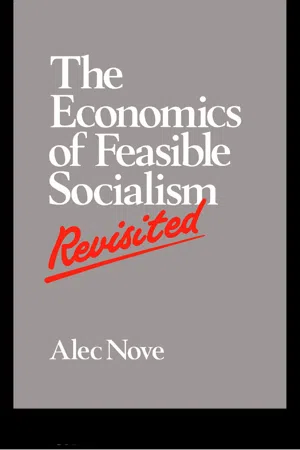
The Economics of Feasible Socialism Revisited
About this book
Characteristically readable, controversial and full of insights, Alec Nove's new book is essential reading for anyone concerned with evaluating the relevance of Marxism to contemporary social and economic problems.
Information
Part 1
The Legacy of Marx
What Did Marx Mean by Socialism?
It is my contention that Marx had little to say about the economics of socialism, and that the little he did say was either irrelevant or directly misleading. The word ‘feasible’ is in the title of this book as a kind of flank guard against utopian definitions. One can, if one chooses (and, as I shall show, many have so chosen), define socialism in such a way that economic problems as we know them would not, indeed could not, exist. If one assumes ‘abundance’, this excludes opportunity-cost, since there would be no mutually exclusive choices to make. If one assumes that the ‘new man’, unacquisitive, ‘brilliant, highly rational, socialised, humane’, will require no incentives, problems of discipline and motivation vanish. If it is assumed that all will identify with the clearly visible general good, then the conflict between general and partial interest, and the complex issues of centralisation/decentralisation, can be assumed out of existence. If human beings in society can see ex ante what needs to be produced and the correct way of producing and utilising all products, then there is no need for ex post verification; the indirect and imperfect link between use-value and exchange-value, via exchange relations and the market, can be replaced by direct conscious human decisions on production for use. Division of labour will have been overcome, by ‘brilliant’ multipurpose human beings. ‘While not everyone may be able to paint as well as Raphael, everyone will be able to paint exceedingly well.’ Everyone will govern, there will not be any governed. Since all competing interests will have disappeared, there will be no need to claim rights of any sort, no need for restrictive rules, laws, judges, or a legislature. Of course, there will be no state, no nation-states (and so no foreign trade, or any trade). The wages system will have gone, as well as money.
Bertil Ollman has gathered together Marx’s sayings about communist society, and the above represents a summary, with a few quotations, of his article.1 He points out, correctly, that Marx never offered a systematic account of communist society, that he considered such attempts as ‘foolish, ineffective and even reactionary’. One has broad indications, scattered about his works, often in the form of a contrast with the capitalist system that he was criticising.
It is sometimes alleged that no distinction was known to Marx between socialism and communism, or even that such a distinction was an invention attributable to Stalin and Stalinists. This is surely not so. Marx’s Critique of the Gotha Programme spoke of a first or lower stage. And certainly Bukharin and Preobrazhensky distinguished between socialism and communism on similar lines; see their ABC of Communism, which expressed the Marxist-Leninist orthodoxy of the time. Trotsky, too, spoke of ‘the lower stage of communism or socialism’, even while denying that Stalin’s Russia had reached that stage.2 The ideologists of Brezhnev’s USSR claimed that it is a society of ‘mature’, or ‘developed’ socialism, and engaged in ‘building communism’. Many Marxists sharply criticise the Soviet system, denying its claim to be socialist. It is then relevant to ask: by what criteria is one to judge the claim? Clearly no one supposes that the USSR is communist in the ‘Ollman’ sense. Most people, surely also most Marxists, do not believe that it could have been. Some prefer to regard any society which is not communist, but is on the road towards communism or ‘real’ socialism, not as ‘socialist’ but as ‘transitional’. Some apply this term to the USSR, others attack it as a new kind of class system. This is not the place for a discussion of this topic.3 I should like instead to include in my own definition of ‘feasible socialism’ the notion that it should be conceivable within the lifespan of one generation—say, in the next fifty years; conceivable, that is, without making extreme, utopian, or far-fetched assumptions. I would add that for a society to be regarded as socialist one requires the dominance of social ownership in the economy, together with political and economic democracy. My reasons for not at present going beyond this doubtless oversimple definition will become apparent later.
It is surely the case that Marxists saw communism not as a distant dream, but as an attainable reality, ‘feasible’ in the sense used here. Such men as Lenin, Trotsky, Bukharin, sincerely believed that young party members might see its achievement. The ‘socialism’ of the Critique of the Gotha Programme is already a long way towards communism, the principal difference being that rewards would be in accordance with work and not yet with need, and workers would be issued with vouchers in respect of the time they devoted to social labour. Bettelheim is right in ascribing to Marx and Engels the view that, when socialism wins, when the workers take hold of the means of production, ‘even at the beginning there would be neither commodities, nor value, nor money, nor, consequently, prices and wages’.4 So there is much to support the proposition that classical Marxism saw socialism and communism as, if not exactly interchangeable terms, then as one being the incomplete stage of the other, containing many of its essential elements.
The problem that we must tackle is twofold. First, what view did Marx and his followers take of the political economy of socialism? Secondly, what are we to make of their general image or model of a socialist society?
One answer, supported by a considerable set of precedents, is that there is not and cannot be a political economy of socialism. Let me quote Bukharin:
Political economy is a science…of the unorganised national economy. Only in a society where production has an anarchistic character, do laws of social life appear ‘natural’, ‘spontaneous’ laws, independent of the will of individuals and groups, laws acting with the blind necessity of the law of gravity. Indeed, as soon as we deal with an organised national economy, all the basic ‘problems’ of political economy, such as price, value, profit, etc., simply disappear. Here the relations between men are no longer expressed as ‘relations between things’, for here the economy is regulated not by the blind forces of the market and competition, but by the consciously carried out plan… The end of capitalist and commodity society signifies the end of political economy.5
This may seem to follow from the definition of socialism that Bukharin thought he inherited from Marx. If economics is concerned with uncontrolled (‘anarchic’) phenomena, with purchase-and-sale, exchange, markets, profits, money, exploitation, then what relevance can it have under socialism? The ‘law of value’, and economic laws generally, relate to capitalism.
Similar opinions were expressed also by Preobrazhensky, in the course of discussions in the 1920s with such Marxist economists as SkvortsovStepanov. He wrote that to consider that political economy relates ‘to relations of production in general. contradicts totally all that Marx has written on the object and methods of political economy…’.6 Bukharin made several times the point that ‘in an organised economy… a socialised economy of the socialist state, we would not encounter a single problem the solution of which is related to the theory of political economy’. Skvortsov-Stepanov, on the contrary, argued that Marxist economics ought also to relate to pre- and post-capitalist formations. He was in a small minority at the time.
Naturally, they recognised that the law of value survived in the USSR of the New Economic Policy (NEP); but this was because of the survival of private property and of the market-based relationship with the peasantry. Under socialism, by definition, it would be eliminated. There would then be something like ‘scientific management’, ‘the science of socially organised production’, but it would not be economics. These were phrases used respectively by Bukharin and Preobrazhensky. A remarkably welldocumented survey of the debate on the law of value and other economic laws under socialism has been written by Louis Baslé.7
Already in 1920 Lenin was not satisfied with such an answer. In his marginal notes on Bukharin’s Economics of the Transition Period, he remarked, first, that it is not quite true to describe capitalism as ‘unorganised’: it too is organised. He also pointed to the survival even under communism of such economic laws as those governing the basic proportions of the economy.8 He might have agreed with Baslé, who imagined two species or aspects of the law of value: ‘LV1’ relates to the allocation of labour in various proportions for various purposes, which must exist in any society, and ‘LV2’ is the form in which this manifests itself in the commodity economy, with exchange, markets, competition, and so on.
Some contemporary Soviet economists adopt a similar posture. Thus Kosolapov quotes in his support the following from Volume III of Das Kapital:
After the abolition of capitalism… under socially organised production, value determination [opredeleniye] remains dominant in the sense that the regulation of labour time and the distribution of social labour between different sectors of production, and the accountancy that encompasses all this, become more important than ever.
Kosolapov draws from this the conclusion that there will be no commodities and no value, as there will be no one to exchange with, and that commodities and values will exist.9 Presumably by putting forward this deliberately contradictory view he is trying to argue on the lines of Baslé’s ‘LVl’ and ‘LV2’.
This question is discussed in an interesting essay by X. Richet,10 and also by the Hungarian A. Brody,11 and by A. Mattick, 12 who in their various ways consider the meaning of Marx’s recognition of the fact that all societies need to distribute social labour in given proportions to satisfy needs. Richet challenges Mattick’s assertion that Marx did not have in mind an ‘economic law of universal validity’, thereby taking up a position similar to Baslé’s ‘LVl’. Brody writes: ‘For Marx the notion of value becomes significant from the time that there is choice between various activities and various products’; while Marx sees that there can be no exchange-value in the absence of commodity production,
nevertheless the underlying notion, value, will be present so long as there is division of labour, so long as there are different activities to be compared. So long as it is necessary to economise the labour of society, the notion of value is necessary whether or not there is a market…
But in any case the purely negative answer cannot possibly satisfy us, and this for several reasons. First, it amounts to saying that economic problems in socialism would have to be solved without reference to Marx or Marxism, which, unless one so defines socialism as to ensure the absence of economic problems, leaves one in an uncomfortable intellectual void. One must discuss what sort of economic problems it is reasonable to expect to encounter in any socialism defined with some reference to real-life possibilities. Secondly, Marx’s own view of capitalism, his basic analysis of its features, rests explicitly and implicitly on his picture of an alternative society. Its precise blueprint he left vague, and so should we, but its essential features cannot be simply assumed to be the unanalysed consequences of revolutionary struggle. Thirdly, it is important for Marxists, or for anyone analysing feasible socialism, to face up to the objection that what is proposed is an unrealisable utopia. As long ago as 1908 Barone, commenting on the failure of the Marxists of his time to reply to his arguments, wrote that ‘their attitude in this respect is reminiscent of the reluctance with which dogmas of religion are discussed, especially when the latter has great propaganda value’.13 Seventy years later another Italian, Luciano Pellicani, after listing some dogmatic assumptions about a socialist future, wrote that ‘they make impossible any critical discussion on the realism or validity of the revolutionary alternative’. He spoke of the ‘Reign of liberty of Marx and Engels corresponding to the Paradise of the Christians: it is not describable with the conceptual categories at our disposal—hence the typical refusal of the revolutionary gnostic to speculate about the future society’.14
These same problems worry Marxists too. Thus, referring to the vision of the future of the young Marx (at the end of a vigorously Marxist analysis of capitalist crisis), Alain Lipietz wrote of ‘the idealist aspect of materialist dialectics’, the ‘dream’ of totally liberated humanity: Marx wrote ‘pages as beautiful and shadowy as the Gospel according to St John: the 1844 manuscripts. Indeed behind Feuerbach and Hegel one feels the myth of the Cross and the Resurrection, called here Alienation and Reappropriation.’15 Such ‘religious’ references could be multiplied. Finally, commenting on the Ollman article concerning Marx’s vision of socialism-communism, David Murray, in Radical Philosophy, agrees with Ollman that ‘giving workers … a better notion of what life would be like under communism is essential to the success of the socialist project’, but then attacks him for ‘his consistent refusal to relate Marx’s writings to their subsequent use, or even to their practical relevance’.16 Murray goes on to criticise the incompleteness and ambiguities of Marx’s own formulations (for example, on the abolition of division of labour and on the need for a ‘directing will’ in organising production, matters which will be discussed at length later), and ends by asking: ‘how effective would this [i.e. Ollman’s] account be in persuading people of the desirability of communism?’ His reply: it would be ‘a piously dull place…the presentation of such a utopia would have the opposite effect to that which Ollman wishes’.
One might include Debray here: after some fine romantic revolutionary eloquence, faintly tinged with irony, he asks:
What does all this mean? To do what? At what cost? For what aim?
Inappropriate questions…Impertinent; maybe pertinent from the outside, but without relevance to the subject. For the acts of the revolutionary are too disinterested for him to lower himself to considering the usefulness, the results, or the limits of revolution…Such questions, apart from sapping our energy, would deprive the revolution of its entire point by subjecting it to the contemptible criteria of efficacy, a task undertaken only by those who do not make revolutions…17
I have been accused by at least one Marxist-millenarian of being a ‘conservative’ because I question the validity of the romantic-utopian-religious elements of the Marxist tradition. I have great respect for faith. The Russian Christian socialist Levitin-Krasnov wrote: ‘If the ideal of a society without rich or poor, wi...
Table of contents
- Cover Page
- Title Page
- Copyright Page
- Preface
- Preface to the Second Edition
- Introduction: Socialism—Why?
- Part 1: The Legacy of Marx
- Part 2: Socialism and the Sovient Experience
- Part 3: Reform Models and Experiences
- Part 4: Transition
- Part 5: Feasible Socialism?
- Appendix 1: On Contradiction
- Appendix 2: Three Critiques
- Appendix 3: A Note On Utopia
Trusted by 375,005 students
Access to over 1.5 million titles for a fair monthly price.
Study more efficiently using our study tools.
Frequently asked questions
Yes, you can cancel anytime from the Subscription tab in your account settings on the Perlego website. Your subscription will stay active until the end of your current billing period. Learn how to cancel your subscription
No, books cannot be downloaded as external files, such as PDFs, for use outside of Perlego. However, you can download books within the Perlego app for offline reading on mobile or tablet. Learn how to download books offline
Perlego offers two plans: Essential and Complete
- Essential is ideal for learners and professionals who enjoy exploring a wide range of subjects. Access the Essential Library with 800,000+ trusted titles and best-sellers across business, personal growth, and the humanities. Includes unlimited reading time and Standard Read Aloud voice.
- Complete: Perfect for advanced learners and researchers needing full, unrestricted access. Unlock 1.5M+ books across hundreds of subjects, including academic and specialized titles. The Complete Plan also includes advanced features like Premium Read Aloud and Research Assistant.
We are an online textbook subscription service, where you can get access to an entire online library for less than the price of a single book per month. With over 1.5 million books across 990+ topics, we’ve got you covered! Learn about our mission
Look out for the read-aloud symbol on your next book to see if you can listen to it. The read-aloud tool reads text aloud for you, highlighting the text as it is being read. You can pause it, speed it up and slow it down. Learn more about Read Aloud
Yes! You can use the Perlego app on both iOS and Android devices to read anytime, anywhere — even offline. Perfect for commutes or when you’re on the go.
Please note we cannot support devices running on iOS 13 and Android 7 or earlier. Learn more about using the app
Please note we cannot support devices running on iOS 13 and Android 7 or earlier. Learn more about using the app
Yes, you can access The Economics of Feasible Socialism Revisited by Alec Nove in PDF and/or ePUB format, as well as other popular books in Politics & International Relations & Politics. We have over 1.5 million books available in our catalogue for you to explore.