- 184 pages
- English
- ePUB (mobile friendly)
- Available on iOS & Android
eBook - ePub
About this book
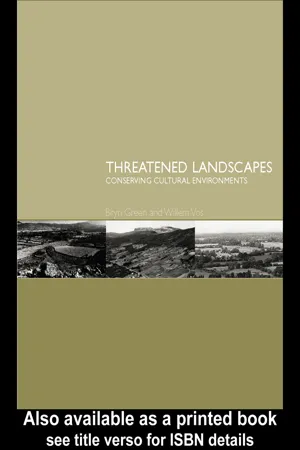
Few, if any, environments are free of human intervention. Often this generates ecosystems which are rich in biodiversity, historical interest, recreational opportunity and scenic beauty just as worthy of conservation as the more natural ecosystems on which protection programmes have been almost exclusively focussed.
These 'cultural landscapes', ranging from the farm and forest lands of Europe and Eastern North America, through to the pasture lands and savannas of the Middle East and Africa to the paddylands of the Pacific Rim, are usually the product of relatively low-level, sustainable exploitation of the environment over long periods of time. Many have survived for centuries, if not millennia, but now urban expansion, depopulation of rural areas and, most damagingly, the intensification of agricultural and sylvicultural practices, are everywhere leading to a loss of their cherished biodiversity and amenity. Whilst past changes have mostly added to the valued characteristics of these landscapes, modern farming and forestry are creating sterile monocultures on the better land whilst marginal lands are being abandoned.
This book documents these changes, illustrates them through detailed case studies of a representative selection of threatened landscapes, analyses their underlying causes and explores ways by which they can continue to be maintained, or new landscapes created which maintain their desired characteristics.
Information
Publisher
Taylor & FrancisYear
2003Print ISBN
9780419256304
9781138437425
Edition
1eBook ISBN
9781135802561
Part One
What are landscapes?
Chapter 1
Landscape development and change
F.H.A. Aalen
We do not enough conceive for ourselves that variegated mosaic of the world’s surface which a bird sees in its migration … We know the differences in detail, but we have not that broad glance and grasp which would enable us to feel them in their fulness.
(Ruskin, J. 1844)
Introduction
The great physical and cultural variety of Europe has resulted in a profusion of contrasting landscapes. Broad latitudinal zones of distinctive relief, climate and natural vegetation cross the continent; moving from south to north, they include the Mediterranean evergreen woodland, the massive barrier of Alpine ranges, a wide belt of temperate deciduous forest on the North European Plain and, beyond it, the subarctic coniferous forest and treeless tundra of the Scandinavian north. Within these major ecozones, and especially marked in the major mountain chains, there is a mosaic of interlinked local ecologies. This ecological frame has actively influenced a long, eventful history involving many ethnic groups and major civilizing forces. A complex pattern of agrarian settlement traditions emerged, intimately adjusted to the natural background but also transforming it. European landscapes are indeed a complex meshing of nature and culture, created by millennia of dynamic interaction between communities and their habitats. Through the careful study and historical reconstruction of these landscapes we can uncover new and useful evidence of humanity’s transformation of and by the earth.
The study of landscape history
Landscape history aims to describe and understand landscapes in their entirety (embracing all features be they contemporary, historic, abandoned or buried) and as objectively as possible, and to construct a realistic account of the longterm processes of landscape development using fieldwork, aerial survey, relevant scientific techniques and historical sources. As an object of study, the landscape is shared by many disciplines. It is central to landscape ecology and has been a long-standing if fluctuating concern within geography. Other contributing disciplines include: palaeoecology, which provides detailed accounts of past vegetation and landscape change and is especially relevant to the earliest and inescapably obscure phases of human transformation of nature which have left few or no traces in the present landscape (Birks et al. 1988); landscape archaeology, which attempts to reconstruct the totality of settlement patterns in ancient landscapes (Fleming 1998, Fabech & Ringtved 1999, Ucko & Layton 1999, Cooney 2000); and environmental history, or ecohistory, a strengthening historical field embracing an ecological perspective on human activities as against the perceived ‘anthropocentricity’ of traditional history and much of geography (Worster 1988, Russell 1997, Grove & Rackham 2001).
Landscape history is thus inherently inter-disciplinary and without an agreed body of theory or methodology. However, it is a potentially strong medium for unifying the varied perceptions of the complex aspects of landscape and thereby generating some rapprochement between disparate and discrete bodies of knowledge. Society and its environment are in constant transition, and understanding their inter-connections in the formation of a landscape requires collaboration between humanities and sciences and deep time-perspectives. La longue durée is also essential to effective landscape management; carefully locating the present in a long-term trajectory of change highlights the historical and ecological significance of the landscape’s present-day components and helps to evaluate the potential impact of contemporary and future trends.
There is at present an upsurge of interest in landscape study in several disciplines. In part, this reflects attempts to overcome perceived deficiencies of approach within the disciplines themselves. However, it is also a manifestation of wider public awareness that landscapes are rapidly changing and that their quality and diversity have been seriously diminished in recent decades by many potent forces, such as intensive mechanized farming, largescale afforestation, mass tourism, despoliation around industrial cities and the abandonment and decay of valued cultural landscapes owing to rural depopulation. Peoples and governments, it is now argued, must protect and enhance landscape qualities, and the landscape has moved on to international as well as national policy agendas (Stanners & Bourdeau 1995, Aalen et al. 1997). At the same time, landscape approaches have moved into the mainstreams of conservation thought, mainly through the agency of landscape ecology. The idea of landscape has singular applicability to current problems and policies. To ‘think landscape’ is to think not about single elements but about wholes which are expressions of coherent natural and cultural processes. This focus on the linkage of nature and people has a special resonance in the post-Rio period with landscapes presented as natural frameworks for initiatives in sustainable development (Wascher 2000).
The meshing of nature and culture
Research in various disciplines over recent decades has provided evidence that human influences on nature are more pervasive and profound than formerly envisaged and has brought a fuller appreciation of the deep historical roots of Europe’s landscapes. Vegetation types and soil types, for example, have been much modified by prehistoric and historic systems of land use, and many landscape elements once regarded as natural, such as grasslands, bogs, heaths and karsts, have been deeply influenced by humans. Save in the remoter parts of the northern taiga forests, little survives of the continent’s natural primary forest cover, owing to clearance and disturbance by the grazing, burning and woodcutting activities of farming communities. The depleted forests, however, have been decisive in shaping the prevailing patterns of secondary vegetation. In long settled and deeply humanized areas such as Europe, a simple distinction between natural and cultural landscapes is thus unwarranted; the concept of a gradient of human impact is more useful (Birks et al. 1988).
The close intertwining of human and natural processes complicates the reconstruction of landscape history. Hence, it is often difficult, especially in prehistory, to disentangle natural from human processes and establish a clear pattern of causation. It is not always clear, for example, whether or how far the patterns observable in a fossil pollen record are the result of climatic changes or human impacts; early deforestation by humans may alter vegetation in ways that mimic climatic shifts, and at some stages humans may have been accentuating natural changes, while in others working contrary to them. Or again, did the frequent submergence of prehistoric fields and settlements under peat bogs in Britain and Ireland result simply from natural processes of bog expansion during moist phases, or was it induced by early human interference with the natural vegetation cover, leading to intensified leaching, hard-pan development and local waterlogging? Even more controversial is the interpretation of Greek environmental history. The stony barrenness of much of Greece seems incongruous with the great cultural achievements in the Bronze Age and classical times. Was the land greener and more productive during the great days of Greek civilization and was it the demands of civilization which eventually precipitated an environmental collapse through deforestation, soil erosion and overgrazing? Or could environmental changes without human agency have led to the cultural decline? Yet another possibility is that the Greek environment has not substantially changed at all and cultural eminence and decline resulted from purely social and political processes. Despite considerable recent research on Greece, there are still widely divergent views on these matters (Rackham 1990, Runnels 1995), although the weight of expert opinion seems to lie with anthropic origins and point to a long history of misusing the land.
Changes in cultural landscape are expressed not only in human settlement patterns and the rural economy but have often involved considerable alteration to the physical setting by, for example, drainage, flood control, and modification and erosion of the soil. Contemporary landscape in many places has been so deeply modified by human activity that it can be a misleading analytical template upon which to base studies of past human settlement and exploitation; earlier settings, especially on flood plains and the surroundings of major cities, must be carefully reconstructed using a variety of methods. Most societies have had to relate to already deeply humanized landscapes, not to a natural environment, and while it is an exaggeration to speak of ‘retrospective determinisms’, such landscapes are not simply a passive recipient of human activity but an active element in the evolution of the society using it, constraining and influencing the activities of subsequent inhabitants (Chapman & Dolukhanov 1997).
Time layers in the landscape
Aerial survey, field archaeology and improved geochronological techniques have shown that prehistoric populations in Europe were more numerous and their settlements and field systems more widespread and ordered than once assumed (Cunliffe 1994). Moreover, many of the cultural outlines in the present-day landscape are much older than previously thought. For example, regular land divisions still visible on the infields in southern Vastergotland (Sweden) seem to be prehistoric in origin, and walled enclosures associated with Iron Age forest clearances on the Baltic island of Gotland have survived into historic times (Helmfrid 1994). On Dartmoor and in other areas of England, there are extensive fossil field systems consisting of long, parallel stony banks (reaves), often extending for many miles, which are attributed to large-scale landscape planning in the Bronze Age (Rackham 1986). Comparable field patterns of Neolithic date have been discovered under bogs in western Ireland and the excavated dry-stone walls are similar to and, in some instances, connect with the walls still used on the surrounding land (Cooney 2000).
Some ancient agrarian structures have been notably enduring. For example, centuriation, a regular grid of rectangular holdings with an approximate area of 50ha, originated as part of a systematic general plan for colonization in parts of the Roman Empire. Many later features were inserted, but the imprint of these monumental frameworks can still be clearly seen in many areas, such as the Po plains and Campania (Italy), and the basic lines often determine the orientation of fields and lines of trees as well as boundaries and local roads (Sereni 1997). Rectilinear field systems were used earlier in planned Greek colonies and can still be traced in the landscapes of the Mediterranean and Black Sea coasts. These extensive Roman and Greek projects are somewhat comparable in their scale and endurance to the archetypal dry-field (ti) landscapes of the North China plain; the latter are characterized by narrow, rectangular plots which, it has been suggested, may represent a progressive subdivision of an earlier chequerboard pattern, introduced by the state to distribute land to peasants in equal units.
Clearly, present-day landscapes are not the product of modern activities alone but have matured over lengthy periods of prehistoric and historic time and bear the imprint of a range of past cultures and patterns of land use and settlement. Indeed, at every point in history a landscape always consists largely of its past. A sequence, or palimpsest, of distinctive landscape patterns is sometimes discernible, superimposed on each other. Each time the land-scape was remodelled, fragments of the earlier system tended to survive in undisturbed places or to show through the newer pattern in a subdued, less legible form. These earlier patterns can be readily distinguished when they are independent features out of phase with standing field divisions and roads. Where, however, older features, such as field boundaries, have been adapted and incorporated piecemeal into a changing landscape, they may be difficult to identify without careful study and the antiquity and continuity of landscape features can consequently be underestimated. Extensive traces of early landscapes remain buried beneath the ground surface and can be revealed with uncanny clarity on aerial photographs as ‘crop-marks’, subtle colour variations in crops growing above the sub-surface archaeological remains. Photographs taken in contrasting weather and crop conditions provide extra detail and permit a composite map of the ‘hidden landscape’; this is particularly helpful in fertile, arable areas where earlier surface features have often been erased by successive occupation and intensive cultivation.
Dynamics of landscape change
The dialectic between society and habitat leads to a continuous process of landscape change. Cultural changes, such as population increase, growing social complexity and technological capacities, constantly alter human relationships to their environment. The environment itself can sometimes change independently through, for example, climatic change, shifts in sea level or the spread of plant and animal diseases, but landscape changes are more often a direct response to human impacts. Although phases of marked landscape transformation through human agency can be recognized, change was normally gradual and partial because the ability to restructure human ecology developed slowly and the inherited landscape fabric, so costly of human effort to create, remained intact unless subjected to exceptional pressures. Even in the most artificial landscapes, however, human activities do not override ecological processes. Rather they channel them towards a culturally preferred outcome, which may not be stable or sustainable in the long run. It seems that land-use practices have often been continued to the verge of ecological breakdown and the succession of fundamental transformations evident in the history of cultural landscapes, whilst no doubt multicausal, may in part reflect the search for new relationships with nature made necessary by the instability or failure of earlier ones. The landscape palimpsests of Europe are expressions of changing socio-economic organization, but the crucial question is how far the changes were of necessity or choice. Palimpsests also reflect the resilience of European nature, which, in a relatively benign climate, had the capacity to absorb change and regenerate, its recuperative powers generally outbalancing various forms of misuse.
The idea that the land-use systems of pre-agricultural and traditional peasant societies were relatively stable owing to practices and beliefs evolved to maintain some equilibrium with the landscape and involving concepts of resource conservation has support among some ethno-ecologists but may be misguided (Sanders & Webster 1994). Human adaptation is highly dynamic and population growth and societal changes were invariably accompanied by an intensified use of the natural environment which was opportunistic and little concerned with long-range problems. There was a tendency to stretc...
Table of contents
- Cover
- Halftitle
- Title
- Copyright
- Contents
- Foreword
- Preface
- List of Contributors
- Part One: What are landscapes?
- Part Two: Landscapes worthy of protection
- Part Three: Landscape conservation
- References
- Index
Trusted by 375,005 students
Access to over 1.5 million titles for a fair monthly price.
Study more efficiently using our study tools.
Frequently asked questions
Yes, you can cancel anytime from the Subscription tab in your account settings on the Perlego website. Your subscription will stay active until the end of your current billing period. Learn how to cancel your subscription
No, books cannot be downloaded as external files, such as PDFs, for use outside of Perlego. However, you can download books within the Perlego app for offline reading on mobile or tablet. Learn how to download books offline
Perlego offers two plans: Essential and Complete
- Essential is ideal for learners and professionals who enjoy exploring a wide range of subjects. Access the Essential Library with 800,000+ trusted titles and best-sellers across business, personal growth, and the humanities. Includes unlimited reading time and Standard Read Aloud voice.
- Complete: Perfect for advanced learners and researchers needing full, unrestricted access. Unlock 1.5M+ books across hundreds of subjects, including academic and specialized titles. The Complete Plan also includes advanced features like Premium Read Aloud and Research Assistant.
We are an online textbook subscription service, where you can get access to an entire online library for less than the price of a single book per month. With over 1.5 million books across 990+ topics, we’ve got you covered! Learn about our mission
Look out for the read-aloud symbol on your next book to see if you can listen to it. The read-aloud tool reads text aloud for you, highlighting the text as it is being read. You can pause it, speed it up and slow it down. Learn more about Read Aloud
Yes! You can use the Perlego app on both iOS and Android devices to read anytime, anywhere — even offline. Perfect for commutes or when you’re on the go.
Please note we cannot support devices running on iOS 13 and Android 7 or earlier. Learn more about using the app
Please note we cannot support devices running on iOS 13 and Android 7 or earlier. Learn more about using the app
Yes, you can access Threatened Landscapes by Bryn Green,Willem Vos in PDF and/or ePUB format, as well as other popular books in Biological Sciences & Urban Planning & Landscaping. We have over 1.5 million books available in our catalogue for you to explore.