Popular music is with us constantly. It is part of our everyday enviroment and in global terms it is now perhaps the most universal means of communication.
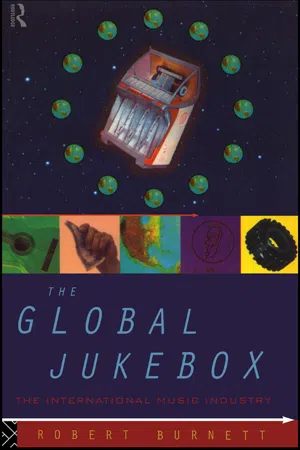
The Global Jukebox is the first comprehensive study of the international music industry at a time of great change, as the entertainment industry acknowledges its ever growing global audience. Robert Burnett provides an international overview of the music business and its future prospects in the UK, Northern Europe and the United States and Canada. He examines the relationship between local and global cultures and between concentration of ownership (Sony, Warner and the rest of the `big six') and the diversity of music production and consumption.
The Global Jukebox not only illuminataes the workings of the contemporary entertainment industries, it captures the dynamics at work in the production of musical culture between the transnational media conglomerates, the independent music companies and the public. It is essential reading for anyone studying popular music.
- 192 pages
- English
- ePUB (mobile friendly)
- Available on iOS & Android
eBook - ePub
About this book
Information
Chapter 1
Introduction
Popular music is with us constantly, it is part of our everyday environment, and increasingly part of the aural or sonic soundscape that surrounds us. Not only do we listen to music in our homes and at concerts, but also as a background in cars, bars, aeroplanes, restaurants and shopping malls. Tagg (1982:37) has estimated that the ‘average Westerner’s brain probably spends around twenty five per cent of its lifetime registering, monitoring and decoding’ popular music. Chambers (1982:19) has noted that popular music is ‘one of the more powerful expressions of the “culture industry”’ worldwide. Robinson (1986:33), goes as far as to claim that popular music ‘is the only truly universal mass medium’. Certainly most people would agree with Bradley’s (1981:205) observation that ‘music speaks a universal language of emotions’. Popular music is now the lingua franca for a large segment of the world’s youth population. It’s probably fair to say that music is the most universal means of communication we now have, instantly traversing language and other cultural barriers in a way that academics rarely understand.
Indeed, whereas consumption of other media products is often limited by geographical availability and consumer income, almost anyone anywhere can listen to popular music, often regardless of whether they want to or not. Most of us at one time or another have felt pursued by music itself. In this respect popular music is certainly the most global aspect of our ‘global village’.
It was a Canadian, the late Marshall McLuhan, who called the world a ‘global village’ created by the homogenizing effects of the universal availability of new electronic technologies. Since he long ago coined the phrase our world has shrunk even further and our horizons have grown wider through new media technologies such as computers, digitalization, video cassettes, satellite broadcasting and cable television. The evolution of technology and the proliferation of global cultural products have had many effects, not the least of which is the fact that the ‘stars’ of the contemporary entertainment industry are increasingly catering to an international audience that is constantly growing. McLuhan was not thinking of popular music when he coined his now famous phrase, though he might well have been. Today, we are all listening to the global jukebox.
In 1994 more than 90 per cent of the gross sales of recorded music worldwide came from albums, singles and music videos owned or distributed by one of six multinational corporations: Time Warner, Sony, Philips, Bertelsmann, Thorn-EMI and Matsushita. Some day soon, the Big Six expect to transmit albums directly into our homes. We will no longer have to visit the record store to buy prerecorded music. The record shops of today may be replaced by ‘virtual music shops’ on the Internet.
This is something that the music industry is well aware of. The director general of the branch organization, the International Federation of Phonogram and Videogram Producers, recently commented:
We know, at some time in the future, recorded music will be widely available on-line, interactively, and as a major part of multimedia products; but at present we rely almost exclusively on retailers for the revenue which drives the industry. Our challenge, in terms of developing rights for producers, is how to get from here to there, with an industry intact.
(IFPI, 1995)
The transnationals are intent on keeping control of the music business. ‘One of the definitions of a major record company is that you are in the distribution business’, said an industry executive. ‘We don’t simply want to be providers of content to someone else’s electronic delivery system. Why would we empower someone else to do this?’ (Details, 1994).
Roughly speaking, it costs a major label about one dollar to manufacture and package a CD, and another dollar for distribution. Royalties to the artist and songwriter average between one and two dollars per CD. Retailers then add about five dollars to the cost of each CD. Clearly in this equation the major labels are making big money. Now if the Big Six could download their products into our homes, they could reduce their manufacturing and distribution costs as well as eliminate the retailer from the picture. They would make more money and we, the consumers, theoretically might pay less per album. While nobody knows exactly how music, film and information will be delivered into our homes, it is only a matter of years before it starts happening on a major scale.
Popular music is also a phenomenon of increasingly worldwide significance. The international music industry based on the production and sales of phonograms (records, cassettes, mini and compact discs) had an annual turnover in 1994 of $33 billion US worldwide (IFPI, 1995). The industry’s products have wide-ranging effects on our acoustical environment, either directly or with the assistance of other forms of mass communication. Phonograms are potent and omnipresent carriers of culture and agents of socialization for whole generations of youth.
Academic research has traditionally shown little systematic interest in popular music. The study of popular music as well as popular culture in general has rarely been considered a serious academic pursuit. Consequently, because of academic neglect, there are gaps in our knowledge about most aspects of popular music. There is still little recognition that music is possibly a much more important component of youth experience with mass media than television, for instance, which has been the subject of intense and wide-ranging research for decades. This lack of interest in popular music by the academy is strongly contrasted by the enthusiasm shown by non-academics. The problem is that most works on popular music and the music industry simply offer a fan’s account of the major performers or the most popular songs, although there are also a number of serious works including biographies of major figures, considerations of aspects of the music business or analyses of various styles. None of these, however, give a coherent picture of both the industry and the commercial factors that lie behind the music.
Fortunately the lack of interest on behalf of the academy appears to be changing. Blumler (1985) has criticized the mainstream literature for its continuous focus on the medium of television at the exclusion of all else, while Ewen (1983:223) suggests that rock ‘n’ roll is a ‘vital resource for studying media in society’. In an important editorial epilogue, Chaffee (1985) further suggests that ‘popular music is perhaps the most international mode of communication’. In recent years important academic journals have all published special issues on popular music and a new journal, Popular Music, was started. In spite of these positive developments there clearly remains much work to be done.
Seen from a historical perspective, popular music has played an important role in distributing ‘America’s’ myths, dreams and ideals around the world (Frith, 1981). The music industry has also at least partially provided the foundation for many of today’s transnational, diversified communication conglomerates. Thus, despite the continuous introduction of new forms of entertainment and communications technology, the music industry remains an important component of the expanding information and entertainment sector. It is especially important to remember that popular music has developed as a commodity which is produced, distributed and consumed under market conditions that inevitably influence the types of phonograms made, who make them, and how they are distributed to the public.
Before the Second World War, the American and British music industries remained essentially domestically based and oriented. Practically all revenues came from the domestic market. Anglo-American music was sold abroad but the resulting revenues hardly compared to what the respective domestic markets yielded. Foreign revenue was simply an added increment, extra profit upon which American and British music companies did not depend. The foreign markets did not warrant enough attention to force companies to modify significantly the music to suit tastes abroad, or induce the companies to maintain elaborate overseas organizations (Gronow, 1983). Today the situation is very different, the American and British music industries now derive over half of their incomes from foreign markets. Of course, some companies exist on revenues derived predominantly from the domestic market, but for the industry as a whole, the foreign market has become very important.
As we near the magic year 2000 one thing is increasingly clear, the cultural economy, at least, is becoming globally integrated. This globalization has been defined by Giddens (1990:64) as ‘the intensification of worldwide social relations which link distant localities in such a way that local happenings are shaped by events occurring many miles away and vice versa’. Globalization in this study refers to the organization, distribution and consumption of cultural products on a global scale. This is particularly evident in the media entertainment industries, especially film, television and music.
Penetration of the world market by the predominantly transnational industry has generated changes in policy and structure worldwide, changes which have important implications for the production, content and marketing of popular music. The economic base of the transnational industry has clearly expanded and the related drive to secure world markets has provoked clearly detectable reactions in some countries.
Although it is impossible to accurately measure, it has been estimated that in the 1990s, American mass media products account for 75 per cent of broadcast and basic cable television revenues worldwide. Some 55 per cent of all film screenings and 55 per cent of all home video rentals worldwide are American materials. American phonograms account for over half of world recording revenues. American books make up 35 per cent of the book market worldwide (Bernstein, 1990:57). Even if it is no longer the case that the ‘media are American’ (Tunstall, 1977) the contents appear to remain so to a great extent.
Reviewing most mass communications literature from the 1970s and early 1980s one finds that terms like ‘media imperialism’ and ‘cultural imperialism’ are frequently used to sum up the domination of the international news and entertainment fields by American companies. With rare exception, studies of international media simply traced the now familiar story of American domination in publishing, films, television shows and music. This is no longer the case, with takeovers, fusions and mergers in the American publishing, film and music industries by European and Japanese firms becoming a regular occurrence in recent years. During the past decade, the United States lost its sole dominance as the owner and producer of mass communications around the world. The new globalization of ownership of mass media content, production and technology has major implications for audience definitions and theories about who controls these media, for what purposes, and with what effects. Some of the questions that need to be asked are:
- What are the driving forces behind media expansion and concentration?
- What does media concentration mean for diversity and innovation of media content?
- Can there be room for cultural and musical diversity in these times of instant access digital technologies dedicated to pumping the same sounds and images across the entire western popular culture market?
Change, or at least the appearance of change, is vital to the dynamic nature of the entertainment industry. Consumer interests have limited lifespans. The same old products offered again and again inevitably results in declining audiences. The dilemma is that basic entertainment does not change that much. How the entertainment is packaged and delivered is the real subject of change. Just think of all the recording artists who have had their entire musical output reduced to a packaged set of CDs less than the size of a box of corn flakes! The industry struggles to discover new methods of repackaging our entertainment to make it appear novel and unique, although the content often remains the same. This need for change plunges the entertainment industries into high risk ventures. The potentials for hugh payoffs are accompanied by the possibilities of economic disasters. While profits from Spielberg’s movie Jurassic Park and its accompanying merchandising exceeded a billion dollars worldwide, other movies lose millions of dollars. Michael Jackson’s Thriller album sold over 40 million copies and almost singlehandedly revived lagging sales across the music industry in the mid-1980s. His follow up albums Bad and Dangerous have only sold a quarter of what Thriller did and have made much less profit for his record label, Sony, than anticipated. Success and failure are relative terms.
Thus, in this study I will suggest that economic imperatives have strongly determined the production and consumption of popular music. In fact, a major argument of this study is the problem of uncertainty and the industry’s attempt to overcome it. Uncertainty is the permanent condition of the cultural industries, as it is of much of the entire business world. As Gitlin (1985:14) points out: ‘As soon as capital pays its lip service to risk (for which profit is its just reward), it gets busy trying to minimize it. “The marketplace”, the intended recipient of the product, is an abstraction and an imperfect guide. It cannot tell the anxious executive what to do.’ Therefore, the music industry, like others, constantly tries to develop new ways to control both supply and demand. The system of production attempts to smooth the process of supply. The system of consumption seeks to ensure that demand is of a sort the companies are set up to satisfy.
The purpose of this study is threefold. The first is to show that popular music is an important and certainly neglected area of research within the literature of media and communication studies. The second is to describe and characterize the contemporary popular music industry and explain its role within the increasingly global entertainment industry. The third and most important is to illuminate and analyse some of the factors and constraints under which the popular music industry functions and thus make a contribution to our understanding of this most important cultural industry.
Chapter 2 starts us off by examining the role of the music industry within the expanding global entertainment industry and introducing some key concepts. In Chapter 3 we will locate the study of popular music within theoretical approaches to the concepts of mass culture and popular culture. The chapter then moves on to a more specific examination of definitions of popular music and ends by relating the study of popular music to mass communication research. Chapter 4 is a description of the developments taking place in the popular music industry. The main actors in the music industry are also introduced.
Chapter 5 introduces the production of culture model. Here it will be suggested that the subsystems of production and consumption of culture are analytically and factually distinct and that the relationships within the sectors of production and consumption, respectively, are much stronger than the connections between them. Chapter 6 examines the consumption system of popular music and takes up the role of technology. Chapter 7 is devoted to the largest and single most important market for commercial music, the United States. Chapter 8 looks at the music industry changes taking place in a small country, Sweden. Chapter 9 is the final chapter which draws together and summarizes the key findings of the different aspects of the study. Implications of recent trends will be discussed along with suggestions as to where the music business is headed.
Before we start, American media scholar Ben Bagdikian gives us a timely reminder that there is a dark side to McLuhan’s vision of a ‘global village’ in an era when: ‘one medium can be used to promote the same idea, product, celebrity, or politician in another medium, both owned by the same corporation. Each of the new global giants aims for control of as many different media as possible: news, magazines, radio, television, books, motion pictures, cable systems, satellite channels, recordings, videocassettes, and ownership of movie houses’ (Bagdikian, 1990:243). Let us now begin our journey by looking a little closer at these ‘global giants’.
Chapter 2
Music and the entertainment industry
- The world is our audience.
- (Time Warner)
- Think globally—act locally.
- (Sony)
- A truly global organization.
- (Thorn-EMI)
- A European based global recording company.
- (Polygram)
- Globalize local repertoire.
- (BMG)
In recent years the international music companies have begun to stress that they are global organizations. Globalization in their case, and as reflected in company annual reports, means the organization of production, distribution and consumption of cultural goods on a world scale market. The flow of information, ideas and cultural artifacts on a global scale has greatly increased in recent decades, due in part to the many developments of new communication technology. Appadurai (1990:296) suggests five dimensions of cultural flow: ethnoscapes, technoscapes, finanscapes, mediascapes and ideoscapes, which are all interconnected. Ethnoscapes are made up of the landscapes of people representing the world we inhabit. Amongst these we find tourists, immigrants, refugees, and other groups of migrant people who are on the move. Technoscapes refer to the global arrangement and rapid movement of technology. Finanscapes consist of the disposition and transfer of global economic capital. The fourth dimension of global cultural flow, mediascapes, describes both the distribution of information technology and the images of the world that the media create. The final dimension, ideoscapes, are linked to the building of politically or ideologically defined images. In simplified terms, Appadurai’s five dimensions apply to the global flow of people, machinery, money, images and ideas.
According to Appadurai, it is no longer fruitful to try to understand the new global cultural economy by using old models of conflict that contrast the centre versus the periphery. In most of these models of ‘cultural imperialism’ an underlying concern or fear of ‘cultural homogenization’ and/or ‘cultural synchronization’ (Hamelink, 1983; Schiller, 1976) is expressed in the wake of growing Americanization and commodification. What is clear is that in the 1990s the international media environment is far more complex than that suggested by earlier models of media imperialism.
Keeping these re...
Table of contents
- Cover Page
- Communication and Society
- Title Page
- Copyright Page
- Figures
- Tables
- Acknowledgements
- Chapter 1: Introduction
- Chapter 2: Music and the entertainment industry
- Chapter 3: Music as popular culture
- Chapter 4: The music industry in transition
- Chapter 5: The production of popular music
- Chapter 6: The consumption of popular music
- Chapter 7: The American example
- Chapter 8: The Swedish example
- Chapter 9: Future sounds: a global jukebox?
- Postscript
- Appendix: Internet World Wide Web (WWW) music home pages
- Bibliography
Trusted by 375,005 students
Access to over 1.5 million titles for a fair monthly price.
Study more efficiently using our study tools.
Frequently asked questions
Yes, you can cancel anytime from the Subscription tab in your account settings on the Perlego website. Your subscription will stay active until the end of your current billing period. Learn how to cancel your subscription
No, books cannot be downloaded as external files, such as PDFs, for use outside of Perlego. However, you can download books within the Perlego app for offline reading on mobile or tablet. Learn how to download books offline
Perlego offers two plans: Essential and Complete
- Essential is ideal for learners and professionals who enjoy exploring a wide range of subjects. Access the Essential Library with 800,000+ trusted titles and best-sellers across business, personal growth, and the humanities. Includes unlimited reading time and Standard Read Aloud voice.
- Complete: Perfect for advanced learners and researchers needing full, unrestricted access. Unlock 1.5M+ books across hundreds of subjects, including academic and specialized titles. The Complete Plan also includes advanced features like Premium Read Aloud and Research Assistant.
We are an online textbook subscription service, where you can get access to an entire online library for less than the price of a single book per month. With over 1.5 million books across 990+ topics, we’ve got you covered! Learn about our mission
Look out for the read-aloud symbol on your next book to see if you can listen to it. The read-aloud tool reads text aloud for you, highlighting the text as it is being read. You can pause it, speed it up and slow it down. Learn more about Read Aloud
Yes! You can use the Perlego app on both iOS and Android devices to read anytime, anywhere — even offline. Perfect for commutes or when you’re on the go.
Please note we cannot support devices running on iOS 13 and Android 7 or earlier. Learn more about using the app
Please note we cannot support devices running on iOS 13 and Android 7 or earlier. Learn more about using the app
Yes, you can access The Global Jukebox by Robert Burnett in PDF and/or ePUB format, as well as other popular books in Media & Performing Arts & Music & Business. We have over 1.5 million books available in our catalogue for you to explore.