- 90 pages
- English
- ePUB (mobile friendly)
- Available on iOS & Android
eBook - ePub
Gladstone and the Liberal Party
About this book
With a public career spanning 62 years, Gladstone dominated the Victorian political arena. Yet he remains an enigmatic figure; a high Anglican, Tory protectionist who became leader of the Liberals, a party associated with free trade and religious Nonconformity. Michael Winstanley examines both Gladstone and the environment in which he operated, concentrating in particular on the political and social composition of the party which he led. He argues that the parliamentary `Gladstonian Liberals' were far from unqualified supporters of Gladstone and that much of his power was derived from his popularity amongst the electorate. He concludes with an assessment of Gladstone's achievements and his political legacy.
1
Interpretations of Gladstone
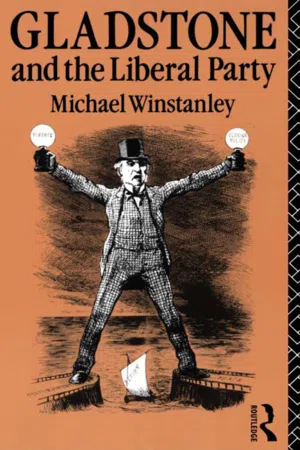
Like the Colossus who bestrode Rhodes in the ancient world, William Ewart Gladstone (1809–98) straddled the Victorian era. It is impossible to ignore him. Yet, despite – or possibly because of – his voluminous diaries, correspondence, publications and speeches charting each agonising decision, each crisis of conscience, exaltation of the spirit and political calculation, the man still remains something of an enigma. With the exception of Morley’s Life of Gladstone (1903), the ‘lives’ published around the turn of the century contribute little to our understanding, since so many were written by sycophantic admirers, and even subsequent attempts by historians to explain what motivated and sustained him have found that the sheer length and variety of his political career, stretching from 1832 to 1894, have precluded any easy generalisations. The publication in recent decades of his massive diaries, ably edited and annotated by distinguished scholars, has served largely to emphasise the personal and political complexities of the man. Perhaps, as an earlier disciple, F. W. Hirst, commented, ‘A great man cannot be explained’. Perhaps, even, as a less enthusiastic historian has mischievously suggested, Gladstone was simply ‘a middling bloke who wrote odd diaries’.*
These diaries and the wealth of personal correspondence which has survived have certainly tended to give undue prominence in current works to Gladstone’s own interpretation of his life and times. What we are often presented with is not the importance of Gladstone to the world, not even the world’s view of Gladstone, but Gladstone’s own view of the world and himself. This has done nothing to dispel the myth that the Liberal Party was ‘Gladstone’s’ when in fact it wasn’t. Similarly, tempting though it is to argue that he was the chief representative of the Victorian Age, personifying many of its values and contradictions, moving inexorably with, even moulding the forces which created it, passing away just as the old order was changing, there is also a danger of taking this too far. His colleagues were not in the habit of wandering the streets on ‘benevolent nocturnal rambles’ to rescue prostitutes. They did not – as far as we know – practise self-flagellation or spend their leisure time translating Greek texts or felling trees. They did not break into spontaneous prayer, or work sixteen hours a day or (thankfully perhaps) compile a soul-searching diary over seventy years or experience such a complex political conversion. Gladstone was far from the archetypal Victorian. Resort to stereotypes anyway, is always dangerous; the heterogeneity of Victorian society defies easy characterisation. In fact, like the Queen who gave her name to the period, Gladstone was something of an oddity by the standards of the time, a loner who neither fitted into nor represented any of its recognised social, political or religious groupings. Gladstone was very much his own man and, as we shall see, much of his political prominence and influence depended on his ambiguities, anomalies and persistent failure to conform.
For politically prominent he most certainly was. After entering parliament in 1832 as a young, unknown protectionist Tory he was to find himself a junior minister as early as 1834 during Peel’s short-lived minority government. He then went on to serve in, and subsequently head, the Board of Trade and the Colonial Office during Peel’s Conservative administration of 1841–6, rising to Chancellor of the Exchequer under Aberdeen (1852–5) and Palmerston (1859–66). By 1865 he was leader of the Liberal Party in the House of Commons, going on to hold the office of Prime Minister in the years 1868–74, 1880–5, 1886, and 1892–4. Even during his first ‘retirement’ between 1875 and 1880, when he gave up the party leadership but not his seat, he attracted more public attention than any of his colleagues. Yet his early experience as a Conservative protectionist and opponent of the Whig Reform Bill of 1832 was an unlikely background for the later leader of a party with a reputation for parliamentary reform and a commitment to free trade. Furthermore, whilst Liberalism became increasingly associated with the Nonconformist causes, Gladstone remained loyal to his High Anglican principles.
Before we can understand how and why this unlikely bond was cemented, how the partnership functioned, what it achieved and why it gradually disintegrated, we need to explore its constituent parts. Who were these ‘Liberals’ and to what extent are we justified in referring to them as a ‘party’ or wholehearted supporters of Gladstone? More immediately, what interpretations have been proffered to explain Gladstone’s own political behaviour?
The man of God: politics as a religious crusade
Religion, or more precisely, Christianity, permeated every aspect of Gladstone’s long life. It was, he declared dogmatically in 1839, ‘the pole star of my existence’. Despite its neglect by John Morley in his classic biography, Gladstone’s religious belief has often subsequently been put forward as the key to his public life.
Brought up in an Evangelical Anglican household, Gladstone went on to develop a sense of calling as a young man, particularly during his student days at Oxford, writing to his father in 1830 expressing a desire to enter holy orders. Although he soon abandoned this option, partly because of his father’s less than enthusiastic response, both his private and his public lives continued to centre on religious devotion. He scoured the Old Testament for divine inspiration, compiled a meticulous diary accounting for all the time allocated to him on earth in preparation for the great audit with his maker on the day of reckoning, partook in daily private worship, mixed with and engaged in debate influential religious leaders of his age, and published on doctrinal controversies such as the Vatican decrees on infallibility. Even his loyal wife Catherine, whom he married in 1839, was bluntly, if sympathetically, told that the Church would always be his first love, his greatest source of inspiration and comfort.
The first thirteen years of his public life were characterised by an overt attempt to marry this religious fervour to practical politics. The power of the State was to be employed to correct the ‘chronic malaise within the social and moral order’ which Gladstone had identified. There was, in Perry Butler’s words, ‘an extraordinary sense of mission’ running through this period of Gladstone’s life; he was to be ‘one of God’s providential instruments in the divine regeneration of society’. Gladstone’s means, expressed most cogently in his book on The State in its Relations with the Church (1839), was to restore, through state action, the privileges of the Established Anglican Church and reaffirm its indissoluble link with the State as the true and only expression of ‘national religion’. He had little time for Protestant Nonconformity of whatever sect, and even less for Roman Catholicism and Judaism. He consequently supported the levying of church rates (compulsory local taxes to maintain Anglican establishment), opposed the removal of those civil disabilities which prevented Jews from sitting in parliament and holding political office, resisted the admission of Dissenters to the ancient universities and stood out against increases in state financial aid to, and control of, education. His belief in the Anglican Church’s claim to unquestioned legitimacy and deference seemed unshakable.
In this he was at odds not only with the liberalising trends of the 1830s reflected in popular, militant Radicalism and mild Whig Reformism but also with the majority of the Tory Party whose adherence to Anglicanism was both lukewarm and tempered by the realities of practical politics. By appointing him to the Board of Trade in 1843, Peel, his mentor in more worldly matters, hoped to direct his energies to mundane affairs, but his ardour for religious concerns apparently remained undiminished. Until, that is, the ‘Maynooth Crisis’ of 1844–5 ended this extraordinarily reactionary phase of his life.
The Maynooth seminary in County Kildare had been established in 1795 to provide training for Irish Catholic priests. Both its foundation and its continued financial support depended on a British government well aware of the potential influence of the clergy over the population and the dangers of allowing them to become alienated from British rule, especially during the war-torn decades of the 1790s and 1800s. Annual grants continued to be renewed by parliament in an attempt to curry favour with the Irish Catholic com munity. As such, the policy already contravened Gladstone’s strict Anglican ideals; the State was supporting a rival body to the Established Anglican Church of Ireland. The proposals of 1844 to increase financial aid and make it permanent were too much for Gladstone and he resigned his cabinet post in January 1845, much to Peel’s incomprehension and frustration. Had he remained true to his original intentions his career would have been blighted. He would have remained a voice in the wilderness, fighting for a lost cause. But he didn’t. After much soul-searching, Gladstone found a way of redefining his beliefs and objectives which enabled him to function even more effectively in public life. Not for the last time, principled pragmatism triumphed over hopeless idealism.
When the division in the House of Commons was taken in April 1845 Gladstone voted in favour of the motion. His closest associates were dumbfounded, seeing it as a gross act of betrayal. Some speculated that, like his sister Helen and confidants Newman and Manning, he was veering towards Rome. The experience was, he admitted, a ‘nightmare’, but he awoke from it with a new vision of his role which justified his continuing in political life for which he had now developed an appetite. Vestiges of his rigid High Anglicanism lingered: he spoke against the bill of 1849 which would have allowed a man to marry his deceased wife’s sister and led the unsuccessful opposition to the Divorce bill of 1857 as contrary to divine law. For a quarter of a century he was also to fight proposals to abolish religious tests at Oxford University, for which he sat as MP between 1847 and 1865. But these battles only confirmed the conclusion he had arrived at in 1845: the State could no longer be trusted as the guardian of the Church and the latter ought, therefore, to be given ‘greater autonomy’ to pursue its own destiny. Indeed he became convinced that a tolerant, pluralist approach based on a belief in religious liberty was necessary to further the cause of religion and as a matter of ‘social justice’.
Gladstone, however, carefully preserved a role for the State which justified his continuation in political life. As Richard Shannon has remarked in his recent biography, ‘Abandoning office noisily was a way of quietly not abandoning politics’. He had already hinted to his Tory colleague Stanley in March 1844 that he thought ‘the lower ends of a state ought to be fulfilled even when the higher ones become impractical’. Now he was to go further; government should be dedicated to the pursuit of this ‘social justice’ and legislation was to be formulated according to a high moral code. While taking into account ‘an equitable and comprehensive regard to the actual circumstances of the period and of the country’ each measure was to be judged by criteria which stressed contributions to the material, the mental, but above all, the moral improvement of individuals, whether they be overseas or within the United Kingdom itself. It was his duty to remain in politics to ensure that this was the case.
For the rest of his life the notion that the State retained a high moral purpose in its management of domestic and foreign affairs remained Gladstone’s guiding principle. His earlier commitment to specific causes or missions, however, was not dimmed. His espousal and single-minded pursuit of fiscal reform (see pp.) in the 1850s and 1860s cannot be understood other than as a ‘financial mission’ (Lord Aberdeen), dedicated not just to improving material welfare but to achieving social justice, furthering individual moral and political responsibility. In foreign affairs, he believed passionately in the ‘mission of substituting the concert of nations for their conflicts’ (1866), championing the creation of mutually beneficial links through trade while opposing military adventurism. His commitment to ‘pacify Ireland’ in 1868 was similarly subsequently described as a ‘mission’ and his strident denunciation in the late 1870s both of the atrocities committed on the Bulgarian Christians by the Turks and the Disraelian government’s handling of the affair, had all the hallmarks of an Evangelical campaign . . . and more (see p.). Such dogmatic crusading, justified primarily on moral rather than material grounds, often betrayed an inflexibility of purpose, even, in his later years, an air of unreality and unworldliness which was to alienate sections of his party. Fortunately for Gladstone, however, his strident calls were echoed by a receptive political public for much of the mid-Victorian period.
The economist: architect of the minimalist state
The belief that good government was not only cheap but interfered as little as possible in the affairs of individuals gained increasing acceptance in the mid-nineteenth century. This is not to imply that there was complete consensus on the issue; battles over the role of government were hard fought at least until the 1850s and then emerged again with renewed ferocity from the 1880s as British self-confidence and superiority ebbed. Not all historians agree that what was professed was actually fully implemented, but most would agree with Eric Hobsbawm’s remark that ‘In the mid-nineteenth century British government came as near “laissezfaire” as practical in a modern state’. The achievement of this owed much to Gladstone.
Laissez-faire was manifested in three main ways. Firstly, the cost of government remained tiny. In monetary terms the amount spent by central government rose little in the half century after 1830 and even fell during Gladstone’s period as Chancellor of the Exchequer between 1859 and 1866. As population rose dramatically over the century, the cost per head of managing the affairs of state did not rise until after 1880, while the proportion of the country’s Gross National Product (GNP) absorbed by government exceeded 10 per cent only in times of military crisis (1855–8, 1860) and was otherwise rarely more than 7 per cent, a fraction of the figure which obtains today. Most expenditure was accounted for by military commitments and interest payments on the National Debt. Apart from Post Office employees and tax collectors, few civil servants were needed to perform the functions of government.
Secondly, alone among industrialising nations, British government dismantled the complex controls it had previously exercised over the economy. International trade was encouraged by the lifting of numerous import duties on a host of foodstuffs, raw materials and manufactured goods and by lifting bans on exports of machinery and capital. Legally sanctioned restrictive practices such as those which controlled adult males’ wages and conditions of employment, had fallen into disuse long before the Statute of Artificers was formally repealed in 1813. Only women and children, who were not considered ‘free agents’ able to defend their interests in an unregulated, male dominated society, were afforded any legal protection from exploitation.
Finally, as a corollary of this, responsibility for social welfare was laid squarely at the door of individuals and their families. State aid, in the form of poor relief, was intended as a last resort and only the desperate were willing to accept the humiliating treatment which the Poor Law Amendment Act of 1834 enshrined in its policy of ‘less eligibility’. The official view was that, since economic progress offered the opportunity for all to benefit and since inequalities could be removed by individual effort, pauperism was a manifestation of moral degeneracy, to be discouraged by making access to relief as unattractive as possible.
Gladstone strongly supported the principles which lay behind these policies and helped to create a climate in which they flourished, especially during his terms of office as Chancellor of the Exchequer. ‘Economy’, he confided in a letter to his brother Robertson in 1859, ‘is the first and great article . . . in my financial creed’. As with religion, he applied the principle of economy to both his public and his private life. The financial parsimony or ‘thrifty husbandry’, as Morley commendingly calls it, which characterised his management of domestic affairs often appeared unhealthily obsessive. He regularly checked the price of his wife’s household purchases, rigidly controlled allowances to members of his family, enthused in the 1870s about the saving of time and money which the recently introduced postcards facilitated, and re-used scraps of paper, even official baggage labels.
He applied the same detailed scrutiny to national accounts. ‘The chancellor of the exchequer’ he declared, ‘should boldly uphold economy in detail. . . . He is ridiculed, no doubt, for what is called candle-ends and cheese-parings, but he is not worth his salt if he is not ready to save what are meant by candle-ends and cheese-parings in the cause of the country. . . . All excess in the public expenditure beyond the legitimate wants of the country is not only a pecuniary waste, but a great political, and above all a great moral evil’. Savings made by cutting salaries, reducing staffing or dictating the quality of paper and binders which government departments could use were small, however. Significant ‘retrenchment’, as the policy of reducing expenditure was known, could only be achieved by attacking the size of the National Debt and the policies of the major spending departments. Gladstone hoped to lower interest payments on the National Debt by reducing the amount that government borrowed each year. He also retained the income tax which Peel had introduced as a temporary measure in 1842,...
Table of contents
- Cover Page
- Title Page
- Copyright Page
- Foreword
- Chronological Table of Events
- 1 Interpretations of Gladstone
- 2 The Liberals
- 3 Gladstone and the Liberals, 1859–74
- 4 Doubts, Desertions and Decline: 1880–94
- 5 Conclusion
- Appendix
- Select Bibliography
Trusted by 375,005 students
Access to over 1.5 million titles for a fair monthly price.
Study more efficiently using our study tools.
Frequently asked questions
Yes, you can cancel anytime from the Subscription tab in your account settings on the Perlego website. Your subscription will stay active until the end of your current billing period. Learn how to cancel your subscription
No, books cannot be downloaded as external files, such as PDFs, for use outside of Perlego. However, you can download books within the Perlego app for offline reading on mobile or tablet. Learn how to download books offline
Perlego offers two plans: Essential and Complete
- Essential is ideal for learners and professionals who enjoy exploring a wide range of subjects. Access the Essential Library with 800,000+ trusted titles and best-sellers across business, personal growth, and the humanities. Includes unlimited reading time and Standard Read Aloud voice.
- Complete: Perfect for advanced learners and researchers needing full, unrestricted access. Unlock 1.5M+ books across hundreds of subjects, including academic and specialized titles. The Complete Plan also includes advanced features like Premium Read Aloud and Research Assistant.
We are an online textbook subscription service, where you can get access to an entire online library for less than the price of a single book per month. With over 1.5 million books across 990+ topics, we’ve got you covered! Learn about our mission
Look out for the read-aloud symbol on your next book to see if you can listen to it. The read-aloud tool reads text aloud for you, highlighting the text as it is being read. You can pause it, speed it up and slow it down. Learn more about Read Aloud
Yes! You can use the Perlego app on both iOS and Android devices to read anytime, anywhere — even offline. Perfect for commutes or when you’re on the go.
Please note we cannot support devices running on iOS 13 and Android 7 or earlier. Learn more about using the app
Please note we cannot support devices running on iOS 13 and Android 7 or earlier. Learn more about using the app
Yes, you can access Gladstone and the Liberal Party by Michael J. Winstanley in PDF and/or ePUB format, as well as other popular books in History & Modern British History. We have over 1.5 million books available in our catalogue for you to explore.