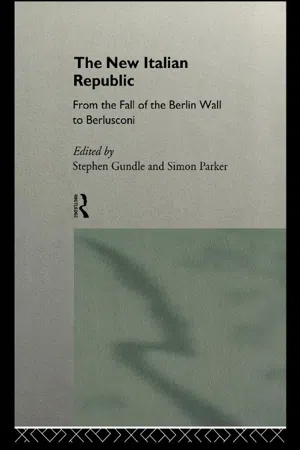
The New Italian Republic charts the breakdown of the old party system and examines the changed political climate that has allowed Berlusconi to rise as Italy's new master and subsequently precipitated his rapid fall from power.
eBook - ePub
The New Italian Republic
From the Fall of the Berlin Wall to Berlusconi
- 352 pages
- English
- ePUB (mobile friendly)
- Available on iOS & Android
eBook - ePub
About this book
Information
Part I
Context
1 Explaining Italy’s crisis
Paul Ginsborg
At the end of 1991 Christian Democrat and Socialist leaders were comfortably engaged in setting the pattern of Italian politics for the new decade. La Repubblica (17 November 1991) reported that Craxi and Andreotti had stored away an agreement on governing together for another five years. On the same day and from the columns of the same newspaper, Antonio Gava, former Minister of the Interior and Neapolitan city boss, proclaimed unwisely that ‘from now on we will get votes for who we are, and not simply for our anti-communism’. Nobody could have been more wrong, but at the time few if any commentators would have dared to predict a radically different scenario. The shortcomings of the Italian state and its political system had long been studied and denounced, but year after year the stability of the Italian electorate and the durability of its political elite were confirmed.
Instead, the years from 1992 to 1994 were amongst the most dramatic in the history of the Italian Republic. In the course of one year, 1993, the five ruling parties of the post-war period were wiped off the political map. A group of magistrates attacked corruption in a way that was unprecedented in the history of the unified state. Unyielding war was waged against the Mafia, receiving for the first time widespread popular support in Sicily, and especially in Palermo. The old political elite, seemingly as immortal as its Japanese counterpart, fell, not only from power but into ignominious disrepute. Finally, in the elections of March 1994, the political climax to the crisis, an extraordinary coalition which included the neo-fascists and was headed by the entrepreneur Silvio Berlusconi, won a resounding victory.
Even from this bare list of the crisis’s major elements and principal political outcome, it is possible immediately to grasp its complexity and contradictory nature. The crisis of 1992–94 is not a historical process which has a homogeneity and inner cohesion, such as the events of 1968–69 had for all of Europe. Rather it is constituted of very disparate elements, more than one of which is in open contradiction with another. It does not have at its heart a political party or strategy, or a single class or social force which causes it, pushes it forward and reaps its benefits. Viewed from differing vantage points, it presents quite diverse faces: from the Palace of Justice in Milan, it is a battle against corruption and for the restoration of the rule of law; from the Bank of Italy it is a crisis of debt and of international confidence; from Lombardy and the Veneto it is about devolution, a new social bloc, the triumph of the self-made man; at Montecitorio its focus is on electoral laws and the demise of the old elite; in the fragile civil society of Palermo it is a desperate fight against Mafia power.
The purpose of this chapter is to attempt an explanation of the causes of this extraordinary crisis, and of the form it has taken. Before starting though, it is perhaps worth signalling a number of methodological points. First, it is not at all helpful to adopt what may be called a Cassandrian view of recent Italian history, according to which the Italian Republic has been in permanent crisis since its inception, and that riven by its many contradictions, its demise was inevitable and merely a matter of time. Eugenio Scalfari has always been one of the most lucid exponents of this scheme, from his Autunno della repubblica (1969) onwards. While only the most fervent of apologists for the Christian Democrats would attempt to deny the many and deep fault lines of the Republic, to concentrate exclusively on them impedes us from explaining both the timing of the crisis and its specific shape. The account which follows suggests rather that the crisis of 1992–94 owes much to the virtues of Italian democracy as well as its vices, and is indeed incomprehensible without considering both.
Second, my explanation attempts to avoid a mono-causal interpretation of events. Massimo Salvadori (1994) has recently argued powerfully for an interpretation which ascribes the failures of successive Italian political regimes (liberal, fascist, republican) to the perennial absence of political alternation such as that found in most other twentieth-century Western democracies. There is an obvious kernel of truth here, but also a real danger of reductionism. The ‘regimes’ of the last 130 years of Italian history were profoundly different one from another, and the crises at their ends (if 1992 is an end) bear little relation to each other. It is only natural to seek patterns in historical explanation, but perhaps dangerous to make them over-dependent on a single, political causal factor.1
By contrast, I have tried to build an account which takes into consideration a number of different spheres—economic, political, social and cultural—and to apply to them diverse levels of explanation—long and short term, external and internal, structural and subjective.2 To establish a hierarchy of causation is always a hazardous operation, as Marxists (but not only they) have discovered to their cost. Hopefully, the relationship between the various elements of my explanation and its ordering of priorities will become clear as the argument unfolds.
PUBLIC DEBT AND INTERNATIONAL CONFIDENCE
After the major economic crisis of 1974–75, in which ‘the authorities all but lost control of the situation’ (Giavazzi and Spaventa 1988:10), the Italian economy could boast of a considerable number of positive indicators in the following years. Italy’s GDP grew by almost 50 per cent between 1976 and 1990, six percentage points above the average of the EC (Padoa Schioppa Kostoris 1993:225, note 1). Her percentage share of world exports was 4.6 in 1970, fell to 4.4 in 1982, but rose again to 5.0 in 1987 (Zamagni 1994:365, table 12.4). Her internal market was extremely buoyant throughout the period (consumption being 13 points higher than the EC average), and her inhabitants’ propensity to save—as well as to consume—amongst the highest in the West. Michael Porter, in his comparative study of the competitive economic advantage of ten nations, acknowledged Italian industry’s ‘remarkable ability’ to innovate in products as well as to incorporate state-of-the-art manufacturing and other technologies in relatively small and medium-sized firms. He also paid tribute to ‘sophisticated and advanced home buyers and the development of world-class Italian supplier industries’ (Porter 1989:691).
However, the downside of Italy’s economic performance in this period was also considerable. It took the form of a failure to invest in research and technology, a lack of major international companies in a period of accelerated global concentration (Baldassari 1994:15), and the marked weakening of international standing between 1979 and 1993 in the key sector of goods produced on a high economy of scale—cars, consumer durables such as washing machines, electronic office equipment, organic and inorganic chemical products, etc. (Guerrieri 1994:384, table 1).
Above all, Italy’s economic performance was viewed with growing concern at an international level because of the unchecked increase of public debt. This had not been a historic problem of the Italian Republic: in 1960 for instance, Italy had a primary surplus, a very low borrowing requirement and a low debt ratio (Giavazzi and Spaventa 1988:5). The situation deteriorated slowly in the 1970s and dramatically in the 1980s and early 1990s. At the heart of the problem lay high spending on pensions, high but inefficient spending on health provision, and very low levels of fiscal income from the self-employed—especially shopkeepers and the small business sector.
At the time of the European-wide discussions of the Maastricht Treaty, with their strong thrust to greater economic unity and a single European currency, public debt in Italy became a question of national emergency. Historically, Italy’s standing in the Community had been a modest one, her presence characterised by passivity and absenteeism, by strong verbal enthusiasm but a failure second to none to enforce EC regulations or even to spend its money (Giuliani 1992).
These long-term failings were compounded sharply in 1991 by the realisation that the country came nowhere near meeting any of the three main requirements for European Monetary Union. Her public debt stood at 103 per cent of GDP, in the face of a European requirement of not more than 60 per cent; her budget deficit at 9.9 per cent, against a requirement of 4 per cent; inflation was at 6.9 per cent—well above the three best performing countries. Overall, only Greece did worse (Menet-Genty 1992:261–268). The result was a sort of national panic, with unprecedented coverage in the mass media of the country’s economic plight, and of her imminent relegation from the premier league of European nations to the second division. ‘Enterprise Italy, overwhelmed by debt, will miss the European train’ (La Repubblica 22 December 1991), was only one of many such headlines of the time.
Worse was to follow. In January 1990 Giulio Andreotti had moved the Italian lira into the narrow band of EMS currencies, hoping that its new position would reap rewards in terms of discipline and competitiveness. In the event, so exalted a position could not be sustained. Just two years later the lira came under heavy attack and the government of Giuliano Amato was forced to intervene heavily in order to save it. Then, in September 1992 international confidence in the exchange rate of the lira (and simultaneously of the pound sterling) gave way completely. Devaluation and exit from the EMS followed immediately.
Debt crisis and waning international confidence cannot, therefore, be treated as simple constants in recent Italian history. The present crisis should be seen rather as the conflict between two very different forces: on the one hand, the refusal of successive Italian governments to take seriously the growing debt mountain, choosing to buy consent at home at the cost of compromising Italy’s standing abroad. The responsibility of the governments of the second half of the 1980s—a time of economic boom— was very considerable in this respect (for a good view from the inside see Amato 1990).
On the other hand, we find a concerted push, from the most advanced and successful of the European capitalist economies, towards greater economic unity, to a single currency as well as a single market. Again, this is not a constant in the history of the European Community, but a specific sequence of events in the late 1980s and early 1990s (Tsoukalis 1991).
These two tendencies, the one of international capital, the other of national mismanagement, enter into direct conflict in September 1992. Initially, it is the wider European project, which retreats with a bloody nose. But the conflict of interests and perspectives will certainly not go away, and in the long run it is a very uneven contest. In this part of the explanation of Italy’s crisis, external, structural and long-term elements play a predominant role and their power of constraint is considerable. Public debt and international confidence are the contrôleurs of the crisis, the measuring rods by which all political projects for its solution will be judged.
VICE AND VIRTUE IN ITALIAN DEMOCRACY
The failures of Italian democracy have been so often rehearsed, albeit with different tonalities (e.g. Ginsborg 1990; Scoppola 1991; Lanaro 1992; Hine 1993; Lepre 1993), that only the briefest summary will be presented here. The electoral system of proportional representation, with its concomitant weak government, the dominance of one party and its allies for so many decades, their occupation of the state, and the absence of a feasible alternative, have all had grave but as yet non-fatal consequences for Italian democracy. The development of ‘party-ocracy’ (partitocrazia) not only affected all the state’s inner workings, but coloured with brutal tints its intervention in society. The need for a party card, the politicisation (in the worst sense) of all public appointments (from hospital managers to opera administrators), the division of the spoils of state radio and television between the major political parties, both of government and opposition, have been amongst the worst features of Italian democracy. They are real insults to any reasonable concept of political citizenship.
A similar story must be told for the civil service. Sabino Cassese, the enlightened and reforming minister for the public administration at the height of the crisis (April 1993 to March 1994), has calculated that each Italian citizen loses between 15 and 20 working days each year trying to cope with the country’s lethal bureaucracy (Presidenza del Consiglio dei Ministri, Dipartimento per la Funzione Pubblica 1993:13). A deeply deformed relationship between state and citizen developed over time, based on the inefficiency of the civil service and its consequent discretionary power. The speed and efficacy of a bureaucratic act depended to a great extent upon the pressures that a citizen could exert upon the administrator. Naturally, not all the citizens were equal or could exert equal pressure. Inducements to bureaucratic action varied, from the relatively innocuous use of contacts to outright corruption (Ginsborg 1990:149).
These vices of Italian democracy, both in its formal and informal workings, were historical growths, not immutable features of a Republican landscape. As with the question of public debt, so in this area, the 1980s was a grim period: as Gian Carlo Caselli, the chief prosecuting magistrate at Palermo, has said, these were ‘years of political arrogance which threatened the balance of the Constitution…years of shameless idiocy on the part of certain power centres of the state’ (Caselli 1993:15–16). Along with the Christian Democrats, and often exceeding them, the Socialist Party of Bettino Craxi played a leading role in the systemisation and theorisation of corrupt practice. This was the period when kickbacks on public contracts became a highly organised affair, when party and personal financing flourished directly from the illegal use of political prerogative.
At stake was something more than the European-wide decline of interest in politics, noted by many commentators and made manifest in the rising levels of absenteeism at national elections (Flickinger and Studlar 1992). Rather, the pattern of misgovernment seemed part of the failure of Latin Socialism, and many of the same features of state plunder were (and are) to be found in the Spanish, Greek and even French parties. Rather than trying to reinvent political agency (Dunn 1993:265), the southern European Socialists were content to maximise their own advantages.3
However, the political explanation for the crisis does not lie simply in the long-term failures of the system, aggravated by Socialist arrogance. The virtues of the Republic have also played a crucial causal role. In the long term, one of the most important of these elements has been the official morality of the Republic created in the years 1943–48. Italy’s post-war settlement in many ways lagged far behind its counterparts in France, West Germany and Great Britain. Italy failed to overhaul its state apparatus or to provide the bases for social citizenship. However, the founding fathers of the Republic were much more successful in translating the Res...
Table of contents
- COVER PAGE
- TITLE PAGE
- COPYRIGHT PAGE
- CONTRIBUTORS
- ABBREVIATIONS
- INTRODUCTION: THE NEW ITALIAN REPUBLIC
- PART I: CONTEXT
- PART II: THE OLD PARTY SYSTEM
- PART III: THE ‘NEW’ PARTIES
- PART IV: POLITICS AND SOCIETY
- PART V: ECONOMIC ASPECTS OF THE CRISIS
- PART VI: CONCLUSION
Trusted by 375,005 students
Access to over 1.5 million titles for a fair monthly price.
Study more efficiently using our study tools.
Frequently asked questions
Yes, you can cancel anytime from the Subscription tab in your account settings on the Perlego website. Your subscription will stay active until the end of your current billing period. Learn how to cancel your subscription
No, books cannot be downloaded as external files, such as PDFs, for use outside of Perlego. However, you can download books within the Perlego app for offline reading on mobile or tablet. Learn how to download books offline
Perlego offers two plans: Essential and Complete
- Essential is ideal for learners and professionals who enjoy exploring a wide range of subjects. Access the Essential Library with 800,000+ trusted titles and best-sellers across business, personal growth, and the humanities. Includes unlimited reading time and Standard Read Aloud voice.
- Complete: Perfect for advanced learners and researchers needing full, unrestricted access. Unlock 1.5M+ books across hundreds of subjects, including academic and specialized titles. The Complete Plan also includes advanced features like Premium Read Aloud and Research Assistant.
We are an online textbook subscription service, where you can get access to an entire online library for less than the price of a single book per month. With over 1.5 million books across 990+ topics, we’ve got you covered! Learn about our mission
Look out for the read-aloud symbol on your next book to see if you can listen to it. The read-aloud tool reads text aloud for you, highlighting the text as it is being read. You can pause it, speed it up and slow it down. Learn more about Read Aloud
Yes! You can use the Perlego app on both iOS and Android devices to read anytime, anywhere — even offline. Perfect for commutes or when you’re on the go.
Please note we cannot support devices running on iOS 13 and Android 7 or earlier. Learn more about using the app
Please note we cannot support devices running on iOS 13 and Android 7 or earlier. Learn more about using the app
Yes, you can access The New Italian Republic by Stephen Gundle,Simon Parker in PDF and/or ePUB format, as well as other popular books in Politics & International Relations & Political Parties. We have over 1.5 million books available in our catalogue for you to explore.