Alun Howkins' panoramic survey is a social history of rural England and Wales in the twentieth century. He examines the impact of the First World War, the role of agriculture throughout the century, and the expectations of the countryside that modern urban people harbour. Howkins analyzes the role of rural England as a place for work as well as leisure, and the problems caused by these often conflicting roles.
This overview will be welcomed by anyone interested in agricultural and social history, historical geographers, and all those interested in rural affairs.
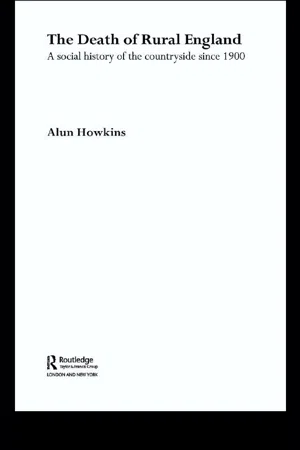
- 272 pages
- English
- ePUB (mobile friendly)
- Available on iOS & Android
eBook - ePub
About this book
Information
Part I
‘Blue remembered hills’
Rural society, 1900–21
1 The countryside in a new
century, 1900–14
Rural England and Wales were, in 1900, countries of contrasts and of regional diversity. It was a land which presented a Janus face, with many elements of traditional and even backward agricultural practice and social structure, coexisting with others which were profoundly modern and efficient. This split personality was to continue to be a part of rural society well into the mid-twentieth century. It was only being resolved in the period after 1950 when a ‘second agricultural revolution’ based on the widespread use of chemicals and machinery finally gained the upper hand.
Conventionally, rural England and Wales has been divided into two great regions following the lines laid down by James Caird in 1852,1 but long predating his description. Also, since the divisions were based in the first instance on climate, landscape and soil they still dominate the countryside of today.2 Simply Caird divided England into an area south and east of a line drawn from the Scottish Border in West Northumberland to the Exe, which was lowland and largely arable, and an area north and west of that line which was upland and largely pastoral. In Caird’s ‘map’ Wales is included in the upland zone, although there were areas of cereal production in Anglesey and on the southern coast. Caird also argued that these areas of England and Wales were dominated by different farming types. The north and west were areas of small farms and the south and east of large ones. To this we can add that the upland areas were, and are, areas of scattered homesteads dispersed across the landscape, while the lowland regions are characterised by village settlements.3
At the end of the nineteenth century, and even more at the end of the twentieth, we might wish to tinker with Caird’s divisions, but they remain essentially the same now as they did in 1852. More importantly Caird’s divisions conceal almost endless regional variations. A county as firmly southern as Sussex contains, as Peter Brandon and Brian Short have shown,4 three or even four landscape types and settlement patterns, and this can be duplicated in many counties of England and Wales.5 What is important to remember, and we will return to this often, is that these divisions were not purely spatial but also social, cultural and economic. In a very real sense, even in the mid-twentieth century, England and Wales were not only two nations but also many regions.
If the persistence of regional and landscape divisions can be seen as supporting the traditional face of Janus, one of the most distinctively modern aspects of England and Wales in 1900 was its population distribution. The 1901 census revealed that England, and to a lesser extent Wales, was firmly established as the world’s first truly urban and industrial nation. In that year 77 per cent of the population of the two countries lived in urban areas and 23 per cent lived in the rural districts. In the 10 years before 1901 the rural population had declined by about 12 per cent. This followed a long-term trend. As the General Report of the 1921 census says, ‘[a]fter 1851, when the proportions were about equal, the urban element gained a definite lead which was rapidly and consistently increased in each decennium up to the year 1901.’6 The urban nature of this population distribution was also reflected in the occupations of the people. Although there were still over 1.3 million men employed in agriculture in Britain in 1901 this made up only 11.5 per cent of the working population; while for women the figure was less then 1 per cent.7
Nevertheless, in most country districts in 1900 agriculture remained the main employer, although there were areas in the north and west of England and parts of Wales where coal mining and quarrying provided a working population that was distinctly non-agricultural. In addition there was a huge diversity of trades in the rural districts and in the county towns, but at the turn of the twentieth century these men and women usually relied on agriculture.
The numbers employed in agriculture in 1900 are a problem since certain categories, especially women, are clearly underestimated. There are two main reasons for this. First, the category of ‘farmer’s wife or daughter’, clearly recognised as a working category in the census of 1851–71, was dropped in 1881 thus causing an apparently huge decline in the number of farmers and the obliteration of a whole working group.8 While some wives and daughters of farmers did not work most did, a fact recognised by the reintroduction of this category in 1911. Second, the work of Nicola Verdon and Celia Miller has shown that the census constantly underestimated the numbers of women employed on farms in all capacities.9 Finally, the number of ‘landed proprietors’ also had women removed in 1871 and then the category as a whole disappeared in 1881. It is however possible to produce some figures (see Table 1.1) which give a sense of the numbers working the land of rural England and Wales in 1901 divided into what Caird had called in 1851 ‘the three great interests connected with agriculture – the landlord, the tenant and the labourer.’10
The industry in which all these worked or drew a profit from was still, in the early 1900s, in a period of mixed fortunes, and nobody felt this mix more than the farmers. The whole idea of the farmer is in some ways a difficult one since it covered such a variety of men, women and holdings. As B.A. Holderness put it:11
The census category [of farmer] included capitalists occupying 2,000 acres and small holders with but 5 or 10 acres. . . . [After] 1851 farmers were readily differentiated only by the size of their holdings, but the diversity of agriculture was such that mere acreage was an inadequate indicator of social status.
However, for many farmers, whatever the size of their holding, the great profits and successes of the ‘golden age of high farming’, which stretched for the best part of 40 years from the late 1840s, came to an end in the 1870s and 1880s with the import of cheap cereals, especially from North America. To contemporaries, like Henry Rider Haggard, who toured rural England in 1901, it was a disaster. He wrote that ‘the impression left upon my mind by my extensive wandering is that English agriculture seems to be fighting against the mills of God.’12 Yet historians have argued since at least the 1960s that the ‘Great Depression’ in agriculture was essentially a regional phenomenon.13 It hit most at those counties where cereals were grown in the south and east, and especially those areas, like the heavy clay lands of Essex, where input costs were high.14 Aubrey Spencer, who visited the Denegie Hundred in northeast Essex for the Royal Commission on Labour in 1894, left a powerful descriptions of the area’s decay.15
The heavy clay land . . . is essentially a wheat producing district. . . . This part [of England] has suffered terribly by the agricultural depression – probably as much or more so than any other part of England. . . . A considerable amount of land is altogether out of cultivation. . . . A more melancholy sight from an agricultural point of view can scarcely be imagined than this part of the district presents.
But these farmers were, as Richard Perren points out, ‘only a fraction of all British farmers, and even before the depression arrived cereals were only a small part of the total value of British agricultural output.’16 Where other crops were produced, and even in areas, like Norfolk, where large cereal farms and good soils enabled farmers to carry the cost of the fall in price, things could and did look different. Put simply while the price of wheat, the basis of Britain’s staple diet fell, wages remained stable. As a result working men and women had more money to spend on other goods including food such as dairy products, meat and even fresh fruit and vegetables, and so the sectors of agriculture producing these showed real expansion in the years after 1880. By 1913 nearly 75 per cent of gross agricultural output was accounted for by livestock products. Of these the most important was meat but the fastest growing was milk.17 However, even more unlikely elements were beginning to emerge. By 1908 the total value of fruit, flowers, poultry and eggs made up 6 per cent of British agricultural output compared with wool, once a staple product, which made up only 1.7 per cent.18
Table 1.1 The ‘Agricultural Orders’, England and Wales 1901–11
| Year | Landowners | Farmers | Labourers | Total |
| 1901 | 25,431* | 475,633** | 621,068** | 1,124,701 |
| 1911 | 25,431* | 383,333 | 656,337** | 1,065,101 |
Notes
*These figures are those given at the last available date (1871). They are crude and clearly do not represent all landowners, only those who described themselves as such. But there is no reason to think they changed substantially during the period 1871–1931 or even later.
**These figures contain an element of adjustment, adding in an estimated number of women in these categories. The basis of the estimation is explained in Alun Howkins, Reshaping Rural England 1850–1925 (London, 1992) p. 11.
What this meant was that the effect of the depression and indeed the speed of the recovery from it were profoundly regional – a theme we shall come across again and again in this book. Those areas or farmers who were able or willing to adapt weathered the worst of the bad years. In 1895 Mr Wilson Fox visited the Spalding district of Lincolnshire and saw an area of real prosperity.19
In the neighbourhood of Spalding I made a somewhat exhaustive enquiry among some of the market gardeners. A great variety of vegetables, fruit and flowers are grown for the northern and London markets. The following produce is raised in this district: early potatoes, early cabbages, horse radish, carrots, celery, rhubarb asparagus, turnips, mangold and mustard seed, beans, peas, black and red currants, gooseberries, apples, pears, plums, greengages, cherries, bulbs . . . also violets. Strawberries are also grown at Long Sutton, this industry having been started by some Kent growers.
Such spectacular changes were often, as Joan Thirsk has written, ‘modest, local efforts, which only the assiduous seeker in out-of-the-way places was likely to uncover’. Yet, as she continues, ‘they expanded the frontiers of farming business . . . [and] in a positive frame of mind, their undertakers met and accepted the challenge of a changed situation in a fresh and constructive way.’20
The ability to adapt or change clearly affected how those who lived through the depression experienced its outcome, and this in turn depended, in part at least, on what part of England and Wales we are discussing. The north and west, already pastoral economies and often near the cities of the industrial revolution were, as T.W. Fletcher argued many years ago, virtually untouched by the depression.21 For this reason these areas were able to build on that success and knowledge in the first part of the twentieth century, as were other areas in Yorkshire, Wales and even the English west country. Farmers near big towns in the south, especially around London, were able to switch to dairying or other alternative crops, as were the small holders of Evesham in Gloucestershire, Spalding or Sandy in Bedfordshire, which had good rail links to the cities and towns of the industrial revolution. The market gardeners and plantsmen (and women) of Surrey and north Sussex benefited from the first waves of middle-class suburbanisation with its demand for garden plants, flowers and vegetables.
On the other side, the cereal farmers and even some who were producing livestock suffered, although this was not universal. The worst hit areas were those of marginal cereal lands, like Essex, which had relied on high prices and high inputs coupled with cheap labour to maintain profits. However, it is also clear from the experiences of the Scots, Welsh and west country migrants who took many of these farms between the 1880s and 1930s, and made a living from them, that the standard of life expected by many an English farmer was way beyond the means of his land, except in very good times.22
As the 1900s progressed a new kind of equilibrium began to appear in the agriculture of England and Wales. Some of the worst land went out of production altogether. ‘In 1872’, L. Margaret Barnett writes, ‘the United Kingdom had 24 million acres under crops, or 51.3 per cent of the cultivated area. By 1913 this had shrunk to 19½ million or 41.6 per cent.’23 However, this loss of land tended to be piecemeal, in most areas, rather than whole districts reverting to thistles and scrub. Further, despite much press comment at the time, there were relatively few farming bankruptcies since reduced rents in arable areas cushioned many against the worst effects of depression.24 Also the increase in dairying and other forms of ‘alternative husbandry’ meant that some at least continued to do well. By the late 1900s farming seems to have adapted well to the new patterns of demand and supply, even if it left the British consumer heavily reliant on imports. In 1911–12, A.D. Hall made three ‘farming tours’ through England and concluded: ‘We must recognise that the industry is at present sound and prosperous. . . . To the man who takes the trouble to learn and attend to his business, farming now offers every prospect of a good return on his capital.’25
Most farmers in England and Wales in the 1900s were tenants – they rented their land. Landownership still remained firmly the prerogative of a few, for while many thousands held some land the vast majority of the land of England was still the possession of a small number of great territorial magnates. The only figures we have were from the ‘New Domesday’ of 1876, which listed all owners of land in Britain and revealed that just under a million men and women in England and Wales owned land. However, over 700,000 owned less than an acre. It was the work of the notably non-radical John Batemen that, by analysing this material, produced the clearest picture of the inequality of landownership ...
Table of contents
- Cover Page
- Title Page
- Copyright Page
- Plates
- Acknowledgements
- Abbreviations
- Introduction
- Part I: ‘Blue Remembered Hills’: Rural Society, 1900–21
- Part II: The ‘Locust Years’, 1921–39
- Part III: The Second Agricultural Revolution, 1937–90
- Part IV: What Is the Countryside for?: Rural Society, 1945–2001
- Notes
Trusted by 375,005 students
Access to over 1.5 million titles for a fair monthly price.
Study more efficiently using our study tools.
Frequently asked questions
Yes, you can cancel anytime from the Subscription tab in your account settings on the Perlego website. Your subscription will stay active until the end of your current billing period. Learn how to cancel your subscription
No, books cannot be downloaded as external files, such as PDFs, for use outside of Perlego. However, you can download books within the Perlego app for offline reading on mobile or tablet. Learn how to download books offline
Perlego offers two plans: Essential and Complete
- Essential is ideal for learners and professionals who enjoy exploring a wide range of subjects. Access the Essential Library with 800,000+ trusted titles and best-sellers across business, personal growth, and the humanities. Includes unlimited reading time and Standard Read Aloud voice.
- Complete: Perfect for advanced learners and researchers needing full, unrestricted access. Unlock 1.5M+ books across hundreds of subjects, including academic and specialized titles. The Complete Plan also includes advanced features like Premium Read Aloud and Research Assistant.
We are an online textbook subscription service, where you can get access to an entire online library for less than the price of a single book per month. With over 1.5 million books across 990+ topics, we’ve got you covered! Learn about our mission
Look out for the read-aloud symbol on your next book to see if you can listen to it. The read-aloud tool reads text aloud for you, highlighting the text as it is being read. You can pause it, speed it up and slow it down. Learn more about Read Aloud
Yes! You can use the Perlego app on both iOS and Android devices to read anytime, anywhere — even offline. Perfect for commutes or when you’re on the go.
Please note we cannot support devices running on iOS 13 and Android 7 or earlier. Learn more about using the app
Please note we cannot support devices running on iOS 13 and Android 7 or earlier. Learn more about using the app
Yes, you can access The Death of Rural England by Alun Howkins in PDF and/or ePUB format, as well as other popular books in Historia & Historia británica. We have over 1.5 million books available in our catalogue for you to explore.