eBook - ePub
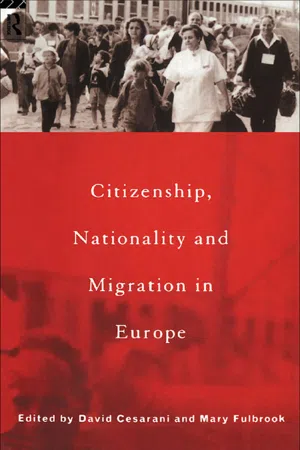
Citizenship, Nationality and Migration in Europe
- 240 pages
- English
- ePUB (mobile friendly)
- Available on iOS & Android
eBook - ePub
Citizenship, Nationality and Migration in Europe
About this book
Throughout Europe longstanding ideas of what it means to be a citizen are being challenged. The sense of belonging to a nation has never been more in flux. Simultaneously, nationalistic and racist movements are gaining ground and barriers are being erected against immigration. This volume examines how concepts of citizenship have evolved in different countries and varying contexts. It explores the interconnection between ideas of the nation, modes of citizenship and the treatment of migrants. Adopting a multi-disciplinary and international approach, this collection brings together experts from several fields including political studies, history, law and sociology. By juxtaposing four European countries - Britain, France, Germany and Italy - and setting current trends against a historical background, it highlights important differences and exposes similarities in the urgent questions surrounding citizenship and the treatment of minorities in Europe today.
Information
1 INTRODUCTION
David Cesarani and Mary Fulbrook
Who is a citizen? Who is entitled to be part of a ‘national’ community, and who is to be excluded? Who may cross what boundaries and borders, reside and work within particular states, and who may not? What perceptions do insiders have of outsiders? How do different communities within states behave towards each other, define, manipulate and act upon their mutual perceptions?
In every community, there are common-sense understandings of who belongs, and who does not. Societies the world over have developed conceptions of ‘self’ and ‘other’, the ‘civilized’ and the ‘barbarians’, those who belong and those who are ‘beyond the pale’. Identities have been forged on the basis of many possible imagined attributes: the myth of common ancestry, the inheritance of blood, the binding force of tribal tradition, custom and belief are historically among the most widespread. With the rise of nation states in the late eighteenth to late twentieth centuries, new elements of definition began to emerge; notions of citizenship defined by common ideals and the right to reside in the country of birth rather than of ancestry began to overlay or displace the primacy of kinship. Perceiving something of a sea-change in bases of identity in the modern era, historians and social scientists have for some time been grappling with an attempt to define the concept of national identity.1
However one seeks to define concepts of citizenship and national identity, ‘imagined communities’ attain an extraordinary impact as real social phenomena in which people believe and on which they act. The French sociologist Émile Durkheim’s injunction to ‘treat social facts as things’ becomes brutally relevant when people are attacked or murdered because of (imagined) ‘racial inferiority’, or when families are torn apart and relatives sent ‘home’ by officials paid to guard borders and prevent the entry of ‘illegal immigrants’.
Self-definitions of communities and the movement of peoples are phenomena stretching back through thousands of years of human history. In each age, however, there are new features and new issues. The current situation in Europe has a number of distinctive features. Global processes of the internationalization of the economy, enhanced communications networks, and transnational institutions and cultural currents have over a considerable period of time been changing the character and functions of nation states. Processes of European integration over the post-war decades have led to fundamental changes within the European Union, many of which have not yet been comprehended—or even registered—by citizens of European states. Since the fall of the Iron Curtain in 1989, there have been major upheavals in the broader European context, with increased levels of migration from eastern to western Europe for both political and economic reasons. The massive geopolitical earthquakes in south-eastern Europe, the Middle East and elsewhere in the last few years have been accompanied by heightened political tensions within the western European states. Right-wing movements, present already in the 1980s, have capitalized on the changes of the 1990s to seek to expand their electoral support. Less organized, apparently spontaneous racism has become more visible and frightening, as in the case of reunified Germany—of particular resonance, half a century after the demise of the Hitler regime. For many people in the 1990s, the current situation appears disturbingly turbulent and uncertain.
The recent rise of racism and xenophobia in Europe has focused public attention on issues concerning asylum-seekers and economic migrants. Yet migration is not a new phenomenon in Europe, and has not always been associated with inter-group violence. Immigrant communities have often been successfully integrated and new social and national identities have developed over time.
Bringing together international experts from a range of disciplines, this volume explores key questions concerning patterns of migration and different national policies, and their relation to political, social and cultural processes. Part One begins by examining the broader global and European context. Parts Two and Three then focus on four selected countries—Britain, France, Germany and Italy—within the broader European context. Controlled comparisons among these four countries allow for careful exploration of some of the major arguments in what is often a rather confused and emotive set of debates on an issue of great current interest and public concern.
The book examines a series of interrelated questions across thefour cases. First, how do ideas and definitions of citizenship and nationality change over time? Under what conditions do they change very quickly? What changes cause a problematization of previously unexamined assumptions? How are these changes and associated tensions resolved (or not)?
Second, how far are ideas of the national community inclusive or exclusive? To what extent does the state generate and how does it sustain definitions of national identity? What other factors (media, social policies, etc.) are important in constructing a sense of identity?
Finally, the book confronts the following questions: Under what conditions are perceived differences politicized, to form the basis of serious cleavage and conflict? What factors mitigate against conflict and foster harmony or the celebration of difference?
THE CURRENT SITUATION IN EUROPE
On 26 March 1995 ‘Schengenland’ came into existence. This is the informal term that denotes the area comprising seven European Union (EU) states between which internal border controls have been abolished under the terms of the Maastricht Treaty. Despite the fact that internal passport controls have been waived by the participant countries only at the price of massively strengthened external border controls, right-wing politicians throughout the EU have adopted an anti-Schengen stance and raised the spectre of a ‘flood’ of immigrants entering the union from north Africa and eastern Europe. As a result, it is increasingly likely that the prospect of ‘Fortress Europe’ will be realized as governments act to stop volatile electorates falling prey to the alarums of right-wingers.2
Changes in citizenship and nationality within the EU have thus had, and continue to have, a concordant effect on immigration controls as well as the rights of resident immigrants and asylum-seekers trying to join them. So one paradoxical effect of European unity and the greater internationalism of the Europeans (within Europe) has been a strengthening of Eurocentrism, a sort of higher xenophobia directed against Muslims and the modern version of the Mongol hordes—east Europeans attempting to escape the economic rubble of communism.3
The seven Schengen states are France, Germany, the Benelux countries, Spain and Portugal. Greece, Italy and Austria will soon join, while the Scandinavian countries are still debating the matter. The British Conservative Government in 1995 was resolutely opposed to any relaxation of frontier controls. Several leading British politicians expressed misgivings about the trend of EU policy on citizenship, immigration and nationality. One minister, Charles Wardle, even resigned from the government in protest against what he alleged was the loss of sovereign rights to regulate immigration. Thanks to these politicians and to newspapers such as the Daily Mail, which ran immigration scare stories on its front page throughout February and March 1995, these issues were set to figure prominently in the next British General Election. The British Home Secretary, Michael Howard, soon signalled that even tougher measures against illegal immigrants were in the pipeline. New anti-immigration laws featured in the proposed legislation revealed by the Conservative Government for the 1995/6 session of Parliament, a legislative package which was designed with one eye on a General Election.4
The revived salience of immigration as a party-political issue in Britain is mirrored throughout Europe. Several of the chapters in this book examine these trends in detail. Here it will suffice to mention that French presidential contenders Jean-Marie Le Pen and Philippe de Villiers both inscribed anti-immigrant and anti-Maastricht slogans on their election banners. Like the British right, they see European integration eroding each country’s power to control the influx of aliens. In October 1994, Jörg Haider’s Freiheitliche Partei Österreichs (Austrian Freedom Party) won over 22 per cent of the votes in the Austrian General Election after a campaign in which anti-immigration rhetoric played a large part.5
How is it possible to explain the paradox of insurgent nationalism at a time of European integration? What role do the very mechanisms of integration play in the exclusion of non-Europeans? To what extent are we witnessing a continuity of European racisms, or are there new forces at work as we near the end of the twentieth century? These are some of the questions which this volume sets out to answer. It approaches the interlocked phenomena of citizenship, nationality and migration from an interdisciplinary standpoint. There are chapters by historians, political scientists, sociologists and lawyers. This combination has been chosen to illustrate the deep, historical context for current political debates around migration. Too often the challenge which migration sets for concepts of citizenship and nationality is treated as contemporary. Consequently, important lessons go unlearned and analytical tools are blunted. This volume tries to understand the synchronic relationships between migration, citizenship, national identity and nationality alongside their dynamic relationship over time.
THE CASES FOR COMPARISON: BRITAIN, FRANCE, GERMANY AND ITALY
Four countries have been selected for examination. Each one represents different attributes of the debate.
Britain is an ‘old country’ with a reputedly stable constitutional system, but a weak notion of citizenship and a confused definition of nationality. The mixture of jus soli (nationality derived from place of birth) and jus sanguinis (nationality acquired by descent or blood) reflects the long evolution of England towards becoming the dominant party in a domestic and then a global empire. Throughout British history immigration has been a catalyst for defining and amending nationality and citizenship.
France in the modern era pioneered the definition of an active citizenship that was inclusive of all who accepted the principles of the Revolution and French culture. The availability of French citizenship to the children of immigrants on condition of their education in, and identification with, French culture expresses the idea of the French nation as a ‘daily plebiscite’. Yet the very presence of immigrants who utilize the right to be different against the universalism of the rights of the citizen has caused French people to reassess the nexus between citizenship and ethnic nationality.
Citizenship in Germany has, until recently, been shackled to an exclusive, ethnic sense of nationality and was passed on according to the principle of jus sanguinis. The predominance of ethnic nationality stemmed from the singular history of the German nation. However, it is now being challenged. Developments in Germany over the last forty years, connected in part with immigration, have forced a reconsideration of the ethnic basis of citizenship.
Italy, like Germany, is an old nation but a relatively new state. Unlike the previous examples, until quite recently it was not a country of immigration. The Italian response to immigration has exposed latent assumptions about national identity, while attempts to accommodate citizenship to the new realities of mass immigration have foundered on the curious, postmodern character of the global movement of people. Immigration to Italy poses problems quite unlike those faced in Britain, France or Germany in earlier periods.
All four countries are members of the EU as well as signatories to international conventions governing human rights, refugee issues and asylum. Since immigration, citizenship and nationality issues are quite dramatically affected by transnational agreements and political associations, this volume begins with chapters relating the theory and practice of citizenship law and rights at international level to more limited national loci.
In chapter 2, Yasemin Soysal challenges the established dichotomy between forms of belonging to nations on the basis of either civic or ethnic components. She argues that since 1945 a person’s identity as a member of a nation has been uncoupled from their rights. International migration, supra-national associations and the discourse of human rights have created an alternative need and source for the legitimation of individual and collective rights other than membership of a nation. For example, the International Labour Organisation defines and monitors the observance of the rights of migrant workers, demanding and obtaining for them entitlements which at one time only citizens of a country might customarily have expected to receive. ‘What we have is a trend towards a new model of membership anchored in deterritorialized notions of persons rights’.
Elspeth Guild explains the rapidly changing nature of European citizenship and nationality (chapter 3). Under the Maastricht Treaty citizens of individual EU member states acquired a second citizenship: that of the EU. Guild shows that according to most agreed legal criteria this citizenship is also a form of nationality: it confers rights on EU citizens in third-party states. However, the internal operation of this citizenship is unusually messy and confusing. The contradictions illustrate Yasemin Soysal’s assertion that ‘classical conceptions of citizenship are no longer adequate in understanding the dynamics of membership and belonging in contemporary Europe’.
The difference between old and new forms of membership and their derived rights has generated tension. The assertion of non-territorial rights grinds against common notions of sovereignty. The population of a particular state ends up as a tiered social formation, with different groups having different bundles of rights. Ironically, the universal language of human rights that is legitimated by reference to international conventions and guarded by international judicial instruments actually incites particularism and intolerance. Ethnic groups, national groups and almost any collectivity of people who define themselves as a ‘nation’ demand the universal right to self-determination: the right to be different. The result, as seen in the former Yugoslavia, can be chaotic and bloody. Many of these ethnic and national conflicts are historically rooted, which underlines the need for a historical perspective to the current fluid, and bewildering, state of citizenship and nationality.
The British case (chapter 4) exemplifies the fluid nature of national identity, its interaction with nationality and citizenship. The concept of citizenship was always weak in England. Subjecthood was the preferred mode of belonging to the nation and persisted into the modern era by virtue of Parliament’s assumption of the sovereign’s mantle. Access to political rights was, at various times, restricted due to the confessional nature of the state. Despite the pre-eminence of jus soli, full belonging was predicated upon belonging to the national church: Anglicanism and Englishness were fused together. The creation of the United Kingdom and the British Empire necessitated a flexible category of belonging, which was supplied by the perpetuation of allegiance to the crown by British subjects throughout the empire. However, the emergence of the dominions and the entrenchment of racial thinking led to a bifurcation of white and non-white British subjects.
The racialization of belonging was not unprecedented: Jewish immigrants to Britain at the turn of the century had been the object of hostile attention on racist grounds. But mass immigration from the colonies and the New Commonwealth after 1945 strongly accentuated the desire to draw the criteria for national belonging more tightly and to exclude non-white peoples. By the late-1970s, immigration controls and citizenship were overdetermined by considerations of ‘race’, even if disguised as cultural concerns. The struggle over the definition of an exclusive or an inclusive national identity is still not resolved, but the treatment of immigrants and non-white citizens bears the marks of a dominant exclusivist ethos.
Since the late nineteenth century, French citizenship has been inclusive and non-ethnic. But Patrick Weil (chapter 5) fears that this tradition is under threat paradoxically because of European integration and the extension of voting rights to non-nationals in EU member states. The Maastricht Treaty allows each EU member state to determine who ‘belongs’ according to their own nationality laws. This latitude was permitted out of recognition for the sovereignty of member states and rested on the essentialism of nationality: it was assumed that each nation state had criteria for belonging that were unique and which could not be standardized. As a result, a sharp distinction was drawn between French nationality and German nationality, which Weil regards as a false polarity with unfortunate consequences. It confirmed the Germans in their chosen mode of ‘ethnic nationality’ at just the time when it was most appropriate to modify it. By perpetuating the French notion of an elective citizenship, symbolized by voting, it created the grounds for an ethnic backlash. Weil worries that focusing citizenship around voting rights may actually perpetuate the otherness and inequality of immigrants.
In France since 1889, duration of residence and socialization into French culture have been critical to gaining citizenship. Contrary to Renan’s rhetorical flourish that the nation was a daily plebiscite, most Frenchmen only exercised this choice symbolically on certain occasions, such as voting in national elections (see note 38).
There is no differentiation in the French social imagination between identity, citizenship and nationality, between local and national citizenship. It is for this reason that the creation of a citizenship that is enlarged to include all foreigners or only Europeans (as envisioned by the Treaty of Maastricht) which would break the bonds between the vote, citizenship, nationality and identity is still very hotly contested.
(Weil, this volume, p. 81)
A profligate dissemination of voting rights might provoke an assertion of ethnic identity in order to answer the question ‘who is a French person?’. Weil concludes that it would have been far better to sweep away separate nationalities and create a genuine European nationality with a common citizenship carrying common rights, and one that was accessible to non-Europeans. At present, Weil regards EU law as deepening the cleavage between European voters and non-European non-voters without any guarantee that the latter will ever gain full political rights.
German national identity has been resolutely ethnic and exclusive in character (chapter 6). At the time of German unification in 1871 many ethnic Germans lived outside the boundaries of the German state, while many non-Germans lived within it. After 1913, citizenship was linked to the notion of a nationality inherited by jus sanguinis. This sense of the nation was maintained after the demise of the Third Reich, notwithstanding the perversion of ideas about the Volk, or people, committed by the Nazis. In 1945 Germany was a divided nation; large numbers of ethnic Germans were being uprooted and driven towards Germany. In order not to foreclose the possibility of reunion and to enable the absorption of the ethnic German refugees, West Germany adopted the völkish definition of citizenship. The East Germans, like the West Germans, initially hoped that the division of Germany was temporary and avoided setting up a separate nationality. When the division petrified, the East Germans formulated a socialist concept of nationality that was supposed to differentiate them from that of the West. Ironically, while East Germans seem never to have lost their sense of ethnic nationhood, young West Germans developed a more cosmopolitan and inclusive idea of Germanness.
The pre-eminence of an ethnic identity helped to undermine the East German state and facilitate reunification in 1989. The down-side of this was the exclusion of guestworkers and long-term settlers from the nation and citizenship. This regime of closure became increasingly untenable when nationalism led to attacks on foreigners in Germany, many of whom had been the...
Table of contents
- COVER PAGE
- CITIZENSHIP, NATIONALITY AND MIGRATION IN EUROPE
- TITLE PAGE
- COPYRIGHT PAGE
- NOTES ON CONTRIBUTORS
- LIST OF TABLES
- ACKNOWLEDGEMENTS
- 1 INTRODUCTION
- PART I: THE INTERNATIONAL CONTEXT
- PART II: CITIZENSHIP, NATIONALITY AND THE CONSTRUCTION OF NATIONAL IDENTITY
- PART III THE POLITICIZATION OF ‘DIFFERENCE’
Trusted by 375,005 students
Access to over 1.5 million titles for a fair monthly price.
Study more efficiently using our study tools.
Frequently asked questions
Yes, you can cancel anytime from the Subscription tab in your account settings on the Perlego website. Your subscription will stay active until the end of your current billing period. Learn how to cancel your subscription
No, books cannot be downloaded as external files, such as PDFs, for use outside of Perlego. However, you can download books within the Perlego app for offline reading on mobile or tablet. Learn how to download books offline
Perlego offers two plans: Essential and Complete
- Essential is ideal for learners and professionals who enjoy exploring a wide range of subjects. Access the Essential Library with 800,000+ trusted titles and best-sellers across business, personal growth, and the humanities. Includes unlimited reading time and Standard Read Aloud voice.
- Complete: Perfect for advanced learners and researchers needing full, unrestricted access. Unlock 1.5M+ books across hundreds of subjects, including academic and specialized titles. The Complete Plan also includes advanced features like Premium Read Aloud and Research Assistant.
We are an online textbook subscription service, where you can get access to an entire online library for less than the price of a single book per month. With over 1.5 million books across 990+ topics, we’ve got you covered! Learn about our mission
Look out for the read-aloud symbol on your next book to see if you can listen to it. The read-aloud tool reads text aloud for you, highlighting the text as it is being read. You can pause it, speed it up and slow it down. Learn more about Read Aloud
Yes! You can use the Perlego app on both iOS and Android devices to read anytime, anywhere — even offline. Perfect for commutes or when you’re on the go.
Please note we cannot support devices running on iOS 13 and Android 7 or earlier. Learn more about using the app
Please note we cannot support devices running on iOS 13 and Android 7 or earlier. Learn more about using the app
Yes, you can access Citizenship, Nationality and Migration in Europe by David Cesarani, David Cesarani,Mary Fulbrook, David Cesarani, Mary Fulbrook in PDF and/or ePUB format, as well as other popular books in Política y relaciones internacionales & Historia del mundo. We have over 1.5 million books available in our catalogue for you to explore.