Charts Western influence and national development. Beginning with the mid-19th century, when China encountered the West and began to enter the modern age, this encyclopedia offers an overview of the world's largest and most populous nation. The coverage includes not only major political topics, but also surveys the arts, business, literature, education, journalism, and all other major aspects of the nation's social, cultural, and economic life. The encyclopedia also offers significant material on such often neglected subjects as women and minorities, modern drama, Sino-French War, the federalist movement, overseas Chinese, Mongolian independence, and more. Special emphasis throughout is on the dramatic changes that have taken place in the country since the end of World War II. Provides an overview of the modern era. The entries are written by China specialists, who are thoroughly familiar with every aspect of the nation and its peoples. While history predominates, the articles cover all academic fields and include considerable material on recent decades as well as on earlier periods. There are entries on national political leaders and key thinkers, major events and trends in the nation's history, institutions, organizations, and currents of thought that led to the emergence of the modern nation. The encyclopedia's longer essays offer detailed and insightful surveys of censorship, important eras, literary movements, powerful social groups, anti-imperialism campaigns, Five Year Plans, the Sino-Vietnamese War, economic breakthroughs, and other vital topics. The coverage is informed by a thorough exploration of the historical role of Chinese nationalism, a potent force that was shaped by the need to retain national unity and independence under foreign assault.
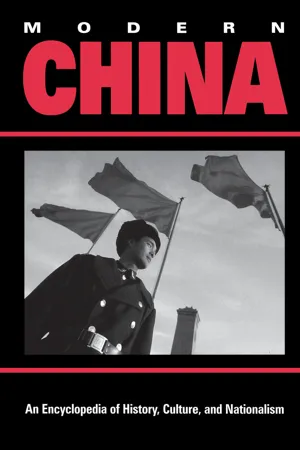
eBook - ePub
Modern China
An Encyclopedia of History, Culture, and Nationalism
- 480 pages
- English
- ePUB (mobile friendly)
- Available on iOS & Android
eBook - ePub
Modern China
An Encyclopedia of History, Culture, and Nationalism
Modern China
A
Amur River Massacres
In 1900, imperial Russia dispatched 200,000 troops into China as part of an international expedition to suppress the Boxer Uprising and to rescue the foreign embassies in Beijing. In July, the Russian army imposed a blockade along the Amur River, which served as the Sino-Russian border at the time. Most of the northern bank of the river, an area densely populated with Chinese residents, had been ceded to Russia in the Treaty of Aigun in 1858, but part of the area was still under Chinese jurisdiction. In an attempt to reduce Chinese influence in that area, the Russians massacred more than seven thousand Chinese residents along the northern bank (as in Hailanpao) and burned their houses. The Chinese authorities in Heilongjiang Province, south of the river, could offer little protection to those Chinese. After the incident, Russia annexed the entire northern bank.
The Russian army proceeded to occupy Manchuria during the expedition and refused to withdraw after the suppression of the Boxers. It was not until her defeat by Japan in the Russo-Japanese War (1904-05) that Russia evacuated southern Manchuria. She finally gave up northern Manchuria after World War I (1914-18).
Wang Ke-wen
References
Quested, R. K. I. "Matey" Imperialists? The Tsarist Russians in Manchuria, 1895-1917. Hong Kong: Oxford University Press, 1982.
Anarchist Movement
Although anarchism is internationalist in ideology and cosmopolitan by nature, Chinese anarchists demonstrated nationalist impulses as well as attacked what they regarded as narrow nationalism. The anarchist movement flourished in a radical atmosphere from about 1905 to the late 1920s, and its influences persisted considerably longer. During this period of intense and widespread nationalism, anarchists argued that their revolution would lead to the demise of the state, national borders, and perhaps even national identity and to the rise of a worldwide egalitarian, cooperative social system. Nonetheless, they were anti-imperialists, who supported movements to gain freedom from foreign domination and, before 1911, promoted the anti Manchu republican revolution. Criticized by self-avowed nationalists and national revolutionaries, anarchists argued that the true interests of the Chinese people lay in an international system of strictly voluntary organizations; some argued that indeed the good aspects of Chinese culture would flourish if the internal repression and external exploitation inherent in a state system were absent.
Most Chinese anarchists, although consistently deprecating chauvinism, encouraged nationalist movements as positive steps taken by oppressed peoples toward the achievement of a real revolution. Liu Shipei in 1907 in some respects anticipated Lenin's theses on imperialism. Liu foresaw that populist national liberation struggles would weaken the ruling classes of the colonial powers and help to precipitate revolutions in Europe and America. However, along with Zhang Binglin at the time, Liu favored a pan-Asianist, anti-imperialist movement—one that would forge links with Western radicals and lead a world revolution. In Liu's analysis, imperialism was rooted in capitalism and in old notions of in-group exclusivity and racism. Nationalist movements were therefore an important step, but only a first step, in creating a truly new order.
Before 1911, anarchists were firmly in the anti-Manchu camp. Although some emphasized the dangers of a nationalist revolution, which would re-create the faults of the Manchu regime under Han Chinese leadership, most joined the umbrella revolutionary organization, the Tongmenghui. Wu Zhihui and several other anarchists strenuously argued that the Manchus' grasp on power was especially pernicious and that revolution appropriately started with their destruction.
After the Revolution of 1911, some of the first-generation anarchists turned to cultural and, above all, educational reform in an effort to raise the Chinese people's "level of civilization." This eventually brought them into the Guomindang of Sun Yatsen and Chiang Kaishek. If "labor-learning" became a motif in Chinese radicalism generally, their anarchism, though continuing to be cited as a final goal, became attenuated. Liu Sifu (Shifu) assumed leadership of the movement after the founding of the Republic, giving it a strong moral thrust. He sharply distinguished his anarcho-commu-nism from other forms of socialism. A number of his followers went on to leading positions in academia and the labor movement.
The May Fourth movement of 1919 represented an outburst of nationalist feeling, but it was also an era of social radicalism, and anarchism therefore played an ideological role through the 1920s. Nationalists tended to merge society into the state in an effort to strengthen China; these tendencies were prevalent in the Guomindang and the Chinese Communist Party. Anarchists would, in contrast, merge the state into society and replace governmental functions with voluntary organizations. Yet even with an overlay of internationalism, anarchism was not directly opposed to many nationalist goals. Above all, anarchists offered a critique of capitalism that explained the sources of imperialism. Although many anarchists regarded class analysis a useful tool and promoted working class movements, some assailed communists for using class struggle to divide the people. Eventually, Chinese Marxists combined social revolution and nationalism with effective organization in a way that anarchist revolutionaries found impossible to achieve.
The appeal of anarchism as an ideology was undoubtedly weakened by its criticisms of nationalism. Chinese anarchism was a modern incarnation of humanist and universalist elements of the traditional Chinese world view. The anarchists' main focus remained a social and cultural revolution, and Chinese radicalism as a whole was most receptive to anarchist influences in these realms rather than on the political stage. However, anarchists inevitably wove strands of nationalist feelings into their doctrines. They argued that only an international, anti-authoritarian revolution would enable the Chinese to flourish, along with the world's other peoples. In their view, a revolution that strengthened the state would fail to produce a society with greater freedom, but would inevitably create a new hegemonic system.
Peter G. Zarrow
References
Dirlik, Arif. Anarchism in the Chinese Revolution. Berkeley: University of California Press, 1991.
—. The Origins of Chinese Communism. Oxford: Oxford University Press, 1989.
Zarrow, Peter. Anarchism and Chinese Political Culture. New York, NY: Columbia University Press, 1990.
Anfu Club
A political faction that dominated the Chinese parliament in the late 1910s, the Anfu Club supported Duan Qirui's government and was generally regarded as the civilian branch of Duan's Anhui Clique.
Following the aborted attempt by Zhang Xun to restore the Qing dynasty in July 1917, the Beijing government fell under the control of Premier Duan Qirui. Duan proposed the election of a new parliament as the basis of what he called the "re-established Republic." In March 1918, Duan's principal followers, Wang Yitang and Xu Shuzheng, organized the Anfu Club, named after their meeting place in Beijing's Anfu Alley, to ensure the election of pro-Duan politicians into the new Parliament.
The Anfu Club was remarkably successful in its operations. When the new parliament opened in August, the club controlled 70 percent of the seats. From late 1918 to late 1920, the Anfu politicians effectively controlled the parliament, which soon came to be known as the "Anfu Parliament." Under the leadership of Wang Yitang, they proposed and decided on legislations as a group, and then, with their majority, they imposed their will on the parliament. The club supported Duan's pro-Japanese policies and strengthened Duan's legitimacy as the national leader. By then, however, the Chinese Republic had become engulfed by warlordism, and the central political institutions as a whole hardly exerted any real influence over the political situation in the country.
In July 1920, Duan's Anhui Clique was defeated by its rival, the Zhili Clique, in the Zhili-Anhui War, resulting in the collapse of Duan's government. In August, the Zhili Clique entered Beijing and dissolved the "Anfu Parliament." The Anfu Club thereafter disappeared from the Chinese political scene. Some of its members later served as Japanese puppets during the Sino-Japanese War of 1937-45.
Wang Ke-wen
References
Nathan, Andrew J. Peking Politics, 1918-1923: Factionalism and the Failure of Constitutionalism. Berkeley: University of California Press, 1976.
Anhui Clique
See DUAN QIRUI
Anti-American, Anti-Government Demonstrations
The anti-American, anti-government demonstrations were an anti-civil war movement that lasted from October 1945 to April 1949 and was mainly a Communist-instigated movement to undermine Guomindang (GMD) authority. The demonstrations condemned the "brutality" of the United States in China and its support for the GMD, and accused the GMD of initiating the civil war and mistreating and suppressing the Chinese people. Thus the Communists and their urban allies succeeded in accelerating the collapse of the GMD.
After the war with Japan was over, the GMD government pursued an unskillful program of reorientation and examinations in the recovered territories, which alienated the "puppet" teachers and students and gave the Chinese Communist Party (CCP) an opportunity to denounce the "reactionary" nature of the government. The first Communist student demonstration was the peaceful Anti-Examination movement (October 1945-June 1946) that started in Beijing-Tianjin, followed by the bloody December First movement (1945) in Kunming. The emergence of slogans such as calls "to end one-party [GMD] dictatorship" and "to withdraw the American troops in China," and the inability of the government to control these demonstrations, were early signs of GMD weakness.
The period between June 1946 and July 1947 marked the high tide of the anti-American, anti-government demonstrations. The CCP exploited the alleged rape of a Beijing University coed (Shen Chong) by two American marines on December 24, 1945, by organizing a student-led Protest the Brutality of the American Military Personnel in China movement (December 1946-January 1947). The GMD could not control the students, and its opposition to the students' demands for withdrawal of all American influence compromised its stated commitment to Chinese nationalism. The Anti-Brutality movement thereby enabled the CCP to grasp the banner of Chinese nationalism and to lead the students. Partly influenced by the Shen Chong affair, The United States ordered most of the American troops to leave China by the end of 1947. The objectives of the Communist-instigated American Troops Quit China movement (1947) was therefore satisfied.
The pro-government demonstrations, especially the Anti-Soviet, Anti-Communist movement (February 1946), subdued the Communist-instigated "student tides" only temporarily, but did not succeed in seriously discrediting the CCP and the Soviet Union. In May 1947, a new wave of student demonstrations protested China's economic plight. By publicizing the issues of hunger, the government's huge military budget, and GMD repression, the Communists convinced some Chinese of the reactionary nature of the GMD government. The Anti Hunger, Anti-Civil War movement (May 1947) proved so effective in undermining the GMD's prestige that Zhou Enlai and Mao Zedong glorified it as the "Second Battle Front," in contrast with the military "First Battle Front" in the countryside.
In July 1947, the GMD issued an order to suppress the Communists, but it could not restrain student power nor stop the demonstrations. The GMD could not break the Communist hold on the various student self-governing organizations or destroy the Communist-controlled All-China Student Association. In May and June 1948, the Communists launched a protest against American support of Japan—the last openly anti-American, anti-government demonstration. This time, the slogans included "Long live the independence of the Chinese nation" and "Stop the second Marco Polo Incident [of July 7, 1937]." The Communists claimed that the demonstrations exposed the treachery of American imperialism and the traitorous actions of the GMD.
In August 1948 the GMD was resolved to crush the Communist student movement once and for all. But the August Nineteenth Great Arrest (1948) of students and other social elements failed; this incident marked the beginning of the end of the GMD's political control in urban China. The last anti-government protest before the Communist conquest of Nanjing (April 24, 1949) was the six-thousand-strong student demonstration in the GMD capital on April 1, 1949, which demanded the GMD's acceptance of the Communist peace offer and an end to American meddling.
Until at least 1947, most students and other social elements supported neither the GMD nor the CCP overtly. This situation then changed. Student-based demonstrations ultimately discredited the GMD, but not the CCP. The anti-American, anti-government demonstrations decisively benefited the Communists during the civil war.
Joseph K. S. Yick
References
Pepper, Suzanne. Civil War in China: The Political Struggle, 1945-1949. Berkeley: University of California Press, 1978.
Wasserstrom, Jeffrey W. Student Protests in Twentieth-Century China: The View from Shanghai. Stanford, CA: Stanford University Press, 1991.
Anti-American Boycott
The boycott of 1905 in protest against American immigration policy was one of the first attempts in modern China at using economic means to achieve nationalistic political ends.
In 1904, the U.S. Congress passed a bill that permanently excluded Chinese immigration from American territories. The news enraged many Chinese, who saw the law as a form of racial discrimination. The Qing government immediately began negotiations with the United States in hopes of changing this new legislation. To demonstrate their dissatisfaction with the American policy, and to strengthen the Qing government's position in the negotiations, Chinese merchants in Shanghai, Nanjing, Canton, and other major cities organized a boycott of American goods and services in 1905. In their proclamations, the merchants pointed out that cheap American products had earned huge profits for American businesses but had driven Chinese laborers out of work. As a result, many Chinese went to the United States to work on its railways and in its factories. Instead of showing their gratitude for the contributions that the Chinese had made to their economic well-being, the Americans were now depriving the Chinese workers of their opportunity to make a living.
The boycott movement was c...
Table of contents
- Cover Page
- Half Title Page
- Title Page
- Copyright Page
- Contents
- Introduction
- Entries by Subject
- Chronology
- Contributors
- Maps
- The Encyclopedia
- Index
Trusted by 375,005 students
Access to over 1.5 million titles for a fair monthly price.
Study more efficiently using our study tools.
Frequently asked questions
Yes, you can cancel anytime from the Subscription tab in your account settings on the Perlego website. Your subscription will stay active until the end of your current billing period. Learn how to cancel your subscription
No, books cannot be downloaded as external files, such as PDFs, for use outside of Perlego. However, you can download books within the Perlego app for offline reading on mobile or tablet. Learn how to download books offline
Perlego offers two plans: Essential and Complete
- Essential is ideal for learners and professionals who enjoy exploring a wide range of subjects. Access the Essential Library with 800,000+ trusted titles and best-sellers across business, personal growth, and the humanities. Includes unlimited reading time and Standard Read Aloud voice.
- Complete: Perfect for advanced learners and researchers needing full, unrestricted access. Unlock 1.5M+ books across hundreds of subjects, including academic and specialized titles. The Complete Plan also includes advanced features like Premium Read Aloud and Research Assistant.
We are an online textbook subscription service, where you can get access to an entire online library for less than the price of a single book per month. With over 1.5 million books across 990+ topics, we’ve got you covered! Learn about our mission
Look out for the read-aloud symbol on your next book to see if you can listen to it. The read-aloud tool reads text aloud for you, highlighting the text as it is being read. You can pause it, speed it up and slow it down. Learn more about Read Aloud
Yes! You can use the Perlego app on both iOS and Android devices to read anytime, anywhere — even offline. Perfect for commutes or when you’re on the go.
Please note we cannot support devices running on iOS 13 and Android 7 or earlier. Learn more about using the app
Please note we cannot support devices running on iOS 13 and Android 7 or earlier. Learn more about using the app
Yes, you can access Modern China by Ke-wen Wang, CRSN Staff, Ke-wen Wang,CRSN Staff in PDF and/or ePUB format, as well as other popular books in History & Chinese History. We have over 1.5 million books available in our catalogue for you to explore.