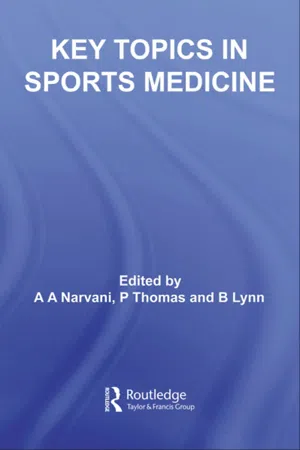
Students have often commented on the need for a concise textbook on sports medicine that presents the essential information otherwise scattered across several much larger medical textbooks on other topics. Addressing this need, Key Topics in Sports Medicine makes effective use of the successful Key Topics format to provide extensive relevant information in an accessible and easy-to-follow manner. Practical and clearly presented, this is an invaluable resource for those students and practioners of sports medicine and rehabilitation, athletic training, physiotherapy and orthopedic surgery.
- 336 pages
- English
- ePUB (mobile friendly)
- Available on iOS & Android
eBook - ePub
Key Topics in Sports Medicine
About this book
Information
Urinary tract injuries
P Thomas
Renal injuries
Haematuria is the symptom present in ruptures or contusions but absent in avulsions where the vascular pedicle is still intact. The pain the athlete experiences is at the renal angle below the twelfth rib. IVP investigation or CT scan will assist diagnosis.
An avulsion that has occurred beyond 12 hours will require a nephrectomy but renal ruptures can be treated with partial or complete kidney salvage. In cases of perinephric tamponade ruptures, then surgery is necessary because of hypovolaemia.
Following renal injury, a persistent hypertension may exist and it will need attention. Counseling and advice should be provided to the individual athlete with a solitary kidney on the risks, although low, in taking part in contact sports.
Bladder injuries
Such injuries are usually associated with a full bladder during contact sport. A cystogram will assist diagnosis. Intra-peritoneal rupture will require laparotomy and repair. However, with an extra-peritoneal rupture then bladder drainage alone is sufficient in the majority of defects.
Urethral injuries
Usually they occur from a kick to the groin or a fall onto an object such as a bicycle handlebar. The athlete will present with an inability to void or the presence of blood in the urine. A urethrogram is diagnostic. A urine catheter must not be introduced until the diagnosis is made to avoid risk of creating a false urethral passage.
Scrotum injuries
They are common and obvious injuries. They can be classified as contusions, haematoma, torsion or rupture of the testicle. It is important to organise an ultrasound scan to distinguish between a traumatic haematoma and the presence of a tumor, which could be detected in young individuals.
Further reading
Zachazewski JE et al. (Eds) Athletic Injuries and Rehabilitation. Philadelphia: WB Saunders, 1996.
Related titles from Routledge
Drugs in Sport
Drugs in Sport
Fourth Edition
Edited by David R. Mottram
Drug use is perhaps the biggest challenge facing sport today. Yet with media and public opinion, medals and morals all at stake, it is difficult to gain a clear perspective on this complex issue. Drugs in Sport is the most comprehensive and accurate text available on the subject. Taking into account the latest regulations, methods and landmark cases, it explores the hard science behind drug use in sport, as well as the ethical, social, political and administrative context. Key topics include:
- Action and side-effects of each major class of drugs used in sport
- The latest WADA doping control regulations
- Advances in doping control, and the sanctions for testing positive
- The use of therapeutic drugs banned in sport
- Ethical, political and administrative issues in monitoring drug use
- An assessment of the prevalence of drug taking in sport
Extensively referenced, Drugs in Sport provides a comprehensive, objective resource for students and researchers, athletes, sports scientists and coaches, journalists, sports administrators and policymakers.
David R. Mottram is Professor of Pharmacy Practice at Liverpool John Moores University.
Hb: 0-415-37563-0
Pb: 0-415-37564-9
Pb: 0-415-37564-9
Available at all good bookshops For ordering and further information please visit:
www.routledge.com
Related titles from Routledge
Food, Nutrition and Sports Performance II
Food, Nutrition and Sports Performance II
The International Olympic Committee Consensus on Sports Nutrition
This book presents the latest consensus statement on Food, Nutrition and Sports Performance from the International Olympic Committee Medical Commission Working Group on Sports Nutrition, together with detailed discussion of research evidence, guidelines for athletes and coaches, and key issues in sports nutrition.
Includes:
- Energy balance and body composition
- Macronutrient metabolism and availability
- Athletes’ fluid and electrolyte requirements
- Dietary supplements
- Nutrition and immune function
- Nutritional s...
Table of contents
- Cover Page
- Title Page
- Copyright Page
- List of Contributors
- Preface
- Abdominal Injuries In Sport
- Achilles Tendon Rupture
- Ageing and Sport
- Ankle–Acute Sprains
- Ankle–Persistent Problems Following Sprains: Overview
- Ankle–Persistent Problems Following Sprains: Lateral Ankle Instability
- Ankle–Persistent Problems Following Sprains: Other Injuries
- Back Pain–Overview
- Back Pain–Lumbar Strains and Sprains
- Back Pain–Discogenic
- Back Pain–Spondylolysis
- Biomechanics
- Calf Pain
- Cervical Spine Injuries–Overview
- Cervical Spine–Cervical Ligament and Muscle Injuries
- Cervical Spine–Cervical Disc Injuries and Herniations
- Cervical Spine–Fracture/Dislocation
- Cervical Spine–Cervical Cord Neuropraxia
- Cervical Spine–Nerve Root/Brachial Plexus Injuries
- Chest Injuries
- Compartment Pressure Syndromes
- Diabetes and Exercise
- Disability and Sport–Overview
- Disability and Sport–Classification
- Disability and Sport–Medical Problems
- Disability and Sport–Equipment
- Drugs In Sport–Overview
- Drugs In Sport–The Administrative Framework: Doping Control Procedures
- Drugs In Sport–Anabolic Steroid Abuse
- Drugs In Sport–Blood Doping, Erythropoietin and Altitude Training
- Diving–Hyperbaric Medicine
- Ear, Nose, Throat Conditions In Athletes
- Elbow–Lateral Epicondylitis (Tennis Elbow)
- Elbow–Medial Epicondylitis (Golfer’s Elbow)
- Elbow–Throwing Injuries
- Epilepsy and Exercise
- Exercise Physiology–Circulatory and Respiratory Systems
- Exercise Promotion
- Eye Injuries In Sports
- Female Athlete–The Triad
- Female Athlete–Exercise During Pregnancy
- Fitness Testing
- Forearm and Wrist Conditions
- Gender Verification
- Groin Pain
- Hand Injuries
- Head Injury
- Heel Pain
- Imaging of Sports Injuries–Plain Radiograph (Plain X-Ray)
- Imaging of Sports Injuries–Ultrasound (USS)
- Imaging of Sports Injuries–Isotope Bone Scan
- Imaging of Sports Injuries–Magnetic Resonance Imaging (MRI)
- Imaging of Sports Injuries–Computed Tomography (CT)
- Knee–Acute Injuries
- Knee–Overuse Injuries
- Knee–Anterior Knee Pain
- Lumbar Intervertebral Disc Herniation
- Maxillofacial Injuries In Sport
- Muscle Properties Relevant to Sports and Exercise (Including Fatigue)
- Nerve Injury–Overview of Peripheral Nerve Injuries
- Nerve Entrapment Syndromes–Upper Limb
- Nerve Entrapment Syndromes–Lower Limb
- Orthoses In Sport
- Osteoarthritis and Sport
- Osteoarthritis–Treatment
- Paediatrics–Sports Medicine
- Paediatrics–Sports Injuries
- Paediatrics–Osteochondrosis (Osteochondritis)
- Physiotherapy–General Principles
- Physiotherapy–Acute Injury Management
- Physiotherapy–Rehabilitation
- Physiotherapy–The Team Physiotherapist
- Prevention of Sports Injuries
- Psychology–Performance Enhancement
- Psychology–Sports Injuries
- Pulmonary Disorders and Exercise
- Risk of Sudden Death In Athletes
- Shin Pain
- Shoulder–Acute Dislocation
- Shoulder–Instability
- Shoulder–Impingement Syndrome/Rotator Cuff Disease
- Shoulder–Acromioclavicular Joint Injuries
- Skin Infections In Athletes
- Sport and Exercise At Altitude
- Sport and Exercise In the Cold–Hypothermia
- Sport and Exercise In the Heat–Thermoregulation and Fluid Balance
- Sport and Travelling
- Sports Footwear
- Stress Fractures In Sports
- Team Physician
- Thigh Pain (Anterior)–Quadriceps Muscle Injuries
- Thigh Pain (Posterior)–Hamstring Strains
- Thigh–Muscular Contusions and Myositis Ossificans
- Thoracolumbar Spine Fractures
- Training
- Unexplained Underperformance Syndrome
- Urinary Tract Injuries
Trusted by 375,005 students
Access to over 1.5 million titles for a fair monthly price.
Study more efficiently using our study tools.
Frequently asked questions
Yes, you can cancel anytime from the Subscription tab in your account settings on the Perlego website. Your subscription will stay active until the end of your current billing period. Learn how to cancel your subscription
No, books cannot be downloaded as external files, such as PDFs, for use outside of Perlego. However, you can download books within the Perlego app for offline reading on mobile or tablet. Learn how to download books offline
Perlego offers two plans: Essential and Complete
- Essential is ideal for learners and professionals who enjoy exploring a wide range of subjects. Access the Essential Library with 800,000+ trusted titles and best-sellers across business, personal growth, and the humanities. Includes unlimited reading time and Standard Read Aloud voice.
- Complete: Perfect for advanced learners and researchers needing full, unrestricted access. Unlock 1.5M+ books across hundreds of subjects, including academic and specialized titles. The Complete Plan also includes advanced features like Premium Read Aloud and Research Assistant.
We are an online textbook subscription service, where you can get access to an entire online library for less than the price of a single book per month. With over 1.5 million books across 990+ topics, we’ve got you covered! Learn about our mission
Look out for the read-aloud symbol on your next book to see if you can listen to it. The read-aloud tool reads text aloud for you, highlighting the text as it is being read. You can pause it, speed it up and slow it down. Learn more about Read Aloud
Yes! You can use the Perlego app on both iOS and Android devices to read anytime, anywhere — even offline. Perfect for commutes or when you’re on the go.
Please note we cannot support devices running on iOS 13 and Android 7 or earlier. Learn more about using the app
Please note we cannot support devices running on iOS 13 and Android 7 or earlier. Learn more about using the app
Yes, you can access Key Topics in Sports Medicine by A.A. Narvani,P. Thomas,B. Lynn in PDF and/or ePUB format, as well as other popular books in Medicine & Orthopedics. We have over 1.5 million books available in our catalogue for you to explore.