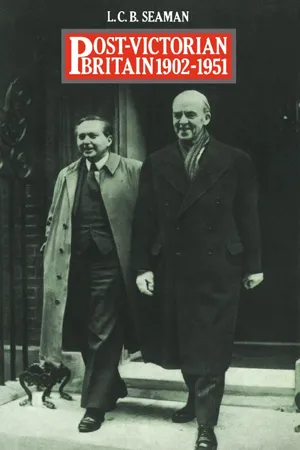
This comprehensive survey of English history during the first half of the twentieth century has three main themes: the political and social consequences of the replacement of the Liberal Party by the Labour Party; the continuous development of the welfare state; and the changes in England's imperial and international position caused by the ambitions of Germany and Japan and by the emergence of the U.S.A and the U.S.S.R as world powers. The leading personalities of the period are brilliantly portrayed and the issues challengingly presently.
- 544 pages
- English
- ePUB (mobile friendly)
- Available on iOS & Android
eBook - ePub
Post-Victorian Britain 1902-1951
PART I:
END AND BEGINNING 1902–1914
1 ·
Conspectus, 1902
In 1902 Lord Salisbury had retired, Edward VII had been crowned and the Treaty of Vereeniging had been signed. The Labour Representation Committee had been formed at Farringdon Street in 1900 and in 1902 had already won two seats at by-elections. 1902 was also the year of the Balfour Education Act and of the Anglo-Japanese alliance. All these circumstances justify taking this particular year as a starting-point.
In political history the retirement of Salisbury was as much the end of an era as had been the retirement of Gladstone or the death of Palmerston. Salisbury was the last Prime Minister to sit in the Lords. He was the last to bring to his office, though in a different and somewhat less excessively publicized manner, that devout awareness of Christianity which had also characterized Gladstone. What had distinguished Salisbury’s Christianity from Gladstone’s was that Gladstone’s was basically Protestant, strenuous and optimistic, whereas Salisbury’s was more Catholic and more pessimistic. Thus Salisbury, little though he relished selfishness and irresponsibility when he found it in other noblemen, attached, in contrast to Gladstone, little value to legislation as a means of human betterment. Unlike Gladstone, too, he was on the whole, except for the occasional railway directorship, a long way away from the commercial middle class and further still from the urban working class; Lord Salisbury belonged to that fast-dying era when the aristocratic politician could still think of the labouring poor chiefly as rural tenants. The profound but aloof pessimism of an eccentric other-worldly Christian who had himself never lacked for anything was one of the factors behind the marked lack of significant social legislation in the long years of Salisbury’s political domination. There was already much evidence that the new forces in the electorate were not content with this state of affairs, and their discontent was speedily made evident when Salisbury left the political scene. His lightweight nephew, philosophical and sceptical where his uncle had been religious and devout, was equally remote from the realities of a great industrial State. Lloyd George commented on the evidence he saw of this in Balfour during the First World War, relating with sardonic enjoyment Balfour’s somewhat glazed astonishment when confronted for the first time with a trade union delegation. Lacking his uncle’s experience, his authority and his appearance of toughness, Balfour was unequal to dealing with the increasing political awareness of the lower orders, resulting from the growth of the trade union movement, and the general discredit which the length and difficulty of the Boer War had brought upon the only genuinely popular element in late nineteenth-century Toryism, its Imperialism. When to these were added the rogue-elephant tactics of Chamberlain in launching a Tariff Reform campaign, the stage was set for the election defeat of 1906 which condemned Balfour to spend the greater part of his political career as England’s most distinguished former Prime Minister. The party considered itself lucky to have won the socalled Khaki Election of 1900 and, indeed, their victory then is ascribable not merely to their somewhat unscrupulous appeal to patriotism but also to the continued disarray of the Liberal Party. They therefore not surprisingly paid the penalty of an overwhelming defeat in 1906, and were not again undisputed masters of the political stage until the days of Baldwin.
The death of Queen Victoria and the accession of Edward VII were naturally taken then, and have been so considered since, as marking the end of an era. It is possible perhaps at this date to underestimate the effects on the national mind. Even more than Lord Salisbury, the Queen had linked the England of 1900 with the still largely rural England of the age before the Railway Mania; she had also linked England with the continent of Europe in a more personal way than has since been possible. Like Salisbury, and for longer than Salisbury, the Queen, by age and experience and through the marriages of her children and grandchildren, the unofficial head of many of Europe’s royal families, in a symbolic way bound England, notwithstanding its notorious insularity, with Europe no less than she had bound it to the colonies. And just as the Conservative Party found itself diminished when Salisbury had been replaced by Balfour, so England was in some ways diminished (since politics domestic and foreign are not to be explained in terms wholly rational) by the substitution of Edward VII for Queen Victoria. William II was in awe of his grandmother but tried to patronize Uncle Bertie; and this was not without its significance in view of the temperaments of the two men. Moreover, Edward VII symbolized and encouraged the growing English suspicion of Germany by his obvious preference for France which, though not without precedent among statesmen, can be paralleled among the King’s predecessors only by Charles II. The King was also only the second monarch since Charles II to identify himself publicly with ‘smart’ society; and since an important factor of the years after 1902 was a much increased display of affluence by the rich at a time when real wages were at best stationary, Edward the Peacemaker perhaps contributed a little, through his highly convivial personality and his un-Victorian choice of associates, to that increasing hostility of the poor towards the wealthy which Lloyd George was to exploit so high-spiritedly between 1909 and 1911. Edward VII’s uniqueness in this respect is all the more noticeable when contrasted with his successors as well as his predecessors. George V and Queen Mary once again made the monarchy uncontroversial and, perhaps unwittingly, began the process which, by the middle of the twentieth century, had compelled the royal family to take part in an almost continuous ceremonial soap-opera.
The signing of the Peace of Vereeniging in 1902 appeared to have brought to a satisfactory conclusion, if not to a glorious climax, the age of Imperialism in English history. One of the unnoticed features of British Imperialism, however, is the short run it had as a dominant political theory. A phenomenon which was spoken of in this country by J.A.Hobson and then outside it by Lenin, as the arch-enemy of liberty throughout the world, which has long been used to justify vilification of this country not only in Marxist-Leninist Russia but also in the United States, was in fact a phenomenon which barely existed before 1874 and which dominated the English mind only from 1885 to 1902. It is only in these years that Government and large sections of public opinion appeared to accept the rightness of a policy of actively extending the boundaries of Empire; only in these years was opposition to this idea without really effective political expression. ‘Land of Hope and Glory’ could not have been written at any time before the 1880’s, and it could never be taken quite seriously at any time after 1906; and it is altogether fitting that Elgar himself, who prided himself on his Englishness, soon found it unbearable to listen to. In the Leninist and American-Liberal sense of the phrase, Gladstone had been an anti-Imperialist and so had Aberdeen, Peel, Castlereagh and Pitt. After Gladstone, Imperialism found full political expression only in the careers of Chamberlain and Rhodes. Behind them, it is true, had been the subtle mind of Salisbury, but though his Governments added many square miles to the British Empire he superintended this process very largely as a matter of political and diplomatic tactics, in a manner not altogether unlike that in which, in the early 1880’s, Bismarck had also undertaken a colonial policy in pursuit of a particular domestic policy. The Boer War was seriously damaging to Imperialism partly by its inefficiencies and partly because of the publicity given by the Government’s Liberal critics to Kitchener’s concentration camps; conditions in these were, of course, the inevitable consequence of Kitchener’s notorious lack of interest in the medical care even of his own troops. He was hardly likely to show much imagination in his treatment of enemy aliens even if they were women and children. The Boer War did lasting damage to the British Empire chiefly because it made too many Englishmen as uncritically ashamed of Empire as, before 1899, too many had been uncritically proud of it.
The formation of the Labour Representation Committee had attracted no attention in 1900. But in the 1906 election, the L.R.C. and its T.U.allies were to win about fifty seats, a startling indication of the extent to which both the traditional political parties were felt to have failed the working class. The nineteenth century is widely and rightly thought of as a period of continuous social reform; but it is difficult to point to any reforms passed by Whigs or Liberals which were specifically intended to confer direct benefits on the working class as such. This would have seemed contrary to the Liberal concern to achieve what it considered a proper balance between the classes. To the nineteenth-century mind, laws which conferred exclusive benefits on any one class were bad laws. It was for this reason that the Liberals had set out to destroy the privileged legal position previously enjoyed by the aristocracy and the Church. It was also in this spirit that the Tories had legislated in the 1840’s against the undue advantage which the common law appeared to give factory owners over their female and child employees. It was because it was widely held that universal suffrage, by giving numerical superiority to the labouring poor, would lead to governments being conducted solely in their interest that democracy had remained a term of abuse in the nineteenth century and parliamentary reform after 1832 had been so long delayed. By 1900, however, the working class had begun to demand once more what it had demanded hardly at all since the failure of Chartism, namely direct political power. Since 1848 the organized working-class movement had ceased to seek political power, partly because of the general material progress of the country, in which all classes except the unskilled worker had tended to share, and partly because the New Unions believed they could safeguard their special position as the aristocracy of labour industrially by negotiation, and politically by acting as pressure groups, procedures which made less heavy demands on their finances. This state of affairs was already coming to an end when Salisbury became Prime Minister for the second time, in 1886. Bloody Sunday (1887), the Match Girls’ strike (1888), the London Dock strike (1889) and the growth of industrial unionism among the unskilled workers, suggested that the political future would be shaped, and perhaps dominated, by the greater political awareness of the working class. This new militancy no doubt resulted in part from the sharp decline in the prosperity of some sections of English agriculture in the last quarter of the century and from uncertainties caused by the so-called Great Depression. There was thus a stirring from the depths in late Victorian society, depths which decades of material progress had hardly touched and which had defied the intense missionary zeal of the churches altogether. Yet, at the beginning of the twentieth century, neither of the traditional parties showed signs of coming to grips with the problems thus posed or even of being aware that they existed.
Disraeli had to some extent foreseen that the party which was the more successful in wooing the workingclass electorate could best meet the challenge of the future. It was for this reason that he had invented the idea of Tory Democracy, based on social reform and the Empire. It is true that Disraeli’s so-called Imperialism was more an imitation of the foreign policy of Palmerston than an anticipation of the colonial policy of Chamberlain and Rhodes; but, in encouraging pride in Empire, Disraeli showed real understanding of the working classes. For working men, the colonies were not, as they were to Gladstonian Liberals, costly administrative inconveniences, but places to which their closest relatives had emigrated and to which lack of employment in this country might eventually compel them to emigrate also. Disraeli had had the sense to see that blood was not only thicker than water but a more living source of political power than the holierthan-thou counting of pence which so often passed among Liberals for a foreign and colonial policy. He had seen too, ahead of his contemporaries, that the extension of the franchise compelled the political parties to woo the working man more directly; and the social legislation of 1874– 80, such as the Trade Union Act, the Public Health Act and the Artisans’ Dwellings Act, was a real departure in policy; it represented an appeal, limited though it was, to the daily interests of the working class, which, as the record shows, had not been made by Gladstone even in his prime between 1868 and 1874.
Unfortunately Disraeli’s clairvoyance was not shared by his successor. Salisbury served his party ill in the long run by his remoteness from the working class. Tory Democracy, it is true, found an immediate champion after Disraeli’s death in Lord Randolph Churchill, but Churchill ruined his career by staking more than was politically justifiable on his personal indispensability and on the value which Salisbury would attach to Churchill’s following among the now further enfranchised working classes. The power with which the constitution and the party system combine to endow a Prime Minister makes other members of a Cabinet among the most easily replaceable of public figures; a circumstance which goes far to explain the survival in later years of Baldwin without Winston Churchill, and of Neville Chamberlain without Churchill, Eden, Amery, Duff Cooper and Cranborne. Unfortunately, the graver social problems of a great people cannot ultimately be solved by political adroitness. In this matter of the condition of the people, therefore, Salisbury sowed the whirlwind that Balfour was to reap.
The only other source from which the Tories might have continued to imbibe Tory Democratic principles was Joseph Chamberlain. Chamberlain was, however, largely lost to the radical cause by his espousal of Imperialism, and this was a double disaster for the Tory Party. It produced the psychological shock of the Boer War and it enabled Liberalism in 1906 to capture from the Tories the working-class vote which, on its previous record, it had done so little to deserve. This was made easier for the Liberals because Chamberlain added to his other political errors the greater error of championing the cause of Tariff Reform from 1903 onwards. This, coming as it did after nearly twenty years of Conservative rule during which hardly anything had been done politically to satisfy the social demands of the masses, helped to make more credible Lloyd George’s attack on the Tories, and the Tory peers in particular, as enemies of the people. It explains also the size of Labour’s representation in the 1906 Parliament. This was, however, more than a working-class judgement on the Tories; it was also a serving of notice upon the triumphant Liberals that they were victors on condition that they served the cause of the working class.
The Balfour Education Act of 1902 is likewise a starting-point. It originated the process which the 1950’s and 1960’s were taught to think of in disparaging terms as the education of a ‘meritocracy’. The most important feature of the Act to contemporaries appeared to be that Nonconformists were now compelled to contribute by way of their local authority rates to the upkeep of the Church schools. They had been contributing to this through the national taxes since 1833, and their opposition was thus illogical; but it is customary to regard Nonconformist anger over this matter as a contributory factor to the Liberal victory in 1906. It was, like Tariff Reform, calculated to give new life to old Liberal shibboleths, and is better regarded as an indication of the quite temporary, not to say illusory character of the Liberal victory; for just as Free Trade was a slowly dying cause so the Nonconformist conscience was well on the way to becoming a small ignored voice. What gave the Act its significance both for good and ill was its creation of State responsibility for secondary education through the education committees of the county councils. The lower middle class were now able to educate their children above the elementary level by the payment of relatively low fees; and the children of even the least prosperous among them could henceforth enter these secondary schools provided they could establish a claim to free tuition and a maintenance grant by success in a stiff competitive 10-plus ‘scholarship’ examination. The State grammar schools thus created were later subject to continuous criticism. The Labour Party disliked them on the grounds that they turned lower middle-class and working-class children into bourgeois snobs; and the Conservatives disliked them on the grounds that they enabled fact-crammed examinees to establish a claim to positions in society for which their lack of public school character-training was alleged to make them fundamentally unsuited. This suggests that the grammar schools were almost the only successful solvent of class divisions which this country evolved during the first half of the twentieth century. It would not be far wrong to say that it was the grammar-school educated who gave Labour its decisive victory in the 1945 election and who, out of discontent with the fruits they obtained from that election, put the Conservatives back into power in 1951.
Where the Balfour Act and its consequences are most open to criticism is that the schools which it created or revived were in fact grammar schools, too ready to assume that a traditional education, taking its spirit and aims from the public schools, was the only possible education to give to the new pool of ability for which they catered. A much greater readiness to respond to the country’s obvious need for improved technical education would have been more in keeping with the first decade of the century, let alone later decades. By 1902 it was already nearly forty years since a Royal Commission had first called attention to the inadequacy of English technical education, and already well over a decade since the foundation of the Polytechnic movement by Quintin Hogg had pointed a way to the future which, despite the Technical Instruction Act of 1889, the local authorities and the State tended to ignore. They continued to ignore it when the 1944 Act gave them another opportunity to create secondary technical schools on a national scale.
Nevertheless, the grammar schools, along with the trade unions, provided for the first time since before the Reformation an organized route by which persons of humble birth with no flair for making money could rise to positions of authority. As it turned out, the grammar school quickly outpaced the trade unions as a nursery for new talent. Although the trade union movement produced a Foreign Secretary in Ernest Bevin, it. is not likely to throw up a man of comparable type again; the Ernest Bevins of the future will be shaped differently by universal secondary education. The significance of educational expansion in effecting social change in the first six decades of the century is not of course to be exaggerated: a number of plays and novels in the 1950’s testify to the durability of the fiction that the grammar school product, even when given a university education as well, remained something of a barbarian.
The signing of the Anglo-Japanese alliance in 1902 used to be regarded as marking the end of England’s ‘splendid isolation’. There are good grounds for saying that Salisbury’s policy had never been one of splendid isolation; and grounds also for saying that if splendid isolation had been his policy the Anglo-Japanese Alliance did not end it. Learned arguments as to the origin and implication of the phrase need not debar its use if it is taken to refer to the evident fact that, whereas by the mid-1890’s the continental Powers were joined into rival groups, the United Kingdom was formally associated with neither. It is in this sense and this sense alone that the British were ‘isolated’, and since it was an isolation from Europe, an alliance with Japan can hardly be said to have ended it.
The Anglo-Japanese alliance had, however, immediate consequences of far-reaching importance and it was certainly a landmark in the history of the relations between the European and the non-European world. For the first time in the modern period, a European Great Power was treating a non-European Power as an equal. The alliance may or may not have ended England’s isolation but it clearly ended Japan’s; it raised the curtain on a drama which reached its apocalypse at Hiroshima and proceeded thereto by way of the Manchurian crisis, Pearl Harbor and the fall of Singapore. By a curious twist of circumstance, the fact that the British were the first European Power to treat an Oriental Power on terms of equality was never to redound to their credit; but there is no doubt that British patronage of Japan was a decisive event in the revival of the peoples of the East. There were, within less than ten years of it, a would-be ‘Westernizing’ revolt in Turkey, the first moves in the long-drawn-out Chinese revolution, and the first stirrings of Indonesian revolt against the Dutch. Nothing more pregnant of future change had happened to Asia since Vasco da Gama’s arrival at Calicut in 1498.
The alliance also set in train events which changed the course of European history. Without it, the Japanese would not have risked their war with Russia; and that had for its sequels the abortive Russian revolution of 1905, the Anglo-Russian entente, and a renewed if unwilling concentration of Russian policy on the Balkans, which by 1914 had produced a situation from which war seemed the only possible escape. By making a Russo-Japanese War possible it made an Anglo-French entente more urgent. The French had been working for this since Fashoda; but it was the French desire to bring the Russo-Japanese War to a speedy end before it disastrously weakened France’s one European ally that impelled the French to make haste to sign an agreement with England, the ally of Japan. The Anglo-Japanese Alliance was also the first successful positive step that British Governments had taken in foreign policy since the Cyprus Convention of 1878. After 1878, foreign policy was hesitant, as under Gladstone, or cautiously serpentine, as under Salisbury. Egypt had been acquired inadvertently; in 1898 there had been failure to obtain agreement with Russia, and between 1898 and 1901 successive failures to secure agreement with Germany. Even Fashoda was largely negative and its significance greatly exaggerated. All that Fashoda had done was to recall sharply to the French that it was exactly a hundred years since Nelson’s victory at the Battle of the Nile had destroyed the one real chance the French had ever had of controlling Egypt, that it was over fifty years since Palmerston had bludgeoned Louis Philippe out of trying to secure Egypt for France by exalting Mehemet Ali, and nearly twenty since the French had opted out of the expedition to Alexandria in 1882. The purpose of the Anglo-Japanese alliance was certainly the negative one of restraining Russia in north China; but it is significant that the British had at last taken on a new commitment, by offering support for Japanese ambitions in Korea, just as two years later they took on the new commitment of supporting French ambitions in Morocco. In 1902 the British had thus taken the first step along a path from which they were to find it impossible to retrace their steps.
2 ·
Conservative Balance Sheet, 1902–05
The defeat which the Conservatives suffered in the election of 1906 was so overwhelming that it cannot be explained solely on rational grounds. Considered as a verdict on the achievements of Balfour’s Ministry since 1902 it was unjust; and it would be wrong to take it as implying an overwhelming desire on the part of the electorate for the legislation which the Liberals eventually put on the statute book. There seems little evidence that the electorate either knew that they were voting for a Government which would later be described as ‘founding the welfare state’; or that, if they had known this, they would have necessarily voted for it. This is shown by the heavy losses the Liberals suffered in the 1910 elections. Discontent with twenty years of Tory rule was deep-seated but incoherent; and there is much to be said for the view that the Conservatives were defeated in...
Table of contents
- Cover Page
- Half Title page
- Title Page
- Copyright Page
- Dedication
- Contents
- Text Illustrations
- Maps
- Introduction
- Acknowledgements
- Part I: End and Beginning 1902–1914
- Part II: First World War 1914–1918
- Part III: The Wizard Merlin 1918–1922
- Part IV: Baldwin and Macdonald 1922–1931
- Part V: The National Conservatives 1931–39
- Part VI: 'without Grip or Grasp': British Foreign Policy 1931–1939
- Part VII: War for Europe and Asia
- Part VIII: A Grand Alliance? 1941–1945
- Part IX: Beginning and End, 1945–1951
- Books
- Index
Trusted by 375,005 students
Access to over 1.5 million titles for a fair monthly price.
Study more efficiently using our study tools.
Frequently asked questions
Yes, you can cancel anytime from the Subscription tab in your account settings on the Perlego website. Your subscription will stay active until the end of your current billing period. Learn how to cancel your subscription
No, books cannot be downloaded as external files, such as PDFs, for use outside of Perlego. However, you can download books within the Perlego app for offline reading on mobile or tablet. Learn how to download books offline
Perlego offers two plans: Essential and Complete
- Essential is ideal for learners and professionals who enjoy exploring a wide range of subjects. Access the Essential Library with 800,000+ trusted titles and best-sellers across business, personal growth, and the humanities. Includes unlimited reading time and Standard Read Aloud voice.
- Complete: Perfect for advanced learners and researchers needing full, unrestricted access. Unlock 1.5M+ books across hundreds of subjects, including academic and specialized titles. The Complete Plan also includes advanced features like Premium Read Aloud and Research Assistant.
We are an online textbook subscription service, where you can get access to an entire online library for less than the price of a single book per month. With over 1.5 million books across 990+ topics, we’ve got you covered! Learn about our mission
Look out for the read-aloud symbol on your next book to see if you can listen to it. The read-aloud tool reads text aloud for you, highlighting the text as it is being read. You can pause it, speed it up and slow it down. Learn more about Read Aloud
Yes! You can use the Perlego app on both iOS and Android devices to read anytime, anywhere — even offline. Perfect for commutes or when you’re on the go.
Please note we cannot support devices running on iOS 13 and Android 7 or earlier. Learn more about using the app
Please note we cannot support devices running on iOS 13 and Android 7 or earlier. Learn more about using the app
Yes, you can access Post-Victorian Britain 1902-1951 by L.C.B. Seaman in PDF and/or ePUB format, as well as other popular books in History & Modern British History. We have over 1.5 million books available in our catalogue for you to explore.