- 416 pages
- English
- ePUB (mobile friendly)
- Available on iOS & Android
eBook - ePub
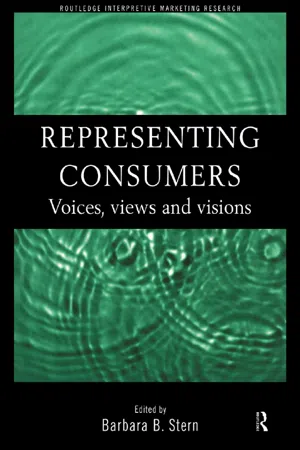
About this book
Consumer research has traditionally focused on issues of epistemology in the collection and analysis of data. As a consequence, the crisis in representation which has radically reshaped understanding in the social sciences, has, so far, had very little impact on consumer research. This book redresses the balance with an investigation of representation and constructions of 'truth' in consumer research. Subjects covered include:
* construction of the researcher and consumer voice
* quantitative tools and representation
* advertising narratives
* poetic representation of consumer experience
* the crisis in the crisis concept
* consumer-oriented ethnographic research.
The essays are written by experts from Britain and the United States and draw on a broad range of theoretical approaches.
Part I
RESEARCHERS AND
REPRESENTATION
1
THE ICONS OF CONSUMER
RESEARCH
Using signs to represent consumers’ reality
Kent Grayson
In consumer research—as in all types of human communication—there is an inevitable link between representation and deception. In articles, monographs, and books, consumer researchers seek to present consumer experiences, behaviors, and general tendencies to readers. However, because experiences, behaviors, and general tendencies cannot be presented directly to a reader, they must instead be represented using words, tables, graphs, diagrams, formulae, and other signs. Thus, a great deal depends on the researcher’s ability to choose the most representative signs because they are the only link that a reader has with what the researcher has examined. To the extent that the researcher chooses unwisely—or worse, chooses selectively in order to present a more convincing account—the reader will be left with an incorrect or distorted view of what was researched. Umberto Eco (1979:59) summarizes this line of reasoning with the proposition that “every time there is signification, there is the possibility of using it in order to lie.”
Are lies prevalent in consumer research? The answer depends on one’s definition of a lie. Certainly when researchers choose signs to represent consumer experiences, they leave out some things and simplify others. Kenneth Burke suggests that this alone leads to misrepresentation and deception, saying that people search for:
vocabularies that will be faithful reflections of reality. To this end, they must develop vocabularies that are selections of reality. And any selection of reality must, in certain circumstances, function as a deflection of reality (emphasis his).
(Burke 1945:59)
Perhaps it is unfair to call consumer research a lie if it “deflects reality” by omission or simplification. Readers undoubtedly would find fault with a consumer research article if it described every methodological detail, discussed every aspect of the raw data, or mentioned every possible exception to a general tendency.Yet, from the perspective of Burke’s quotation, there is little difference between a researcher who does not report an outlier in order to make the write-up more general or easier to read, and a researcher who omits an outlier to make the write-up more convincing. Although the motives of these two researchers are different, both write-ups are misrepresentations, and both mislead the reader.
In Plato’s “Republic” (1989), Socrates takes a similar perspective on the diffiulty of accurately representing reality. Using the example of a painting of a couch, he argues that the painting is “far removed from truth” (Part X: 823) because it is neither an actual couch nor an imitation of a couch, but an imitation of how a couch appears, and thus twice removed from reality. Its inability to do justice to the reality of the couch is highlighted by the fact that it shows the couch from only one angle or perspective and therefore “touches or lays hold of only a small part of the object” (Part X: 823). Paradoxically, although it is twice removed from reality and shows only a small part of the couch, the painting leaves viewers with the impression that they have come to know the real couch, and more than just the small part shown in the picture. Thus, according to Socrates, the painting “associates with the part in us that is remote from intelligence” (Part X: 828). Socrates and Burke therefore make a more absolute connection than Eco: it is not that representation raises the possibility of deception, but that it cannot avoid deception.
As consumer researchers, we are representing not couches but consumer experiences and behaviors. And yet, like Socrates’s proverbial painting, our research inevitably touches or lays hold of only a small part of the consumer experience we are studying. How can we maximize the representative power of the signs we use? How can we minimize their potential to deceive? In this chapter, I draw from semiotic theory to explore these questions.To do so, I begin by presenting some key elements of this theory, focusing particularly on the concept of truth in semiotic relationships. I then outline different ways in which truth can be achieved in representation, focusing particularly on the role of iconic representations. Then, using examples of representations from published articles in the Journal of Consumer Research and the Journal of Marketing Research, I explore the idea of iconic symbols in consumer research.
The triadic semiotic model applied to consumer research
Symbols form a bridge between our consciousness and the world beyond it. They help us to know what products can be found inside grocery-store packages, what sights can be seen in countries we may never visit, and what thoughts lie within the minds of others. We also use symbols to communicate our own experiences of the world to others. Symbols are such a pervasive and useful element of our lives that we do not—and in general, need not—think about how they work. Yet, in order to consider the proposition that symbols are often misleading, the semiotic process must be brought out from the background of experience. This is the purpose of semiotic models: to examine how ink on a page can successfully represent the price of a product, the proceedings of a seminar, or the response of a consumer to an advertising message.
This section describes the semiotic model developed by Charles Sanders Peirce, one of the thinkers who stand at the foundation of semiotic theory. Peirce’s model differs from other semiotic models (e.g. Derrida 1976; Saussure 1959) in a number of ways. One of the most important of these differences is Peirce’s proposition that a real world exists independently of human text, and that semiotic models need to take this real world into account (Peirce 1940:38–9; Sheriff 1989; Silverman 1983; Tallis 1995). This is clearly a useful premise when examining how symbols may represent the behaviors of a real consumer in the real world. In this section, I outline the three elements of Peirce’s semiotic model and describe how these elements interrelate. This will lay the groundwork for subsequent sections, which define an icon and explore its unique role in representation and in consumer research.
Peirce described the semiotic process in terms of three interacting elements, which are depicted in Figure 1.1. One element, a sign, is “something which stands to somebody for something in some respect or capacity” (Peirce 1940:99). The “something” that the sign stands for is called the object, which can be an element of the real or social world; or can be just a possibility. In the mind of the “somebody” perceiving the sign, the sign prompts an idea or mental image called the interpretant. (Note that Peirce viewed an interpretant as being a sign in the mind’s eye, and the term therefore differs somewhat from the term “interpretation” (Singer 1984:66– 9).) Applying these concepts to consumer research, the object of any research is ultimately consumer experiences or behaviors. These are represented by signs such as words, figures, equations, etc., which appear in journal articles, monographs and books.These signs prompt in readers’ minds interpretants (signs in the mind’s eye) of the consumer experience being examined.

Figure 1.1The triadic semiotic model
1Source: Adapted from Peirce (1940) and Ogden and Richards (1923)
Most authors and/or readers of consumer research hope that the interpretants prompted by what they write or read will reflect as accurately as possible the consumer experience under examination. This is what Stierle describes as a desire to “fill the gap between word and world” (Stierle 1980:84). Although researchers may differ in their methods for filling this gap and in their level of confidence in how well this gap can be filled, few (if any) researchers are in the business of making their texts unrepresentative of the consumer experience. Thus, some researchers focus on achieving “construct validity” or “internal validity” (Cook and Campbell 1979), while others seek “findings that correspond to the consumption reality experienced by consumers” (Belk et al. 1988:467) or interpetations that “illuminate, disclose, and reveal the lived experience” of the consumer (Hudson and Ozanne 1988:515).
Peirce’s semiotic model is useful for understanding how texts can be more or less successful in illuminating consumer experience. This utility is best illustrated by examining individually each of the three dyadic relationships in Peirce’s triad. Although Peirce was clear in his later work that the elements of his triad “are bound together…in a way that does not consist in any complexus of dyadic relations” (1940:100), he himself examined the relationships among the three dyads (1982:79–80), illustrating (as this chapter will) that focusing on one dyadic link leads unavoidably to examining the others. The three links in Peirce’s triad are marked in Figure 1.1 by the letters A, B and C. Ogden and Richards (1923:11) respectively describe these links as referring to relationships of adequacy, correctness, and truth:
- Link “A” refers to the connection between the interpretant and the object. A common goal of consumer research is to prompt a symbol in the reader’s mind that successfully represents or reflects the consumer experience. Because human communication and cognition always are inexact reflections of reality, the reader’s impression of the consumer’s experience always will be incomplete or distorted. However, the researcher, the reader, and to some degree even the consumer hope that this link is adequate, which means that the interpretant and object are similar enough that the reader gains knowledge about the reality of the consumer’s experience.
- Link “B” refers to the relationship between the sign and the sign prompted in the reader’s mind. If the reader misreads or misunderstands the signs used by the researcher, then the relationship between sign and interpretant will be threatened. However, researcher, reader, and consumer hope that this link is correct, which means that the sign has prompted the interpretant that was intended by the sign’s user and/or that is dictated by well-established rules of sign reading.
- Link “C” is the connection between object and sign. Is this connection clear and unquestionable? If not, then even a correct interpretation of the sign can lead to a misperception of the consumer experience. However, researcher, reader, and consumer hope that the link between sign and object is true, which means that the sign is unequivocally connected with the consumer experience.
In an ideal semiotic process, each of the three relationships will function properly. However, it is important to note that the three links are independent of one another. For example, adequacy does not depend on truthfulness or correctness.To illustrate this, consider the example of a novice reader reading an article written by a novice researcher. The researcher has developed a scale to measure consumer experience “X” but, being a novice, does not realize that the scale is extremely vulnerable to method bias (for example, the items are all positive statements, measured using only four-point Likert scales, placed together on the survey, and so forth).The researcher reports that the Cronbach’s Alpha for the scale is 0.93 and that responses to the scale are therefore an excellent indication of consumer experience “X.” Given the strong method bias, the scale is not an excellent indication of the consumer experience, and so the researcher’s statement (sign) is not true. However, the novice reader (being a bit overwhelmed by the technicalities in the researcher’s report) misreads the article and comes away with the belief that the scale is not an excellent indication of consumer experience “X.” The end result is that the researcher’s sign is untrue (link “C”), and the reader’s interpretation is incorrect (link “B”), but the reader’s interpretant is adequate (link “A”).
I have described this dysfunctional semiotic process to illustrate the point that each dyad in Peirce’s semiotic triad depends on different conditions that can operate independently. Although the example is extreme, it highlights the importance of two issues. First, for the semiotic process to function properly, both the reader and the sign maker must have a level of knowledge about, if not an expertise in, the types of sign being used.This is an important issue that I will return to at the end of this chapter. Second, the researcher must be exceptionally good at ensuring that he or she chooses signs that accurately reflect the consumer experience under investigation (see, e.g. Shulman 1994). In Peircian terms, this is the relationship between sign and object, which can be either truthful or untruthful, and which is the topic of the next section.
C...
Table of contents
- Cover Page
- Title Page
- Copyright Page
- Plates
- Figures
- Tables
- Poems
- Contributors
- Introduction: The Problematics of Representation
- Part I: Researchers and Representation
- Part II: Representation and Verbal Data
- Part 3: Representation and Pictorial Data
- Part 4: Pragmatics, Innovation and Critical Issues
Trusted by 375,005 students
Access to over 1.5 million titles for a fair monthly price.
Study more efficiently using our study tools.
Frequently asked questions
Yes, you can cancel anytime from the Subscription tab in your account settings on the Perlego website. Your subscription will stay active until the end of your current billing period. Learn how to cancel your subscription
No, books cannot be downloaded as external files, such as PDFs, for use outside of Perlego. However, you can download books within the Perlego app for offline reading on mobile or tablet. Learn how to download books offline
Perlego offers two plans: Essential and Complete
- Essential is ideal for learners and professionals who enjoy exploring a wide range of subjects. Access the Essential Library with 800,000+ trusted titles and best-sellers across business, personal growth, and the humanities. Includes unlimited reading time and Standard Read Aloud voice.
- Complete: Perfect for advanced learners and researchers needing full, unrestricted access. Unlock 1.5M+ books across hundreds of subjects, including academic and specialized titles. The Complete Plan also includes advanced features like Premium Read Aloud and Research Assistant.
We are an online textbook subscription service, where you can get access to an entire online library for less than the price of a single book per month. With over 1.5 million books across 990+ topics, we’ve got you covered! Learn about our mission
Look out for the read-aloud symbol on your next book to see if you can listen to it. The read-aloud tool reads text aloud for you, highlighting the text as it is being read. You can pause it, speed it up and slow it down. Learn more about Read Aloud
Yes! You can use the Perlego app on both iOS and Android devices to read anytime, anywhere — even offline. Perfect for commutes or when you’re on the go.
Please note we cannot support devices running on iOS 13 and Android 7 or earlier. Learn more about using the app
Please note we cannot support devices running on iOS 13 and Android 7 or earlier. Learn more about using the app
Yes, you can access Representing Consumers by Barbara Stern in PDF and/or ePUB format, as well as other popular books in Business & Business General. We have over 1.5 million books available in our catalogue for you to explore.