- 176 pages
- English
- ePUB (mobile friendly)
- Available on iOS & Android
eBook - ePub
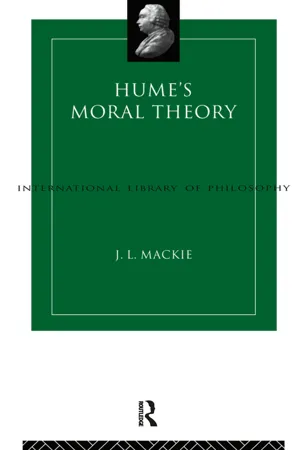
Hume's Moral Theory
About this book
First Published in 1980. This volume looks at Hume's moral theory as a relatively neglected area of Hume's philosophy and Law. It explores Hume's account of what he called article virtues and his anticipations of utilitarianism.
Information
IV
MORALITY NOT BASED ON REASON
(TREATISE III i 1)
In the first two sections of Book III of the Treatise Hume argues that moral distinctions are not derived from reason and that they are derived from a moral sense. This looks straightforward, and seems to show merely that he is agreeing with Shaftesbury and Hutcheson against Clarke and Wollaston and Balguy. But in fact what he says is riddled with ambiguities: it is not clear for what meaning of ‘reason’ he is saying that morality is not based on reason, and it is not clear exactly how we are to interpret ‘moral sense’ or to understand how moral distinctions are due to it.
In saying that moral distinctions are not derived from reason, does Hume mean only that they are not reached by demonstrative reasoning analogous to that which establishes mathematical conclusions? Or is he saying something stronger than this, that they are not derivable from any true beliefs, and hence are not objects of knowledge? Or something still stronger, that drawing moral distinctions is not a matter of having beliefs at all? The first of these would be compatible with several different positive views, including what I called, when commenting on Hutcheson, the objectivist interpretation of ‘moral sense’: according to this interpretation, moral sense is analogous to the perception of a primary quality, it is a faculty which discerns moral differences which are literally there to be perceived. But this view would be ruled out by the second or the third meaning of the thesis that moral distinctions are not derived from reason. The second would allow moral sense to be analogous to the perception of a secondary quality, where, for example, we ordinarily believe that something is, quite literally, red as we see red, but in itself it is not so; thus this second meaning might go with an error theory of moral judgments.1 The third meaning would make moral sense, if it was admitted at all, analogous to the perception of pain, and would go with an explicitly non-descriptive (emotive or prescriptive) analysis of moral judgments.2
There are remarks in Hume’s text which point in these different directions. Thus he starts by referring to his distinction (drawn first in Book I) between impressions and ideas, and suggests that the problem is ‘Whether ’tis by means of our ideas or impressions we distinguish betwixt vice and virtue, and pronounce an action blameable or praiseworthy?’ This makes it look as if the view against which he is arguing is merely that moral distinctions depend on relations between ideas, that is, demonstrative reasoning, leaving it open that they might depend upon correct impressions and possess empirical truth. The same suggestion is given by the next few remarks, which give, as the account which he is rejecting, a précis of Clarke’s doctrine of eternal fitnesses.
But (as we shall see) he says something quite different at the end of this section, and in any case his main argument offers a contrary indication. This uses as one premiss the conclusion of the section discussed in chapter III, that reason alone can have no influence on action. Combining this with the second premiss, that morality is practical, that it does produce or prevent actions, Hume concludes that morality cannot be derived from reason alone. Now if the conclusion here were intended merely to rule out a demonstrative derivation of morality, the first premiss would need to say only that demonstrative knowledge or reasoning alone cannot influence action. But the argument of II iii 3 explicitly makes a stronger claim than this, that neither demonstration nor probability nor any combination of them can, by itself, support or oppose an action. The conclusion of II iii 3, conjoined with the second premiss that morality is (by itself) practical, would entail that morality cannot be derived from any combination of reasoning, knowledge, and belief alone, whether a priori or empirical, and whether the beliefs are true or false. We may surmise that Hume himself was not quite clear about what he was doing; perhaps he set out only to argue against rationalists like Clarke and Wollaston, but found that he had, without intending this, developed arguments with more sweeping implications. It may, therefore, be impossible to find the correct interpretation of what Hume says; but we can examine and evaluate some of the different arguments which can be constructed with his materials.
Hume’s second premiss, that morality is practical, that ‘morals…have an influence on the actions and affections’, must, if we are to get a valid argument, be read as meaning or entailing something like this: the state of mind which is the making of moral judgments and moral distinctions has, by itself, and just because it is that state, an influence on actions. If we conjoin this with the strong premiss which Hume thinks he has established as the conclusion of II iii 3, that knowledge, beliefs, and reasoning (of any kinds) alone do not influence actions, we can validly draw the conclusion that the state of mind in question does not consist wholly of knowledge, beliefs, and reasoning of any kinds.
However, as we found in chapter III, Hume has not really established the conclusion which would be the major premiss of this argument, since he has not examined and disposed of Clarke’s rival theory, though he has correctly pointed out that Clarke has not actually produced any demonstration of his alleged necessary truths. There is no conclusive argument yet on either side. In fact the position is even worse for Hume than this would suggest, if the premiss he wants is that knowledge, beliefs, and reasoning (of any kind) alone do not influence actions. To undermine this, it is not necessary that anything like Clarke’s view should be true; it is enough that someone should believe it to be true. For if Clarke, say, believes that there is a necessary fitness which requires him, in circumstances of kind X, to do Y, and also believes that the present circumstances are of kind X, will not these two beliefs together give Clarke a motive for doing Y? Even if Clarke’s moral theory is false, the mere fact that he sincerely holds it is sufficient to falsify the strong premiss which Hume seems to be using here. It is evident that there can be sets of moral and factual beliefs which are, by themselves, motives to action.
There is, on the other hand, a weaker premiss which is much more defensible, and which emerges more clearly as a conclusion from the arguments of II iii 3. This is that nothing made up of demonstrative reasoning, causal knowledge, and factual information of ordinary sorts can by itself influence action, without the help of some passion or desire. The complete failure of Clarke and his followers to produce the demonstrations of which they speak, and the weakness of the analogy on which Clarke relies between mathematical fitting and moral fitness, makes this premiss highly plausible. But if we conjoin it with the one which says that the state of mind which is the making of moral distinctions does by itself influence actions, the conclusion we draw is that that state of mind cannot be made up merely of demonstrative reasoning, causal knowledge, and ordinary factual information. This would be a result of some importance, since it would rule out all varieties of naturalism. But it would leave open the possibility of a non-natural objectivism, an intuitionism such as was explicitly adopted by Hume’s successors, Price and Reid, and more recently by Moore, Prichard, and Ross. There might be some non-ordinary sort of what was still factual information, some special sort of belief or even knowledge supplied by a moral sense as the objectivist interpretation understands it, which does make moral distinctions that can in and by themselves influence action. Consequently, though this conclusion would fulfil one interpretation of Hume’s programme of showing that such distinctions are derived from a moral sense and not from reason, it would be a more modest conclusion than the one which emerged from Hume’s argument on the previous reading.
But, whichever of these two interpretations of Hume’s major premiss we follow, there is, as Harrison points out, another way in which his conclusion can be evaded.3 We could simply deny the minor premiss, that the state of mind which is the making of moral judgments and distinctions has, by itself, an influence on actions. We could say that just seeing that this is right and that is wrong will not tend to make someone do this or refrain from that: he must also want to do whatever is right. That is, we could deny the intrinsic action-guidingness of moral judgments. This would, of course, draw the teeth of Hume’s argument. Whatever conclusion we allow him to have established in II iii 3, whatever he can include in the ‘reason’ which is incapable of supporting or opposing choices on its own, it will no longer follow that this reason cannot be the source of moral distinctions. For all that Hume’s argument would now show, these distinctions might be the product of demonstration or causal inference or ordinary sense-perception and observation or some combination of these. There may, indeed, be other grounds for doubting this, but Hume’s argument will now be powerless to disprove it.
But note how big a concession this would be, and how reluctant Clarke, for instance, or Butler would be to make it. Clarke insists not only that the unalterable and eternal relations of things and the consequent fitnesses are necessarily evident to the understandings of all intelligent beings—unless their understandings are very imperfect or very much depraved—but also that ‘by this understanding or knowledge of the natural and necessary relations, fitnesses, and proportions of things, the wills likewise of all intelligent beings are constantly directed, and must needs be determined to act accordingly’ unless those wills are ‘corrupted by particular interest or affection, or swayed by some unreasonable and prevailing passion’. And this is surely how moral characterization has been understood throughout the whole history of moral philosophy. It is not merely that it is linguistically odd to use words like ‘right’ and ‘wrong’ with no prescriptive force—to say, for example, ‘X is right and Y is wrong, but of course it is entirely up to you whether you prefer what is right to what is wrong.’ (If ‘fair’ and ‘unfair’, for example, are substituted for ‘right’ and ‘wrong’ here, the remark becomes more acceptable: ‘fair’ can more easily be used as a purely descriptive term than ‘right’ can.) What is more important than this linguistic point is that Clarke, Butler, and many others are concerned to defend the metaphysical view which is represented by the way in which such moral terms combine a descriptive logic with a prescriptive force, namely that there are objective requirements or categorical imperatives in the nature of things.4 Harrison’s suggestion would abandon this claim; it would save the objectivity of moral distinctions from Hume’s attack only by giving up their prescriptivity. Instead of a sentiment of the understanding or a perception of the heart, we should have a straightforward perception of the understanding and, quite distinct from this, a sentiment of the heart which may or may not be associated with it.
Besides this main argument, Hume uses a number of othersg to show that morality is not based on reason. A second, which also echoes II iii 3, is that since passions, volitions, and actions are ‘original facts and realities, compleat in themselves’—with no representative function—they cannot be true or false, and hence cannot ‘derive their merit from conformity to reason’. This ignores Wollaston’s argument that actions, at least, can have a representative function; but even apart from this it would show only that the morality of these various sorts of item cannot consist in conformity to reason in one very simple and literal sense, that their moral quality cannot be just truth or validity. It would not show that there is any incoherence in the notion of an objectively authoritative prescription, and so it would leave open the possibility that actions might conform, or fail to conform, to reason by obeying or violating such a prescription.
A third argument starts from the concessions Hume has made, that actions and passions can be contrary to reason in a loose sense either if they are based on a false belief about the existence or the quality of an object or if they rely upon mistaken causal beliefs and expectations. Possible examples would be running away from an imaginary danger, refusing food because you think, wrongly, that it will have a nasty taste, or trying to transmute lead into gold. But no irrationalities of any of these sorts can be what makes actions morally wrong, Hume argues, because such mistakes of fact are not held to be criminal, and people who make them are not blamed but pitied.
Fourthly, Hume echoes an argument which Hutcheson had used against Wollaston. If the rightness and wrongness of actions consisted in truth and falsehood respectively, then all wrong actions would be equally wrong; there are no degrees of falsehood. Wollaston says that there are different degrees of importance in the truths which actions may deny; but Hutcheson rightly replies that there can be differences of importance between truths only if there is some ground of moral values other than truth and falsity themselves (368). Hume extends this into an argument to show that moral distinctions cannot even be derived from truth and falsehood, adding (rather unconvincingly) that if they were so derived, not only could there be no differences of importance, but we should also be unable to distinguish morally between avoidable and unavoidable errors. Hume’s argument is not as cogent as Hutcheson’s simpler one, directed specifically against Wollaston’s view.
Fifthly, if it is suggested that though mistakes of fact do not produce immorality, mistakes of right may do so, Hume replies, soundly, that such mistakes cannot be the foundation of moral distinctions; there can be a mistake of right only if there already is, for some other reason, a difference between right and wrong.
In a sixth argument Hume replies explicitly to Wollaston, interpreting his thesis, that a wrong action is one which denies things to be as they are, as meaning that an action is wrong if and only if it communicates a falsehood, if it tends to cause false beliefs. If all that was wrong with committing adultery with my neighbour’s wife was that it tended to arouse, in simple-minded observers, the belief that the lady was my own wife, then, Hume says, ‘if I had used the precaution of shutting the windows, while I indulg’d myself in those liberties with my neighbour’s wife, I should have been guilty of no immorality.’ This would be a good reply to Wollaston’s theory as Hume interprets it. But it is an unfair interpretation. Wollaston identifies wrongness with an action’s declaring that things are otherwise than they are, not with its communicating this falsehood. His system is indeed open to conclusive objections, but Hume’s is not one of them.
Seventhly, Hume argues against Locke’s or Clarke’s claim that morality is susceptible of demonstration. Demonstration, he says, depends wholly on relations of four sorts: resemblance, contrariety, degrees in quality, and proportions in quantity and number. Clearly moral conclusions cannot be drawn from these alone. The obvious objection is that there may be some other kind of relation which allows demonstration, but to this Hume replies forcefully with a challenge: it is up to those who say that morality is demonstrable to point out this other kind of relation. He also shows how hard it will be for anyone to take up this challenge. What is, say, morally wrong is a certain intended action, an item which already involves a relation between the agent’s mental processes and external objects; nothing that involves either only mental processes or only external objects and events can be immoral. What sort of relation could it be, Hume asks, that must thus have a foot in both camps, both in the agent’s mind and in the external world, and that could not occur in either sphere on its own? Moreover, this supposed kind of relation is alleged necessarily to direct the will of every rational being, that of God no less than that of man; what kind of relation could it be that did this? Besides, Hume claims to have shown, in Book I of the Treatise, that there is no genuinely necessary connection between causes and effects, that is, no possibility of a priori knowledge that one thing will produce another. The connection between the supposed moral relation and choice by any rational agent would need to be necessary and intelligible a priori; it would need to have just those features which Hume has shown causal relations not to have.
This seventh argument has a good deal of force against the suggestion that there are demonstrable categorical imperatives. It would have much less force against an opponent who adopted Harrison’s above-mentioned proposal, giving up any claim to objective prescriptivity. But, as I have said, that would itself be a major concession.
An eighth argument, which Hume offers as an illustration of points made in the seventh, is that morality cannot consist in relations between situations and actions, because relations just like those which, in human conduct, are regarded as immoral occur in animal behaviour and among inanimate things and are not there thought to be immoral. It is wicked for a child to kill his parent; it is not wicked if a young oak tree overtops and destroys the parent tree from one of whose acorns it grew. Incest in humans is immoral, but exactly the same sorts of sexual relations among animals are innocent. But this argument is more picturesque than cogent. It is easy to reply that there are further elements in the human situations which make them relevantly different from the non-human ones with which Hume compares them.
Many of these arguments have been directed primarily or even wholly against the view that moral judgments are demonstrable. But Hume ends with a claim that they show also that morality does not consist ‘in any matter of fact, which can be discover’d by the understanding’. A ninth argument offers a further proof of this conclusion. If you examine any action that is held to be vicious, such as wilful murder, all you can find in it is certain passions, motives, volitions and thoughts.
There is no other matter of fact in the case. The vice entirely escapes you, as long as you consider the object. You never can find it, till you turn your reflexion into your own breast, and find a sentiment of disapprobation, which arises in you, towards this action. Here is a matter of fact; but ’tis the object of feeling, not of reason. It lies in yourself, not in the object. So that when you pronounce any action or character to be vicious, you mean nothing, but that from the constitution of your nature you have a feeling or sentiment of blame from the contemplation of it. Vice and virtue, therefore, may be compar’d to sounds, colours, heat and cold, which, according to modern philosophy, are not qualities in objects, but perceptions in the mind…...
Table of contents
- Cover
- Halftitle
- Title
- Copyright
- Contents
- Preface
- I Introduction: Outline of Hume’s Theory
- II Some Predecessors: Hobbes, Shaftesbury, Clarke, Wollaston, Mandeville, Hutcheson, Butler
- III Hume’s Psychology of Action (Treatise II iii 3)
- IV Morality not Based on Reason (Treatise III i 1)
- V Variants of Sentimentalism (Treatise III i 2)
- VI The Artificial Virtues
- VII The Natural Virtues (Treatise III iii 1–5)
- VIII Some Successors: Smith, Price, Reid
- IX Conclusions
- Notes
- Index
Trusted by 375,005 students
Access to over 1.5 million titles for a fair monthly price.
Study more efficiently using our study tools.
Frequently asked questions
Yes, you can cancel anytime from the Subscription tab in your account settings on the Perlego website. Your subscription will stay active until the end of your current billing period. Learn how to cancel your subscription
No, books cannot be downloaded as external files, such as PDFs, for use outside of Perlego. However, you can download books within the Perlego app for offline reading on mobile or tablet. Learn how to download books offline
Perlego offers two plans: Essential and Complete
- Essential is ideal for learners and professionals who enjoy exploring a wide range of subjects. Access the Essential Library with 800,000+ trusted titles and best-sellers across business, personal growth, and the humanities. Includes unlimited reading time and Standard Read Aloud voice.
- Complete: Perfect for advanced learners and researchers needing full, unrestricted access. Unlock 1.5M+ books across hundreds of subjects, including academic and specialized titles. The Complete Plan also includes advanced features like Premium Read Aloud and Research Assistant.
We are an online textbook subscription service, where you can get access to an entire online library for less than the price of a single book per month. With over 1.5 million books across 990+ topics, we’ve got you covered! Learn about our mission
Look out for the read-aloud symbol on your next book to see if you can listen to it. The read-aloud tool reads text aloud for you, highlighting the text as it is being read. You can pause it, speed it up and slow it down. Learn more about Read Aloud
Yes! You can use the Perlego app on both iOS and Android devices to read anytime, anywhere — even offline. Perfect for commutes or when you’re on the go.
Please note we cannot support devices running on iOS 13 and Android 7 or earlier. Learn more about using the app
Please note we cannot support devices running on iOS 13 and Android 7 or earlier. Learn more about using the app
Yes, you can access Hume's Moral Theory by J.L. Mackie in PDF and/or ePUB format, as well as other popular books in Philosophy & Empiricism in Philosophy. We have over 1.5 million books available in our catalogue for you to explore.