eBook - ePub
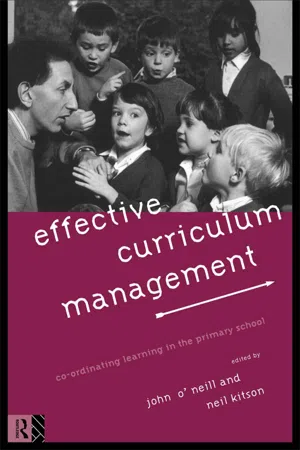
Effective Curriculum Management
Co-ordinating Learning in the Primary School
- 248 pages
- English
- ePUB (mobile friendly)
- Available on iOS & Android
eBook - ePub
Effective Curriculum Management
Co-ordinating Learning in the Primary School
About this book
Written by experienced teachers and teacher trainers, this book focuses on:
*the issues which curriculum co-ordinators need to consider
*how best to manage the learning of pupils within the school
*how to promote a quality curriculum across the key stages
*factors affecting the wider curriculum such as IT, differentiation, the use of outside agencies and the role of the head teacher.
It also takes each subject area in turn and for each examines the key areas of:
*knowledge, skills and understanding
*teaching styles
*learning approaches
Information
Part I
Thework of the curriculum co-ordinator
Chapter 1
Teaching, learning and the co-ordinator
Maurice Galton
INTRODUCTION
This chapter will review the recent research evidence concerning the role of the primary school curriculum co-ordinator, here defined as an appointment from within the staff of a school. However, any consideration of this research cannot be divorced from the studies of the roles of advisory teachers, here defined as externally appointed consultants. During the early 1980s when the main emphasis was on the use of advisory teachers, many of the issues which are now germane to the work of the in-school co-ordinator began to emerge. In this chapter we shall begin by looking at the similarities and the differences of the two roles.
THE ADVISORY TEACHER
During the mid-1980s a ‘cascade’ model of professional development began to emerge, whereby the adviser passed the necessary knowledge down to the advisory teacher who then passed it down to the school post holder who then disseminated it to other staff. Following the 1988 Education Reform Act, and the shift to local financial management in schools, the role of the internal post holder as a subject coordinator has assumed increased importance.
Whichever method of support for the development of classroom teachers was preferred, little direct observational evidence has been collected about the success of these attempts at improving the curriculum. Insofar as success or failure can be inferred from data about changes in practice, collected in different contexts, it must be concluded that the role of the advisory teacher and the in-school co-ordinator has not been altogether successful. Evidence in support of this proposition comes from the general findings of research that there have been few signs of change in classroom practice over time (Galton et al. 1980, Mortimore et al. 1988, Tizard et al. 1988, Alexander 1991). More recently, with the advent of the National Curriculum, there is evidence from the PACE studies (Pollard et al., 1993) that, for the most part, teachers have continued to ‘bolt on’ their existing practice to these new curriculum initiatives.
Various suggestions have been put forward to explain these failures to bring about identifiable changes in patterns of teaching and learning in the primary school (O’Mahony and Sollars 1990, IPSE 1988, Stillman and Grant 1989). A major shortcoming is that both advisers and advisory teachers are expected to learn on the job. It is assumed, by those appointing them, that their reputation as ‘proficient practitioners’ (the main reason why they were appointed in the first place) will be sufficient to persuade colleagues back in the schools to accept their advice and to imitate their practice.
Other reasons for the advisory teachers’ limited success have been attributed to the temporary nature of the posts, particularly the lengths of appointments. Harland (1990) has argued that the lack of a satisfactory career structure leads advisory teachers to opt for short-term rather than long-term goals. Reorganising a school’s resources or developing a new theme pack were tangible results of a secondment which could be mentioned at subsequent interviews. Concentrating efforts on aspects of practice which were slow to change, and where it was difficult to demonstrate success in the short term, was a considerably less ‘marketable’ achievement.
However, neither Harland (1990) nor O’Mahony and Sollars (1990) single out a further reason why advisory teachers or co-ordinators tend to enjoy limited success. In almost all cases, those responsible for appointing to these posts ignore the underlining power structures which exist within the primary school system and which determine not only how the advice will be received but also how it will be delivered. For example, Galton et al. (1991) describe the response of an advisory science teacher who avoided any discussion with the headteacher of a small rural school after an unsatisfactory lesson. When asked why she had not attempted to intervene nor discussed the lesson with the headteacher afterwards, the advisory teacher replied, ‘Well she’s the head! I’ve only been a teacher for five years.’ Asked in a follow-up question about how she hoped to bring about a change in the headteacher’s practice, the advisory teacher replied, ‘By letting her see what I am doing. I hope through team teaching that something of what I do will rub off on her practice next time.’
This theory of ‘osmosis’, where it is hoped that a natural diffusion of the expert’s practice to the less competent teacher will take place, appears to be the main way in which advisory teachers, and school coordinators, attempt to change existing classroom practice. In Galton et al.’s (1991) study of curriculum innovation in rural primary schools many of the advisory teachers spoke of the difficulties of power relationships both with the headteacher and with more junior colleagues. Very often, advisory teachers stated that they needed to begin by establishing their credibility. This they did by taking lessons to demonstrate their competence. Only when they had established their credibility in this way did they feel able to proffer advice.
Harland (1990) identified a number of ways of providing this advice. He notes that, at its simplest, the role of the advisory teacher was to provide resources or to offer information about how such resources should be procured or constructed. This Harland called the provisionary method. The second method of advising consisted of oral or (more rarely) written communications which passed on information, advice or ideas. This hortative mode was used regularly during debriefing sessions or during talks to staff, for example as part of a ‘Baker Day’. The third mode, which has already been described, was that of the role modelling mode where advisory teachers either demonstrated some aspect of practice or worked alongside the classroom practitioner. Clearly, as Harland indicates, there are links between all three modes. For example, in the SCENE project, Galton et al. (1991) recorded an incident where an advisory teacher demonstrated the use of the concept keyboard by taking a lesson. Throughout the lesson, however, the interaction with the pupils was continually interrupted by a stream of advice directed at the classroom teacher concerning the best ways to set up the apparatus or to overcome technical problems.
The fourth method noted by Harland was termed the zetetic mode. Here, the advisory teacher attempts to explore with the classroom practitioner the latter’s view of practice and to establish, first, why things are done in a particular way and, second, whether these ways might be changed to the mutual benefit of both the teacher and the learner. In its fullest form this model is similar to the idea of the teacher as a ‘reflective practitioner’ (Schon 1983) whereby teachers attempt to theorise about their own practice. The distinction between reflecting and theorising is, however, not always obvious (McIntyre 1992). Generally, this approach has its antecedents in the concept of the ‘teacher as a researcher’ where the classroom is viewed as an experimental laboratory. Teachers arrive at explanations, for example, when children fail to learn, create hypotheses of the best way to remedy the situation, test these out, observe further and then modify the hypotheses if necessary. Studies of this ‘action research’ approach (Galton and Williamson 1992) do not suggest that up to now it has been totally successful even in the hands of skilled consultants. The success of this approach in a situation where, as reported earlier, few advisory teachers had any serious induction training, is clearly questionable.
THE SCHOOL POST HOLDER
The role of the school post holder has also been the subject of research. In all cases there are similarities with the problems experienced by externally based advisory teachers and internal co-ordinators. Campbell (1985) notes, for example, the tension between the formal status of the post holder, as described by the headteacher, and the perception of this status by colleagues. Most teachers, while accepting advice, did not wish to be observed implementing this advice in the classroom. Post holders often experienced conflict between their advisory role and their position as class teachers. Post holders also experienced stress in an educational context since they were held accountable for the quality of the school’s provision in their subject. Not only were they required to identify their colleagues’ shortcomings but they were also expected to provide the necessary resources to enable corrective action to be initiated. When colleagues performed well the post holder received little credit; when things went badly he or she took the blame (Campbell 1985, pp. 6876).
Similar problems emerged in one of the largest intervention programmes involving internal appointments, the Leeds Primary Needs Project (PNP). By far the largest proportion of the £13 million allocated was used to appoint an additional teacher co-ordinator to each of the participating schools. In the first year some of these teachers had not managed to gain access to their colleagues’ classrooms (Galton 1994). Some appointments were strongly resented because the co-ordinators had not previously worked in an inner city classroom. Headteachers were puzzled by the ambiguities of the coordinator’s role in comparison with that of the deputy head. In some schools, headteachers tended to see the appointment of the co-ordinator as indicative of their own failure to manage the curriculum successfully. Subsequently, Alexander (1991) reported that there was very little change in these perceptions throughout the five years of the project. As in other cases, coordinators undertook the task of supply teacher, partly to improve their credibility and partly to gain access to the pupils. When eventually coordinators did establish their credibility then, as in Harland’s study, the modelling strategy was most frequently used to demonstrate improved practice.
One of the most puzzling features of the subject co-ordinator’s work is this reluctance to engage in direct instruction with colleagues although this teaching approach is often used in his or her own limited training. Part of the reason for this reluctance is, as Campbell (1985) has argued, to do with the nature of the power relationships within the school and the need for the coordinator to be seen to be at one with colleagues, both in the interests of harmonious daily relationships and also for future promotion prospects. But a more deep-seated reason may have to do with the co-ordinator’s lack of any deep understanding concerning theories of curriculum change, or of theories about the ways in which expertise can be developed in teachers and, more importantly, of the way this development can be fostered by different INSET approaches.
In any school teachers will be at various stages in their development. Yet it is rare for any school based INSET approach to attempt to differentiate between these different levels. Usually, one approach is offered with the consequence that, although some teachers may appear satisfied, there will be others who find what was offered either too facile or irrelevant to their needs. As Eisenhart et al. (1991) argue, a weakness of teacher training is that it is not based on any theory of how teachers learn to teach. Eisenhart and colleagues single out initial teacher training but the same criticism can be applied to INSET in that there are also no theories of how experienced teachers learn to teach better. It is to these two issues, the nature of curriculum change and the nature of expertise in teaching and its development, that we now turn.
THE NATURE OF CURRICULUM CHANGE
Studies of the change process, as it affects individual teachers during the adoption of a new curriculum, suggest that it consists of a series of interrelated stages. In the SCENE project, although the particular issue concerned the development of collaborative structures within clusters of rural schools, the implications of what was observed during this process have a bearing on all curriculum change. Briefly, the SCENE project established that teachers proceeded through three main stages in their thinking during a curriculum innovation. During the first stage, termed the initiation stage, teachers operated according to what Doyle and Ponder (1977) described as ‘the practicality ethic’. This refers to the balance between the teacher’s estimated costs of an innovation as against its perceived benefits. Only if the benefits are perceived to outweigh the personal costs will teachers agree to proceed in a positive fashion. The more benefits outweigh costs the greater the enthusiasm on the part of the teachers. For example, in the SCENE project where teachers were asked to plan jointly curriculum initiatives, the extra workload involved in attending ‘after-school’ planning meetings was set against the perceived benefits of ending personal isolation and of pupils working with the other children from the surrounding villages. At this stage, the main objective of the co-ordinator or adviser is to ease the additional workload. For example, in the SCENE project, teachers needed time to talk to one another in order to plan joint activities and if this time was to take place during the normal school day, then support was required for supply cover. At this point, therefore, little expertise other then general good classroom competence is required from the advisory teacher or co-ordinator. Theirs is a generalist role.
Once, however, there has been general acceptance of the value of the innovation the teachers begin tomove to the next stage, which in the SCENE project was called the consolidation stage. Here the main objective is to achieve success in ways which satisfy the objectives of the innovation as closely as possible. At this stage, teachers require specific expertise in those parts of the curriculum which are undergoing change. In Harland’s (1990) terms the help is mostly provisionary and hortative (see p. 13). Teachers need to know how to procure the necessary resources. They need advice on how to use these materials. Advisory teachers at this stage will, therefore, usually be specialists in the particular subject area where innovation is taking place. The emphasis will be on learning to use new materials and procedures and evaluating their effectiveness. For the most part, ‘direct instruction’ (i.e. demonstration followed by practice) should be the predominant mode of training.
In many cases, innovation may not proceed beyond this stage. Even after five years in the SCENE project, only a few clusters of teachers moved to the third phase involving reorientation. Here teachers ceased to think about meeting the objectives of the innovations as closely as possible and instead began to consider how to adapt the innovation in ways which advanced pupils’ learning more effectively. There was now less emphasis on the subject matter content and more interest in the nature of the learning processes involved and how best to enhance it. This requires teachers to engage in reflection in the manner proposed by Schon. More importantly, the resource for supporting the change should now mainly come from within school rather than from outside. Well trained in-school co-ordinators now have a key role. A sense of ownership of the process by those involved is now very important because any changes in practice which are considered necessary to enhance the learning process will, inevitably, involve a debate between the teachers about their beliefs and philosophies. This debate can be heated and for some teachers threatening.
In this situation, change is sometimes only superficial, as a result of what Galton (1989) has called the ‘common market’ approach on the part of the headteacher. Just as negotiators in the European Union often agree a form of words in policy documents which do not involve any serious change in an individual state’s present practice, so too schools draw up policy guidelines without defining in sufficient detail the meanings attached to key words. Thus all teachers may agree that the school should increase the proportion of collaborative group work in the classroom. But unless what this involves is clearly spelt out, teachers can return to their own classrooms and continue to operate grouping arrangements which are at variance with the intended policy. Only insiders are able to penetrate this surface level of behaviour and, providing they have the necessary skills, confront colleagues whose practice is at variance with the agreed norms. Managing curriculum change effectively requires those offering advice and support to adopt these generalist, specialist and negotiating roles according to the stage of a teacher’s development.
DEVELOPING EXPERTISE IN TEACHERS
The changes in teachers’ thinking during the process of curriculum innovation appear to be a specific example of a more general process of teachers learning to teach. The transition of novice teacher to experienced expert have been the subject of considerable research effort in recent years (Berliner 1992). Novice teachers find it difficult to focus on several elements of classroom activity at the same time. Consequently they have difficulty translating general advice into practice during training. Novice teachers also rely heavily on predetermined planning and are therefore largely very inflexible in their approach. Galton (1989) has described this overreliance on the use of entry strategies and contrasted it with the expert’s use of exiting strategies. For example, if a novice finds that a lesson is too long he or she will go back to the material and look for ways of shortening it, only to find, in all probability, the lesson still does not finish on time. Experts, on the other hand, recognise that there are always unforeseen events which waylay even the best laid plans. They, therefore, don’t bother with precise planning but rely on identifying a point where it is convenient to engineer a closure. As a result, the lesson looks well planned although the various moves required to bring this about are largely improvised. For this reason, experts have been described by Borko and Livingston (1989) as ‘improvisational performers’.
As novices become competent and gain the necessary experience to be able to ‘read’ events in the classroom, their ability to solve problems increases. Unlike the expert, however, this problem solving takes place through the use ofwhat have been termed ‘maxims’. Galton (1989) has argued that these maxims or procedural rules often involve ‘two stage theories of teaching’. Stage 1 sees the competent teacher behave in a particular way until pupils reach a certain state of readiness whereupon stage 2 behaviour is instituted. An example of this process involves guided discovery where teachers first set tasks which re...
Table of contents
- COVER PAGE
- TITLE PAGE
- COPYRIGHT PAGE
- INTRODUCTION
- PART I: THEWORK OF THE CURRICULUM CO-ORDINATOR
- CHAPTER 1 TEACHING, LEARNING AND THE CO-ORDINATOR
- CHAPTER 2 THE ROLE OF THE CO-ORDINATOR
- CHAPTER 3 THE ROLE OF THE CO-ORDINATOR AUDITING FOR DEVELOPMENT
- CHAPTER 4 AN INSPECTOR CALLS
- CHAPTER 5 QUALITY AND THE PRIMARY SCHOOL CURRICULUM
- CHAPTER 6 SUPPORTING NEW TEACHERS
- PART II: PROMOTING A QUALITY CURRICULUM
- CHAPTER 7 CO-ORDINATING THE ENGLISH CURRICULUM
- CHAPTER 8 MATHEMATICS
- CHAPTER 9 SCIENCE
- CHAPTER 10 DESIGN AND TECHNOLOGY
- CHAPTER 11 HISTORY
- CHAPTER 12 GEOGRAPHY
- CHAPTER 13 CO-ORDINATING THE PHYSICAL EDUCATION CURRICULUM
- CHAPTER 14 ART
- CHAPTER 15 MUSIC
- CHAPTER 16 RELIGIOUS EDUCATION
- PART III: THE EXTENDED CURRICULUM
- CHAPTER 17 GETTING STARTED THE PROCESS OF IMPLEMENTATION
- CHAPTER 18 A CURRICULUMFOR ALL
- CHAPTER 19 CO-ORDINATING INFORMATION TECHNOLOGY IN THE PRIMARY SCHOOL
- CHAPTER 20 USING HELP FROMBEYOND THE SCHOOL
- CHAPTER 21 CONCLUSION CO-ORDINATING TEACHING OR LEARNING?
Trusted by 375,005 students
Access to over 1.5 million titles for a fair monthly price.
Study more efficiently using our study tools.
Frequently asked questions
Yes, you can cancel anytime from the Subscription tab in your account settings on the Perlego website. Your subscription will stay active until the end of your current billing period. Learn how to cancel your subscription
No, books cannot be downloaded as external files, such as PDFs, for use outside of Perlego. However, you can download books within the Perlego app for offline reading on mobile or tablet. Learn how to download books offline
Perlego offers two plans: Essential and Complete
- Essential is ideal for learners and professionals who enjoy exploring a wide range of subjects. Access the Essential Library with 800,000+ trusted titles and best-sellers across business, personal growth, and the humanities. Includes unlimited reading time and Standard Read Aloud voice.
- Complete: Perfect for advanced learners and researchers needing full, unrestricted access. Unlock 1.5M+ books across hundreds of subjects, including academic and specialized titles. The Complete Plan also includes advanced features like Premium Read Aloud and Research Assistant.
We are an online textbook subscription service, where you can get access to an entire online library for less than the price of a single book per month. With over 1.5 million books across 990+ topics, we’ve got you covered! Learn about our mission
Look out for the read-aloud symbol on your next book to see if you can listen to it. The read-aloud tool reads text aloud for you, highlighting the text as it is being read. You can pause it, speed it up and slow it down. Learn more about Read Aloud
Yes! You can use the Perlego app on both iOS and Android devices to read anytime, anywhere — even offline. Perfect for commutes or when you’re on the go.
Please note we cannot support devices running on iOS 13 and Android 7 or earlier. Learn more about using the app
Please note we cannot support devices running on iOS 13 and Android 7 or earlier. Learn more about using the app
Yes, you can access Effective Curriculum Management by Neil Kitson,John O'Neill in PDF and/or ePUB format, as well as other popular books in Education & Education General. We have over 1.5 million books available in our catalogue for you to explore.