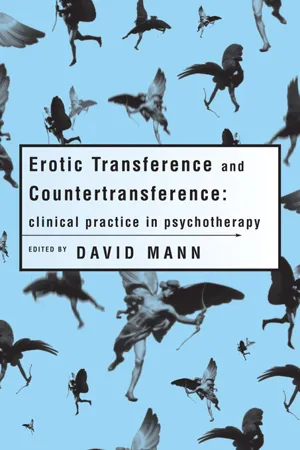
Erotic Transference and Countertransference brings together, for the first time, contemporary views on how psychotherapists and analysts work with and think about the erotic in therapeutic practice. Representing a broad spectrum of psychoanalytic perspectives, including object relations, Kleinian, Jungian and Lacanian thought, the contributors highlight similarities and differences in their approaches to the erotic in transference and countertransference, ranging from love and sexual desire to perverse and psychotic manifestations. Erotic Transferenceand Countertransference offers ways of understanding the erotic which should prove both useful and thought-provoking.
eBook - ePub
Erotic Transference and Countertransference
Clinical practice in psychotherapy
- 192 pages
- English
- ePUB (mobile friendly)
- Available on iOS & Android
eBook - ePub
About this book
Information
Part I
Love and the Erotic
Developmental Issues and their Relevance to Clinical Practice
1
Love in the time of Psychotherapy
Jackie Gerrard
It is the physician’s love that heals the patient.
Attributed to Ferenczi
It has long seemed to me that ‘love’ in our work as psychoanalytical psychotherapists has been much neglected. I believe that most patients who present for analysis or psychotherapy feel themselves quite unlovable at some very deep level. My hypothesis in this chapter is that until and unless there can be felt moments of love for the patient by the therapist, the patient is not able to develop fully. I think it is only when a patient can arouse our deepest loving feelings (not empathy) that we can really hope for a truly positive outcome from our work.
At times when I have questioned changes in patients, I have asked myself: ‘Do I love X because he/she is making use of me and starting to change?’ (my narcissism); or, indeed, ‘Is it because I have found myself able to love him/her that growth and a sense of lovableness are now possible?’ (allowing his/her healthy narcissism to develop). Paradoxically, I may discover my loving feelings when a patient is finally able to vent his/her rage and hate towards me, or when a patient is struggling or has managed to reach feelings of pain, loss, despair, joy, etc., either towards me or towards some significant other. I may find my loving feelings when a very ‘concrete’ patient shows some capacity for play and symbolization. In other words, those moments, not of compassion, pity or empathy, but of an unspoken rush of feeling of ‘I really love you’ for a patient, can arise at various times and within many scenarios.
In my first analysis, when I felt unlovable very often even though I had many loving relationships in my life, I wanted urgently to know if my analyst loved me. Her wise response was something like ‘When you come to feel loved by me, then you will know’. It was very true. It happened again in my second analysis. In hindsight, although many years of hard work and interpretation were undergone by both of us, what mattered most to me was that I reached a deeply felt sense of being lovable.
First, I shall endeavour to say what I mean by love, then to trace the various historical theories regarding love and finally to give some clinical material for illustration. Coltart (1992:118–19) speaks of love as a mystery, indefinable by the language of psychological theory. She also writes of qualities such as ‘patience, endurance, humour, kindness and courage’, then adds ‘detachment’ and states that they can ‘all be subsumed under the name of love’. ‘Loss or lack of it brings about depression, alienation, feelings of emptiness, and False-Self manifestations’.
Suttie (1935:31) emphasized that the love bond comes from an emotion of tenderness; ‘more a mental sympathy than a genital relationship’. It is this emotion of tenderness that I am referring to in this chapter, although I would almost wish to call it ‘extreme tenderness’ to distinguish it from a milder feeling. Suttie stressed the point that tender feelings and affection are not based on libido theory and sexual desire, but on the ‘preoedipal, emotional and fondling relationship with the mother and upon the instinctual need for companionship’. In other words, Suttie saw these tender feelings arising out of a similar but discrete instinctual need ‘characteristic of all animals which pass through a phase of nurtured infancy’ (p. 86). Tender love, which is the descendant or derivative of infantile need combines with (oral or genital) appetite in a state he describes as the ‘complete passion of love’ (p. 72). Suttie is quite clear that tenderness operates alongside sexual desires.
I believe my patients need to experience (or re-experience) the therapist as a loving mother. This would encompass Coltart’s qualities listed above, although I feel that ‘detachment’ is not present in more primitive loving states. To these qualities mentioned by Coltart, I would add containment and reverie (Bion) and the oft-missing ingredients referred to by Suttietenderness and affection. However, these tender loving feelings must emanate from one’s most authentic self—there is no place for sentimentality here.
As I demonstrate, love is initially experienced through an ‘oceanic’ feeling (Freud) or a ‘harmonious, interpenetrating mix-up’ (Balint 1968) but later matures into a separated-out activity, with recognition of the other’s subjectivity (‘detachment’). Perhaps these earlier feelings are part of Coltart’s ‘mystery’. In any case, I believe that more mature, object related love is a derivative from the earlier oceanic feelings and primary love. I assume that both are present in my countertransference feelings, and are significantly linked to mother love. Unlike most mothers, however, I am unlikely to begin a new therapy ‘loving’ a patient, though I may like him/her. Thus, I shall also be exploring what happens in the therapy to arouse my love, without which I am suggesting my patients cannot reach their capacity for loving and a sense of lovableness.
Moving now to history and Freud’s statement in his ‘Three essays on the theory of sexuality’, ‘a child sucking at his mother’s breast has become the prototype of every relation of love’ (Freud 1905:145). Coltart called this first stage of Freud’s theory on love the ‘genetic’. The second stage she termed the ‘narcissistic’, referring to his 1914 paper ‘On narcissism’, regarding the conditions for falling in love, and the third stage (the nucleus of object relations theory) ‘the expression of the whole sexual current of feeling; of the relation of the total ego to its object’ (Coltart 1992:114). By 1923 in ‘The Ego and the Id’, Freud had replaced the topographic model with the structural model, incorporating the Ego Ideal and thus the importance of the object began to be emphasized further. In his 1930 paper, ‘Civilization and its discontents’, Freud refers to ‘falling in love’ and ‘oceanic feelings’ (undifferentiated love) and later to ‘aim inhibited love’ and ‘genital love’ (differentiated love). The latter two imply more mature object related love and would therefore develop out of the former.
Since 1920 in ‘Beyond the pleasure principle’, Freud struggled with the antithesis between death and life instincts—the need to overcome hate with love. Later, Klein too was strongly influenced by Freud’s ideas on libidinal and death instincts. Meira Likierman (1993) considers these ideas in her article, ‘Primitive object love in Melanie Klein’s thinking’. She has noted that most Kleinian papers, while emphasizing destructiveness and sadism, pay little attention to primitive loving feelings. Indeed, there is a current tendency to confuse loving feelings with a state of idealization, as opposed to an acceptance of an early object love arising ‘in response to the love and care of the mother’ (Klein 1937:65).
Likierman identified two separate states in Kleinian thinking: that of ‘a normal primary experience of an ideal nature’, and another where it is ‘defensively transfixed in a boundless, all-giving form’ (1993:251). She states that it would be quite erroneous to think that Klein believed the infant to experience only a defensive form of idealization. Ferenczi (1933:166) became convinced that it was necessary to separate out early feelings of ‘tenderness’ from a later, more mature, partly sexual love of passion, thus seeing love as having its own developmental phases from the beginnings of life. Klein, however, believed ‘the infant to experience love of an ideal, boundless quality from the beginning of post-natal life’ (Likierman 1993:251). I feel my term of ‘extreme tenderness’ to some extent combines the tenderness referred to by Ferenczi and Suttie with these feelings referred to by Klein and by Balint (primary love). I shall return later to ideas of the infant’s love ‘in response to’ the love and care of the mother.
Ferenczi’s ideas, focusing on the role of the mother’s loving feelings for the infant as vital for healthy growth, were a strong influence on Klein, and began to place an emphasis on the role of the mother that had to a large extent been overlooked by Freud. Alice Balint’s (1949) paper, ‘Love for the mother and mother-love’, describes the archaic love that exists from the beginning in both child and mother. What the infant demands is absolute unselfishness from the mother—that she should ‘be there’ or ‘not be there’ as needed. ‘The ideal mother has no interests of her own’ (p. 252) and the infant has a complete lack of reality sense in regard to the interests of its love object. This fundamental archaic love implies a mental state where there is a ‘complete harmony of interests’ (p. 254).
Balint (1949:255–9) then goes on to examine the mother’s archaic love for her infant and sees in it the same lack of reality sense because ‘one’s child is indeed not the external world’. For the child, the mother is an object of gratification and so is the child for the mother who looks upon her child as a part of herself. She calls this early relationship ‘instinctive maternity’ as opposed to later ‘civilized maternity’ and goes on to say: ‘The real capacity for loving in the social sense…(tact, insight, consideration, sympathy, gratitude, tenderness)…is a secondary formation’ governed by the reality principle. She stresses the essential difference between maternal love and love for the mother in that ‘the mother is unique and irreplaceable, the child can be replaced by another’ and ‘We experience the repetition of this conflict in every transference neurosis’. So, in this archaic love, there is no reality sense towards the love object but ‘what we are wont to call love’ develops directly under the influence of reality.
Alice Balint has written about a patient who had within her ‘the deep conviction that it belongs to the duties of a loving mother to let herself be killed for the well-being of her children’ and quotes a warm feeling—something like: ‘How kind of you that you did die, how much I love you for that’ (1949:251). This is most reminiscent of Winnicott’s statement in ‘The use of an object’ where the subject says: ‘Hullo Object!’ ‘I destroyed you’, ‘I love you’, ‘You have value for me because of your survival of my destruction of you’, ‘While I am loving you I am all the time destroying you in (unconscious) fantasy’ (Winnicott 1971:105). This, then, also leads on to the idea that archaic love demanding the life of the other is what has to pre-date civilized love—love occurring within the reality principle—within the real world of objects.
In contrast to this destructive, devouring, archaic love, Michael Balint (1968:65) takes a gentler approach to primitive love and puts forward his theory of ‘primary love’ as a more apt and useful concept than ‘primary narcissism’. He likens it to ‘an all embracing harmony with one’s environment, to be able to love in peace’. So, while Freud (1930) saw this feeling of fusion (‘oceanic feeling’) as a pathological phenomenon, being a regression to an early state of narcissism and an inability to relate to objects in the real world, Balint saw it as an essential stage of early development. He also felt that regression to this state would occur in important moments in analysis.
Balint stresses the point that aggressiveness and even violence ‘may be used and even enjoyed, well into the states immediately preceding the desired harmony, but not during the state of harmony itself’ (1949:65, my italics). Winnicott (1950:205) also says ‘aggression is part of the primitive expression of love’. In ‘Hate in the countertransference’, he says ‘if the patient seeks objective or justified hate, he must be able to reach it, else he cannot feel he can reach objective love’ (1947:199). He also tells us ‘that the mother hates the baby before the baby hates the mother, and before the baby can know his mother hates him’ and that the ‘patient cannot see that the analyst’s hate is often engendered by the very things the patient does in his crude way of loving’ (pp. 200, 203).
Here, I am trying to make the point that our emotions, particularly those of love and hate, are extremely closely connected but, at the moment of loving harmony, hate takes a back seat. So that, in writing of love, I am not ignoring hate, rage, violence and destructiveness but I want to place the emphasis on love for the purposes of this chapter. I take a position akin to that of Michael Balint—that sadism and hate are secondary phenomena—consequences of inevitable frustrations. This is, of course, a very different approach from that of Melanie Klein who focused on the innateness of sadism.
Balint (1968:67) feels the individual is born ‘in a state of intense relatedness to his environment’. The primary objects that prove to be gratifying are normally, first of all, one’s mother. During certain stages of analysis or psychotherapy, the therapist or analyst also becomes this primary object.
In this harmonious two-person relationship only one partner may have wishes, interests and demands of his own…it is taken for granted that the other partner, the object or the friendly expanse, will automatically have the same wishes, interests and expectations.
(Balint 1968:70)
This is like the ‘archaic love’ that Alice Balint postulates, in the sense of the ‘harmony of interests’. I have pondered whether Michael Balint is talking of dependency or love here. I suspect he sees this as the most primitive form of love: the harmonious environment is the all-embracing love object and the infant can, according to Klein too, respond lovingly to this love and care. Because there is a relatedness, however primitive, Balint rejects the term ‘primary narcissism’.
Fromm (1976) distinguishes between infantile love and mature love. Infantile love says, ‘I love because I am loved’ and ‘I love you because I need you’. Mature love says, ‘I am loved because I love’ and ‘I need you because I love you’. ‘I love because I am loved’ is a responsive love (Klein) while ‘I love you because I need you’ would seem to be more in line with Alice Balint’s ideas on archaic love and the ‘harmony of interests’. Fromm’s statements regarding mature love imply a sense of self and other—an adult, separated-out state of being.
I return now to Freud whose paper, ‘Observations on transference love’, warns the analyst to resist any tendency towards countertransference feelings of love. Freud (1915:166) states that it is dangerous to let oneself have tender feelings for the patient and it is imperative not to give up the neutrality acquired by keeping the countertransference in check. He goes as far as to say, ‘the love-relationship in fact destroys the patient’s susceptibility to influence from analytic treatment’. It would seem, therefore, that Freud felt that tender love, a feeling of fusion, and erotic love on the part of the analyst were all equally threatening to a successful outcome from analytic work. These views did not modify over time.
Searles (1959), in total contrast to Freud, wrote a most frank and illuminating paper on ‘Oedipal love in the countertransference’ and, indeed, is of the opinion, which I share, that the analyst’s work has to realize within the patient both ‘the capacity for feeling loved’ (p. 289) and the recognition of one’s capability for being able to achieve mature love. He says later that the ‘patient’s self-esteem benefits greatly from his sensing that he is capable of arousing such responses in his analyst’, and feels that the degree to which a patient is able to arouse these loving feelings in the analyst will affect the ‘depth of maturation which the patient achieves in the analysis’ (p. 291).
It might seem, therefore, that what I am trying to convey was said most lucidly and movingly by Searles in this paper where he talks about the analyst’s countertransference to the patient as ‘a deeply beloved, and desired, figure’ (p. 286). I am making a similar point to Searles’, except that throughout his paper, love is Oedipal and not pre-Oedipal. In addition, Searles is referring to the therapist as responding to the patient’s love and longing; or to the analyst’s narcissism when the patient gratifyingly improves; or else to the likeable adult the patient becomes in the termination phase of analysis. Other love responses are attributed to the therapist’s unanalysed transference feelings carried over from his own past.
My point, therefore, is somewhat different in that I am stating that for many patients (particularly those with schizoid and narcissistic personalities), the therapist’s love (not just his/her unanalysed transference feelings) will need to be aroused by the patient before the patient is able to discover his/ her own capacities to love and feel lovable. This was Klein’s point—the infant finding its loving feelings in response to the love and care of the mother. So I believe we are trying to work towards our patients reaching a state of lovableness within, and a capacity to love (out of intimacy and gratitude) their therapists truly—rather than all kinds of feelings which could be misconstrued as love, such as idealization, worship, clinging and defences against hate. Indeed, if this does not happen, then I believe that the state of being here described by Klein (1937:63) remains unchanged: ‘an unconscious fear of being incapable of loving others sufficiently or truly, and particularly of not being able to master aggressive impulses towards others; they dread being a danger to the loved one’.
Before leaving this theoretical section, I hope I have made it clear that I have been referring to two kinds of love—archaic and civilized, infantile and mature, primary and secondary. Whilst Freud considered the first kind somewhat pathological, feeling that it was a regression and not object related, others since have disagreed seeing primitive love as a vital state of being which is at times re-felt in life generally as well as in the consulting room. The capacity for secondary, civilized, mature love arises out of the more enmeshed and primitive but the latter is always present. Indeed, the analyst may not always be aware at the time how primitive or otherwise are the feelings of love engendered by patients. It is possible that if I were to ask myself ‘Why did I feel I loved my patient at that...
Table of contents
- Cover Page
- Half Title Page
- Title Page
- Copyright Page
- Dedication Page
- Contents
- Acknowledgements
- List of Contributors
- Erotic Narratives in Psychoanalytic Practice An Introduction
- PART I Love and the Erotic Developmental issues and their relevance to clinical Practice
- 1 Love in the Time of Psychotherapy
- 2 Bringing up Eros A Kohutian Perspective
- 3 Eros The Connecting Principle (or the Complexities of Love and Sexuality)
- PART II Progressive and regressive aspects of the erotic transference and countertransference
- 4 Oedipus and the Unconscious Erotic Countertransference
- 5 Understanding the Erotic and Eroticised Transference and Countertransference
- 6 ‘O Tell Me the Truth About Love'
- 7 Primal Absence and Loss in Erotic Transference
- 8 Erotic Transference in Clinical Practice
- PART III Sexual abuse and its impact on psychotherapy
- 9 A Sense of All Conditions
- 10 From Sexual Misconduct to Social Justice
- Cupid’s myriad arrows: an afterword
- Index
Trusted by 375,005 students
Access to over 1.5 million titles for a fair monthly price.
Study more efficiently using our study tools.
Frequently asked questions
Yes, you can cancel anytime from the Subscription tab in your account settings on the Perlego website. Your subscription will stay active until the end of your current billing period. Learn how to cancel your subscription
No, books cannot be downloaded as external files, such as PDFs, for use outside of Perlego. However, you can download books within the Perlego app for offline reading on mobile or tablet. Learn how to download books offline
Perlego offers two plans: Essential and Complete
- Essential is ideal for learners and professionals who enjoy exploring a wide range of subjects. Access the Essential Library with 800,000+ trusted titles and best-sellers across business, personal growth, and the humanities. Includes unlimited reading time and Standard Read Aloud voice.
- Complete: Perfect for advanced learners and researchers needing full, unrestricted access. Unlock 1.5M+ books across hundreds of subjects, including academic and specialized titles. The Complete Plan also includes advanced features like Premium Read Aloud and Research Assistant.
We are an online textbook subscription service, where you can get access to an entire online library for less than the price of a single book per month. With over 1.5 million books across 990+ topics, we’ve got you covered! Learn about our mission
Look out for the read-aloud symbol on your next book to see if you can listen to it. The read-aloud tool reads text aloud for you, highlighting the text as it is being read. You can pause it, speed it up and slow it down. Learn more about Read Aloud
Yes! You can use the Perlego app on both iOS and Android devices to read anytime, anywhere — even offline. Perfect for commutes or when you’re on the go.
Please note we cannot support devices running on iOS 13 and Android 7 or earlier. Learn more about using the app
Please note we cannot support devices running on iOS 13 and Android 7 or earlier. Learn more about using the app
Yes, you can access Erotic Transference and Countertransference by David Mann in PDF and/or ePUB format, as well as other popular books in Psychology & Human Sexuality in Psychology. We have over 1.5 million books available in our catalogue for you to explore.