- 400 pages
- English
- ePUB (mobile friendly)
- Available on iOS & Android
eBook - ePub
About this book
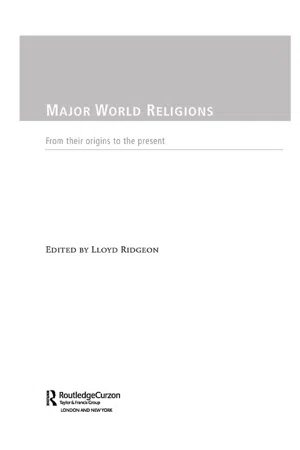
This work seeks to answer questions about the great religious traditions in the contemporary age. It focuses upon those religions that continue to demand the attention of the Western world. Following an introduction on the philosophy of religion, attention is focused on Hinduism, Buddhism, Judaism, Christianity, and Islam which are religions that have had (and probably continue to have) the greatest number of followers in Western society. In addition to the lasting impact that religion has had in society, we are witnesses to the development of secularism on the one hand and the revival of religious sentiment on the other, thus chapters on modernity, postmodernism, and 'fundamentalism' have also been included. The distinctive feature of the book is its modern feel. Each chapter brings the reader up-to-date with recent developments and commentaries upon recent religious thought, theology and religious-political movements. Moreover, the length of the chapters permits a detailed analysis which is so often lacking in books on world religions.
Information
CHAPTER 1
Hinduism
Dermot Killingley
1 WHAT IS HINDUISM?
The introductory chapter has discussed religion, but we now turn to particular religions. While the study of religion and the study of religions are related and support each other, they are different kinds of study. When we study religion we deal with questions which cannot be answered satisfactorily by examining a particular religion, such as: ‘Is religion a necessary part of being human, or is it something that some people opt into and others opt out of ?’ ‘How is religion related to society?’ ‘Are religious claims in principle verifiable, or falsifiable?’ When we study a religion, we deal with related but different questions. For instance: ‘How many adherents has this religion?’ ‘How is this religion related to the society in which those adherents live?’ We may also judge whether the claims made by this religion are true or false, or we may deliberately avoid such judgements. But whatever our findings about this religion, they are not directly related to what we may think about some other religion, or about religion in general. Thus the questions we might ask when studying a particular religion are different in kind from those we might ask when studying religion. Religions and religion are two different things, and we study them in different ways.
To make this clearer, we can observe that the word religion has two uses which are grammatically different as well as different in meaning. English has two classes of nouns: countable (or count) nouns and uncountable (or mass) nouns. A countable noun x occurs in either singular or plural form, in phrases such as an x; the x; these xes; another x; three xes. An uncountable noun x can occur by itself (without a word such as a, the, this/these) as the subject or object of a sentence, e.g. x is useful; we all need x; it does not occur in the plural. For instance, the noun pebble is countable: you can say a pebble; these pebbles; another pebble; three pebbles, but it would be grammatically odd (leaving aside the question of what it might mean) to say pebble is useful; we all need pebble. The noun oxygen is uncountable; you can say oxygen is useful; we all need oxygen, but it would be odd to say an oxygen; these oxygens; another oxygen; three oxygens.
Some nouns occur in both classes: you can say three coffees, and you can say we all need coffee, without sounding odd. Some nouns, such as iron or lamb or curiosity, occur in both classes but with a distinct difference of meaning; consider the difference between you need an iron and you need iron, or between I like lambs and I like lamb. Other examples of nouns which occur in both classes, but with different meanings, are religion and language. The difference between the countable and the uncountable sense of language is well known: when we study a language (countable) we are concerned with its grammar, pronunciation, vocabulary, and so on, which are noticeably different from those of other languages. When we study language (uncountable), we are concerned with questions such as whether language is a universal feature of humankind, or how it is related to the structure of the human mind. French has two nouns: la langue (countable) and le langage (uncountable), and linguists writing in English sometimes use these nouns, rather than the ambiguous English noun language, to make it clear which they mean.
The difference between the countable and the uncountable sense of religion is less well known, but similarly important. The uncountable sense has a long history, going back to the Latin noun religio, which refers to something within a person that governs their actions and makes them inclined to revere the gods or God. The countable sense is much more recent; it dates from the seventeenth and eighteenth centuries, when English-speaking people (and people using similar words to English religion in other languages) began to study and write about ‘the religion of the Mohammedans’ (meaning Muslims), ‘the religion of the Hindus’, and so on (Smith 1978). Note that in these contexts there is no grammatical indication whether the noun religion is countable or uncountable; it is ambiguous in the same way as ‘the lamb on the table’ is ambiguous. An eighteenth-century writer might therefore write of ‘the religion of the Hindus’, meaning the various rituals which Hindus perform, the norms of behaviour which they follow, the way they worship gods, and so on, using the word religion in the uncountable sense. But the phrase could easily be understood differently, using religion in the countable sense. ‘The religion of the Hindus’ would then be a system of religion which Hindus follow, which differs from the religion that Christians follow or the one that Muslims follow.
To avoid confusion between the two senses of religion, some scholars speak of ‘religious traditions’ rather than ‘religions’. This helps us to remember that the religions, or religious traditions, of the world do not exist as self-perpetuating entities, but depend on being handed down and received by individual men and women, and thus are liable to change. It may also help us to see that the religions, or religious traditions, of the world are not a number of discrete entities, like so many pebbles or lambs. We talk about Hinduism, Islam, Christianity, and so on, and call each of them a religion, as if each of them was equally a specimen of a species called religion; but that is merely one of the ways in which we mentally simplify the world around us, so that we will not be totally bewildered by its complexity, and so that we can talk about it coherently to each other. Some such simplification is always necessary, but it is often misleading. In this case it disguises the fact that each of these religions or religious traditions is a bundle of traditions: Islam includes the Sufi and Ismaili traditions and many more, while Christianity includes the Maronite and Calvinist traditions and many more, and so on. Some of these traditions are highly organized and others not, while each of them is in turn divisible into smaller traditions. When we consider this fact, we may question whether our habit of bundling certain traditions together and calling them a religion is not arbitrary, resulting from historical accident rather than from the nature of the case.
1.1 In what sense is Hinduism a religion?
It is useful to begin an account of the major religions of the world with Hinduism, because the example of Hinduism shows how misleading our habit of cataloguing the religions of the world can be. It has been argued that what is called Hinduism is not one religion but several, related to each other as Judaism, Christianity and Islam are, though in a more complex way whose history is harder to trace (von Stietencron 1991: 20f.). For various historical reasons, many different traditions have come to be regarded (at least by non-Hindus) as sects within one religion called Hinduism. For other historical reasons, Jains and Sikhs have been counted as followers of religions distinct from Hinduism, though they can as reasonably be called Hindu as Lingayats, for instance, can.
The word Hinduism is an extreme case of a term which disguises the multiplicity of an indefinite number of religious traditions, and appears to include some traditions which might have been excluded, and exclude some that might have been included. However, it is not a unique case. In describing Hinduism we have to make general statements for the sake of simplicity, or to avoid a bewildering complexity. We should therefore remember that when we are talking about Hinduism, general statements are always subject to exceptions. This, indeed, is the only reliable general statement that can be made. But when we look at other religions we should still be prepared for dodgy generalizations and fuzzy boundaries, because in the last analysis we are dealing with countless individuals whose religious experiences are different from one another, and whose responses to the traditions they have received are not uniform. The extreme case of Hinduism should put us on our guard against the falsehoods inherent in the construction of entities called religions.
1.2 The term ‘Hinduism’
It is often said that Hinduism is very ancient, and in a sense this is true, as we shall see in the next section of this chapter (pp. 15ff.). Yet when we use the word Hinduism we are using a word that dates only from the late eighteenth century, and became generally current in the early nineteenth. It was formed by adding the English suffix -ism, of Greek origin, to the word Hindu, of Persian origin; it was around the same time that the word Hindu, without the suffix -ism, came to be used mainly as a religious term. This is not just a matter of the history of the English language: there was no word for ‘Hinduism’ in Indian languages either. But once the word Hinduism became current, it influenced the thinking of people who spoke or read English, including the growing number of Hindus who did so.
The name Hindu was first a geographical name, not a religious one, and it originated in the languages of Iran, not of India. It is used in inscriptions in the Old Persian language, which list ‘Hindu’ among the countries ruled by the Persian emperor Darius around 500 BCE (Kent 1953: 136f.). It is also found in the Avesta, a collection of ancient ritual texts in another Old Iranian language, related to Old Persian but distinct from it. In the Avesta and the Old Persian inscriptions, the name Hindu referred to the land around the great river Indus, and was also the name of the river itself. (In Sanskrit and other Indian languages the river is called sindhu, which is also used as a common noun meaning ‘river’ or ‘ocean’. Iranian languages are closely related to Sanskrit, and have many words in common with it, but regularly have the sound h at the beginning of a word where Sanskrit has s, e.g. Persian haft, Sanskrit sapta ‘seven’.) The name Hindu as the name of the river was adapted into ancient Greek as Indos, and another Greek name India was formed for the adjacent land. These two names were in turn adapted into Latin as Indus and India; these are the names we still use in English, and similar names are used in many other modern languages. In time, the name India has come to be applied to a far larger territory than the Indus region to which it originally referred; moreover, since the partition of India in 1947 the Indus region has not been part of India, but of Pakistan (See Page).
In Persian, the name Hindustan ‘the country of the Indus; the Hindu country’ is applied to northern India, or to the whole of India. The name Hindu continued to be used in Persian for the people of the region; originally a geographical name, it had become an ethnic name. Persian was the language used by the various Muslim powers which had great political and cultural influence in India from the eleventh to the eighteenth century CE, though many of them were not of Persian origin, but Afghan or Turkish (See Page). Muslims in India, descended from immigrants or from indigenous converts, became a substantial part of the population (22.2 per cent according to the 1931 census). They referred to the non-Muslim majority, together with their culture, as ‘Hindu’. In time, both Muslims and non-Muslims came to refer to certain people, families, ways of dress or diet, and so on, as Hindu, in contrast to others which were Muslim (O’Connell 1973; Wagle 1991). Since the people called Hindu differed from Muslims most notably in religion, the word came to have religious implications, and to denote a group of people who were identifiable by their Hindu religion. In this way, the word has passed into English as a religious term.
Even in English it was not always used in this way, but remained an ethnic term in some contexts. Sir William Jones (1746–94), who went to India as a judge in 1784 and was one of the pioneers of Western scholarship on ancient India, wrote an important essay ‘On the Hindus’ in 1789 (Marshall 1970: 246–61). In this essay Jones writes of the Hindus not as a religious group but as a people, particularly an ancient people, to be studied in the same way as the ancient Greeks and Romans. Even in the nineteenth century, Hindu could be an ethnic term without religious implications, so that it was still possible to speak of a ‘Hindu Christian’, or even a ‘Hindu Muslim’, meaning one who is Hindu by ethnicity and culture.
However, it is as a religious term that the word Hindu is now used in English, and Hinduism is the name of a religion, although, as we have seen, we should beware of any false impression of uniformity that this might give us. The word Hinduism became current in English in the late eighteenth century, as a shorter term for what had hitherto been called ‘the religion of the Hindus’ or ‘the Hindu system of religion’ (Sweetman 2001: 219 n. 4). Probably the first Hindu writer to use it was Rammohun Roy (See Page).
If a word denotes a group of people, it means one thing to members of that group and another to outsiders. To the former it refers to ‘us’, and implies familiarity, reliability, normality. To the latter it refers to ‘them’, and implies something strange, unpredictable, and calling for explanation. It also calls for evaluation, whether ‘we’ think of ‘them’ as wicked, miserable and ignorant, or as better, happier and wiser than ‘we’. One of the most knowledgeable and perceptive outsiders ever to write on Indian culture, Al-Biruni (973–1048), a Muslim from Uzbekistan writing in Arabic, leaves his readers in no doubt about the otherness of the Hindus: ‘For the reader must always bear in mind that the Hindus entirely differ from us in every respect’ (Sachau 1888: 17).
Some Western writers of the eighteenth century greeted the otherness of the Hindus with enthusiastic admiration. Voltaire (1694–1778) believed that India was the home of a primordial rational religion, which was the source of all true religion (Halbfass 1988: 57f.). Sir William Jones also admired the ancient culture of the Hindus, though in a much better-informed way. In the sphere of religion, he thought that the Hindu idea of rebirth in accordance with one’s deeds was preferable to the Christian doctrine of eternal punishment (Mukherjee 1968: 119). A far more hostile reaction to the otherness of Hinduism came from Christian missionaries. To them, the religion of the Hindus was a system of error, the more monstrous for being the product of a learned tradition and not of mere ignorance. Alexander Duff (1806–78), the first Church of Scotland missionary to India, wrote: ‘Of all the systems of false religion ever fabricated by the perverse ingenuity of fallen man, Hinduism is surely the most stupendous’ (Duff 1839).
The word Hinduism thus had connotations of otherness for its first users, whether the other was to be admired or shunned. But in the early nineteenth century there was a growing number of Hindus using English, and for them Hinduism did not connote otherness. They were, however, aware of British views on Hinduism, and this influenced their own views. Rammohun Roy used the word in two contrasting ways. In 1816, he wrote: ‘The chief part of the theory and practice of Hinduism, I am sorry to say, is made to consist in the adoption of a peculiar mode of diet’ (Roy 1906: 73). In the following year, he wrote: ‘The doctrines of the unity of God are real Hinduism, as that religion was practised by our ancestors, and as it is well known at the present day to many learned Brahmins’ (Roy 1906: 90).
In the first quotation, Rammohun deplores the concern with rules of food and purity into which he believes Hinduism has degenerated. In the second, he claims that, despite its many gods, Hinduism contains an ancient tradition, still surviving but insufficiently known, of belief in one God. He thus divides Hinduism into two: a false Hinduism which he condemns, and a true Hinduism which he seeks to promote.
This double view is found among other Hindu writers who are concerned with the definition of Hinduism. Bankim Chandra Chatterjee (1838–94), another Bengali brahmin, wrote of a ‘false and corrupt Hinduism’ and the ‘true Hinduism’ (King 1978). During the nineteenth and twentieth centuries, Hinduism was exposed to the criticism of the English-speaking world, and Hindu thinkers reacted to this criticism by rejecting as ‘false Hinduism’ those parts of their tradition which were most open to objection, and upholding as ‘true Hinduism’ those which they thought the objectors had ignored or misrepresented. Hindu writers did not all agree on what to uphold or reject, but ‘false Hinduism’ often included the elaborate rules of purity decried by Rammohun; Gandhi similarly complained that ‘unfortunately today Hinduism seems to consist merely in eating and not eating’ (Killingley 1993: 64). ‘False Hinduism’ also often included the worship of many gods and the oppression of women and low castes, while ‘true Hinduism’ often included belief in one God as the source of the universe, and an ethic of universal love.
It would be an oversimplification to conclude that Hinduism is an eighteenth-century Western construct. Hinduism is several constructs, some of which are indigenous and some Western; some, too, are products of the composite indigenous and Western culture which dominated Indian political and intellectual life from the mid-nineteenth century to the late twentieth. Long before the word Hinduism was formed, there already existed a vast literature in Sanskrit, which embodied many of the beliefs, values and practices that are now recognized as typically Hindu: an indefinite number of gods; rebirth according one’s deeds; a hierarchical social order, in which the hereditary class called brahmins have authority in religious and legal matters; rituals involving service to images; and so on. This literature represents a construct which would later be called Hinduism. But the Sanskrit texts vary enormously in the rules they give for acts of worship and for the social order, and above all in the myths they narrate about the gods.
Accounts of Hinduism that have been written since the word was formed vary also. There is the Hinduism attacked by Duff and other nineteenth-century missionary writers: idolatrous, irrational and cruel, especially to women. There is also the Hinduism vindicated by James Stuart, a British military officer in India, who protested against the missionary view with A Vindication of the Hindoos, published in 1808, claiming that the Hindus had an exalted idea of God and a pure system of morality. There is Rammohun Roy’s...
Table of contents
- Cover Page
- Title Page
- Copyright Page
- List of Contributors
- Introduction Studying religion
- Chapter 1 Hinduism
- Chapter 2 Buddhism
- Chapter 3 Judaism
- Chapter 4 Christianity
- Chapter 5 Islam
- Chapter 6 From modernism to postmodernism
- Chapter 7 Religious fundamentalism and politics
Trusted by 375,005 students
Access to over 1.5 million titles for a fair monthly price.
Study more efficiently using our study tools.
Frequently asked questions
Yes, you can cancel anytime from the Subscription tab in your account settings on the Perlego website. Your subscription will stay active until the end of your current billing period. Learn how to cancel your subscription
No, books cannot be downloaded as external files, such as PDFs, for use outside of Perlego. However, you can download books within the Perlego app for offline reading on mobile or tablet. Learn how to download books offline
Perlego offers two plans: Essential and Complete
- Essential is ideal for learners and professionals who enjoy exploring a wide range of subjects. Access the Essential Library with 800,000+ trusted titles and best-sellers across business, personal growth, and the humanities. Includes unlimited reading time and Standard Read Aloud voice.
- Complete: Perfect for advanced learners and researchers needing full, unrestricted access. Unlock 1.5M+ books across hundreds of subjects, including academic and specialized titles. The Complete Plan also includes advanced features like Premium Read Aloud and Research Assistant.
We are an online textbook subscription service, where you can get access to an entire online library for less than the price of a single book per month. With over 1.5 million books across 990+ topics, we’ve got you covered! Learn about our mission
Look out for the read-aloud symbol on your next book to see if you can listen to it. The read-aloud tool reads text aloud for you, highlighting the text as it is being read. You can pause it, speed it up and slow it down. Learn more about Read Aloud
Yes! You can use the Perlego app on both iOS and Android devices to read anytime, anywhere — even offline. Perfect for commutes or when you’re on the go.
Please note we cannot support devices running on iOS 13 and Android 7 or earlier. Learn more about using the app
Please note we cannot support devices running on iOS 13 and Android 7 or earlier. Learn more about using the app
Yes, you can access Major World Religions by Lloyd Ridgeon in PDF and/or ePUB format, as well as other popular books in Teologia e religione & Religioni comparate. We have over 1.5 million books available in our catalogue for you to explore.