In this era of rapid and unsettling change, boys now more than ever face difficulties in establishing their self-image and status. In this original and challenging study Mike O'Donnell and Sue Sharpe explore how teenage boys from white, African-Caribbean and Asian backgrounds negotiate contemporary uncertainties to construct their gender identities.
Drawing theoretical insights about how class, race and ethnicity critically affect the formulation of masculinities throughout, the authors examine:
* the discrepancies between boys and girls' attitudes and expectations
* the split between boys' formal acceptance of politically correct ideas and their informal behaviour amongst the peer group
* boys' leisure pursuits including involvement in illegal activities and their selective identification with global youth culture.
Uncertain Masculinities is a fascinating account of the complexity of contemporary boys' identities and will be of use to students of the sociology of youth and of gender studies.
eBook - ePub
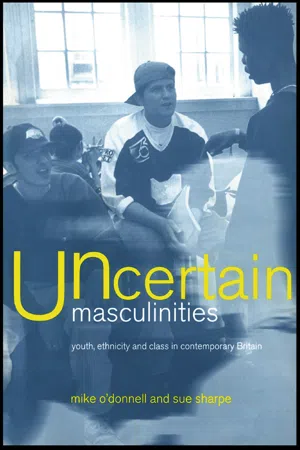
Uncertain Masculinities
Youth, Ethnicity and Class in Contemporary Britain
- 224 pages
- English
- ePUB (mobile friendly)
- Available on iOS & Android
eBook - ePub
About this book
Information
1 Gender, ‘race’ and the peer group
The school and neighbourhood contexts
This chapter discusses the contribution of the education system and the peer group to the formation of boys’ masculinities. The boys’ sense of ethnic identity and, in some cases, their experience of racism—either as victims or perpetrators or both—also contribute to the way they think of themselves as masculine, and are discussed at length later in the chapter. To a considerable extent, the school authorities and the boys’ peer groups were pulling in different directions, with the schools trying to shape attitudes to gender and ‘race’ to reflect egalitarian values and with many of the boys expressing still quite sexist and racist attitudes. Although masculine identities are, of course, defined primarily in gender terms, other influences than gender relations help to construct them. Prominent among these are class, ethnicity/nationality, youth culture and the media. This chapter begins with a brief overview of some of the main factors influencing the formation of masculinities in British society, with particular reference to the immediate post-war period—our point of departure.
Any analysis of youthful forms of masculinity must address gender relations in the parent culture. In capitalist societies, class plays a fundamental role in shaping gender relations and identities. Class-influenced patterns of behaviour are conveyed largely through the family and are sometimes inadvertently reinforced in school. Because of the interest in social inequality of many British sociologists writing in the early post-war decades, we know a great deal about gender relations among the working class, even though class rather than gender was the main focus of concern. Almost incidentally, therefore, one of the most fully researched forms of masculinity by British sociologists is working-class ‘macho masculinity’, which historically was formed in the often oppressive conditions of industrial capitalist society. Macho masculinity was characterised by reciprocal loyalty and support among the in-group of ‘mates’ or ‘lads’, and frequently by suspicion and mockery of the ‘bosses’ and outsiders. This form of masculinity was practised prominently by working-class boys in secondary-modern schools and many comprehensives in the post-war years. If anything, macho behaviour was probably expressed in more raw and dramatic forms by those younger men, whose behaviour had not yet been tempered by the constraints of family and work.
Working-class macho is not, however, the only form of working-class masculinity. Many working-class men and boys have achieved solid and productive relations with each other and with women, relations which it would be insulting to label as macho. A more neutral term for this form of masculinity might be ‘solidaristic’ working-class masculinity, and this term will be occasionally used here. If there was an egalitarian sense of shared experience and status among many men in traditional working-class culture, women tended to be seen as different, very much as ‘the other’, or even ‘the opposite’ (sex). Sharply distinct if not segregated conjugal roles were part of a generally, though not undiluted, patriarchal social structure and culture (Young and Willmott, 1957). Although many working-class boys and men were content to remain working-class, many others aspired to higher social status and this could erode identification with ‘the lads’. Such men and boys were likely to conform more closely to middle-class values, including notions of masculine career success and achievement.
Radical shifts in the British economy and class structure have had an impact on established forms of masculinity to an extent which justifies references to a ‘crisis’ of masculinity. However, experiences of this generalised crisis can be very different for boys of different social backgrounds. Much of this book describes how the boys in our survey engaged with varying degrees of confidence and confusion, both with economic challenges and with problems of constructing their identities, particularly gender identities.
Class was not the only factor forming the masculinities of British boys and men. In the 1950s and 1960s, people talked about the influence of America on British culture almost as much as they now talk about the globalisation of culture. These influences included notions and images of what it is to be a man or to be masculine. Globally, as well as in Britain, it was the American model of ‘cool, hard, and in control’ masculinity such as that portrayed with variations by Humphrey Bogart and Clint Eastwood, that became the best known and perhaps most influential form of contemporary masculinity. It is this form of masculinity that Bob Connell has referred to as ‘hegemonic’ and it has certainly had an influence in Britain and elsewhere (Connell, 1995). This form of masculinity does not have the collective class-based characteristics of macho working-class masculinity, and instead reflects much more strongly values of individual control, competition and survival. Its roots lie in the struggle of immigrants to America to succeed in often hostile conditions and, ludicrous as it seems, in a bloody and often racist cowboy culture. As Connell notes, in the contemporary period the largely American-inspired model of masculinity is particularly dominant in the world of work, especially among business leaders and those who aspire to emulate them.
With reference, then, to a wider context, this chapter analyses the attitudes and opinions the boys expressed about gender and ‘race’. Further, it provides some empirical reference for the more theoretical discussion in the next chapter of the interplay of ethnicities and masculinities in relation to white, African-Caribbean and Asian boys. In the present chapter, the formal policies and practices of the schools in relation to both gender and ‘race’ are briefly examined, and their impact or lack of impact on the attitudes and behaviour of the boys in less formal contexts within and outside of school, including that of the peer group, is discussed. Official school policy on gender and ‘race’ equality is a significant factor in the attitude formation of many of the boys. However, although all the boys we questioned were aware of the policies of their schools on these matters, their responses to them varied considerably. It was apparent that in many cases the boys’ attitudes were formed primarily outside school. Each of the four schools in our study had in place strongly stated equal opportunity policies in relation to gender and ‘race’. It was clear from our interviews that the boys understood that, as far as the schools were concerned, anti-sexism and anti-racism were to be taken as correct. In practice, many of the boys did not always observe these principles, especially outside of the school environment.
The schools: gender in the formal and informal curriculum
The formal curriculum
The Sex Discrimination Act, implemented in 1975, made discrimination on grounds of sex illegal in education as well as in other areas of public life. However, comprehensive gender equality in education was not quickly achieved and in some respects has still not been achieved, despite the impressive way in which the performance of girls and women at every level up to degree has caught up with and in most subjects now surpasses that of boys and men. A major factor preventing fuller achievement of gender equality has been early and often premature subject specialisation along sex/gender lines. Prior to the introduction of the national curriculum (via the Education Act of 1988), large numbers of girls would opt out of chemistry, physics and technology-based subjects, and even general science and maths, as early as 14 years of age, while many boys would seek to avoid studying foreign languages, biology and home economics. Overall, early subject specialisation produced an unbalanced pattern of educational attainment along sex lines.1 Undoubtedly this pattern of subject specialisation has benefited men at the expense of women, and has fed into and supported the structure of patriarchy. This is because the subjects boys tend to opt for still tend to lead to higher paying jobs. Thus, the maths, science and technology qualifications attained by proportionately more males tend to lead to better paying jobs than the social science and arts qualifications attained by proportionately more females. The introduction of a compulsory national curriculum to age 16 has reduced but by no means removed gendered subject specialisation which, however, tends now to occur most sharply at A level and degree level.
There is a crucial class dimension to this pattern of gendered educational attainment. It is middle-class young men studying at post-compulsory education level that most benefit from the gendered pattern of subject specialisation and its consequences for career choice. Young men of working-class origin are less likely than middle-class boys to remain in post-compulsory education and more likely than young women of all class origins to leave school with poor qualifications. Far from obtaining any relative benefit from education, these boys are now the main failures of the system. Their predicament is being seen as a major contemporary social issue and is a genuine ‘gender crisis’ (albeit one narrower in scope than the inequality experienced to a greater or lesser extent by all women and girls under patriarchy). Whereas women in general are the main exploited group under patriarchy, young working-class men are the most obvious casualties of a major structural shift developing in that system. This change in patriarchy stems from complementary developments in capitalism and technology. The advantage that their position in industrial labour gave working-class men over working-class women has been steadily eroded in the last thirty years or so. Working-class boys from certain ethnic minorities can be doubly disadvantaged because of racism. However, for those working-class boys who are academically successful, a gender advantage or—to use R W Connell’s term—a gender ‘dividend’, can still flow from opting to study subjects associated with hard, ‘masculine’ rationality such as the natural sciences, or from studying the new technological or higher status vocational subjects such as computer studies or business studies.
Notwithstanding the continuing importance of gendered subject specialisation in reproducing patriarchy, it is the lower level of attainment, relative to girls, of boys at 16 years old which has emerged in the majority of subject areas that most captured public attention and concern during the 1990s. Undoubtedly it is the problem of social control generated by these difficult to employ and often disaffected youths that has driven this concern. This chapter deals only briefly with the issue, although it was a substantial one in the schools in our study. However, the issue of educational attainment recurs throughout this chapter as a factor relevant to youthful masculinities. The pattern of boys’ educational attainment and underattainment is deeply interwoven with masculine cultures as well as with class and ethnicity.
Despite the fact that the national curriculum had been in place for several years, we found considerable evidence that gendered curriculum specialisation persisted in some subject areas studied by the year-11 students of our study. This occurred even within subjects which the schools required all students to take. The ‘mechanism’ by which this occurred was through the provision of option choices within subject areas prescribed by the national curriculum. Where a particular option was associated more strongly with one or other sex, boys and girls tended to ‘choose’ accordingly. This process occurred in relation both to some academic subjects and to physical education. Indeed, the reduction of the compulsory element in the national curriculum at 14 in 1998, while enhancing student choice, may have increased these opportunities. On the other hand, subject content across the curriculum now tends to be less blatantly gendered. For instance, Home Economics contains considerable material about the commercial and industrial aspects of food production and about health and nutrition and the bio-technological aspects of food, rather than merely teaching pupils ‘how to cook’.
Nevertheless, a gender neutral curriculum has not become a reality for all pupils. Edward, a student at one of the Ealing schools, commented on his experience:
See Table
Edward also commented that few boys studied Child Development, ‘probably because either they don’t do that kind of job…or because, if they did, their friends might think they’re a bit weird’.
Other students confirmed Edward’s observation that, while most classes contained roughly the same number of each sex, classes in certain subjects often did not. Courtney, also attending an Ealing school, stated that ‘there’s not one female’ in Technology ‘whereas in Art there are a lot of females in the class’. The two explanations given above by Edward for the sex imbalance in certain subject areas were quite commonly offered by the boys we interviewed. In more sociological terms, Edward’s first point is that the gendering of subject ‘choice’ is conditioned by the gendering of the labour market—paid and domestic. The labour market is still highly differentiated by gender, and in Edward’s view students normally prepare themselves for this by making gendered curricular choices—where they deem it appropriate and where they still can. Second, Edward suggests that those who deviate significantly from the expected choices might trigger social censure—’their friends might think they’re a bit weird’. This kind of traditional perception was especially common among some of the less academic boys, often of working-class background, and was also mirrored in the attitudes to unusual choices expressed by girls from these schools studied by Sharpe (1976, 1994).
Sport and physical education are still sometimes assumed to be of lower status than academic subjects, yet it is in these areas that some of the most overt and unreformed gender socialisation takes place. Arguably, the embracing—to the point of obsession—of sport by many boys, and the rejection of it in favour of more ‘feminine’ pursuits by many girls, represents a watershed in their gendered development which is as formative for some as, say, opting to specialise in the humanities rather than the natural sciences. As is repeatedly illustrated throughout this book, sport is of central symbolic significance for many boys, shaping their notions of masculinity and identity perhaps more than anything else. Pattman et al. (1999) argue from their study of 11–14-year-old boys that football is ‘understood by many boys not only as a masculine activity but as something which made boys masculine’, and which helps to emphasise gender differences. They see football as not simply a game, but as a ‘key cultural resource’ and a ‘major site for the construction of gendered identities’. The discourse of competitive sport is closely interwoven with the entrepreneurial capitalism which threatens to engulf it. Further, sport and leisure is a fast-expanding occupational area which is currently serviced mainly by men and thus represents a missed employment opportunity for women. No apology is offered for giving this issue substantial treatment here, although, of course, this does not represent an endorsement of the way sport is organised either commercially or in schools.
In one Ealing school, several boys, like Paul, commented that in PE lessons girls tended to choose different activities from boys:
In PE, there’s football and netball. Some of the boys do trampolining but most boys like football or play basketball. The girls do trampolining and netball…
(Paul)
One way of engaging more girls in sport and, at the same time, perhaps engendering more cooperative and less frenetically competitive values through it would be to have more mixed-sex sport in schools. Of course, equal opportunity in education does not require that all individuals—whether boys or girls—should study in all details precisely the same curriculum, but rather that all should have equal opportunity to develop their abilities and potential. PE and sport, in particular, are perhaps areas in which individual differences of ability and taste are likely to affect curricular preference and choice. Nevertheless, the possible consequences of young men and women carrying out most sporting and physical education activities largely on a separate basis need to be thought through. One outcome is that girls tend to get used to being in a passive ‘watching role’ in relation to popular sports such as soccer, rugby and, to a lesser extent, cricket.
However, realistically and in the foreseeable future, mixed sport is likely only to make up a modest part of this area of the curriculum. It is not a substitute for a satisfactory sports and PE curriculum for girls. To achieve this, two lines of action seem necessary. One is to put more effort into ensuring that girls’ participation in the major established sports, such as soccer and cricket, has equal status with that of boys. The other is to recognise that many girls prefer certain sports and physical education activities which are less popular among boys and to make provisions for this. On the first point, girls’ and women’s soccer in Britain is far less developed in school and generally than in many other countries, including the Scandinavian countries, Germany, China and the United States. In the United States—the 1999 women’s soccer world cup winners—legislation ensures equal status to women’s sport in colleges. Already in the United States, women’s soccer is thriving and leading players attract lucrative sponsorship. It is significant that, in the United States, soccer does not have the ‘macho’ associations that it does in Britain. There, such associations belong to American football and, to a lessor extent, baseball and basketball. However, this does demonstrate that soccer does not necessarily have to carry heavily macho cultural meanings of a kind that many girls and women quite understandably reject.
A second line of action to make sport and physical activities more attractive to girls would be to give more emphasis to those they do enjoy, such as aerobics and dance. Some of these appear to be marginalised by the popularity of the main competitively organised sports. Sue Jones, a senior lecturer in PE at Manchester Metropolitan University, has argued that the ‘restrictions of the national curriculum don’t fit in with what girls want’, and that even ‘if dance and aerobics are offered, the main meal is still competitive’ (Guardian Education, 23.3.99:6). It is the ‘main meal’ that seems to turn some girls off—at least as participants.
Yet there is a cooperative as well as a competitive aspect to most sports, although more so in some than in others. It would not be difficult to structure some sport in schools to socialise pupils towards cooperation, including cooperation between the sexes, although this might require some reshaping of the PE and sporting curriculum. Whereas mixed-sex soccer and rugby teams can cause problems, mixed-sex tennis, swimming and athletics teams need not do so. There is relatively unexplored opportunity for development along these lines. Mixed-sex tennis doubles are familiar enough, but what about mixed-sex relay races? There is no need for sport in schools—which has an educational as well as a recreational purpose—to ape the intensely competitive and masculinised nature of commercialised professional sport, much of which has been reorganised in recent times to emphasise competition and the importance of winning.
It may even be that if a more cooperative approach to sport were to develop between the sexes in sc...
Table of contents
- Cover Page
- Uncertain masculinities
- Title Page
- Copyright Page
- Introduction
- 1 Gender, ‘race’ and the peer group: The school and neighbourhood contexts
- 2 The social construction of youthful masculinities: Peer group sub-cultures
- 3 Marriage, families and relationships: Images and expectations
- 4 Work: Changing structures, changing opportunities
- 5 Culture, leisure and crime
- 6 Conclusion: Boys and men
- Notes
- Bibliography
Trusted by 375,005 students
Access to over 1.5 million titles for a fair monthly price.
Study more efficiently using our study tools.
Frequently asked questions
Yes, you can cancel anytime from the Subscription tab in your account settings on the Perlego website. Your subscription will stay active until the end of your current billing period. Learn how to cancel your subscription
No, books cannot be downloaded as external files, such as PDFs, for use outside of Perlego. However, you can download books within the Perlego app for offline reading on mobile or tablet. Learn how to download books offline
Perlego offers two plans: Essential and Complete
- Essential is ideal for learners and professionals who enjoy exploring a wide range of subjects. Access the Essential Library with 800,000+ trusted titles and best-sellers across business, personal growth, and the humanities. Includes unlimited reading time and Standard Read Aloud voice.
- Complete: Perfect for advanced learners and researchers needing full, unrestricted access. Unlock 1.5M+ books across hundreds of subjects, including academic and specialized titles. The Complete Plan also includes advanced features like Premium Read Aloud and Research Assistant.
We are an online textbook subscription service, where you can get access to an entire online library for less than the price of a single book per month. With over 1.5 million books across 990+ topics, we’ve got you covered! Learn about our mission
Look out for the read-aloud symbol on your next book to see if you can listen to it. The read-aloud tool reads text aloud for you, highlighting the text as it is being read. You can pause it, speed it up and slow it down. Learn more about Read Aloud
Yes! You can use the Perlego app on both iOS and Android devices to read anytime, anywhere — even offline. Perfect for commutes or when you’re on the go.
Please note we cannot support devices running on iOS 13 and Android 7 or earlier. Learn more about using the app
Please note we cannot support devices running on iOS 13 and Android 7 or earlier. Learn more about using the app
Yes, you can access Uncertain Masculinities by Mike O'Donnell,Sue Sharpe in PDF and/or ePUB format, as well as other popular books in Social Sciences & Gender Studies. We have over 1.5 million books available in our catalogue for you to explore.