- 208 pages
- English
- ePUB (mobile friendly)
- Available on iOS & Android
eBook - ePub
About this book
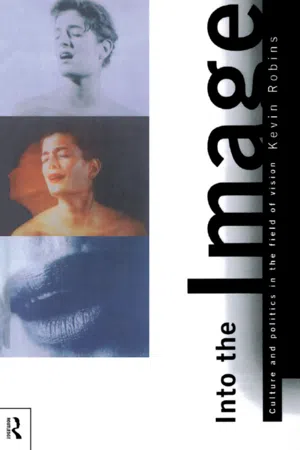
Into the Image examines visual technology sociologically and, in so doing, rejects the fashionable idea that the new visual technologies are displacing the real.
Information
Chapter 1
THE TOUCH OF THE UNKNOWN
1
THE TOUCH OF THE UNKNOWN
There is nothing that man fears more than the touch of the unknown.
(Elias Canetti, Crowds and Power)
Through the sense of touch we risk feeling something or someone as alien. Our technologies permit us to avoid that risk.
(Richard Sennett, Flesh and Stone)
What is at stake in the development and proliferation of new images in our culture (from global media, through surveillance systems, to virtual environments)? According to the prevailing scenario, we are presently undergoing a ‘revolutionary’ transformation in image culture. Great expectations are being sustained: that the new image culture may enhance our knowledge and awareness of the world; that it can extend our range of experiences, pleasures, fantasies; that it could create new forms of sociality and bind together new kinds of community; that it will afford us increased security and protection from the dangers of the world. According to the scenario that prevails, we are on the threshold of an unprecedented new techno-order and what is at stake is a new order of freedom and empowerment, for the individual and for society. As if the technological future would be another world, a Utopian world, a world more in conformity with our desires and our ideals. As if the present world and all its frustrations and limitations—all its reality, that is to say—could be denied and superseded.
Whatever the promises of a new cultural, and even existential, order to come, there is really nothing that we should find surprising or unexpected in this techno-rhetoric. What is presented to us in revolutionary guise should, in fact, be recognised and understood in terms of restitution and restoration. For aren’t we all now familiar enough with the illusion of technology, that distinctively modern illusion of transcendence? An ordinary illusion (are we not all susceptible to its magical promises?), a compulsive illusion (it is sustained whatever its disappointments; there is always another technology, a next and therefore better technology, to believe in)—do we not recognise how fitted it has been to survive in modern times? It is the force of this technological illusion—now being revitalised through the new wave of utopian projections around digital image technologies—that will concern me in the discussion that follows. What I want to consider is how technologies are mobilised in the cause of psychic needs and demands, which may be individual or collective.
We may think of this initially in terms of the struggle to bring order and coherence to the world. The question of technological development can be considered in terms of the modern project for human empowerment, involving the establishment of rational mastery and control over an ordered technospace. But we must take the analysis further. For this, of course, immediately poses for us the question of the disorder and disempowerment (real or imagined) that is to be technologically obviated and overcome; it brings us necessarily to reflect on the defensive and protective motivations that promote the logic of technological rationalisation. And from there, I suggest, it must lead us to confront the fears that drive this logic. What is psychically compelling about the technologies I am considering here, I shall argue, is their capacity to provide a certain security and protection against the frightful world and against the fear that inhabits our bodies. They provide the means to distance and detach ourselves from what is fear-provoking in the world and in ourselves.
It is this question of fear (and the occlusion of fear) that is crucial to understanding the hold of the technological illusion, and its significance will be central to the following argument. Such a concern continues that articulated by Horkheimer and Adorno, who understood the logic of rationalisation as being ‘aimed at liberating men from fear and establishing their sovereignty’. ‘Man imagines himself free from fear when there is no longer anything unknown,’ they observed, ‘Nothing at all may remain outside, because the mere idea of outsideness is the very source of fear.’1 It also extends the concern of Elias Canetti, for whom, too, culture was about organising and containing elemental fear. ‘All the distances which men create round themselves’, Canetti maintained, ‘are dictated by this fear.’2 Fear of the unknown, fear of being touched by the unknown, this is the fear that never goes away. It is with this fear that we must come properly to terms.
In considering the technological response to fear, I shall be focusing specifically on image technologies and on technological ordering in the field of vision. Vision has always provided a particularly important means of defending against what is unknown, outside and beyond (most cultures have attributed special and protective powers to images). It was the achievement of modernity, however, through the elaboration of formal and abstract ways of seeing, to rationalise these visual mechanisms of defence. Technologically mediated vision developed as the decisively modern way to put distance around ourselves, to withdraw and insulate ourselves from the frightening immediacy of the world of contact. What are now at issue are the consequences (usually referred to as ‘postmodern’) of this historical process of rationalisation in the field of vision. For those who have access to them, new image technologies are facilitating greater detachment and disengagement from the world. Vision is becoming separated from experience, and the world is fast assuming a derealised quality. The proliferating system of new vision and image technologies is now instituting what can only be regarded as a structural and generalised condition of dissociation from the world (from its perceived threats and dangers). What is being idealised by the technoculture in terms of (visual) transcendence is, it seems to me, no more than the distinctive, modern strategy of retreat and flight from the world.
I believe that the real crisis confronting contemporary societies is a crisis of the social order, a crisis of social relationships and of forms of sociality. What is fundamentally at issue is the nature of our ‘postmodern’ involvement in the world—increasingly weakened by the technological means we have developed to sustain the more primitive desires we have for disinvolvement. The point now is not whether we can achieve a certain distance and detachment from the fearful principles of reality, but whether we can ever become reconnected to a world that we no longer take for real, a world whose reality has been progressively screened out. From what alternative perspective might we seek to make sense of the developments now occurring in our visual culture? How might we relate to images differently? These are questions I pose in the latter part of this discussion. In considering these difficult questions, I return to the question of fear, and to the relation of fear to outsideness. And I come back again to touch, to consider what is significant, and what is possible, in the touch of the unknown. I believe that it is through what is denied or disavowed in the dominant, rationalistic culture that we can find the basis of real cultural experience. Here are the real sources of cultural transformation and possibility, and if we are not open to these there can only be closure and stagnation. This is what must be recognised, I suggest, by whoever seeks to reaffirm the transitive dimension of visual culture and to reconnect image and experience.
THE ‘OTHER’ OF ANY PLACE
The new image and information culture is now associated with a renewed confidence in technological solutions to the problems of human culture and existence. The new technologies have revitalised the Utopian aspirations in the modern techno-rationalist project. This progressivist and Utopian spirit is articulated through ordinary, spontaneous and commonsensical accounts of what is happening: throughout the culture, there is the sense of almost limitless possibilities inherent in the ‘cyber-revolution’. Indeed, such is the hold of the dominant technological imaginary, that it is almost impossible to discuss the new technoculture in any other way.
I want to indicate the force of the techno-utopian vision through two representative illustrations—one journalistic, one academic—before going on to develop a critical interpretation and perspective. Consider first a typical and conventional expression of Utopian sentiments in a recent issue of Newsweek magazine. Here, journalist Steven Levy makes the claim that the new technologies are bringing into existence a new world and an alternative reality. This is now presenting us, he maintains, with ‘an opportunity to rethink civilisation at the dawn of the new millennium’.3 The virtual revolution is about transforming, not just ways of life, but, much more fundamentally, the nature of life itself. Through our expanding capacity to ‘remake the world with the products of mind,’ Levy maintains, we are on the point of ‘shifting our concept of reality.’4
In trying to explain the basis for this ontological transformation, Levy seeks to establish a primary distinction between the world of atoms and the world of bits:
The former are the building blocks for physical stuff, which until now has formed the basis of our economy as well as our consciousness. Bits, however, are ephemeral—they are simply ones and zeros. From that slight scaffolding, we have the bounty of the information age: all the documents, spreadsheet, audio CDs, multimedia, CD-Roms, movie special effects and virtual-reality environments. As more of our experience comes to us by way of bits, reality itself gradually changes. Literally out of nothing, a new dimension emerges: cyberspace, a place made out of bits, whose intangible nature does not prevent it from becoming a second home, or a primary workplace, for masses of infonauts.5
The crucial inference, of course, is the teleological one: that the palpable world of atoms is giving way to—being progressively substituted by—the ephemeral and virtual world of bits, and that this is an inevitable, even natural, process in so far as the latter is superior to the former. What is it that is superior about this ‘place made out of bits’? The new reality—which is a new kind of reality—is imagined as one that is constituted by principles of mastery and empowerment. Human existence will be drawn into the space of the image, it is suggested, and rational sovereignty will be established over its virtual expanse. What is invoked is an alternative reality of an ‘intangible nature’— a reality that we cannot touch, and which, by the same token, cannot touch us. This drive to order is, at the same time, an expression of the desire to escape the deficiencies and disorder of the ‘physical stuff. In the most ordinary and commonsense way (we would surely expect no less in the pages of Newsweek), Levy is articulating the logic of transcendence, which, I shall argue, is so problematically at the heart of the technological imaginary.
My second illustration of the techno-utopian vision—again I consider it to be typical and representative, and exemplary for that very reason—is an article by Roland Fischer that deals with virtual reality specifically in the context of the history of Utopian thought. Again, what is emphasised is the logic of transcendence, and, particularly, the potential of new image and simulation technologies to ‘realise’ a transcendental order. ‘Originally,’ Fischer argues, ‘utopian desires and dreams had religious, that is, transcendental, foundations and were projected into immeasurably distant spaces.’ But as time went on, he continues, ‘the distance of these faraway places in the “nowhere” started to shrink and the Utopian imagination came closer to the real spaces in the here and now.’6 In the next stage of its historical development, utopia transformed itself first into science fiction and then, crucially, into ‘applied science fiction’, aspiring to actually ‘mimic a world around us as virtual reality’. ‘Departing from distant, untouchable, fictitious places,’ says Fischer, ‘utopia at last arrived at the virtual reality of “cyberspace”.’7 And now, finally, the science fiction has been ‘taken over painlessly by dynamic developments in science and technology’.8 Virtual culture has become, precisely, a reality: ‘is this not another Utopian dream, but in the here and now?’9 Fischer’s teleological narrative culminates in the ‘utopian realm of virtual reality’.
In one respect, we are being given a conventional narrative (metaphysics) of technical progress. With the development of these miraculous new technologies, it is being argued, we have arrived at the historical moment at which we can actualise our visionary aspirations for ‘improving the human condition’. Dreams can be turned into realities. With the products of mind, we are now in a position to remake the world. Does this not give us good reason to invest our rational hopes and expectations in technological deliverance? But, in another respect, what is being posited is a continuity in Utopian desiring and dreaming (and this is clearly fundamental to the other than rational investments that are being made in virtual culture). The virtual realm is attractive precisely because it is a distant, untouchable, fictitious place. It is conceived as an alternative world—one that is more in conformity with our desires and dreams—with the potential to substitute for the limited and flawed reality of the here and now. In this virtual new world, Fischer is wanting to persuade us, we can fulfil the ‘ancient dream’ of transcendence— we can finally realise ‘the desire to be something we are not’.10
In both of these representative accounts, then, what is crucial is the idea, and ideal, of a place of transcendence, a place that is ‘elsewhere’ (‘in the “nowhere”’). It is an idea that has played a fundamental part in the modern social imaginary (we may say that each of the above accounts is representative as a consequence of its conformity to, and continuing idealisation of, this idea). Modernity’s dynamic, in both its expansionist and Utopian aspects, has always involved escaping from the gravity of given and immediate reality. ‘Modernity is, first and foremost, a frontier civilisation,’ observes Zygmunt Bauman; and, as such, ‘it can survive only as long as some frontier is still left as a site for the promised, hoped for, beginning.’11 Louis Marin notes the affinity between modern Utopias and new frontiers (‘beyond the horizon, in the imagination, appear Utopias’).12 In so far as real places elsewhere have been exhausted, it has become necessary to find new kinds of place and frontier to sustain the needs of the modern imaginary. Now the new frontier opens up onto cyberspace, the place of virtual life, and it is there that the self-proclaimed pioneers of the new technoculture (Steven Levy’s ‘infonauts’) believe they will find another beginning. Virtual culture should be seen as continuing the modern struggle against the limitations of the actual world (the world that must always exist on this side of whatever is the next frontier), sustaining and perpetuating the idea of a different and better world, a place of possibility and transcendence (it is in this fundamental sense that we can say there is nothing surprising or unexpected in the new technoculture).
There is, it seems to me, something deeply problematical about this project of transcendence. It is apparent in the way in which the Utopian destination is imagined. Utopia, as Louis Marin makes clear, involves the idea of a journey to a place that is ‘absolutely different’: it is a ‘place without place, a moment out of time, the truth of a fiction’.13 This pure place is one in which the conflicts and antagonisms that characterise the real world may be overcome. In this empty place, there are no longer the frustrations of intractable reality: ‘Utopia develops and displays a virtual or potential spatial order: it offers the beholder-reader an ambiguous representation, the equivocal image of significations that are contrary to the concept of limit.’14 ‘Utopia is the neutral name,’ says Marin, ‘the name of the “neutral”.’15 Within its containing space, there are no constraints and inhibitions on what is possible. The utopian destination is imagined in terms of a place that is beyond disappointment and disillusion, and the Utopian desire is to be in unity, at one, with such an environment. In this respect, we can say that it is ‘the “other” of any place’.16
It is precisely these qualities of neutrality and transcendence that characterise the imagined ‘alterity’ of cyberspace—which is quite literally a virtual or potential spatial order. As Ralph Schroeder argues, the appeal of cyberculture is in the technological promise of ‘new forms of human self expression …which will release human beings from the material constraints of their current lives’; virtual reality systems ‘hold out the promise that human beings may one day be able to live within artificially generated virtual worlds limited only by their imaginations’.17 What is crucial is the suspension of the principles that regulate human existence in the mundane and real world. Cyberculture seems to open up new horizons of creative expression and imagination. For Kiersta Fricke, everything seems possible in the new reality that is the utter antithesis of the real world:
The potential of virtual reality technology to free us from the constraints of time and space appeals to a human longing for transcendence. We want to experience other circumstances without any real threat of danger. We want to be gods, to be able to change shape and form at will. Virtual reality assures us that we can—that we can reach the sun without melting our wings.18
The virtual world is a place that is absolutely different. The ‘otherness’ of this virtual place is now conceived as the ultimate Utopian destination.
I think we must take these aspirations seriously. But not on their own terms, not because of what they might tell us about what our c...
Table of contents
- Cover Page
- Title Page
- Copyright Page
- Acknowledgements
- Introduction Image technologies and visual culture
- Chapter 1 The Touch of the Unknown
- Chapter 2 The Space of the Screen
- Chapter 3 Sights of War
- Chapter 4 Cyberspace and the World We Live In
- Chapter 5 Consuming Images From the Symbolic to the Psychotic
- Chapter 6 The City in the Field of Vision
- Chapter 7 Will Images Move Us Still?
- Notes
- Illustrations
Trusted by 375,005 students
Access to over 1.5 million titles for a fair monthly price.
Study more efficiently using our study tools.
Frequently asked questions
Yes, you can cancel anytime from the Subscription tab in your account settings on the Perlego website. Your subscription will stay active until the end of your current billing period. Learn how to cancel your subscription
No, books cannot be downloaded as external files, such as PDFs, for use outside of Perlego. However, you can download books within the Perlego app for offline reading on mobile or tablet. Learn how to download books offline
Perlego offers two plans: Essential and Complete
- Essential is ideal for learners and professionals who enjoy exploring a wide range of subjects. Access the Essential Library with 800,000+ trusted titles and best-sellers across business, personal growth, and the humanities. Includes unlimited reading time and Standard Read Aloud voice.
- Complete: Perfect for advanced learners and researchers needing full, unrestricted access. Unlock 1.5M+ books across hundreds of subjects, including academic and specialized titles. The Complete Plan also includes advanced features like Premium Read Aloud and Research Assistant.
We are an online textbook subscription service, where you can get access to an entire online library for less than the price of a single book per month. With over 1.5 million books across 990+ topics, we’ve got you covered! Learn about our mission
Look out for the read-aloud symbol on your next book to see if you can listen to it. The read-aloud tool reads text aloud for you, highlighting the text as it is being read. You can pause it, speed it up and slow it down. Learn more about Read Aloud
Yes! You can use the Perlego app on both iOS and Android devices to read anytime, anywhere — even offline. Perfect for commutes or when you’re on the go.
Please note we cannot support devices running on iOS 13 and Android 7 or earlier. Learn more about using the app
Please note we cannot support devices running on iOS 13 and Android 7 or earlier. Learn more about using the app
Yes, you can access Into the Image by Kevin Robins in PDF and/or ePUB format, as well as other popular books in Social Sciences & Media Studies. We have over 1.5 million books available in our catalogue for you to explore.