eBook - ePub
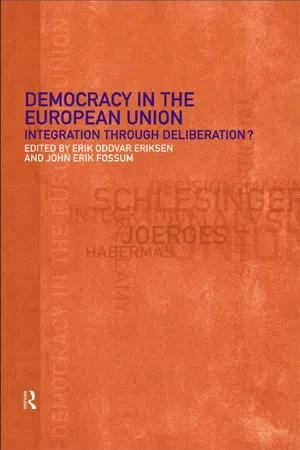
Democracy in the European Union
Integration Through Deliberation?
- 328 pages
- English
- ePUB (mobile friendly)
- Available on iOS & Android
eBook - ePub
Democracy in the European Union
Integration Through Deliberation?
About this book
The European Union is widely held to suffer from a democratic deficit, and this raises a wider question: can democracy at all be applied to decision-making bodies beyond the nation state? Today, the EU is a highly complex entity undergoing profound changes. This book asks how the type of cooperation that the EU is based on can be explained; what are the integrative forces in the EU and how can integration at a supra-national level come about?
The key thinkers represented in this volume stress that in order to understand integration beyond the nation state, we need new explanatory categories associated with deliberation because a supranational entity as the EU posesses far weaker and less well-developed means of coercion - bargaining resources - than do states. The most appropriate term to denote this is the notion of 'deliberative supranationalism'. This pioneering work, headed by major writers such as Habermas, Schlesinger and Bellamy, brings a new perspective to this key issue in contemporary politics and political theory.
Information
Subtopic
Constitutions1 Post-national integration1 Erik Oddvar Eriksen and John Erik Fossum
Introduction: post-national integration—a deliberative perspective
Reflecting on the revolutions in Eastern Europe in 1989, the late Fraçois Mitterand in his 1990 New Year’s speech to the French people stated that ‘Europe is returning home to its history and geography’. However, the revolutions in Eastern Europe should not be construed simply as an occasion to look back, to try to resurrect the past. They also represent a unique opportunity for Europe to try to recapture the aspects of the past that will produce a better future. Now that Europe is no longer divided, it can proceed with the civilizational project that was first initiated during the Enlightenment era, but which has since then faced a number of grave setbacks. European integration is rooted in the past, and ultimately draws its legitimating force from the humanistic developments that have been so important to the Western world. European integration has its foundations in the strongest institutional manifestations of this development, namely the successful establishment of national systems of democratic governance in all of Western Europe, but is also a response to their defects. European integration promises to expand the system of democratic governance to the international level, through the establishment of supranational institutions. Such institutions, it should be noted, are no doubt also efforts to remedy the particular contemporary challenges associated with globalization. Globalization alerts us to the fact that in important respects the state is too small to address some of the most pressing challenges we are faced with today. Globalization—proceeding along legal, cultural, economical and political dimensions—brings forth new and magnifies old challenges to legitimate governance. The state is not able to control international capital flows or technological developments. Nor can it stem the negative social and environmental effects of an increasingly global capitalism. It has become increasingly evident that many problems such as nuclear waste, carbon dioxide emissions, refugees, cross-border financial flows, criminal law problems, and technology transfer require solutions at the international level. In addition, in such a situation, it has become increasingly difficult for the state to uphold the socio-economic compromise, which has long sustained the welfare-state. This compromise consisted of measures to sustain economic growth, on the one hand, and measures to ensure social protection, on the other. In Chapter 2, Jürgen Habermas discusses the consequences of economic globalization and the need for a global welfare regime.
This particular project to develop democracy at the international level, from the vantage point of a system of democratic states, has no historical or contemporary precedents. In particular, the EU attaches citizens to a supranational entity in such a manner as to potentially undermine the nation-state. As such, Europe is facing a unique moment of institutional innovation which attests to what Robert A.Dahl (1994) has called the third transformation in the history of democracy. The first phase concerned the transformation of the undemocratic city-state and began in the fifth century B.C.; the second phase concerned the democratization of the nation-state and began in the wake of the French and American revolutions. There is a parallel between these two phases: as the city-state then became too small to cope with its problems, the nation-state today is too small to cope with its problems, as it has to grapple with the challenge of globalization. Decision-making authority is transferred to the international level, but here democratic structures are rather weak. International bodies of governance are, as a rule, not democratic. The EU, however, is not an ordinary international organization, neither is it a state. It is a unique type of entity. It is unique not only because it has developed a unique set of institutions, but also because there is such a great concern with democracy in the EU. This sets it apart from ordinary international organizations, which are rarely subject to democratic concern or public scrutiny. The democratic quality of the EU is assessed not only in terms of the outcomes that the EU produces, or in terms of its institutional and decisional make-up, but also in terms of its democratic accountability. Democratic accountability is directly linked to popular legitimacy. It is widely held that the EU suffers from a democratic ‘deficit’ and this is often attributed to weak popular legitimacy (Wallace 1993; Weiler 1996a). In Chapters 3 and 4, the notion of democratic ‘deficit’ will be critically scrutinized. In this book, our point of departure is that innovations at such a scale require not simply attention to the empirical nature of the novel governance arrangements. They also require serious re-examination of the concepts available to depict these developments, and thereby theoretical frameworks and attendant standards that we can use to assess the democratic quality of this nascent system of governance. In this introductory chapter, our purpose is to clarify this assertion. We address the most common conceptual approaches that are used to analyse the EU and spell out how—and the extent to which—they assess the democratic quality of the EU. Conventional analyses of international integration are still informed by realist and neo-functional conceptions of political interaction. Realists are not really concerned with the prospects for democratic governance in contemporary Europe and neo-functionalists are prone to take the legitimacy of the EU-based institutions for granted. The deliberative perspective, which is only now gaining adherents among students of the EU, represents the most explicit departure from the dominant frameworks and standards that have thus far been employed. The deliberative perspective alerts us to achievements as well as shortcomings and enables us to assess critically the democratic quality of the EU without recourse to the often misleading standards associated with the nation-state.
The question is how the process of integration in the European Union (EU) can be explained. What are the integrative forces in the EU and how can integration at a supranational level come about? Integration may occur through strategic bargaining or through functional adaptation. However, it may also occur through deliberation or what is commonly referred to as arguing. This latter type of integration is very important, as stability depends on learning and alteration of preferences. Deliberation, when properly conducted, ensures communicative processes where the force of the better argument will sway people to harmonize their action plans. To understand post-national integration, or integration beyond the nation-state, explanatory categories associated with deliberation are required, as supranational entities possess far weaker and less well-developed means of coercion—bargaining resources—than do states.
We start with some observations on the limitations of the nation-state as ontological reality and on the limitations of the vocabulary of the nation-state as tool for the assessment of democratic governance in contemporary Europe.
Beyond the nation-state
The contemporary nation-state is facing many challenges, as manifest in increased interdependence and incorporation into an emerging global economy, and through the establishment of international, transnational and supranational organizations and structures of governance. The pressure on the state is heightened by important changes in the public sphere, such as the internationalization of social movements, transnational epistemic communities, and the emergence of some semblance of a ‘global public opinion’. These developments have raised questions as to the continued relevance of core state attributes such as territorial boundaries and formal and de facto state sovereignty.
The state is ‘Janus-faced’. One face of the state is oriented inwards, to the domestic arena, and the other is oriented outwards, to the international community or society of states. That the state has two ‘faces’ has had important implications for democratic accountability. The state has been seen as accountable to its citizens, whereas its obligations to non-citizens have been seen as weak, at best. This is the most widely held conception of democracy in both its liberal and republican trappings. It is from this notion of the state as a geographically confined and sovereign entity with a clearly defined demos that most standards of democratic governance have been derived. The doctrine of national sovereignty ensured that the interstate arena was seen as marked by anarchy, not in the sense of disorder, but in the sense of absence of an authoritative system of governance. This notion of accountability was wholly compatible with protection of borders and nationally based difference.
After the Second World War, in particular, the international arena has changed so as to heighten the salience of individual autonomy through universal human rights (Held 1993; Driscoll 1989).2 The entrenchment in a body of treaty law of a set of individual and group-based rights at the UN and European levels has led to increased attention and heightened respect for individual and group-based rights other than those explicitly upheld by states. In the contemporary world the two faces of the state can not be kept separate, a development which might have profound consequences for established notions of accountability and democratic governance. The EU seems to reinforce this process of merging the state’s two faces and the attendant sets of accountability.
In the EU, a set of institutions have been established over and above the Member States, which citizens of Member States, as well as aliens and denizens,3 have recourse to, as additional outlets for settling their grievances. The EU is a complex entity without a clearly defined core and, compared to a state, with a far less hierarchical system of governance (Schmitter 1996a). It is a mixture of supranational, transnational, transgovernmental, and intergovernmental structures. Institutions such as the European Commission, the European Parliament and the European Court of Justice are ‘supranational’. Supranationality refers to a system of law-making which exists and operates (partly) independently of the Member States and which supports and is supported by an accommodating process or style of decision-making.4 The particular nature of supranationality in the EU (dynamic, non-hierarchical, and open to different kinds of co-operation and policy solutions) points us in the direction of the discourse theoretical perspective of deliberative democracy because those involved are compelled to sort out their disagreements and commonalities with reference to arguments. In order to reach an agreement and decisions that are binding, they can not simply rely on power or resort to procedures that terminate in voting or bargaining.
Institutions such as the European Council and the Council of the European Union (formerly known as Council of Ministers, and subsequently only referred to as the ‘Council’ here) are generally referred to as ‘intergovernmental’ in the literature, since they are composed of the executive officials of the states. The former is composed of the heads of government, including foreign ministers, and their supportive staffs. The latter is composed of the ministers (including foreign ministers), organized along functional lines, so that one meeting will consist of the agricultural ministers and another of the energy ministers, and so forth. The Council, however, operates in close co-operation with organized interests which means that it operates within and promotes transnational relations, where transnational denotes ‘transboundary relations that include at least one non-governmental actor’ (Risse-Kappen 1996:57). The EU is often referred to as a multi-level structure of governance (Marks et al. 1996; Jachtenfuchs and Kohler-Koch 1996a). The Committee of the Regions promotes transgovernmental relations, where transgovernmental refers to ‘cross-boundary relations among sub-units of national governments in the absence of centralized decisions by state executives’ (Risse-Kappen 1996:58). The contemporary changes in the role of the state have led to renewed interest in democracy and democratic governance. This is discussed in several of the following chapters. In Chapter 2, Jürgen Habermas sheds further light on the limitations of the nation-state. In Chapter 3, Erik O. Eriksen discusses the democratic deficit in the EU, with particular emphasis on clarifying the nature of the underlying evaluative scheme. In Chapter 4, Richard Bellamy and Dario Castiglione address the problems of legitimacy in a mixed polity. In Chapter 5, Andreas Føllesdal discusses the status and role of subsidiarity in the EU. In Chapter 6, John Erik Fossum addresses the question of how constitution-making in the EU is legitimated, in order to see if or the extent to which the EU is accorded an independent normative status. In Chapter 11, Else Grete Broderstad examines the question of indigenous rights, with particular emphasis on the limitations inherent in the nation-state and the potential for the EU to address such.
Democratic governance
Analysts and policy-makers are greatly concerned with the challenges facing the nation-state. Mainstream analysts who have assessed the democratic implications of the challenges, have done so by means of terminology and standards which are direct transpositions of those conceptions of democratic governance that are generally associated with the nation-state. This is particularly evident in the debate on the quality of democracy in the EU. There is consensus among analysts and policy-makers that the EU suffers from a ‘democratic deficit’. Analysts have identified this as a multifaceted problem, which includes deficiencies in representation and representativeness, accountability, transparency, and legitimacy. The most widely held view is that the EU represents the establishment of an additional layer of governance, which has revealed an often surprising ability to take on added tasks. This process, it is often contended, has been largely unchecked.5 The bounds between the EU and the Member States in terms of powers and competences are ill-defined and ambiguous.
That the standards of democratic governance used to assess the EU have been derived from the nation-state is perhaps not so surprising when it is recalled that the founders of the EU, such as Jean Monnet and Altieri Spinelli, agreed on the need to establish a new state-type structure on top of the established states (although they differed on how to proceed with integration) (Navari 1996; Holland 1996). Their view of the EU, as a ‘United States of Europe in-the-making’, is shared by many also today.6 But whether the EU evolves into a state or not, the critics assert, the EU will magnify already existing problems of representativeness and accountability in the states and will also generate new problems. Decisions are further removed from the citizens, due to the greatly increased size of the entity, the added layer of governance, the lengthened chain of representation, and so on. In general terms, internationalization entails extending further the powers and prerogatives of the executive, that is the national officials who are the main actors in international co-operation (Moravcsik 1993, 1994, 1998). The intergovernmental bodies of the EU, the
European Council and the Council, are not properly checked by other institutions, such as the popularly elected European Parliament, nor are they properly checked by a system of constitutional controls. It is observed that whereas EU citizens can elect 626 MEPs directly, the EP is not able to hold the executives properly accountable. The Council is the one institution of the EU that comes closest to being the ‘legislature’ of the EU and consists of nationally elected representatives—government ministers (and their supportive staffs)—from each Member State. Increasingly, decisions are reached by qualified majority voting7 and contribute to strengthening the supranational dimension of the EU. Also, the Commission, which is often considered to be the ‘government’ of the EU and ‘the motor of integration’, consists of twenty Commissioners and twenty-six Directorate Generals. The Commissioners are appointed by the Member States, but are required to act as EU officials and not as national spokespersons.7 The Commission is required to place the interest of the EU first.8 It operates on the majority principle, but when a decision is reached, all Commissioners are expected to give full support to all policies, which further reinforces the salience of the Commission as a supranational institution.
These institutions have a weaker popular basis than do ordinary states. There are no real European political parties that can act as vital intermediaries between the general populace and the central institutions at the EU level. Citizens of Member States are not able fully to control the actions taken by the executive officials that they have elected in national elections. The inter-institutional lines of accountability in the EU are hazy due to a byzantine legal structure—a legal structure made up of ‘bits and pieces’ (Curtin 1993)—and a multitude of complex voting procedures differentiated by policy content.10 The EU has established an EU-based citizenship. EU citizens have obtained civil rights, but the legal enforcement of these rights at the EU level is weaker than in nationally based constitutional systems. EU citizens have also been granted political rights, but are not able to act as the ultimate authors of the laws that emanate from the EU. This brief presentation of the EU serves to underline that the EU is quite different from a state. Further, there is no assurance that these differences will disappear. Therefore, the analogy with the nation-state is misleading11(whether we speak of the nation-state as model or whether we speak of an actual nation-state). In real terms, states differ considerably. But this observation does not alter the fact that the EU is qualitatively different. The question, however, is how the recognition of the EU as different from the nation-state will affect the standards that we must use to assess its democratic quality. Before proceeding with outlining an alternative set of standards, let us try to be a bit more explicit with regard to the shortcomings of the conceptual tools and the analytical perspectives that have dominated mainstream research on the EU.
The tyranny of concepts
In order to address the problem of democratic deficit in the EU, it is necessary to question the widely held conception of democracy and democratic legitimacy as intimately linked with and ...
Table of contents
- Cover Page
- Title Page
- Copyright Page
- Contributors
- Preface
- 1: Post-national integration1 Erik Oddvar Eriksen and John Erik Fossum
- 2: Beyond the nation-state?On some consequences of economic globalization1
- 3: Deliberative supranationalism in the EU
- 4: The uses of democracy
- 5: Subsidiarity and democratic deliberation1
- 6: Constitution-making in the European Union
- 7: The anonymous hand of public reason Interparliamentary discourse and the quest for legitimacy
- 8: Challenging the bureaucratic challenge
- 9: Demanding public deliberation Roberto Gargarella
- 10: Can the European Union become a sphere of publics?1 Philip Schlesinger and Deirdre Kevin
- 11: Indigenous rights and the limitations of the nation-state
- 12: Conclusion Legitimation through deliberation
- Bibliography
Trusted by 375,005 students
Access to over 1.5 million titles for a fair monthly price.
Study more efficiently using our study tools.
Frequently asked questions
Yes, you can cancel anytime from the Subscription tab in your account settings on the Perlego website. Your subscription will stay active until the end of your current billing period. Learn how to cancel your subscription
No, books cannot be downloaded as external files, such as PDFs, for use outside of Perlego. However, you can download books within the Perlego app for offline reading on mobile or tablet. Learn how to download books offline
Perlego offers two plans: Essential and Complete
- Essential is ideal for learners and professionals who enjoy exploring a wide range of subjects. Access the Essential Library with 800,000+ trusted titles and best-sellers across business, personal growth, and the humanities. Includes unlimited reading time and Standard Read Aloud voice.
- Complete: Perfect for advanced learners and researchers needing full, unrestricted access. Unlock 1.5M+ books across hundreds of subjects, including academic and specialized titles. The Complete Plan also includes advanced features like Premium Read Aloud and Research Assistant.
We are an online textbook subscription service, where you can get access to an entire online library for less than the price of a single book per month. With over 1.5 million books across 990+ topics, we’ve got you covered! Learn about our mission
Look out for the read-aloud symbol on your next book to see if you can listen to it. The read-aloud tool reads text aloud for you, highlighting the text as it is being read. You can pause it, speed it up and slow it down. Learn more about Read Aloud
Yes! You can use the Perlego app on both iOS and Android devices to read anytime, anywhere — even offline. Perfect for commutes or when you’re on the go.
Please note we cannot support devices running on iOS 13 and Android 7 or earlier. Learn more about using the app
Please note we cannot support devices running on iOS 13 and Android 7 or earlier. Learn more about using the app
Yes, you can access Democracy in the European Union by Erik Oddvar Eriksen,John Erik Fossum in PDF and/or ePUB format, as well as other popular books in Politics & International Relations & Constitutions. We have over 1.5 million books available in our catalogue for you to explore.