eBook - ePub
Practice Management
New perspectives for the construction professional
- 384 pages
- English
- ePUB (mobile friendly)
- Available on iOS & Android
eBook - ePub
About this book
This book presents the proceedings of a major conference held in April 1991 at the Manchester Business School, examining current issues and new directions in practice management. Practice management is an area of growing concern to construction professionals and contributions have been actively sought by the editors to reflect the 'state of the art' in research and to suggest directions for future developments making the book relevant to all construction-related disciplines.
Information
Part One
Editorial
Practice management: an emerging discipline
P.S.Barrett
University of Salford, UK
University of Salford, UK
A.R.Males
University of Manchester, UK
University of Manchester, UK
Abstract
This paper briefly outlines the paucity of research available on the organisation and management of the professional firm involved in construction. The major changes impacting on such firms are then described and their combined effect assessed using a ‘force field analysis’ which indicates a likely shift towards a more business-orientated approach to practice management in the future.
More research is called for and a coordinating framework is suggested. The desirability of those in practice working together with researchers is stressed.
Keywords: Professional Firms, Construction, Practice Management, Change, Research.
1
Introduction
Managing the professional firm, or practice management, is obviously something that has been done for as long as there have been professional firms. It is arguable that, in the past, if your firm produced good quality work, this would ensure a continued flow of commissions and all involved could enjoy a reasonable standard of living.
Over recent years many of the factors impinging on the construction professions have changed and as a result the need has become apparent for an emphasis on managing the firm itself as well as excelling at the projects done. This in turn demands critical analyses of alternative approaches and the development of hypotheses and models as guides to action. As these are tested in the field, and refined, progress in this new direction will become more certain. The symbiotic interchange between theory and practice will begin to reap results.
So, how far has this process progressed and which are the forces at work?
2
Background
2.1
Historically
Until relatively recently there has been little research into the management of the professional firm (Maister, 1982, p15; Gronroos, 1983, p17).
The issue of the place of professionals within the “line/staff” structure of larger organisations and the tensions this can produce was: “certainly the hottest single topic in the field of organisational analysis during the early 1960 ‘s” (Perrow, 1972, p55; see also Etzioni, 1964; Davies, 1983), but has produced little of significance to professional practices.
Some early work was done by the RIBA, notably their major study of architectural firms: The Architect and His Office (RIBA, 1962). This however pre-dated the implementation of significant advances in research paradigms, for example, the use of systems and contingency approaches, which became evident in published research such as: Burns and Stalker’s (1961) results on appropriate structures for firms in various environments and Lawrence and Lorsch’s (1967) extension of this work.
The effect of this increase in theoretical sophistication did appear in some of the work of the Tavistock Institute in the 1960’s (eg Tavistock, 1966) which focused on the construction industry. Their work was, however, exceptional and is of enduring interest as such.
Most studies until very recently have either been very applied in nature (eg Brunton, 1964; CASLE, 1987) or almost completely descriptive (eg RICS, 1974; Avis and Gibson, 1987). On the one hand there is subjective advice on the other only description of what happens. In either case a comprehensive analytical framework is absent.
So, it can be seen that the research output in connection with the organisation and management of the professional firm was until twenty-five years ago virtually non-existent. Since then several major reports and studies have been published, some of which were too early to benefit from advances in conceptual methods of analysis, others simply did not grasp the opportunity.
In the past the need for rigorous analysis of how professional firms can best react to various contingencies was perhaps of little practical interest, but in the late 1970’s Nisbet (1977) charted the declining fortunes of the professions within society, since Victorian times. There have been much more profound changes since then.
2.2
Competition
A report commissioned by the RIGS in 1985 states:
A combination of slowing market growth and deregulation, both in the markets served by surveyors and those served by other adjacent professionals (eg architects, accountants, solicitors), have combined to greatly increase competition and alter buyer behaviour. Many private surveying practices have consequently found themselves under increasing economic and competitive pressure. (MAC, 1985, p89).
Examples related to increased competition are the abolition of scale fees due, in large, part to the influence of the Office of Fair Trading (Director General OFT, 1986), and the relaxation of professional codes of conduct to allow more explicit approaches to be made to prospective clients for work (eg RICS, 1988).
Alterations in “buyer behaviour” are closely linked to the above, but a very topical example is the PSA’s declared intention that at some time in the future they will only use consultants on the DTI’s register of “quality assured firms” (Dalton, 1987, pp360–366). A less defined, but very real change is the increasing willingness of clients to resort to litigation if dissatisfied. This is evidenced by massive increases in the indemnity insurance premiums paid by firms over recent years. Increases of 100% and over were experienced in 1985 (Kindred and Moreton, 1988) and further, less, severe, escalation has occurred since.
These changes are put in perspective by Rueschemeyer’s (1983, pp45–48) historical analysis. He shows that there has always been a dynamic relationship between “the professions” and the society within which they exist, centred on the extent to which the professions are allowed discretion to regulate their own manner of operating.
2.3
Technology
A further area of rapid change is technology, especially in the field of information technology. For example: computer power allows the analysis of massive quantities of data into information to support decisions, fax machines allow complex messages to be relayed over huge distances instantly, expert systems make more freely available knowledge sources hitherto highly inaccessible and CAD systems make possible greater experimentation, and strikingly realistic illustration, in the design process.
The implications for practice management are manifold. Professional firms are knowledge-based and the delivery of this knowledge to the client is the essence of their service. Knowledge in transit is information. The above examples illustrate that technology enables information to be manipulated ever more flexibily in time, space and substance.
Galbraith (1973) provides an information-processing view of the firm which fits professional firms very well. From his analysis it can be seen that greater information-processing power will enable those in control of firms to exercise their power more ubiquitously through extensive cost and time control systems. This could mean tighter control, or it could allow more flexible, devolved organisational forms. Additionally the firm’s potential is greatly enhanced for coping with data relevant to strategic management and marketing decisions, so making a more proactive stance possible.
Even if the technology is not used directly for practice management, its use in relation to the firm’s workload is a management problem. The choice and implementation of new equipment must be dealt with carefully and the implications must not be overlooked for the firm’s ‘knowledge technology’ (Kast and Rosenzweig, 1981, pp76–77), such as procedures, checklists and standard documents developed through ‘organisational learning’ (Argyris and Schon, 1978).
2.4
Education
In addition to the above factors, the professions themselves have made radical changes in terms of how individuals enter practice. Historically people would join a firm from school and train part-time, graduating from office junior to junior assistant and so on. This implicitly provided for a process of socialisation during which traditional professional norms were inculcated in the aspiring professional (Bierhoff and Klein, 1988, pp256–57). As a result the professions were homogenised to an extent and certainly they were subject to a strong integrating force.
Lately the predominant mode of qualifying has become the exempting degree. This approach results in new entrants to the professions beginning their working careers at much more senior levels and the opportunity for the socialisation of a relatively unformed (professionally) individual is no longer available. Thus, those making up the workforce of the professions are likely to be much more diverse in what they consider to be acceptable and, indeed, possible.
Another factor which has changed is the quantity and emphasis given to management as a topic in the educational process. For example in one department of surveying the number of hours per week of management lectures to various student groups was set to rise between 1986 and 1991 from 5.5 to 14 hours. Additionally the scope of the topics covered developed from management principles, then to include project management and, lastly, practice management was written in (Barrett, 1987).
Qualified practioners have also sought and supported an increasing number of continuing professional development seminars/courses on management-related topics. Thus, both before and after qualification, the construction professional is likely to have a greater familiarity with general management concepts and practices.
2.5
Business or Practice?
It can be seen from the above that there have been great changes of late in the environment of the professional firm. As a result the perceived importance of managing the firm effectively has increased considerably.
Practice management is now a key skill, and it is through effective practice management that a firm can achieve a distinctive competitive position. (MAC, 1985, p90).
So the majority of firms are faced with a decision: do they continue as traditional practices or do they take on business attitudes and techniques? Coxe et al (1987, p23) suggest a continuum from Practice-centred Business to Business-centred Practice. McGee (1985, p21– 22) makes a distinction between “Market” and “Professional” service firms.
Some work by McFadzean-Ferguson (1985, pp82–83) suggests that among Civil Engineering firms the conflict between: “their professional outlook and aspirations and the need for business success to support it” (p83) is causing tensions and resulting in some firms moving towards a more commercial mode of operation.
A practical corollary of this shift, is the relaxation of the professional codes to allow firms to practice with limited liability (eg RICS, 1988). It is not unusual, now, to find that professionals are using the company structure.
3
Synthesis
It is apparent that various forces are at work causing a profound change in the way that professional firms are managed. Kurt Lewin (1947) proposed the use of ‘force fields’ in the analysis of ‘quasi-stationary equilibria’ which typify many social situations. In the case of the construction-related professions the driving forces and restraining forces salient to changes along the business /profession continuum might be as follows.
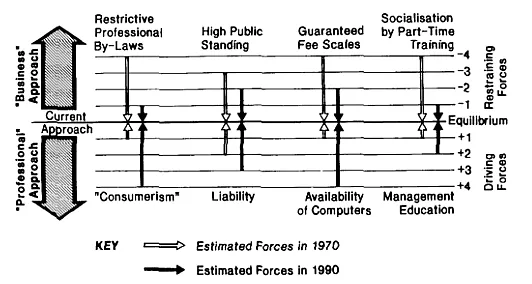
Fig. 1. Force field analysis of approach to practice management
Changes over the last decade, certainly the last two have seen the driving forces towards a business-orientated approach to practice management strengthen considerably, whilst restraining forces have if anything dwindled. Change seems inevitable. It cannot be ignored or escaped.
Garrett (1981, p838) neatly applies to professional firms Revan’s suggestion that to survive an organism must learn at a faster rate than the rate of change it faces. If profound change is upon us then those managing professional firms must learn new skills, assimilate alternative perspectives and above all else react by facing the challenges with an open mind which does not avoid the difficult questions, but determines courses of action that build on strengths and eliminate weaknesses.
But, what areas of theory and practice require development?
4
Facets of practice management
Managers of professional firms face multi-faceted problems of great diversity. A recent study (Barrett, 1990a) identified four main interactions, including feeearning work, which accounted for aggregate time/ effort expended (by all staff), within the twenty-one professional firms studied, as follows:
Only one of the partners and directors interviewed concentrated soley on the first three categories, that is, was a full-time manager of the firm. All of the others operated part-time, often with considerable project commitments. Thus, man...
Table of contents
- Cover Page
- Title Page
- Copyright Page
- Contributors
- Preface
- Part One: Editorial
- Part Two: The Business Environment
- Part Three: Changing Roles and Marketing
- Part Four: Developing the Client’s Brief
- Part Five: Effective Management Procedures
- Part Six: Data Management
- Part Seven: Managing People
- Part Eight: Educating Professionals
Trusted by 375,005 students
Access to over 1.5 million titles for a fair monthly price.
Study more efficiently using our study tools.
Frequently asked questions
Yes, you can cancel anytime from the Subscription tab in your account settings on the Perlego website. Your subscription will stay active until the end of your current billing period. Learn how to cancel your subscription
No, books cannot be downloaded as external files, such as PDFs, for use outside of Perlego. However, you can download books within the Perlego app for offline reading on mobile or tablet. Learn how to download books offline
Perlego offers two plans: Essential and Complete
- Essential is ideal for learners and professionals who enjoy exploring a wide range of subjects. Access the Essential Library with 800,000+ trusted titles and best-sellers across business, personal growth, and the humanities. Includes unlimited reading time and Standard Read Aloud voice.
- Complete: Perfect for advanced learners and researchers needing full, unrestricted access. Unlock 1.5M+ books across hundreds of subjects, including academic and specialized titles. The Complete Plan also includes advanced features like Premium Read Aloud and Research Assistant.
We are an online textbook subscription service, where you can get access to an entire online library for less than the price of a single book per month. With over 1.5 million books across 990+ topics, we’ve got you covered! Learn about our mission
Look out for the read-aloud symbol on your next book to see if you can listen to it. The read-aloud tool reads text aloud for you, highlighting the text as it is being read. You can pause it, speed it up and slow it down. Learn more about Read Aloud
Yes! You can use the Perlego app on both iOS and Android devices to read anytime, anywhere — even offline. Perfect for commutes or when you’re on the go.
Please note we cannot support devices running on iOS 13 and Android 7 or earlier. Learn more about using the app
Please note we cannot support devices running on iOS 13 and Android 7 or earlier. Learn more about using the app
Yes, you can access Practice Management by P. Barrett,R. Males in PDF and/or ePUB format, as well as other popular books in Architecture & Architecture Methods & Materials. We have over 1.5 million books available in our catalogue for you to explore.