- 288 pages
- English
- ePUB (mobile friendly)
- Available on iOS & Android
eBook - ePub
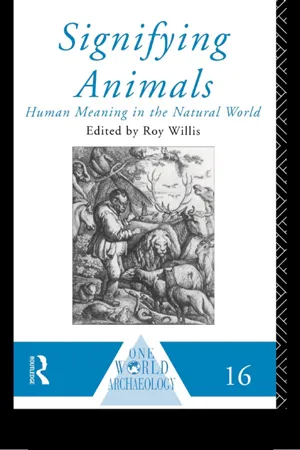
Signifying Animals
About this book
A fresh assessment of the workings of animal symbolism in diverse cultures. Reconsiders the concept of totemism and exposes common fallacies in symbolic interpretation.
Information
1
The Pangolin Revisited: A new Approach to Animal Symbolism
This chapter is a warning against two common ideas about animal symbolism. One is against the unwary use of anomaly. The other is the same warning against metaphor. When I have explained the traps I will suggest a way of avoiding them.
The idea that perception of an anomalous animal kind comes to us out of the nature of biological orders can be firmly laid aside. Animal anomalies are not installed in nature but emerge from particular features of classificatory schemes. In Purity and danger (1966) I thought that this was to say enough. I focused on the ‘nonfit’. Since no scheme of classification can cover the infinite variety of experience there will always be elements that do not fit. Then it is a matter of cultural idiosyncrasy as to which elements escape through the meshes of the classifications, and of cultural bias as to whether they are noticed at all, and whether, if they are noticed as anomalous, this provokes any special interest, either of approval or distaste. The programme that then seemed to lie ahead was to examine the social conditions that demand very concise and exhaustive classifications and those that encourage a lax attitude to fit and misfit. Questions about classification, rather than questions about the identification of particular anomalies or metaphors, have been the centre of my interests, starting with Natural symbols (1970) and going on to the present. The programme does not help to interpret metaphors or to recognize anomalies since it focuses only on features of classification that are sustained by practical use, so at first sight it is not easy for me to have something to say about animal symbolism. But there are many things that have to be said about the justification of interpretations of metaphors and anomalies in general that could perhaps be helpful.
It is obviously wrong to say that a thing is anomalous by using our own categories. It is not even enough to argue from our idea of nature to natural anomalies, such as flightless birds, flying fish, or barkless dogs. We should not expect that what we regard as deviant subspecies widely distributed across oceans and deserts would be accorded special taxonomic status in all cultures. Bulmer (1986) tested this in trying to trace the prohibited birds in Leviticus 11 and Deuteronomy 13, but was forced to conclude that the evidence did not stand up. He was very attached to the idea that a panhuman cognitive disquiet arises in response to deviant subspecies, so the negative result, though disappointing to him, is a valuable contribution to scholarship. The idea rests on the assumption that species are natural kinds, a thesis that Hull (1978) has effectively questioned. With the doubt that perhaps species are not separated by natural boundaries, other doubts arise.
An anthropologist who claims to know that a particular animal or human kind is perceived as an anomaly in the foreign culture needs to justify the claim. But how? Asserting that foreigners recognize an anomaly is a more complex form of the problem raised when asserting that the foreigners see one thing as a metaphor of another. The right way for the anthropologist to deal with suspected anomalies will be the same right way to deal with metaphors. Most of the analyses of the symbolism of animals show the animal kingdom as a projection or metaphor of social life; the analysis depends implicitly on resemblance or picturing. It may be directly, as when the animal is said to depict particular human feelings, such as compassion or cruelty. Or more indirectly, as when by their industry or unruliness, for instance, they are taken to represent certain kinds of human behaviour. All metaphorical identifications depend on making a match. The exercise is to identify some sameness in both fields. However, there is no limit to the power of the imagination for seeing patterns and finding resemblances. So there is no limit to the scope for finding similarity between any sets of objects.
Similarity is not a quality of things in themselves, as Goodman (1972) points out. He makes seven strictures against treating similarity as explanation. The first stricture relates to his concern for a better understanding of the nature of abstraction and realism in art:
Similarity does not distinguish any symbols as peculiarly ‘iconic’, or account for the grading of pictures as more or less realistic or conventional.
Representation does not depend on resemblance alone.
Similarity is relative, variable and culture-dependent.
The second stricture is that similarity does not pick out replicas. The third applies the second to events; two performances of the same work may be very different, repetitions of the same behaviour may involve widely varying sequences of motions. What makes sameness certain in scientific work?
If we experiment twice, do the differences between the two occasions make them different experiments or only different instances of the same experiment, the answer…is always relative to a theory—we cannot repeat an experiment and look for a covering theory; we must have at least a partial theory before we know whether we have a repetition of the experiment (Goodman 1972, p. 439)
The fourth stricture is that similarity does not explain metaphor or metaphorical truth. Rather the other way round, the practice of referring to two objects metaphorically constitutes their similarity.
Metaphorical use may serve to explain the similarity better than—or at least as well as—the similarity explains the metaphor (Goodman 1972, p. 440)
The fifth and sixth strictures are to do with induction and although they are very relevant to the inductions we make as anthropologists about the principles governing other cultures, I make bold to leave them aside in the present context. Already to accept the first four strictures would be for anthropologists a severe curtailment of our usual interpretive activities. The only comfort is that similarity depends on use, on a habit, a practice, a theory however small or a hypothesis however implicit, that picks out the common properties that are held to constitute similarity. If the anthropologist can locate the foreign theory that entrenches a foreign metaphor, and if the theory can be shown to be actually used by the foreigners for prediction, production or remedy, then his interpretation is on safe ground. Otherwise he is probably abusing similarity by making it do more work than it can perform.
This adds up to saying that an interpretation based on discerning a match between one set of things and its representation needs some further guarantee. Metaphors are no more natural phenomena than anomalies. To escape the reproach of having been too imaginative, the anthropologist needs to do more. First, the foreign metaphor has to have local testimony that this is what it means to the foreigner. Then there is the quality of that testimony: is it just one person who said so, or is there some evidence for the wider use of the metaphor; and is the usage a one-off lyrical moment in a poet’s rhapsody, or is it institutionalized as part of the regular habits of the people, a resemblance picked out by their theories of the world and their hypotheses?
All three requirements were met by Turner’s (1962) analysis of whiteness metaphors in Ndembu culture. Why can we believe him when he says that for the Ndembu the whiteness of milk resembles the white sap of a certain tree, and that whiteness of both and whiteness in general means matrilineal descent and continuity? We accept these metaphors not merely because he can quote and name his Ndembu instructors. He witnessed the uses to which the metaphors were put in ceremonies that deployed the redness of blood and of red saps of trees, and the blackness of charcoal and of bile. But important evidence of the institutionalizing of the meanings of the colours is in his account of the social alignments in clans and villages. His interpretations of the metaphors depends upon their use in ceremonies that act the part of theories in upholding perceptions of similarity. Their explanations of the causes of barrenness, sickness and death are indeed theories in which the metaphors are entrenched with consistency at many different levels.
The example is all the better for my purpose because Turner did incautiously let go of these safeguards of his interpretation and tried to find Ndembu meanings of whiteness in other cultures (1962) and, needless to say, found them and got to be duly criticized for it. In situations where there are no guarantees against subjective recognition of similarity, the searcher will always find what he seeks.
I freely confess that in Natural Symbols (1970) I wrote as if the interpretation of the metaphor must be right if it can be shown to correspond to the social structure. But my perception of the social structure as being like that of the symbolic order is a resemblance that I have picked out. It also needs anchorage. Goodman says that correspondence never carries its own guarantee; the match between the symbolic system and the social system is a similarity that I perceive, but of itself it cannot confirm the interpretation that matches them up. Alas, Goodman’s strictures on the abuse of similarity undo this interpretive complacency. First, they apply to the recognition of any pattern as being similar to something else, since similarity is not a quality that inheres in things. When we recognize the social system as the same from one year to the next, we are again invoking similarity; but now we know that similarity is not a quality of things. The matching features of the social system between one visit and the next have to be selected by the viewer as in any other similarity case. Just to see the same social arrangements continuing between two visits involves backgrounding the changes or overlooking them altogether.
Ignorant of these snares, I have attributed to the ancient Israelites a metaphorical construction that makes table, altar, and marriage bed into analogies one with another, and also temple, nation, and human body, and used the larger structure of analogy to explain animal categories prohibited in the Mosaic dietary code (Douglas 1975a). If all these interpretations have to be sent back to the drawing board because we start to take Goodman seriously, so also must be many other interpretations of animal symbols. No names, no pack drill: I name no names, but remark only that I am in good company. The case for animal metaphors is no weaker and no stronger than the case for metaphors found in hair, food, and sex.
Another favourite interpretive ploy is an even worse case: that is the promise to show that symbolic forms are inverted images of social reality. First there is the questionable identifying of enduring images in the symbolism; second, there is the challengeable identifying of enduring patterns in social behaviour; third, there is the dubious alleged resemblance between the symbolic pattern and the pattern of society. Fourth, there is the even more difficult identifying of an inverse pattern of an image; then the alleged enduring inverse pattern of social reality, and last, there is more trouble with the claimed match between the two inverted images.
One attempt to escape from the similarity strictures and other doubts is to throw all the metaphors into the air at once; set the wheel of lights turning, and make such a virtuoso dazzle that everyone will succumb to the irresistible pattern of patterns reflecting one another. This method is used brilliantly by Geertz (1973) in his account of Balinese cockfighting. Reading it, criticism is seduced by each new facet of resemblance that is brought into the play of matching metaphors. For example the cock which the man watching the cockfight is holding between his knees is a metaphorical penis. In themselves umpteen extra facets of metaphor do not improve the analysis of the cockfight’s meaning; their alleged coherence, because it depends on notions of similarity, comes under the strictures like the rest. Claimed coherence between metaphors is a good sign of the investigator’s perseverance and ingenuity; trying to demonstrate it is a spur to improve the evidence. But of itself coherence between numerous metaphors cannot justify an argument. Something more is needed.
Following Ryle (1949), Geertz has called this method of pursuing the ethnographer’s avocation ‘thick description’, an attempt to get at ‘the sort of piled up structures of inference and implication through which an ethnographer is continually trying to pick his way’ (Geertz 1973, p. 7). As the meanings of the people being studied are thickly interleaved, so does the ethnographer’s skill have to be as subtle in uncovering the various layers. The power of this form of reporting to carry conviction depends on showing coherence between multiple contexts.
There is a difference between Ryle’s and Geertz’s use of the idea of thick description. For Ryle it is used critically in a philosophical argument about what the everyday processes of interpretation involve. Geertz is using it prescriptively to help ethnographers to describe what other people’s meanings are. Both are wary of imputing too much intellectual theorizing to the agents who are the subject of study. Geertz is deeply wary of the kind of theorizing that codifies abstract regularities and seeks to generalize even to the point of creating a fantasy world of academic satisfaction that has no correspondence with ethnographic realities. For him the essential task of theory-building is to make thick description possible, generalizing within cases and not across them (Geertz 1973, p. 26) and then gradually to build up an understanding about how cultural processes work. He is not trying to do without theory, but he likes it to be modest and secure in its microfoundations.
Geertz is very explicit that he is not recommending thick description as a method to replace established techniques of gathering information. It is rather an outcome or objective. If he were proffering the rich concatenation of metaphors that he deploys as a method of ethnography he would be vulnerable to the charge of resting explanation on similarity. The strictures do not apply if thickness of description be sought with enough attention to the intentions that have been framed by institutional supports that co-ordinate and steady the meanings, but we the observers have to catalogue them and assess them. We also have to justify our interpretations of the metaphors, and here again, similarity does not pick out replicas or icons. We also depend on theories and institutional habits for our interpretations. Though I fully share Geertz’s preference for small theories tried and working at microlevels, I am sure that it is much better that they be made explicit.
The temptation to let resemblance do the work of explanation is strong because coherence of metaphors works very well as an interpretive rule within one culture. Remember that similarity is culture-dependent. Similarity has explanatory power within our own culture, based as it has to be upon shared similarity perceptions. Statements of similarity ‘are still serviceable in the streets’ (Goodman 1972, p. 446), but they do not help us to go from one culture to another.
On this line of argument, if fieldwork reports have problems with metaphors, so much the more does mythology. Nothing can stave off doubt about the interpretation of metaphor in purely literary uses. In some genres there are verbal equivalents to the supporting institutional structures that safeguard Turner’s Ndembu interpretations. For example, though there is plenty of cause for scepticism about my interpretation of the Mosaic dietary rules, this is in fact much more secure just because it is about rules to be observed and therefore about concepts and theories expected to be in use in a more practical way than stories can ever be. Narrative has problems about symbolization and literary solutions of its own that do not help with interpreting anthropological materials about symbols in use and I regret to say that I do not think that the literary analysis, bound as it is to representational models of interpretation, can be helped by the viewpoint that I am developing here.
Returning to Goodman’s strictures, since similarity is culture-bound, our need is to develop our culture of anthropological interpretation. And since similarity does not pick out icons, since similarity of itself gives no guarantees of interpretation, no method based solely on representational theory will help. The theory has to be one that systematically links behaviour to interpretation; it has to be a theory of behaviour.
For lack of discussion of method and theory the materials that are collected in Central African fieldwork about animal symbolism remain very disparate. The Lele take a special interest in the lesser scaly anteater or tree pangolin (Figure 1.1). They used to make it the object of a fertility cult. I have described it (1957, p. 50) as anomalous in their system of classification on the basis of their descriptions of its habits and habitat, supplemented by knowledge of the rites they perform when they catch one and eat it, and by their theories of sickness and health. I wou...
Table of contents
- Cover
- Half Title
- Title Page
- Copyright
- Contents
- List of contributors
- Foreword
- Preface
- Preface to the paperback edition
- Introduction
- 1. The pangolin revisited: a new approach to animal symbolisim
- 2. Cultural attitudes to birds and animals in folklore
- 3. Animal language in the Garden of Eden: folktale elements in Genesis
- 4. A semantic analysis of the symbolism of Toba mythical animals
- 5. Back to the future: trophy arrays as mental maps in the Wopkaimin’s culture of place
- 6. Sheep bone as a sign of human descent: tibial symbolism among the Mongols
- 7. Ecological community and species attributes in Yolngu religious symbolism
- 8. Pictish animal symbols
- 9. The idea of fish: land and sea in the Icelandic world-view
- 10. Animals in Hopi duality
- 11. Eat and be eaten: animals in U’wa (Tunebo) oral tradition
- 12. Tezcatlipoca: jaguar metaphors and the Aztec mirror of nature
- 13. Nanook, super-male: the polar bear in the imaginary space and social time of the Inuit of the Canadian Arctic
- 14. Antelope as self-image among the Uduk
- 15. The track of the python: a West African origin story
- 16. Nigerian cultural attitudes to the dog
- 17. Rodeo horses: the wild and the tame
- 18. The beast without: the moa as a colonial frontier myth in New Zealand
- 19. The meaning of the snake
- Index
Trusted by 375,005 students
Access to over 1.5 million titles for a fair monthly price.
Study more efficiently using our study tools.
Frequently asked questions
Yes, you can cancel anytime from the Subscription tab in your account settings on the Perlego website. Your subscription will stay active until the end of your current billing period. Learn how to cancel your subscription
No, books cannot be downloaded as external files, such as PDFs, for use outside of Perlego. However, you can download books within the Perlego app for offline reading on mobile or tablet. Learn how to download books offline
Perlego offers two plans: Essential and Complete
- Essential is ideal for learners and professionals who enjoy exploring a wide range of subjects. Access the Essential Library with 800,000+ trusted titles and best-sellers across business, personal growth, and the humanities. Includes unlimited reading time and Standard Read Aloud voice.
- Complete: Perfect for advanced learners and researchers needing full, unrestricted access. Unlock 1.5M+ books across hundreds of subjects, including academic and specialized titles. The Complete Plan also includes advanced features like Premium Read Aloud and Research Assistant.
We are an online textbook subscription service, where you can get access to an entire online library for less than the price of a single book per month. With over 1.5 million books across 990+ topics, we’ve got you covered! Learn about our mission
Look out for the read-aloud symbol on your next book to see if you can listen to it. The read-aloud tool reads text aloud for you, highlighting the text as it is being read. You can pause it, speed it up and slow it down. Learn more about Read Aloud
Yes! You can use the Perlego app on both iOS and Android devices to read anytime, anywhere — even offline. Perfect for commutes or when you’re on the go.
Please note we cannot support devices running on iOS 13 and Android 7 or earlier. Learn more about using the app
Please note we cannot support devices running on iOS 13 and Android 7 or earlier. Learn more about using the app
Yes, you can access Signifying Animals by Roy Willis in PDF and/or ePUB format, as well as other popular books in Social Sciences & Archaeology. We have over 1.5 million books available in our catalogue for you to explore.