"Generative Phonology" offers an overview of the post-SPE theory of generative phonology and is suitable for linguists not specializing in phonology, who want to keep abreast of the latest developments in the subject. It deals with all the major trends in what has come to be known as "non-linear" phonology, including: particle phonology; dependancy phonology; government and charm phonology. Iggy Roca guides the reader through the developments of the various approaches, justifying their rationale against the background of SPE machinery, and providing the reader with the basic tools necessary to penetrate current problems and debates. This text aims to integrate the modules and proposals of what can seem a fragmentary field, into a cohesive body of living theory.
We shall start our discussion with a brief summary of the basic formal fabric underpinning the SPE model of phonology (SPE = Chomsky and Halle 1968), with which we assume a certain familiarity.1 This will give us a useful basis of comparison with subsequent developments, with which the body of this book is primarily concerned.
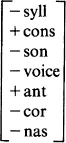
In SPE a phonological representation was made up of a linear array of feature matrices. Let us consider the simple word pen. Each of the three segments of this word was broken down into more elementary particles, called ‘distinctive features’, each essentially representing one aspect of its pronunciation. Formally, each SPE feature was assigned one of two values, positive or negative. Simplifying somewhat, the formal SPE representation of /p/ will therefore be as follows:
(1) SPE representation of /p/
The feature matrix in (1) is of course incomplete, but will suffice at this point in the exposition.
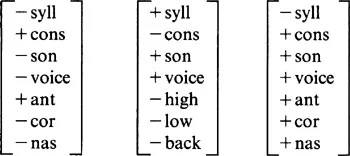
Given such decomposition of segments into features, the word pen will be formally represented as in (2):
(2) Formal representation of pen in SPE
As we shall see in Chapter 3, distinctive feature theory has evolved substantially since the time of SPE, but this is not important for our immediate purposes. Also negligible at the moment is the exact interpretation of each of the feature labels in terms of articulation, acoustics, etc., which we will introduce step by step as we go along (see Chapter 3 for a more thorough discussion). What is significant at the present point is the arrangement of the matrices into unilinear strings characteristic of SPE. In fact, from this perspective, the representation in (2) is equivalent to that in (3):
(3) /pen/
Both (2) and (3) are made up of a linear array of elements, strung together like beads in a string. There is an obvious formal claim implicit in this arrangement, namely, that phonological representations consist of sequences of elements (whether distinctive feature matrices, as in (2), or phonemes, as in (3)) drawn out of a basic vocabulary and capable of entering linear relations of precedence with each other. This is a particularly simple and commonsensical conception of phonological structure, one that also runs through IPA transcription and conventional orthographic writing, where phonetic symbols or letters follow each other in a linear fashion. This mode of representation could therefore easily be thought to be directly rooted in phonetic facts, and thus to constitute the null hypothesis for the representation of sound. As is well known, however, it is in fact not possible to draw up precise boundaries between sounds, for the simple reason that in real life both articulatory and acoustic events form a continuum.
For greater explicitness, we shall now review the relevant formal aspects of the model under scrutiny. Let us say that, for a hypothetical language L, the vocabulary of phonological elements consists of three members, as follows:
(4)
Vocabulary of phonological elements for L
{P, e, n}
Moreover, let us imagine that no restrictions are imposed in L on the precedence relations between these elements. The following sequences will thus be licensed:
(5)
pen
pne
enp
epn
nep
npe
All these strings will be possible phonological words in this language. The number of well-formed phonological objects could of course be easily increased by bringing optionality and recursion into the picture (p, pe, etc.; penpen, penpne, etc.), but such additional complexity is unnecessary for our present purposes. What is important to realise is that the language under consideration has an inventory of three phonological elements, as in (4), and a grammar which allows these elements to enter into unrestricted unilinear relations with each other. A graphic representation of this grammar is given in (6):
(6) xl, x2, x3,.. ., xn
The xs in (6) stand for phonological elements, and the subscripted digits indicate sequential ordering. The precedence relationship (call it ‘<’) has the properties of transitivity, antisymmetry and irreflexivity (see Sagey 1988a). Thus, in (6), (x1 < x2) and (x2 < x3) entails x1 < x3 (transitivity). Given x1 < x2, it follows that it is not the case that x2 < x1 (antisymmetry). Finally, it is also not the case that xj < xj, i.e. no element can precede itself (irreflexivity). This is the gist of the formal representational machinery made available by SPE.
As we shall now see, a revolution that started in the 1970s has profoundly transformed the formalisation of phonological structure in generative phonology. Specifically, the unilinear geometry which characterises SPE has now been abandoned in favour of multilinear representations.2 In order to understand the meaning and implications of this far-reaching change, we shall first briefly examine its basic rationale.
1.2 COMPLEX SEGMENTS
1.2.1 Affricates
The analysis of affricates has long puzzled phonologists, because of the Janus-like nature of these sounds, which behave simultaneously as mono- and bisegmental. Thus, consider the affricate sound [t ∫], which occurs twice in the word church. The following question arises: does such a sound correspond to one or two phonological elements? Specifically, is there in English a phonological element /t∫/, directly corresponding to the affricate, or should this sound be analysed as a sequence of the individual elements /t/ and /∫/, which are attested in tut and shush, respectively. As it happens, there is evidence supporting either stand.
On the one hand, English only allows one obstruent word-initially, with the notable exception of s + obstruent clusters.3 Thus, alongside tar [t
] we have star [st
], but orthographic tsar is not pronounced *[ts
], at least by linguistically unsophisticated speakers, but rather [z
]. Note that, irrespective of their pronunciation, words like tsar and tsetse are felt as exotic, in clear contrast with such everyday non-oddities as church, chat, much, and so on, all containing [t∫]. So, from the point of view of the ...
Table of contents
Front Cover
Generative Phonology
Linguistic Theory Guides
Title Page
Copyright
Dedication
Contents
Series editor’s preface
Preface
List of abbreviations
1 Phonological representations
2 Lexical redundancies
3 Basic elements
4 The sonority fabric
5 Domains and modes of application
Notes
References
Indexes
Trusted by 375,005 students
Access to over 1.5 million titles for a fair monthly price.
Study more efficiently using our study tools.
Frequently asked questions
Yes, you can cancel anytime from the Subscription tab in your account settings on the Perlego website. Your subscription will stay active until the end of your current billing period. Learn how to cancel your subscription
No, books cannot be downloaded as external files, such as PDFs, for use outside of Perlego. However, you can download books within the Perlego app for offline reading on mobile or tablet. Learn how to download books offline
Perlego offers two plans: Essential and Complete
Essential is ideal for learners and professionals who enjoy exploring a wide range of subjects. Access the Essential Library with 800,000+ trusted titles and best-sellers across business, personal growth, and the humanities. Includes unlimited reading time and Standard Read Aloud voice.
Complete: Perfect for advanced learners and researchers needing full, unrestricted access. Unlock 1.5M+ books across hundreds of subjects, including academic and specialized titles. The Complete Plan also includes advanced features like Premium Read Aloud and Research Assistant.
Both plans are available with monthly, semester, or annual billing cycles.
We are an online textbook subscription service, where you can get access to an entire online library for less than the price of a single book per month. With over 1.5 million books across 990+ topics, we’ve got you covered! Learn about our mission
Look out for the read-aloud symbol on your next book to see if you can listen to it. The read-aloud tool reads text aloud for you, highlighting the text as it is being read. You can pause it, speed it up and slow it down. Learn more about Read Aloud
Yes! You can use the Perlego app on both iOS and Android devices to read anytime, anywhere — even offline. Perfect for commutes or when you’re on the go. Please note we cannot support devices running on iOS 13 and Android 7 or earlier. Learn more about using the app
Yes, you can access Generative Phonology by Iggy Roca in PDF and/or ePUB format, as well as other popular books in Lingue e linguistica & Linguistica. We have over 1.5 million books available in our catalogue for you to explore.