This impressive and original study is one of the first books to combine mainstream sociology with feminism in exploring the subject of the professions and power.
This is an important addition to the corpus of feminist scholarship... It provides fresh insights into the way in which male power has been used to limit the employment aspirations of women in the middle classes. - Rosemary Crompton, University of Kent
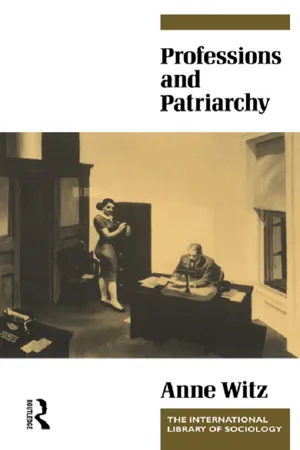
- 244 pages
- English
- ePUB (mobile friendly)
- Available on iOS & Android
eBook - ePub
Professions and Patriarchy
About this book
Information
Part I
GENDER, CLOSURE AND PROFESSIONAL PROJECTS
1
PATRIARCHY, CAPITALISM AND GENDER RELATIONS AT WORK
There has been considerable debate and disagreement about the concept of patriarchy, both over the precise referent of the concept and whether or not it has any utility in explanations of women’s oppression in modern society. Some participants in the debate have exhibited extreme caution regarding the use of the term patriarchy and, at most, seemed prepared to countenance only a historically specific, generational use of the term to refer to the power of the father over women and younger men (cf Barrett 1987). Others advocate the use of a broader gender concept of patriarchy to refer to a social system of gender relations of male dominance and female subordination (cf Hartmann 1979, 1981, Walby 1986, 1989, 1990b, Cockburn 1983, 1985, 1986a, 1988), and one which persists in modern ‘patriarchal capitalism’ (Hartmann 1979, 1981) or ‘capitalist-patriarchy’ (Eisenstein 1979).
In this chapter I shall argue that we need to work with a gender concept of patriarchy which refers to a societal-wide system of gender relations of male dominance and female subordination in order to explain gender divisions in paid work. I acknowledge that this concept may appear as problematic as it is useful, but shall argue that it has enormous explanatory potential if used in an historically sensitive way. The gender relations of patriarchy assume historically, culturally and spacially variable forms, which must be studied in their specificity.
To speak of the patriarchal structuring of gender relations is to describe the ways in which male power is institutionalised within different sites of social relations in society. It is incumbent upon those who argue for the explanatory potential of the concept of patriarchy to specify more precisely: how male power is institutionalised in different sites of social relations—that is, the ways and means, or the ‘material’, of male power (Cockburn 1983, 1986a); the diachronic interrelationship between the gender relations of patriarchy in each of these different sites at any one point in time—or what Walby (1989, 1990a: 20) refers to as the different ‘social structures and practices in which men dominate’ and their inter-relations; and the diachronic shifts in the social patterning of male dominance over time—or those ‘changes in both the degree and form of patriarchy’ (Walby 1990a: 23), such as the shift from ‘private’ to ‘public’ forms in modern, patriarchal capitalist societies (Walby 1990a, 1990b, Holter 1984, Hernes 1987).
The stance of extreme caution with regard to the use of the concept of patriarchy may be associated with the Marxist-feminist current (cf Barrett 1980, 1987; Rowbotham 1981; Beechey 1977, 1978, 1986; Vogel 1983, Humphries 1977, 1981, 1983, Phillips 1987, Glucksman 1990). Barrett (1987) argues that although categories of Marxism cannot allow an exhaustive account of women’s oppression under capitalism, at the same time the concept of patriarchy remains a trans-historical and solely descriptive term when it refers to all expressions of male domination within a society. The concept of patriarchy to which Barrett takes exception is that in current usage among some feminist sociologists and social historians: broadly a gender based concept of male dominance. Rowbotham (1981) is similarly troubled by the use of the term patriarchy to distinguish women’s subordination as a sex from class oppression, objecting to its use on the grounds of its alleged universality and biologism. Curiously, though, Rowbotham takes the referent of the term patriarchy to which she objects to be the ‘power of the father’ and yet this is precisely what Barrett regarded as an acceptable, restricted use of the term. Generally though, what we may broadly define as a Marxist-feminist current has been reluctant to reclaim the concept of patriarchy, whilst acknowledging that the family continues to be a site of male power which is inadequately treated within Marxist theory (cf Vogel 1983). Thus Beechey (1977, 1978, 1986) argued that Marxism must acknowledge the centrality of the family-production relation in explaining women’s oppression and Barrett (1980) stressed the importance of familial ideology in shaping women’s oppression today.
On the other hand, there were those who, albeit in a variety of ways, sought to salvage the concept of patriarchy from theoretical neglect and re-cast it in such a way as to further our understanding of the ubiquity of male dominance and the complexity of gender lrelations and inequality in the family, the labour market and the state (cf Millett 1972, Delphy 1984, Hartmann 1979, 1981, Eisenstein 1979, 1981, 1984, Summerfield 1984, Braybon 1981, Walby 1985a,b, 1986, 1989, 1990a, 1990b, Westwood 1984, Alexander and Taylor 1981, Lown 1983, 1990, Cockburn 1983, 1985, 1986a, 1986b). In their defence of patriarchy, Alexander and Taylor (1981) argue, correctly, that sexual divisions and antagonisms need to be analysed with concepts forged for that purpose. The gender based concept of patriarchy currently in vogue describes the power relations between men and women, in which men are dominant and women are subordinate, i.e. it speaks of a societal-wide system of male dominance, and provides some of these concepts. Inevitably, there have been a variety of divergent formulations of the lynch-pin of such a system and a variety of ‘bases’ of patriarchy have been identified in the literature. Firestone (1974) specifies biological reproduction, Delphy (1984) husbands’ control over their wives’ labour within the marriage relation, Rich (1980) compulsory heterosexuality, Chodorow (1978a, 1978b) mothering, and Hartmann (1979, 1981) men’s control over women’s labour both within and without the household as the underpinnings of male dominance. However, not all writers who argue that women continue to be oppressed within a system of male dominance necessarily utilise a concept of patriarchy. Some writers have used the notion of a ‘sex-gender system’ and still reserve the term patriarchy for an historically specific form of male dominance where male power is synonymous with fatherhood (cf Rubin 1975), whilst Chodorow (1978a) has distinguished between a sex-gender system and the mode of production, but remains ambiguous as to whether the contemporary Western sex-gender system constitutes a patriarchal system.
For those who have argued that we need a concept of patriarchy as well as capitalism to probe the issue of the specifity of women’s oppression, whether in the labour market or elsewhere, the question of their interrelationship becomes central. Eisenstein (1979, 1981) employs a notion of one system of capitalist-patriarchy, arguing that:
capitalism and patriarchy are neither autonomous systems nor identical: they are, in their present form, mutually dependent…. This statement of the mutual dependence of patriarchy and capitalism not only assumes the malleability of patriarchy to the needs of capital but assumes the malleability of capital to the needs of patriarchy.
(Eisenstein 1979:22, 27)
It becomes difficult to disentangle the workings of one from the other system, and Eisensteins’s formulation of ‘capitalist-patriarchy’ relies upon a somewhat biologisitic and essentialist notion of ‘sex-class’ as the unit of patriarchy.
Hartmann (1979, 1981), Cockburn (1983) and Walby (1986, 1989, 1990a), on the other hand, work with a far more robust social constructionist concept of patriarchy.
THE DUAL SYSTEMS FRAMEWORK
Hartmann (1979, 1981) elaborated a dual systems model of separate sets of capitalist and patriarchal relations that interrelate to form a ‘partnership’ of patriarchal capitalism:
Capitalism grew on top of patriarchy; patriarchal capitalism is stratified society par excellence…. Patriarchy, far from being vanquished by capitalism, is still very virile; it shapes the form modern capitalism takes, just as the development of capitalism has transformed patriarchal institutions. The resulting mutual accommodation between patriarchy and capitalism has created a vicious circle for women.
(Hartmann 1979:230, 298)
This has been a highly influential formulation, broadly adopted by other writers, although with minor differences in emphasis. Walby (1986), for example, argues that Hartmann overemphasises the mutual accommodation of capitalist and patriarchal interests, and understates the conflict between the two. Hartmann defines patriarchy as:
A set of social relations which has a material base and in which there are hierarchical relations between men and solidarity among them which enable them in turn to dominate women. The material base of patriarchy is men’s control over women’s labor power. That control is maintained by denying women access to necessary economically productive resources and by restricting women’s sexuality…the material base of patriarchy, then, does not rest solely on childrearing in the family, but on all the social structures that enable men to control women’s labour.
(Hartmann 1981:14, 12)
Hartmann substantiates her claim that capitalism has been built on top of patriarchy through an analysis of the status of women in the labour market, paying particular attention to job segregation by sex (cf 1979), and through an analysis of the family wage, to which she accords a pivotal role in securing the material basis of male dominance in both the labour market and the family in industrial patriarchal capitalism (cf 1981).
When women participated in the wage-labor market, they did so in a position as clearly limited by patriarchy as it was by capitalism. Men’s control over women’s labor was altered by the wage-labor system, but it was not eliminated. In the labor market the dominant position of men is maintained by sex-ordered job segregation…. Women’s subordinate position in the labor market reinforced their subordinate position in the family, and that in turn reinforced their labor-market position.
(Hartmann 1979:217)
Hartmann (1979) argues that historically it has been male workers who have been instrumental in restricting women’s activity in the labour market. Capitalists have played only an indirect role in this process, inheriting job segregation by sex and using it to their advantage through, for example, the substitution of cheaper female labour for male labour and by buying off male workers’ allegiance to capitalism with patriarchal benefits. Hartmann argues:
Job segregation by sex…is the primary mechanism in capitalist society that maintains the superiority of men over women, because it enforces lower wages for women in the labor market. Low wages keep women dependent on men because they encourage women to marry. Married women must perform domestic chores for their husbands. Men benefit, then, from both higher wages and the domestic division of labour. This domestic division of labour, in turn, acts to weaken women’s position in the labor market. Thus, the hierarchical domestic division of labor is perpetuated by the labor market, and vice versa. This process is the present outcome of the continuing interaction of two interlocking systems, capitalism and patriarchy.
(Hartmann 1979:208)
Hartmann’s thesis that patriarchal relations persist within capitalism is further substantiated through an analysis of the family wage (cf Hartmann 1979). This is a wage high enough to support non-working dependents, and the demand for a family wage became a central plank of male trade unionists’ wage bargaining strategies from the mid-nineteenth century onwards (cf Barrett and McIntosh 1980). The argument for a family wage may be seen as a necessary corollary of exclusionary practices as men sought simultaneously to exclude women from paid employment and retain their unpaid domestic services in the home.
The overall purpose of Hartmann’s analysis is to demonstrate how patriarchal relations have been constituted and sustained within capitalism, both in the sphere of paid employment and in the sphere of the family. One of its major strengths is that women’s subordination within these two spheres is seen as dynamically interrelated and reinforcing. Hartmann does not ‘read off women’s subordinate status in the labour market from their sub-ordinate status within the family-household. But the real strength of Hartmann’s analysis derives from her materialist formulation of a theory of patriarchy. Patriarchy is ‘a social system with a material base’ (1979:208). Patriarchal relations are systemic. Hartmann has drawn upon the Marxist method of historical materialism in order to refine a theory of patriarchy, adopting a critical stance towards theories of patriarchy which treat it either as an ideological system autonomous from the economic mode of capitalism (cf Mitchell 1975) or reduce it to biology and reproduction (cf Firestone 1974). The influence of Marxism upon Hartmann comes through in her focus on women’s work or labour and her argument that it is men’s control over women’s work activities which provides the material basis for patriarchy. Hartmann is shifting the emphasis away from what she sees as an overemphasis in radical feminism on biology and reproduction, and towards an emphasis on men’s control over what we could term ‘material-productive’ rather than ‘sexual-reproductive’ activities. Thus, she insists that ‘It is necessary to place all of women’s work in its social and historical context, not to focus only on reproduction (Hartmann 1981:9).
Walby (1986) contributes to a further refinement of a theory of patriarchy in two ways. First she proposes a more exhaustive model of patriarchy than Hartmann’s, where patriarchy is seen as a societal-wide system of interrelated structures of relatively autonomous patriarchal relations through which men exploit women. Walby (1983, 1986) also substantiates her thesis that gender inequality is a consequence of the interaction of the autonomous sytems of patriarchy and capitalism by exploring how these systems interact in the sphere of paid work, focusing on three contrasting areas of employment: cotton textiles, engineering and clerical work. Developing a new theory of patriarchy, Walby combines the insights of the materialist feminist analyses of Delphy (1984) with that of Hartmann. Like Delphy, Walby (1986) regards the domestic division of labour as a patriarchal mode of production, in which the producing class is composed of women-wives and the non-producing, exploiting class is composed of men-husbands. But Walby moves beyond Delphy (1984), who focuses exclusively on the patriarchal mode of production regarding it almost as a completely self-sustaining mode existing in parallel to and unaffected by the capitalist mode. Walby insists that the patriarchal mode only exists in articulation with another mode of production. Moreover, Walby claims that: ‘When the patriarchal mode articulates with the capitalist mode, the primary mechanism which ensures that women will serve their husbands is their exclusion from paid work on the same terms as men’ (Walby 1986:54).
In her most recent publication, however, Walby (1990a) prefers not to use the term ‘mode of production’ to describe patriarchal relations in the household.
Importantly, Walby (1986, 1989, 1990a), like Hartmann attributes considerable causal powers to patriarchal relations in paid work in sustaining women’s subordination throughout society as a whole. Walby’s model of patriarchy (1986) prioritises sets of patriarchal relations in domestic and paid work, but identifies other sets of patriarchal relations that are of key significance in defining patriarchy as a system of interrelated social structures. These are patriarchal relations in the state, male violence and sexuality, whilst patriarchal relations in cultural institutions are added in a later (1990a) formulation of the model. The substantive case study material relating to women’s employment provides invaluable insights into different types of patriarchal strategies, important variations in the nature of patriarchal relations in the workplace and how these interact, often in conflict with, capitalist relations. Walby identifies two main patriarchal strategies: exclusion and segregation. She provides detailed historical documentation of the patriarchal strategies of organised male workers: in cotton textiles where they were not strong enough to sustain exclusionary strategies and where women maintained access to paid work; in engineering where strongly organised male workers excluded women from skilled work; and in clerical work, where men lost their battle to exclude women but maintained sex segregation. Overall, Walby relies too heavily on the concept of ‘exclusion’ to capture the form assumed by patriarchal practices in the labour market As a result, in her eagerness to shift the weight of explanation of women’s position in paid employment from the family to the labour market, she underestimates the significance of other forms of patriarchal control in paid employment, particularly those which derive from familial authority relations and yet which do structure women’s and men’s position in the labour market I shall return to this point later.
Extending her analysis of the shifting nature of patriarchal relations into the twentieth century, Walby (1990a) goes further than Hartmann, who insisted on the dynamic interrelations between women’s oppression in the family and the labour market, to insist that the causal link between family and labour market goes in the reverse direction from that commonly assumed; it goes from the labour market to the family, rather than vice versa. Walby also argues that we have witnessed a shift from ‘private’ to ‘public’ patriarchy, where private patriarchy was based on the household as the primary site of women’s oppression, and public patriarchy is based principally on public sites such as the labour market and the state. But throughout her work runs a constant emphasis on the significance of patriarchal relations in paid employment, particularly job segregation by sex, in sustaining the web of patriarchal relations in modern society.
Cockburn, in her studies of technological change, gender and class relations in printing (1983), in clothing manufacture, mail order warehouses and medical X-ray work (1985) also provides further grist to the mill for Hartmann’s thesis. Whereas Walby (1986) sees exclusion and segregation as distinct outcomes of different patriarchal practices, Cockburn (1985) talks of these in a way which treats the exclusion of women from skilled jobs and their segregation into unskilled and low-paid occupations as related patriarchal practices, as two sides of the same coin. So, for Cockburn, the patriarchal practice of excluding women from compositing was accompanied by their confinement and segregation into book-binding and other print-finishing operations, as men could not prevent employers from engaging women in printing industries, only in particular grades of job.
Cockburn has tended to display an ambivalence about the concept ‘patriarchy’ which is never entirely resolved, except to concede in one of her latest publications that the concept has been used by feminists not because it is ideal but for lack of another. Utilising Hartmann’s ‘dual systems’ framework Cockburn nonetheless locates her analysis of male dominance and technological change in printing within ‘the class relations of capitalism and the gender relations of patriarchy and their bearing upon each other’ (1983:8). Although hesitant about the lack of historical sensitivity of the concept ‘patriarchy’, when loosely used to mean ‘male supremacy’, Cockburn thinks it needs more closely defining rather than rejecting outright Cockburn is also reluctant to prioritise any one set of social relations as the site of patriarchy.
To say that patriarchal power is exercised only in the family or in directly sexual relations is as blinkered as to suppose that capitalist power is exercised only in the factory. The sex/gender system is to be found in all the same practices and processes in which th...
Table of contents
- Cover
- Title Page
- Copyright Page
- Dedication
- Contents
- Acknowledgements
- Introduction
- Part I Gender, closure and professional projects
- Part II Gender and professional projects in the medical division of labour
- Bibliography
- Name index
- Subject index
Trusted by 375,005 students
Access to over 1.5 million titles for a fair monthly price.
Study more efficiently using our study tools.
Frequently asked questions
Yes, you can cancel anytime from the Subscription tab in your account settings on the Perlego website. Your subscription will stay active until the end of your current billing period. Learn how to cancel your subscription
No, books cannot be downloaded as external files, such as PDFs, for use outside of Perlego. However, you can download books within the Perlego app for offline reading on mobile or tablet. Learn how to download books offline
Perlego offers two plans: Essential and Complete
- Essential is ideal for learners and professionals who enjoy exploring a wide range of subjects. Access the Essential Library with 800,000+ trusted titles and best-sellers across business, personal growth, and the humanities. Includes unlimited reading time and Standard Read Aloud voice.
- Complete: Perfect for advanced learners and researchers needing full, unrestricted access. Unlock 1.5M+ books across hundreds of subjects, including academic and specialized titles. The Complete Plan also includes advanced features like Premium Read Aloud and Research Assistant.
We are an online textbook subscription service, where you can get access to an entire online library for less than the price of a single book per month. With over 1.5 million books across 990+ topics, we’ve got you covered! Learn about our mission
Look out for the read-aloud symbol on your next book to see if you can listen to it. The read-aloud tool reads text aloud for you, highlighting the text as it is being read. You can pause it, speed it up and slow it down. Learn more about Read Aloud
Yes! You can use the Perlego app on both iOS and Android devices to read anytime, anywhere — even offline. Perfect for commutes or when you’re on the go.
Please note we cannot support devices running on iOS 13 and Android 7 or earlier. Learn more about using the app
Please note we cannot support devices running on iOS 13 and Android 7 or earlier. Learn more about using the app
Yes, you can access Professions and Patriarchy by Anne Witz in PDF and/or ePUB format, as well as other popular books in Social Sciences & Feminism & Feminist Theory. We have over 1.5 million books available in our catalogue for you to explore.