Nikon D780 For Dummies
eBook - ePub

Nikon D780 For Dummies

  1. English
  2. ePUB (mobile friendly)
  3. Available on iOS & Android
eBook - ePub

Nikon D780 For Dummies

About this book

Join the photographers who turn to the For Dummies series for useful guidance

Nikon D780 For Dummies provides Nikon D780 users and owners with in-depth knowledge and practical advice abouthow toget great shots with their powerful camera. Written by professional photographer Doug Sahlin, thisbookgivesquick and convenient answers to Nikon D780 users' most frequent and pressing questions.

Nikon D780 For Dummies coversthe topics you'll need toget started withyour new D780 camera. The bookincludesclear guidance on topics like:

· Exploring the Nikon D780 body

· Getting to know the settings options

· Seeing results from auto modes

· Taking control of exposure

· Looking into lens options

· Usingthe flash effectively

Written in the straightforward and pragmatic style known and loved by For Dummies readers around the world, Nikon D780 For Dummies is perfect for people just starting outwith digital SLR photographyas well as those who know their way around a camera.

Frequently asked questions

Yes, you can cancel anytime from the Subscription tab in your account settings on the Perlego website. Your subscription will stay active until the end of your current billing period. Learn how to cancel your subscription.
No, books cannot be downloaded as external files, such as PDFs, for use outside of Perlego. However, you can download books within the Perlego app for offline reading on mobile or tablet. Learn more here.
Perlego offers two plans: Essential and Complete
  • Essential is ideal for learners and professionals who enjoy exploring a wide range of subjects. Access the Essential Library with 800,000+ trusted titles and best-sellers across business, personal growth, and the humanities. Includes unlimited reading time and Standard Read Aloud voice.
  • Complete: Perfect for advanced learners and researchers needing full, unrestricted access. Unlock 1.4M+ books across hundreds of subjects, including academic and specialized titles. The Complete Plan also includes advanced features like Premium Read Aloud and Research Assistant.
Both plans are available with monthly, semester, or annual billing cycles.
We are an online textbook subscription service, where you can get access to an entire online library for less than the price of a single book per month. With over 1 million books across 1000+ topics, we’ve got you covered! Learn more here.
Look out for the read-aloud symbol on your next book to see if you can listen to it. The read-aloud tool reads text aloud for you, highlighting the text as it is being read. You can pause it, speed it up and slow it down. Learn more here.
Yes! You can use the Perlego app on both iOS or Android devices to read anytime, anywhere — even offline. Perfect for commutes or when you’re on the go.
Please note we cannot support devices running on iOS 13 and Android 7 or earlier. Learn more about using the app.
Yes, you can access Nikon D780 For Dummies by Doug Sahlin in PDF and/or ePUB format, as well as other popular books in Computer Science & Digital Media. We have over one million books available in our catalogue for you to explore.

Information

Publisher
For Dummies
Year
2020
Print ISBN
9781119716372
eBook ISBN
9781119716426
Part 1

Getting Started with the Nikon D780

IN THIS PART …
Get to know the lay of the land and become familiar with the controls of your Nikon D780.
Learn how to set up your Nikon D780.
Accessorize your Nikon D780.
Find out how to take great pictures automatically.
Specify image size and format.
Master the camera’s tilting monitor.
Chapter 1

Exploring the Nikon D780’s Controls

IN THIS CHAPTER
check
Getting familiar with camera controls
check
Looking at your camera from the top, bottom, front, and back
The Nikon D780, which evolved from the Nikon D750 that was introduced in late 2014, is a full-frame camera that captures stunning 24.5-megapixel images. It has all the latest bells and whistles Nikon has to offer on a full-frame digital single-lens reflex (DSLR) camera. It’s a technological marvel that enables you to take great pictures and capture high-definition (HD) video. The camera has a new processor and an advanced, highly customizable 51-point autofocus system that gives you the ability to capture great images in low light and at a blindingly fast speed of up to 12 frames per second, which is ideal for action photography. You can also create high dynamic range (HDR) images and use the interval timer to create time-lapse movies. This camera features a viewfinder that shows you 100 percent of what the lens captures at a magnification of 0.70x — what you see is what you get. The camera also features a virtual horizon, which enables you to capture images that are perfectly level.
The learning curve with all these bells and whistles may seem a little steep, but don’t worry — I’m an experienced professional photographer, and I take pride in understanding how a camera works and how to get the most from any camera. In this chapter, I introduce you to the Nikon D780’s controls and help you get the lay of the land, so to speak.

Exploring the Top of Your Camera

The top of the camera is where you find the controls you use most when taking pictures. This is where you change settings like ISO (how sensitive the sensor is to light) and shutter speed, choose a shooting mode, and press the shutter button to take a picture.
Technical Stuff
ISO stands for International Organization for Standardization, but all you really need to know is that, on your camera, it controls how sensitive the camera’s sensor is to light.
You can do lots of other things from the top of the camera, which, in my humble opinion, is the most important real estate on the camera, with the possible exception of the lens. I suggest you get to know the controls on the top of your camera intimately, like the back of your hand. Many photographers, including me, make it a point to memorize where the controls are and access them without taking an eye off the viewfinder.
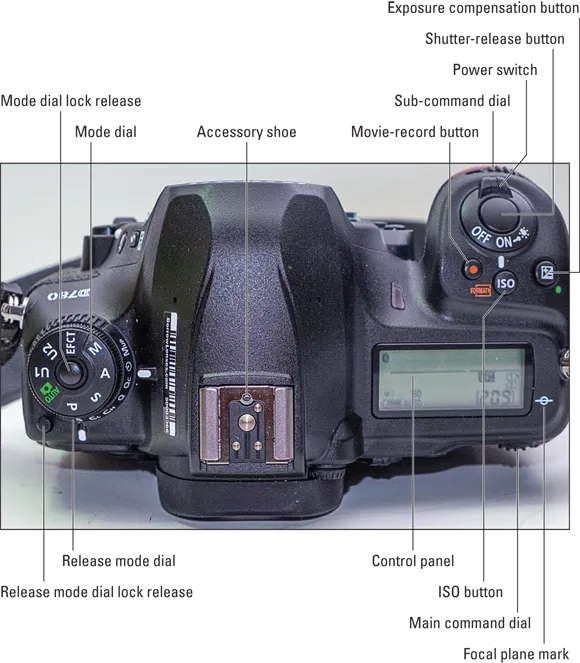
Here’s what you find on the top of the camera (see Figure 1-1):
  • Release mode dial lock release: Press the button to unlock the release mode dial.
  • Release mode dial: Rotate this dial to choose whether pressing the shutter button captures a single image or a sequence or images. (Turn to Chapter 9 for more on the shutter release modes.)
  • Mode dial lock release: Pushing this button enables you to change from one shooting mode to another. When in the upright and locked position, it’s not possible to accidentally change shooting modes in the heat of battle.
  • Mode dial: You use this dial to specify which shooting mode the camera uses to take the picture. (For more on how to use this dial to choose specific shooting modes, turn to Chapter 9; for more on how to choose optimal settings for specific picture-taking situations, turn to Chapter 13.)
  • Accessory shoe: Slide a flash unit that’s compatible with the Nikon D780 into this slot (also sometimes known as a hot shoe). The contacts in the accessory shoe communicate between the camera and the flash unit. (For more on flash photography, turn to Chapter 11.)
  • Sub-command dial: This dial is used in conjunction with menu commands and other buttons to specify settings.
  • Power switch: Turn this switch one notch to power the camera on, and turn it a second notch to turn on the LCD illuminator.
    Image depicting the controls on the top a Nikon D780 camera such as power switch, mode dial, accessory shoe, shutter-release button, and ISO button, and movie-record button.
    FIGURE 1-1: The top of the Nikon D780.
  • Shutter-release button: This button pre-focuses the camera and takes a picture. (Turn to Chapter 2 for more information.)
  • Movie-record button: Press this button to start recording video. (For more on how to use this button with other features to capture videos, turn to Chapter 8.)
  • ISO button: Use this button in conjunction with the main command dial to choose the ISO sensitivity of the camera’s sensor. (For more on setting the ISO, turn to Chapter 10.)
  • Exposure compensation button: Use the button in conjunction with the main command dial to increase or decrease the exposure. (See Chapter 9 for more information on using this feature.)
  • Control panel: This panel shows you all the current settings. (Turn to Chapter 2 for more on how to read the information on the control panel.)
  • Focal plane mark: Used w...

Table of contents

  1. Cover
  2. Table of Contents
  3. Introduction
  4. Part 1: Getting Started with the Nikon D780
  5. Part 2: Taking Control of Your Nikon D780
  6. Part 3: Applying Your Skills
  7. Part 4: The Part of Tens
  8. Index
  9. About the Author
  10. Advertisement Page
  11. Connect with Dummies
  12. End User License Agreement