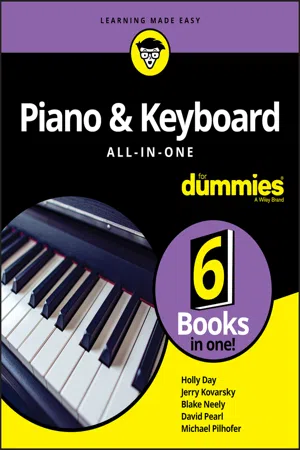
Piano & Keyboard All-in-One For Dummies
eBook - ePub

Piano & Keyboard All-in-One For Dummies

  1. English
  2. ePUB (mobile friendly)
  3. Available on iOS & Android
eBook - ePub

Piano & Keyboard All-in-One For Dummies

About this book

The comprehensive go-to guide for building keyboard skills

Being able to play a tune on the piano can bring you a lifetime of sheer aesthetic pleasure—and put you in serious demand at parties! Whatever your motivation for tinkling the ivories, the latest edition of Piano & Keyboard All-In-One For Dummies gives you the essentials you need both to build your playing skills and expand your knowledge of music theory, from deciding what keyboard suits you best to musing on the science of what makes music so emotionally compelling.

This indispensable resource combines the best of Piano For Dummies, Keyboard For Dummies, Music Theory For Dummies,?and Piano Exercises For Dummies and includes practice strategies, as well as access to streaming and downloadable audio to help guide your progress. In addition to becoming acquainted with the latest in music theory, you'll learn to develop your sight-reading skills and performance techniques—until you can reproduce pieces flawlessly on request!

  • Choose and care for your keyboard
  • Practice until perfect
  • Compose your own songs
  • Hook up to speakers, computers, and more

Learning to play the keys is a never-ending journey of new discoveries and joy, and there's no better companion on your voyage than this friendly, erudite, and comprehensive guide.

P.S. If you think this book seems familiar, you're probably right. The Dummies team updated the cover and design to give the book a fresh feel, but the content is the same as the previous release of Piano and Keyboard AIO For Dummies (9781118837429). The book you see here shouldn't be considered a new or updated product. But if you're in the mood to learn something new, check out some of our other books. We're always writing about new topics!

Frequently asked questions

Yes, you can cancel anytime from the Subscription tab in your account settings on the Perlego website. Your subscription will stay active until the end of your current billing period. Learn how to cancel your subscription.
No, books cannot be downloaded as external files, such as PDFs, for use outside of Perlego. However, you can download books within the Perlego app for offline reading on mobile or tablet. Learn more here.
Perlego offers two plans: Essential and Complete
  • Essential is ideal for learners and professionals who enjoy exploring a wide range of subjects. Access the Essential Library with 800,000+ trusted titles and best-sellers across business, personal growth, and the humanities. Includes unlimited reading time and Standard Read Aloud voice.
  • Complete: Perfect for advanced learners and researchers needing full, unrestricted access. Unlock 1.4M+ books across hundreds of subjects, including academic and specialized titles. The Complete Plan also includes advanced features like Premium Read Aloud and Research Assistant.
Both plans are available with monthly, semester, or annual billing cycles.
We are an online textbook subscription service, where you can get access to an entire online library for less than the price of a single book per month. With over 1 million books across 1000+ topics, we’ve got you covered! Learn more here.
Look out for the read-aloud symbol on your next book to see if you can listen to it. The read-aloud tool reads text aloud for you, highlighting the text as it is being read. You can pause it, speed it up and slow it down. Learn more here.
Yes! You can use the Perlego app on both iOS or Android devices to read anytime, anywhere — even offline. Perfect for commutes or when you’re on the go.
Please note we cannot support devices running on iOS 13 and Android 7 or earlier. Learn more about using the app.
Yes, you can access Piano & Keyboard All-in-One For Dummies by Holly Day,Jerry Kovarsky,Blake Neely,David Pearl,Michael Pilhofer in PDF and/or ePUB format, as well as other popular books in Media & Performing Arts & Music. We have over one million books available in our catalogue for you to explore.

Information

Publisher
For Dummies
Year
2020
Print ISBN
9781119700845
eBook ISBN
9781119700852
Edition
2
Subtopic
Music
Book 1

Piano & Keyboard 101

Contents at a Glance

  1. Chapter 1: Warming Up to the Piano and Keyboard
    1. What’s So Special About the Piano?
    2. Why People Learn to Play the Piano (and Why They Often Quit)
    3. Getting to Know the Piano as an Instrument
    4. Understanding the Language of Music
    5. The Best Way to Play
    6. What You Already Know About Playing the Piano
    7. Electronic Keyboards and other Keyboard Instruments
    8. Making the Most of Your Keyboard’s Basic Features
    9. Delving into More Advanced Digital Features
    10. Practicing with and without Help
  2. Chapter 2:
    1. Acoustic Pianos
    2. Electro-Mechanical Keyboards
    3. Electronic Keyboards
    4. Appreciating How Digital Keyboards Make So Many Sounds
    5. Considering Key Feel and Response
    6. Paying Attention to Polyphony
  3. Chapter 3: Choosing and Buying Your Keyboard
    1. First Things First: Acoustic or Electric (or Both)?
    2. Looking At What’s Important for the Beginner
    3. Playing Well With Others and Alone
    4. Picking the Perfect Acoustic Piano
    5. Selecting a Digital Keyboard That Lasts
    6. Before You Drive It Off the Lot: Sealing the Deal
    7. The MIDI Places You Can Go
  4. Chapter 4: The Setup and Care of Your Instrument
    1. Unboxing Your New Keyboard
    2. Providing a Good Place to Put It
    3. Making It Shine
    4. Calling In a Pro for Tuning, Check-Ups, and Serious Repairs
    5. Setting Up Your Keyboard
    6. Hook Me Up: Keyboard Connections
    7. Protecting Your Investment: Care and Upkeep
    8. Solving Minor Technical Problems
  5. Chapter 5: Getting Comfy at the Keyboard
    1. Blake’s E-Z Key Finder
    2. What Your Parents Never Told You About Posture
    3. It’s All in the Hands
    4. Pedal Power: Getting Your Feet in on the Action
Chapter 1

Warming Up to the Piano and Keyboard

IN THIS CHAPTER
check
Getting acquainted with the piano and music
check
Discovering what you may already know about playing piano
check
Grasping the basic attributes of a keyboard
check
Understanding the benefits of reading music
check
Access the audio track at www.dummies.com/go/pianokeyboardaio/
The piano remains a very popular instrument, with the number of people who love the piano growing and its popularity spreading throughout the world. Even as the piano is treasured for its quality as an instrument, it also adapts itself to the changing times through technological advances.
The first half of this chapter helps you understand what makes the piano so unique and what’s involved in learning to play it. You may find out that you know a lot more about music than you thought you did, even if you’re a beginner. Beyond the familiar black and white keys, though, keyboards can be wildly different instruments, and looking at the front panels may not give you much of a clue as to what’s inside. The second half of this chapter gives you an overview of what keyboards are and just what you can do with them.

What’s So Special About the Piano?

Playing the piano involves the following fundamental musical tasks:
  • Playing different pitches and melodies
  • Controlling the attack and release of a note
  • Playing different dynamics (relative loudness and softness)
But playing the piano is different from playing other instruments in some important respects, and the piano has several attributes that make it an ideal tool for learning and understanding music.

Advantages to playing the piano

The piano occupies a central position in the world of music. It’s the gold standard of musical instruments, utilized by composers and arrangers and featured routinely in nearly all musical styles, in chamber groups, rock bands, and jazz trios. (Okay, not marching bands.) The following characteristics make the piano a unique instrument — in a great way:
  • You can play many different notes at the same time. The fancy word for this is polyphonic.
  • It’s a complete solo instrument. You can play a complete song or other musical work without additional accompaniment or other help from your musical friends. That makes the piano satisfying and self-sufficient.
  • It’s the perfect accompaniment. You can accompany a singer, a choir, a dance class, a silent movie, your own opera, or your own soap opera, not to mention any other instrument.
  • You can play almost anything on the piano. The piano has an unmatched repertoire of music. You name it, there’s piano music for it.

Advantages to learning music at the piano

The piano is an ideal instrument for learning all about music, starting with the design of the keyboard. The notes are laid out before your very eyes in a clear, organized, and orderly way. Understanding and playing musical pitches is quite easy because the keyboard presents a clear visual image for your brain to process the way musical notes go up (higher pitch), down (lower pitch), or stay the same.
Each key on the keyboard produces a single, distinct pitch, and you can’t beat that for simplicity. Not much skill is required to make a nice, musical sound. Compared with some other instruments (cello, violin, clarinet, trombone, trumpet, bassoon, oboe, and tuba), playing any key on the keyboard, no matter how high or low the pitch, is as easy as playing any other key.
Another advantage of the piano is that you can play chords and layer sounds. The keyboard makes it easy to play harmonies and immediately hear how a combination of notes sounds.

A skill and an art

After all is said and done, the reason playing piano is so special may be that it’s an activity that invites your full participation and rewards you just as completely. It has its mental side and its physical side. It requires both creativity and discipline, and engaging your mind and body is deeply satisfying.
As you learn to read music and play the notes on the piano (or keyboard, for that matter), you create information loops from your brain throughout your body. The first loop is from your eyes to your brain, as you take in the notes on the page and process the information. In the second loop, your brain sends signals to your hands and fingers, telling them how and where to move. Your fingers start to develop a sense of what it feels like to move around the keyboard and use different kinds of touch to produce different results from the piano. A third loop is made as your ears hear the sound from the instrument and send information back to your brain for it to process: Did I play the right notes and rhythms? Did I play a note too loudly or softy? Does what I play sound musical, overall? All this information helps you to modify the signals you send throughout your body to improve the results.
This full-sensory experience is paired with an interpretive element, as your inner artist is at work. The notes and directions on the page can only go so far in describing how the music should sound, which is why two pianists playing the same piece will create noticeably different performances. Even two performances by the same pianist will come out differently. Playing the piano lets you be the decider when you make music: how fast, how slow, how much more, how much less, how many encores to give your audience.
The combination of executing skills and interpreting the music is something that happens each time you play. Even when you simply play what’s written, your personal interpretation comes through. With the piano, you’re a musician from day one.

Why People Learn to Play the Piano (and Why They Often Quit)

Many people start taking piano lessons as kids, when they don’t have much say in the matter. But adults come to the piano for many reasons, including wanting to take it up again because it didn’t stick the first time around, when they were kids. Following are some reasons you may want to learn or relearn to play piano:
  • You want to re-create your favorite songs and compositions. When you play a piece of music on the piano, you bring that music to life. Written music is like a blueprint — a set of directions that tell you what notes to play and when and how to play them. It takes a performer to complete the process that starts in the composer’s mind but is unfulfilled until the music reaches the listener’s ear.
  • You like a challenge. Ther...

Table of contents

  1. Cover
  2. Table of Contents
  3. Introduction
  4. Book 1: Piano & Keyboard 101
  5. Book 2: Understanding Theory and the Language of Music
  6. Book 3: Beginning to Play
  7. Book 4: Refining Your Technique and Exploring Styles
  8. Book 5: Exercises: Practice, Practice, Practice
  9. Book 6: Exploring Electronic Keyboard Technology
  10. Appendix: Accessing the Audio Tracks
  11. Index
  12. About the Authors
  13. Advertisement Page
  14. Connect with Dummies
  15. End User License Agreement