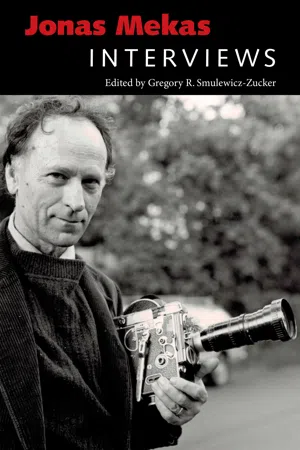
A refugee from post–World War II Europe who immigrated to the US in 1949, Jonas Mekas (1922–2019) became one of America's foremost champions of independent cinema and one of its most innovative filmmakers. An admired poet in his native Lithuania, Mekas began recording his life on film shortly after his arrival in New York. Through his work as the author of the Village Voice's "Movie Journal" column, editor of Film Culture magazine, and founder of Anthology Film Archives and the Film-Makers' Cooperative, Mekas played a vital role in the promotion of avant-garde and independent films. His early films, Guns of the Trees and The Brig, challenged the structure of traditional narrative filmmaking. He is best known for his "diary films," including Walden (Diaries, Notes, and Sketches); Reminiscences of a Journey to Lithuania; and As I Was Moving Ahead Occasionally I Saw Brief Glimpses of Beauty. His films, writings, and the institutions he built have influenced generations of filmmakers, poets, artists, musicians, critics, and scholars.
In Jonas Mekas: Interviews, volume editor Gregory R. Smulewicz-Zucker collects eighteen interviews covering almost sixty years of the filmmaker's career. Mekas discusses his remarkable life as a refugee from Nazi- and Soviet-occupied Lithuania, his role as one of the major figures in the development of the American avant-garde, and his thoughts about his own work. In conversation with scholars, journalists, and other prominent artists, Mekas speaks of his passion for artistic expression and uncompromising vision for a liberated cinema. These interviews preserve Mekas's voice so that it might speak to future generations of artists and intellectuals.
- 232 pages
- English
- ePUB (mobile friendly)
- Available on iOS & Android
eBook - ePub
About this book
Information
Interview with Jonas Mekas
From October, Summer 1984, 82–116; edited for A Critical Cinema 2 (Berkeley: University of California Press, 1992), 77–108. Reprinted by permission.
This interview was recorded in two sessions in December 1982 and January 1983. It was transcribed and edited the following summer and fall. Early in 1984 Mekas checked it for accuracy, and I made final revisions.
From the beginning, my goal was to talk to Mekas about his own films, rather than about his well-known activities as an organizer and polemicist for the New American Cinema.
Scott MacDonald: Though Lost Lost Lost wasn’t finished until 1975, it has the earliest footage I’ve seen in any of your films.
Jonas Mekas: The earliest footage in that film comes from late 1949. Lost Lost Lost was edited in 1975 because I couldn’t deal with it until then. I couldn’t figure out how to edit the early footage.
SM: When you were recording that material, were you just putting it onto reels and storing it?
JM: I had prepared a short film from that footage in late 1950. It was about twenty minutes long, and it was called Grand Street. It’s one of the main streets in Williamsburg, Brooklyn, populated mainly by immigrants, where we spent a lot of time. Around 1960 I took that film apart. It doesn’t exist anymore. Otherwise, I didn’t do anything with that footage. Occasionally I looked at it, thinking how I would edit it. I could not make up my mind what to eliminate and what to leave in. But in 1975 it was much easier.
SM: Is that opening passage in Lost Lost Lost, where you and Adolfas are fooling around with the Bolex, really your first experience with a camera?
JM: What you see there is our very first footage, shot on Lorimer Street, in Williamsburg, Brooklyn.
SM: Were you involved at all with film before you got to this country?
JM: The end of the war found us in Germany. Two shabby, naive Lithuanian boys, just out of forced labor camp. We spent four years in various displaced persons camps—Flensburg, Hamburg, Wiesbaden, Kassel, etc.—first in the British zone, then in the American zone. There was nothing to do and a lot of time. What we could do was read, write, and go to movies. Movies were shown in the camps free, by the American army. Whatever money we could get we spent on books, or we went into town and saw the postwar German productions. Later, when we went to study at the University of Mainz, which was in the French zone—we commuted from Wiesbaden—we saw a lot of French films.
The movies that really got us interested in film were not the French productions, but the postwar, neorealistic German films. They are not known here—films by Käutner, Josef V. Baky, Liebeneiner, and others. The only way they could make films after the war in Germany was by shooting on actual locations. The war had ended, but the realities were still all around. Though the stories were fictional and melodramatic, their visual texture was drab reality, the same as in the postwar Italian films.
Then we started reading the literature on film, and we began writing scripts. What caused us to write our first script was a film—I do not remember the title or who made it, but it was about displaced persons. We thought it was so melodramatic and had so little understanding of what life in postwar Europe was like that we got very mad and decided we should make a film. My brother wrote a script. Nothing ever was done with it. We had no means, we had no contacts, we were two zeroes.
SM: When you were first starting to shoot here did you feel that you were primarily a recorder of displaced persons and their struggle, or were you already thinking about becoming a filmmaker of another sort?
JM: The very first script that we wrote when we arrived in late 1949, and which was called Lost Lost Lost Lost (i.e., four Losts as opposed to the three of the 1975 version), was for a documentary on the life of displaced persons here. We wanted to bring some facts to people’s attention. It did not have to do so much with the fact that we were displaced persons, or that there were displaced persons. It had more to do with the fact that the Baltic republics—Estonia, Latvia, Lithuania—were sacrificed by the West to the Soviet Union at Yalta just before the end of the war and ended up as occupied countries to which we could not return. We were taking a stand for the three Baltic countries that the West had betrayed. Our script was an angry outcry. It was our first English script. We sent it to Flaherty, thinking he could help us produce it, but he wrote back that though he liked the script and found it full of passion, he could not help us. This was at a time when he couldn’t find money to produce even his own films.
We did start shooting nevertheless. Actually, two or three shots at the beginning of Lost Lost Lost are from the original footage we shot for that film. A slowmotion shot of a soldier (actually, Adolfas) and one or two others (a family reading a newspaper, a skating rink, a tree in Central Park) were meant for that film. But my brother was drafted and so we abandoned the project. When he came back from the army a year or so later, things had changed.
SM: During all the intervening time you were recording other material?
JM: Yes, I was collecting, documenting, without a clear plan or purpose, the activities of displaced persons—mainly Lithuanians. I shot footage of New York immigrant communities, and I did some weekend traveling to record communities in Chicago, Toronto, Philadelphia, Boston. I worked in Brooklyn factories and spent all my money on film.
SM: A lot of the footage that ended up in the first reel of Lost Lost Lost is compositionally and texturally very beautiful. When you were shooting originally, were you thinking about the camera as a potential poetic instrument?
JM: The intention was to capture the situations very directly, with the simple means that we had at our disposal. All the indoor footage was taken with just one or two flood lamps. We made no attempt to light the “scenes” “correctly” or “artistically.” Sometimes we were at meetings actually, most of the time—where we couldn’t interfere, or we were too shy to interfere.
During the first weeks after our arrival here, we had read Pudovkin and Eisenstein, so in the back of our minds there was probably something else, a different ambition, but I don’t think that that footage reveals much. In Germany we had bought a still camera and had taken a lot of stills. Maybe that affected how we saw and the look of some of the footage. We also looked at a lot of still photography. In 1953 or so I began working at a place called Graphic Studios, a commercial photography studio, where I stayed for five or six years. The studio was run by Lenard Perskie, from whom I learned a great deal. All the great photographers used to drop in, and some artists, like Archipenko.
In 1950 we began attending Cinema 16 screenings. By this I mean absolutely every screening of the so-called experimental films. We also attended every screening of the Theodore Huff Society, which was run at that time by the young Bill Everson. He showed mostly early Hollywood and European films which were unavailable commercially. I think it’s still going on, but I haven’t been there for years. It’s one of the noble, dedicated undertakings—a University of Cinema—of William Everson, who has performed a great educational role for nearly three decades.
SM: I asked the question about your using the camera as a poetic device because by the second reel there are shots in which it’s clear that more is happening than documentation. I’m thinking of the beautiful sequence of the woman pruning trees, and the shot of Adolfas in front of the merry-go-round.
JM: That shot of Adolfas was intended for our first “poetic” film. It had a title: A Silent Journey. We never finished it, and some of the footage appears in reel three of Lost Lost Lost—the film within the film about the car crash.
SM: Were you collecting sound at this time too?
JM: We were collecting sound, but between 1950 and 1955 this amounted to very little. After 1955 I collected more and more sounds from the situations I filmed.
SM: The early reels are punctuated by images of typed pages. Were you writing a record of your feelings during that time?
JM: Those pages are from my written diaries which I kept regularly between the time I left Lithuania (1944) until maybe 1960. Later I got too involved in other activities—the Film-Makers’ Cooperative, Film Culture, the Cinematheque, etc.—and the written diaries become more and more infrequent.
SM: Did you know English when you arrived here?
JM: I could read. I remember reading Hemingway’s A Farewell to Arms on the boat as we came over. Hemingway is one of the easiest writers to read because of the simplicity and directness of his language. He is still one of my favorite writers. So I could read and communicate, but writing took another few years. To write in an acquired language is more difficult than to read, as you know, and I am still learning. Until the mid-fifties I kept all my notes in Lithuanian. For another two to three years there is a slow dissolve: on some days my notes were taken in Lithuanian and on other days I wrote in English. By 1957 all the diaries and notes are in English.
My poetry remains in Lithuanian. I have tried—mostly fooling around—to write “poetry” in English, but I do not believe that one can write poetry in any language but the one in which one grew up as a child. One can never master all the nuances of words and groupings of words that are necessary for poetry. Certain kinds of prose can be written, though, as Nabokov has shown.
SM: Conrad’s prose often has the suggestiveness and density of poetry.
JM: Conrad was much younger when he left his home and he was immediately cut off from all the other Poles. I think it helped very much that he had all those years on the ship. My brother mastered English much faster than I because he found himself in the army with no Lithuanians around. Of course, I am not talking about our accents. The Eastern European pronunciation requires a completely different mouth muscle structure than that of the English language. And it takes a lot of time for the mouth muscles to rearrange themselves.
SM: When you came to put Lost Lost Lost together in its present form, did you then go back to the journals and film pages with that film in mind or had those pages been filmed much earlier?
JM: I filmed the pages during the editing. When I felt that some aspect of that period was missing from the images, I would go through the audio tapes and the written diaries. They often contained what my footage did not.
Also, as it developed into its final form, Lost Lost Lost became autobiographical: I became the center. The immigrant community is there, but it’s shown through my eyes. Not unconsciously, but consciously, formally. When I originally filmed that footage, I did not make myself the center. I tried to film in a way that would make the community central. I thought of myself only as the recording eye. My attitude was still that of an old-fashioned documentary filmmaker of the forties or fifties and so I purposely kept the personal element out as much as I could. By the time of the editing, in 1975, however, I was preoccupied by the autobiographical. The written diaries allowed me to add a personal dimension to an otherwise routine, documentary recording.
SM: Your detachment from the Lithuanian community in reels one and two seems to go beyond the documentarian’s “objective” stance.
JM: I was already detached from the Lithuanian community—not from Lithuania, but from the immigrant community, which had written us off probably as early as 1948 or even earlier, when we were still in Germany, in the DP camps. The nationalists—there were many military people among the displaced persons—thought that we were communists and that we should be thrown out of the displaced persons camp. The main reason for that, I think, was that we always hated the army. We were very antimilitaristic. We always laughed and made jokes about the military. Another thing that seemed to separate us from the Lithuanian community was that we did not follow the accepted literary styles of that time. We were publishing a literary magazine in Lithuanian, which was, as far as they were concerned, an extreme, modernist manifestation. So we were outcasts; we were not in the mainstream of the Lithuanian community. That was one of the reasons why we moved out of Brooklyn into Manhattan. I was recording the Lithuanian community, but I was already seeing it as an outsider. I was still sympathetic to its plight, but my strongest interests already were film and literature. We’d finish our work in a factory in Long Island City at 5:00 p.m. and without washing our faces, we’d rush to the subway to catch the 5:30 screening at the Museum of Modern Art. To the other Lithuanians we were totally crazy.
SM: You begin Lost Lost Lost with your buying the camera, which does end up recording the Lithuanian community, but the camera is also suggestive of an interest which has come between you and that community.
JM: Yes, recording the community was part of mastering new tools. It was practice. If one has a camera and wants to master it, then one begins to film in the street or in the apartment. We figured, if we were going to film the streets, why not collect some useful material about the lives of the Lithuanian immigrants. We had several scripts that called for documentary material. One of them require...
Table of contents
- Cover
- Title Page
- Copyright
- Contents
- Introduction
- Chronology
- Filmography
- An Interview with Jonas Mekas
- Jonas Mekas at Massachusetts Institute of Technology
- Jonas Mekas at Findlay College
- An Interview with Jonas Mekas
- Jonas Mekas Answers Questions after the Screening of Reminiscences of a Journey to Lithuania
- Jonas Mekas Interview
- Tenants of the House: A Conversation with Jonas Mekas
- Interview with Jonas Mekas
- Just like a Shadow
- Conversation between Jonas Mekas and Stan Brakhage
- Jonas Mekas in Conversation
- “Fragments of Paradise …”: A Conversation with Jonas Mekas
- Short Films from a Long Life
- Keep Dancing, Keep Singing
- Remains of the Day
- I Am Still a Farmer: A Discussion with Jonas Mekas
- Jonas Mekas
- A Conversation between Film Legend Jonas Mekas and Director Jim Jarmusch
- About the Editor
Trusted by 375,005 students
Access to over 1.5 million titles for a fair monthly price.
Study more efficiently using our study tools.
Frequently asked questions
Yes, you can cancel anytime from the Subscription tab in your account settings on the Perlego website. Your subscription will stay active until the end of your current billing period. Learn how to cancel your subscription
No, books cannot be downloaded as external files, such as PDFs, for use outside of Perlego. However, you can download books within the Perlego app for offline reading on mobile or tablet. Learn how to download books offline
Perlego offers two plans: Essential and Complete
- Essential is ideal for learners and professionals who enjoy exploring a wide range of subjects. Access the Essential Library with 800,000+ trusted titles and best-sellers across business, personal growth, and the humanities. Includes unlimited reading time and Standard Read Aloud voice.
- Complete: Perfect for advanced learners and researchers needing full, unrestricted access. Unlock 1.5M+ books across hundreds of subjects, including academic and specialized titles. The Complete Plan also includes advanced features like Premium Read Aloud and Research Assistant.
We are an online textbook subscription service, where you can get access to an entire online library for less than the price of a single book per month. With over 1.5 million books across 990+ topics, we’ve got you covered! Learn about our mission
Look out for the read-aloud symbol on your next book to see if you can listen to it. The read-aloud tool reads text aloud for you, highlighting the text as it is being read. You can pause it, speed it up and slow it down. Learn more about Read Aloud
Yes! You can use the Perlego app on both iOS and Android devices to read anytime, anywhere — even offline. Perfect for commutes or when you’re on the go.
Please note we cannot support devices running on iOS 13 and Android 7 or earlier. Learn more about using the app
Please note we cannot support devices running on iOS 13 and Android 7 or earlier. Learn more about using the app
Yes, you can access Jonas Mekas by Gregory R. Smulewicz-Zucker in PDF and/or ePUB format, as well as other popular books in Medios de comunicación y artes escénicas & Películas y vídeos. We have over 1.5 million books available in our catalogue for you to explore.