A hand-drawn guide to architectural styles throughout history
Architectural Styles is an incomparable guide to architectural styles across the centuries and around the world. Modeled after an architect's plein air sketchbook, the volume features hundreds of detailed drawings by esteemed architectural illustrator Robbie Polley alongside incisive and informative descriptions. This unique guidebook takes readers from Europe and the Americas to Egypt, China, and India. It covers a host of historical and contemporary architectural styles, from ancient and classical to Pre-Columbian, Romanesque, Renaissance, Palladian, art nouveau, Brutalist, and biomorphic. It describes the histories and characteristics of the building traditions of each era and region of the world, and looks at key architectural elements such as buttresses, spandrels, curtain walls, and oculi. The book also includes a section on building parts—from domes and columns to towers, arches, roofs, and vaulting—along with a detailed glossary and bibliography.
Comprehensive and authoritative, Architectural Styles is an essential resource for architects and designers and a must-have illustrated guide for anyone interested in architecture or drawing.
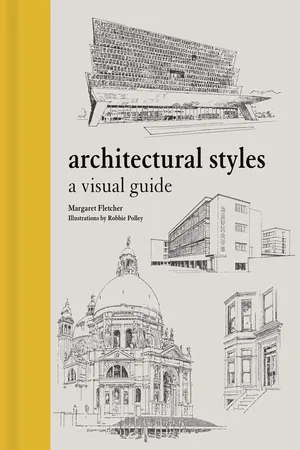
- 288 pages
- English
- ePUB (mobile friendly)
- Available on iOS & Android
eBook - ePub
About this book
Information
Topic
ArquitecturaSubtopic
Arquitectura general1
ANCIENT AND CLASSICAL
ANCIENT MIDDLE EAST
CIRCA 5300 BCE TO 650 CE
The primary building material of the Ancient Middle East was the mud brick. Typically consisting of mud, sand, loam, water, and a binder such as straw, these bricks were either air-dried or fired in a kiln to increase their durability. Glazing techniques for bricks and tiles further increased durability and also allowed for additional ornamental advancements. The everyday homes of this era are no longer in existence, but what remain are the impressive ruins of palaces and temples associated with power and religion. Sculptors were highly skilled in depicting animal battles and grand beasts, surely intended to demonstrate the power of the kings. As such, relief-carved surfaces of brick became an important element of architectural decoration.
Ancient Middle East key features:
- mud brick
- tile
- relief sculpture
- animal and human form in sculpture
- load-bearing construction
- ziggurat

Taq Kasra, Arch of Ctesiphon, Ctesiphon, Iraq, third to sixth centuries CE.
Built as part of an imperial complex, this is the largest brick catenary arch in the world. Constructed without a centering device or scaffolding, it was built by slanting the walls, brick layer by brick layer, until they met at the top.
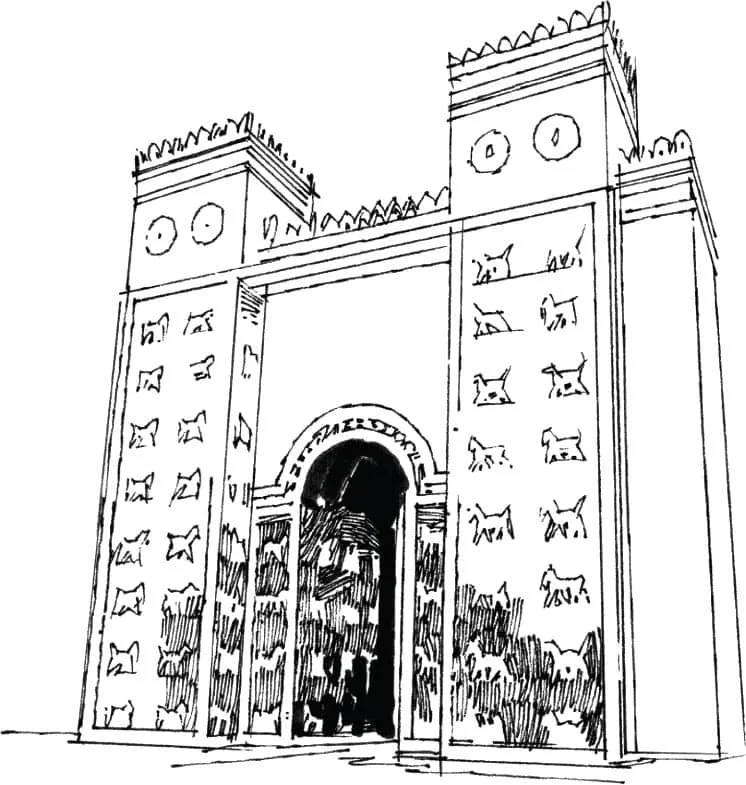
Ishtar Gate, Babylon, Iraq, 575 BCE.
Built as the main gate to the city of Babylon, the Ishtar Gate was dedicated to the Babylonian goddess Ishtar. It was part of a processional way over half a mile long with tall walls—50 feet—on each side. The gate itself is made with bricks, most of which are glazed in blue.

Ziggurat of Ur, Muqayyar, Iraq, twenty-first century BCE.
Oriented to true north, this stepped ziggurat has three levels of terraces, with three monumental staircases leading up to a gate on the first level. Constructed with large mud bricks, each level is supported by the one directly beneath. The temple at the top of the ziggurat did not survive, but the lower parts still exist and give evidence of construction and engineering methods.
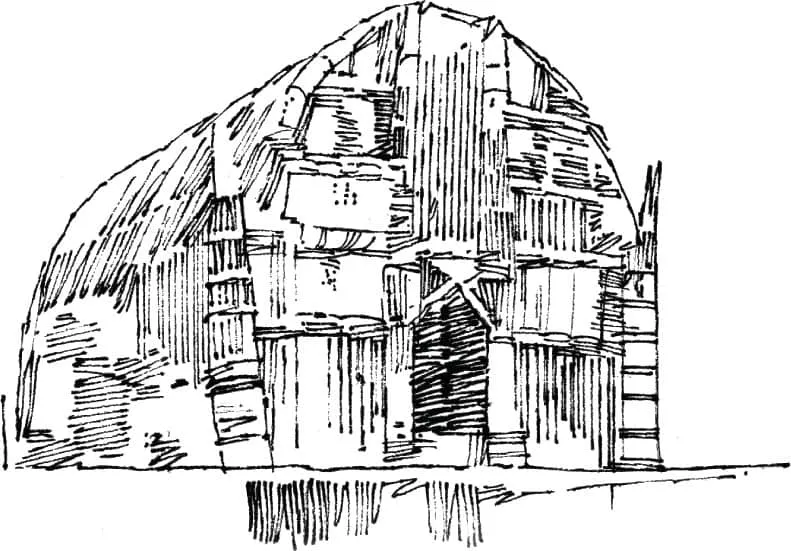
Mudhif House, Iraq, circa 3300 BCE.
This typical Madan structure used for community gatherings is located in the swamps of southern Iraq and made from local reeds. The reeds were bundled into structural arches and arrayed across the space, with horizontal bundles acting as ties to the overall weaving of the exterior reed covering.

Naqsh-e Rostam Necropolis, Fars Province, Iran, sixth to fourth centuries BCE.
The ancient necropolis is of the Achaemenid Dynasty and houses four tombs carved into caves high up on the stone cliffs. Only one of the tombs, for Darius the Great, is identifiable through an inscription.
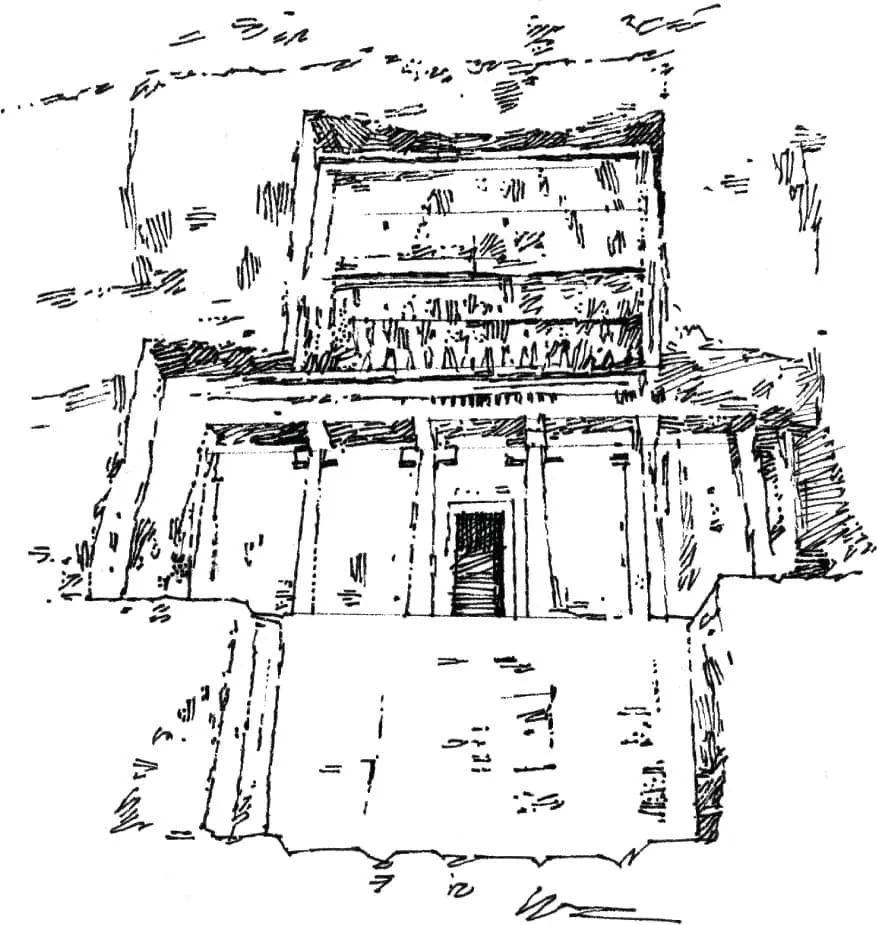
Tomb of Darius the Great, Naqsh-e Rostam, Iran, 485 BCE.
One of the four tombs of kings of the Achaemenid Empire, the monumental Tomb of Darius the Great is carved into a cliff. The tomb is in the shape of a cross, with an opening at the center that leads to a small chamber where the king was buried.
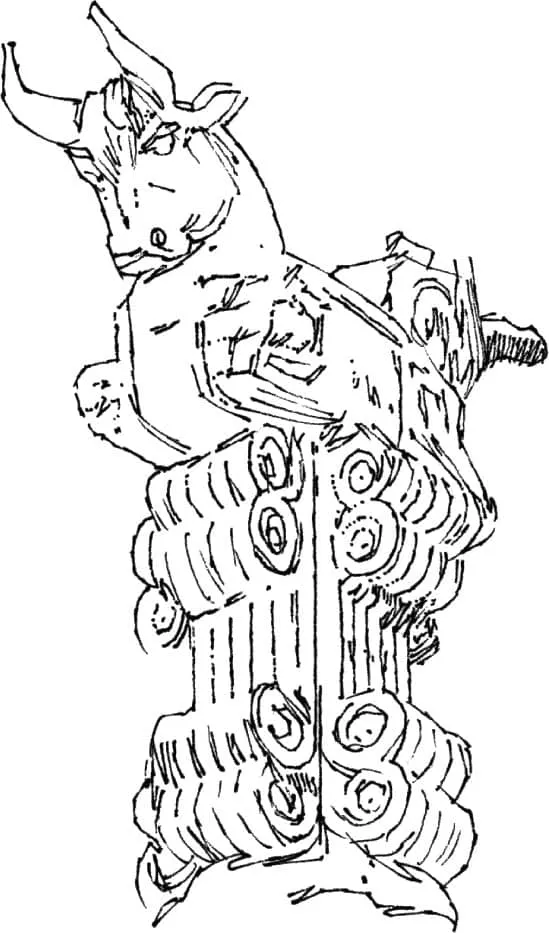
Persian Column, Persepolis, Iran, 550–330 BCE.
This example of a Persian column is from the ancient city of Persepolis, the ceremonial capital of the Achaemenid Empire. The city had at least five palaces, and many of the structures were located upon a great plinth. This typical column capital was likely part of the Apadana, a large hypostyle hall.
ANCIENT EGYPT
CIRCA 3000 TO 30 BCE
The buildings of Ancient Egypt were primarily associated with life, death, and the celebration of the gods. The ruins of temples and tombs reveal that the architecture of Ancient Egypt did not follow a specific style, but rather used building practices of different types with associated features. The two most prominent building systems used were load-bearing and post-and-lintel structures. The load-bearing structures, built from uniform bricks and cut stone block, were massive in size and wall thickness, with sloping walls spreading wider at the base to support their weight and height. Post-and-lintel construction consisted of horizontal elements, in this case stone, bridging the gap between vertical members, columns. Columns were made of stacked stone, carv...
Table of contents
- Cover
- Title Page
- Contents
- Introduction
- 1 Ancient and Classical
- 2 Medieval and Renaissance
- 3 Baroque to Art Nouveau
- 4 Modern and Contemporary
- 5 Elements
- Glossary
- Index
- About the Author
- Copyright
Trusted by 375,005 students
Access to over 1.5 million titles for a fair monthly price.
Study more efficiently using our study tools.
Frequently asked questions
Yes, you can cancel anytime from the Subscription tab in your account settings on the Perlego website. Your subscription will stay active until the end of your current billing period. Learn how to cancel your subscription
No, books cannot be downloaded as external files, such as PDFs, for use outside of Perlego. However, you can download books within the Perlego app for offline reading on mobile or tablet. Learn how to download books offline
Perlego offers two plans: Essential and Complete
- Essential is ideal for learners and professionals who enjoy exploring a wide range of subjects. Access the Essential Library with 800,000+ trusted titles and best-sellers across business, personal growth, and the humanities. Includes unlimited reading time and Standard Read Aloud voice.
- Complete: Perfect for advanced learners and researchers needing full, unrestricted access. Unlock 1.5M+ books across hundreds of subjects, including academic and specialized titles. The Complete Plan also includes advanced features like Premium Read Aloud and Research Assistant.
We are an online textbook subscription service, where you can get access to an entire online library for less than the price of a single book per month. With over 1.5 million books across 990+ topics, we’ve got you covered! Learn about our mission
Look out for the read-aloud symbol on your next book to see if you can listen to it. The read-aloud tool reads text aloud for you, highlighting the text as it is being read. You can pause it, speed it up and slow it down. Learn more about Read Aloud
Yes! You can use the Perlego app on both iOS and Android devices to read anytime, anywhere — even offline. Perfect for commutes or when you’re on the go.
Please note we cannot support devices running on iOS 13 and Android 7 or earlier. Learn more about using the app
Please note we cannot support devices running on iOS 13 and Android 7 or earlier. Learn more about using the app
Yes, you can access Architectural Styles by Margaret Fletcher,Robbie Polley in PDF and/or ePUB format, as well as other popular books in Arquitectura & Arquitectura general. We have over 1.5 million books available in our catalogue for you to explore.