- 328 pages
- English
- ePUB (mobile friendly)
- Available on iOS & Android
eBook - ePub
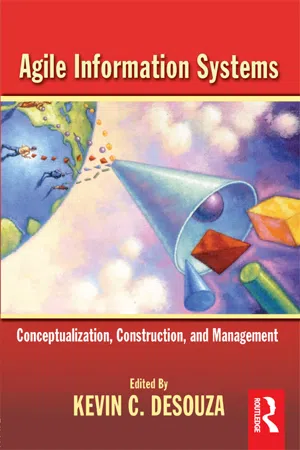
Agile Information Systems
About this book
This book presents cutting-edge research and thinking on agile information systems. The concept of agile information systems has gained strength over the last 3 years, coming into the MIS world from manufacturing, where agile manufacturing systems has been an important concept for several years now. The idea of agility is powerful: with competition so fierce today and the speed of business so fast, a company's ability to move with their customers and support constant changing business needs is more important than ever. Agile information systems:
• have the ability to add, remove, modify, or extend functionalities with minimal penalties in terms of time, cost, and effort
• have the ability to process information in a flexible manner
• have the ability to accommodate and adjust to the changing needs of the end-users.
This is the first book to bring together academic experts, researchers, and practitioners to discuss how companies can create and deploy agile information systems. Contributors are well-regarded academics known to be on the cutting-edge of their fields.
The Editor, Kevin Desouza, has organized the chapters under three categories:
• discussion of the concept of agile information systems (i.e. defining agile information management, its attributes, antecedents, consequences, etc.)
• discussion of information systems within the context of agility (i.e., descriptions of agile information systems and their attributes, how to build agile information systems, etc.)
• discussion of organizational management issues in the context of agile information systems (i.e., how to prepare the organization for agile information systems, management of agile information systems for improved organizational performance, etc.)
1 Strategizing for Agility: Confronting Information Systems Inflexibility in Dynamic Environments1
Over the relatively short history of Information Systems (IS) planning and strategy,2 a major principle that has been taken as axiomatic in the mainstream literature relates to the concept of alignment. In this context, this often means that Information and Communication Technology (ICT) systems should somehow align with an organization’s business strategy. This is surely a “self-evident truth.” When we come to examine this truth, however, we begin to uncover a number of problems and issues that need to be addressed. One such relates to the dynamic nature of an organization’s business environment and the consequent need for flexible—or agile—IS. A second issue relates to our inability to foresee the future and the changing business information requirements that will come with it. A third issue relates to the role that information can play in informing agile responses to changing circumstances and imperatives—a proactive, rather than reactive, role for IS.
This chapter aims to make a contribution to this book by addressing these issues and identifying what this means for agile IS strategy, or more appropriately, IS strategizing. Thus, this chapter will take an alternative perspective to the norm. The perspective will focus more on the process of IS strategizing rather than on the outcome of the process—the IS strategy itself. As I hope to demonstrate, benefit is gained from a more inclusive, exploratory, postmodernist approach to the IS strategy process. This perspective can be contrasted with the common view, which is more concerned with exploiting the potential of ICT systems for business gain. I will attempt to synthesize the arguments arising from a consideration of the problems associated with the somewhat mechanistic treatment of alignment found in the mainstream literature by utilizing concepts of architecture and infrastructure (e.g., Star and Ruhleder, 1996), and of knowledge creation and sharing (e.g., Cook and Brown, 1999; von Krogh, et al., 2000) with a view to refining the IS strategizing framework, introduced in Galliers (2004; 2006a). By means of setting a context for the arguments that follow, the chapter begins with a critique of concepts of alignment, competitive advantage, enterprise systems, and knowledge management. The issues discussed above will then be considered, in turn, with the arguments being synthesized into a revised IS strategizing framework—a framework aimed at strategizing for agile IS.
Alignment, Competitive Advantage, Enterprise Systems, and Knowledge Management: A Critique
As indicated above, a key aspect of IS strategy theory and practice over the years has been the concept of alignment. This concept has had a number of different forms and interpretations. For example, some thirty years ago, McLean and Soden (1977) compared the theoretical need for a “strong link” between an organization’s business and IS plans with its then current practice. They found this link in a minority of cases in their U.S. study. Earl (1983) reported a similar result in the UK. Building on this early work, Earl (1989) introduced the important conceptual distinction between an Information Systems (IS) strategy and an Information Technology (IT) strategy. He argued that the IS strategy is concerned with identifying the information needed to support the business and the information services that need to be provided. Thus, the IS strategy is demand-oriented. Conversely, Earl depicted the IT strategy as being supply-oriented since it focuses on what is and could be made available in terms of IT infrastructure, applications, and services. His argument was that IS and IT strategies should be aligned. Other proponents of alignment include, for example, Parker, et al. (1988), MacDonald (1991), Baets (1992), Henderson and Venkatraman (1992), and Peppard and Ward (2004). These different alignment perspectives make a telling point: What is being aligned with what? The above examples from the literature refer to alignment between the business and IT strategies, between IS and IT strategies, between business performance and IT acquisitions, between an organization’s internal and external environments, and between IS capability and organizational performance.
While the alignment concept may be intuitively appealing, an issue that has remained relatively unchallenged and unquestioned3 is how to align a relatively fixed ICT that is implemented in an organization with a business strategy and associated information requirements that are in constant need of adjustment, while keeping in line with the dynamic nature of the organization’s business imperatives. In other words, the issue is how to make IS agile. Despite the useful distinction made between IS and IT strategies, Earl’s (1989) model, for example, is relatively static and does not account adequately for the changing information requirements of organizations in line with a changing business strategy. While a subset of these information requirements undoubtedly remain relatively constant over time, the dynamic nature of the competitive, collaborative, and regulatory environments in which organizations conduct their business dictates the need for constant and careful attention to this ever-changing nature of information need. In addition, as I have pointed out elsewhere (Galliers, 1991; 1993; 1999), information is needed to question whether an existing strategy continues to remain appropriate, given the changing environmental context, or external considerations, and the lessons learned from the unintended consequences of actions taken and IT systems implemented (Robey and Boudreau, 1999), which are classified as internal considerations.
This issue leads to the conclusion that information itself may usefully be perceived as a medium through which alignment might take place, with necessary information being provided “top-down” in support of the business strategy and “bottom-up” in terms of learning from on-the-ground realities associated with the use made and impact of existing systems and platforms. Indeed, this is implied by Earl’s (1989) model. Alignment between the internal and external environments is an additional dimension to be incorporated into the alignment debate, as noted above. Here, an “inside-out” perspective would also need to be taken. It should be noted, however, that from the perspective of information as the alignment medium, the focus in practice and in the mainstream literature has been on getting the most out of such artifacts as IT and the strategic plan, for bottom-line business benefit. There are, however, those whose approach is more focused on exploration rather than exploitation (cf. March 1991). The former approach has been identified as coming from the processual school (e.g., Whittington, 1993) and is more concerned with the process of strategizing than with the resultant strategy itself.
This brings us to the issue of emergence—a topic of debate in the business strategy literature for the past twenty years or so (e.g., Mintzberg and Waters, 1985). In practice, IS strategy approaches tend to be based on a rational analysis of need, either in response to an extant business strategy and/or an analysis of current ICT capability, or in a proactive manner, based on a “clean slate” approach. The latter was at the heart of the Business Process Reengineering (BPR) movement, the argument being that revolutionary change would lead to “order of magnitude” business benefits (e.g., Hammer, 1990; Venkatraman, 1991; Davenport, 1993). The BPR approach was essentially to identify and streamline key business processes and customer requirements, and then to identify how ICT might support (and often automate) these processes and requirements. The objective was to improve efficiency and effectiveness, and cut costs. The downside to BPR, which is often glossed over, was that it involved quite some risk (Galliers, 1997) and often led to what was euphemistically called “downsizing,” with many middle managers being “let go.” This had a consequent, unintended (cf. Robey and Boudreau, 1999), and deleterious effect on organizational memory and available expertise (Davenport, 1996; Galliers and Swan, 1999).
What is perhaps both surprising and disappointing about the faddishness of much of the literature on IS strategy is that many key lessons were soon forgotten as new technologies or movements emerged. Thus, for example, Leavitt’s (1965) argument that organizations could usefully be viewed as complex socio-technical systems comprising four elements (objectives, structure, technology, and people) seems to have become lost in the excitement, the zeitgeist, if you will. Even one of the founding fathers of the BPR movement proclaimed that it had become “the fad that forgot people” (Davenport, 1996).
The focus in the age of BPR was primarily on ICT and processes, and in the age of Enterprise Systems, it appears to be primarily on a technological architecture that actually dictates how processes should be undertaken. The formal and informal roles that people play in organizations—the role of informal information (Land, 1982)—and the role of knowledge sharing between people and projects (Newell, et al., 2003) have become sidelined.
In some respects, recent developments in ICT, such as Enterprise Systems, have had a negative impact on agility and sustained competitiveness rather than the positive impact most often expounded in the mainstream literature. Companies that have attempted to utilize ICT to increase efficiency and reduce costs may have lost agility in the process. Companies adopting this approach run the risk of reducing their effectiveness, dexterity, and innovative capacity. Unless they can develop the ambidexterity of which Tushman and O’Reilly (1996) speak, they face the common dilemma of gaining efficiency at the expense of innovation (March, 1991). They also run the risk of losing their capacity for organizational learning.
Enterprise Systems are often promoted as a means of transferring “best-practice” knowledge. An Enterprise System’s built-in processes require the adopting organization to adapt its existing processes to the exigencies of the software. The argument is that, since these built-in processes are based on best-practice industry standards, the organization concerned will automatically benefit as a result. However, vendors of Enterprise Systems make much of the consultancy services they offer during and after implementation. Presumably, these services are provided in order for the best-practice solution to become “better,” and the off-the-shelf solution to be customized. Research undertaken by Wagner (Scott and Wagner, 2003; Wagner and Newell, 2004) demonstrates how these so-called best practices have to be molded and adapted to the realpolitik of organizations, despite the services of the vendor. In addition, and in relation to the earlier discussion on alignment, Enterprise Systems are often implemented to replace legacy systems, which presumably have drifted out of alignment to become legacy systems in their own right over time.
Moreover, by advocating the copying of best practices to improve efficiency, organizations are potentially running the risk of reducing their ability to create the new knowledge needed to innovate and respond creatively to changing imperatives. Given that this is a key concern of business strategy, and that knowledge management systems (KMS) are meant to support and inform the process of strategizing, it appears that we may have another problem. ICT such as Enterprise Systems can then be seen as a force for standardization, thus speeding competitive convergence, given that the technology is more or less common—and increasingly commoditized—irrespective of the organization implementing it.
But what of innovation and serendipity? As indicated above, there is a school of thought that argues for the emergent nature of strategic processes. In the field of IS, Ciborra used terms such as bricolage (after Lévi-Strauss, 1966), drift, and tinkering (Ciborra, 1992; 2000; 2002) to propose a more incremental, ad hoc approach to strategizing. He argued that even in situations in which a strategic advantage had been gained from the astute application of ICT, the resultant gain was by no means always expected and in no way preordained. Rather, the organizations concerned had benefited from creating an environment—or infrastructure—in which innovation might emerge. The approach advocated by Ciborra smacks of playfulness. Others see benefit in combining incremental and radical change. The idea of “ambidextrous” organizations, introduced by Tushman and O’Reilly (1996), has already been noted. He and Wong (2004) confirm the utility of this view in an empirical study of more than two hundred manufacturing firms (see also Gibson and Birkinshaw, 2004).
All in all then, the question of alignment is a vexed one. I posed the question, “What is being aligned with what?” There is also the question of “alignment with whom?” Given the advent of inter-organizational systems and the Internet, alignment is also presumably required along the virtual value chain, with such relationships as those with suppliers and customers needing to be a key consideration. Thus, we need to take into account human interaction, rather than almost totally relying on the rational analysis of a reified organizational need or on ICT per se. If we incorporate the emerging field of knowledge management in this discussion, we might consider the need for “boundary-spanning” (Tushman and Scanlan, 1981) and “boundary objects” (Carlile, 2002), understanding and trust (Newell and S...
Table of contents
- Cover
- Halftitle
- Title
- Copyright
- Dedication
- Table of Contents
- Preface
- Acknowledgements
- About the Editor
- About the Contributors
- 1 Strategizing for Agility: Confronting Information Systems Inflexibility in Dynamic Environments
- 2 Agile Information Systems for Agile Decision Making
- 3 The Logic of Knowledge: KM Principles Support Agile Systems
- 4 Producing and Consuming Agility
- 5 Business Agility: Need, Readiness and Alignment with IT Strategies
- 6 Achieving Economic Returns from IS Support for Strategic Flexibility: The Roles of Firm-Specific, Complementary Organizational Culture and Structure
- 7 Balancing Stability and Flexibility: The Case of the California Energy Commission
- 8 Enabling Strategic Agility Through Agile Information Systems: The Roles of Loose Coupling and Web Services Oriented Architecture
- 9 Agile Information Systems as a Double Dream
- 10 Degrees of Agility: Implications for Information Systems Design and Firm Strategy
- 11 Integration Management for Heterogeneous Information Systems
- 12 Investigating the Role of Information Systems in Contributing to the Agility of Modern Supply Chains
- 13 Clumsy Information Systems: A Critical Review of Enterprise Systems
- 14 Enterprise Information Systems and the Preservation of Agility
- 15 Interpretative Flexibility and Hosted ERP Systems
- 16 Agile Drivers, Capabilities and Value: An Over-Arching Assessment Framework for Systems Development
- 17 Vigilant Information Systems: The Western Digital Experience
- 18 Coors Brewing Point of Sale Application Suite: An Agile Development Project
- 19 Organizational Agility with Mobile ICT? The Case of London Black Cab Work
- 20 Co-Evolution and Co-Design of Agile Organizations and Information Systems Through Agent-Based Modeling
- Index
Trusted by 375,005 students
Access to over 1.5 million titles for a fair monthly price.
Study more efficiently using our study tools.
Frequently asked questions
Yes, you can cancel anytime from the Subscription tab in your account settings on the Perlego website. Your subscription will stay active until the end of your current billing period. Learn how to cancel your subscription
No, books cannot be downloaded as external files, such as PDFs, for use outside of Perlego. However, you can download books within the Perlego app for offline reading on mobile or tablet. Learn how to download books offline
Perlego offers two plans: Essential and Complete
- Essential is ideal for learners and professionals who enjoy exploring a wide range of subjects. Access the Essential Library with 800,000+ trusted titles and best-sellers across business, personal growth, and the humanities. Includes unlimited reading time and Standard Read Aloud voice.
- Complete: Perfect for advanced learners and researchers needing full, unrestricted access. Unlock 1.5M+ books across hundreds of subjects, including academic and specialized titles. The Complete Plan also includes advanced features like Premium Read Aloud and Research Assistant.
We are an online textbook subscription service, where you can get access to an entire online library for less than the price of a single book per month. With over 1.5 million books across 990+ topics, we’ve got you covered! Learn about our mission
Look out for the read-aloud symbol on your next book to see if you can listen to it. The read-aloud tool reads text aloud for you, highlighting the text as it is being read. You can pause it, speed it up and slow it down. Learn more about Read Aloud
Yes! You can use the Perlego app on both iOS and Android devices to read anytime, anywhere — even offline. Perfect for commutes or when you’re on the go.
Please note we cannot support devices running on iOS 13 and Android 7 or earlier. Learn more about using the app
Please note we cannot support devices running on iOS 13 and Android 7 or earlier. Learn more about using the app
Yes, you can access Agile Information Systems by Kevin Desouza in PDF and/or ePUB format, as well as other popular books in Business & Business General. We have over 1.5 million books available in our catalogue for you to explore.