![]()
Part I
New political economy
![]()
1 Two themes, three disciplines and five perspectives
INTRODUCTION
This chapter introduces two themes, three disciplines and five perspectives examined in the next fifteen chapters.
THEMES
• organisations in action
• competition between contexts
DISCIPLINES
• organisation and organisation economics
• strategy
• international business
PERSPECTIVES
• modern-positivist
• post-modern
• structuration and symbolic
• realist turn
• neo-modern political economy
The two themes are ‘organisations in action’ and ‘competition between contexts’. These two themes connect the three core disciplines of organisation theory/organisation economics, resource based strategy and international business. The five perspectives being applied to the two themes cross-cut the three disciplines. The examination of the five perspectives commences with the limitations of the modern-positivistic. Then three perspectives offering critiques of the modern-positivist are examined: post-modern, structuration and the realist turn. These offer distinct solutions and open the way to the fifth perspective. The fifth perspective ingests key elements of the post-modern critique and selectively combines the neo-modern, realist turn and structuration with elements of political economy.
‘Organisations in action’ is the title of a seminal and influential account by James Thompson (1967) of the conditions for rationality in organisation theory and the title also suggests a rich mixture of dynamics and politics. As Clegg (1989: 197) observes: ‘Organisational action is an indeterminate outcome of substantive struggles between…people who deploy different resources’. In important respects Thompson’s prepositional theorising was part of the modern perspective. His analysis tended towards the buffering of the firm in a just-incase format and curiously omitted the seminal analysis by Burns and Stalker (1961) of the management of innovation (Clark and Staunton 1989). In Thompson the modernist concept of power is implicated, but its implications are not resolved. Clegg’s account of the everyday frameworks of power points towards forms of theorising that explain dynamics in the metaphor of the political arena. Clegg (1989), unlike Thompson, embraces the stratified reality of societal institutions and draws international comparisons into the conversation.
As a theme, ‘competition between contexts’ goes far beyond the conventional approach to international comparisons in organisational analysis and strategy. Competition between contexts means that if Henry Ford had attempted to finance, design and launch the Ford T in the automobile region of England he would have failed because the configuration of necessary institutional and market features was absent. Likewise, McDonald’s was more probably successful by starting from the USA and California than from continental Europe. Contexts matter. Recently, the analysis of contexts has been the focus of much attention (e.g. complexity theory). In economics the debate over location involving Dunning (1993) and Porter (1990, 1997) provides a useful complement to the massive interest by evolutionary economists (e.g. Metcalfe) in national systems of innovation (e.g. Freeman, Rosenberg, Nelson). Equally, sociological perspectives have implicitly contributed through the new institutional perspectives (e.g. DiMaggio, Powell, Scott, Fligstein) and societal effects (e.g. Sorge). All these studies converge on the theme of competition between contexts.
Coupling the two themes implies that organisations and contexts are in co-evolution and that the sources of stasis or morphogenesis are interactive.
Three disciplines address these two themes. International business extends the previous tightly focused analysis of the immediate context of the firm into a rich analytic description of multiple contexts. If there is competition between contexts then this theme should drive presentations of organisation theory (see Hatch 1997; Thompson and McHugh 1995) and of strategy (see Grant 1990, 1998) because the firm cannot easily be buffered. In fact, the theme of competition between contexts is already taken very seriously by many multinational businesses. The theme of organisations in action deeply impacts upon organisation theory and strategy, yet each tends to approach dynamics and political arenas through ‘time’ rather than temporality.
Perspectives are theoretical-cum-ideological interpretations that transform methodologies into explanatory programmes (Alexander 1995; Archer 1995). Five perspectives are relevant to the two themes and three disciplines. Each of the three disciplines has been impacted by the positivist-modern tendency that dominated the 1950s and 1960s and holds a lingering grip with the intelligent positivists. Modern theories sought universal time-space free solutions to economic and social problems through frameworks that were often technocratic, individual, utopian, linear and rationalistic (Bennis 1966). The critique of positivistic and modern theories was initially led by the post-modern movement. Equally, structuration theory in sociology (e.g. Giddens) and to a lesser extent the action frame of reference in organisational analysis (e.g. Silverman) constructed significant alternatives to positivism and to modern theories. The ‘realist turn’ claims that hidden structures and mechanisms explain patterns of events (e.g. Harre, Bhaskar) and that critical analysis must provide emancipation and alternatives. Thompson and McHugh (1995) demonstrate just how demanding that realist manifesto is for its followers. Finally, I propose that the theoretical-cum-ideological movement currently unfolding combines a neo-Gramscian political economy with elements of neo-modern theorising.
The implication of the discussion of perspectives is that the neo-modern political economy theory-cum-ideological formation transforms the three disciplines and successfully explains the two themes of organisations in action and competition between contexts.
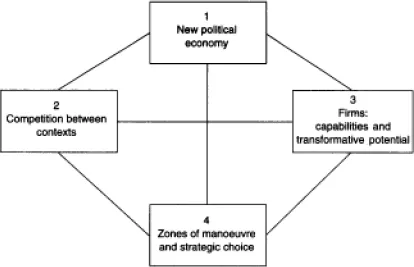
Two themes, three disciplines and five perspectives require some road maps to guide the conversation with the reader. Before coming to the one of these road maps it is worth amplifying the journey being taken from the modern-positivistic through the post-modern, structuration and realist turns into the neo-modern political economy. The next section sketches ten shifts that are taking place as organisation theory moves towards the neo-modern political economy. The section after that sets out the structure of the book as a whole. Meanwhile Figure 1.1 sets out the broad structure of the book. In Part I, Chapters 1 to 5 set out the five perspectives and the contention that neo-modern political economy best characterises the intellectual-cum-ideological configuration relevant to our task. In Part II, Chapters 6 to 10 explore the claim that there is competition between contexts and that the finite zones of manoeuvre in the home base of sectoral clusters often shapes their performance. In Part III, Chapters 11 to 14 explore and reformulate the claims of the resource-based theory of the firm in the light of the previous analysis and of the theme of ‘organisations in action’. Part IV is a single, long chapter combining the finite capacities of the firm and its contexts with an exploration of how management can address the ‘is’, ‘ought’ and ‘can’ statements.
Figure 1.1 Structure of the book: the four areas
MOVING AWAY…TOWARDS?
In contemporary debates and conversations there is a powerful sense of moving away from certain ways of theorising and towards other ways of theorising, describing and explaining the organisation, its context, the experience of work and engaging in a critical search for alternatives (Thompson and McHugh 1995). Reed (1989) contends that the major shift taking place involves travelling away from the notion of organisation theory as a discipline examining order, permanence and techniques in a deterministic framework towards fragmented fields examining the politics of technology, control and change within a voluntaristic, historical pluralism and notions of structuration (Giddens 1984). Reed illustrates the multiple fields by scrutinising five contemporary research programmes: adaptation, order, control, organisation reality and organisational assembly. This chapter introduces ten of the shifts that are unfolding and that indicate the core issues of this book: knowledge and reality; intra-organisational and Americanised background; variables or configurations; pre-existing structuration and agency; realist, neo-contingency and crypto post-modern; time-free or temporality; national characteristics and markets; comparative studies between nations; creative destruction and time-space compression; multiple levels and layers of analysis.
Knowledge and reality
Organisation theory in the positivistic mode is typified by an ontology of reality and knowledge as:
• reality as determinate and knowledge as objective and scientific;
• theories that are universal and free from the specifics of time and place;
• the linearity of time and space theorised by the application of uniform scales;
• history is efficient because the market exits the inefficient firms in frictionless time;
• universities possess a monopoly of knowledge;
• certified experts are politically neutral;
• knowledge is useful and utilised;
• depthless ontologies (Reed 1997)
The movement away is towards a variety of competing and incommensurable points of view. Knowledge in the neo-contingency and realist turn is causal, indeterminate, situated, mediated and contested. The many frameworks, each doing local tasks, are held together by theory, bricolage and analytically structured narratives. The new production of knowledge incorporates structure and agency by asking: what are the mechanisms which create, constitute and sustain particular firms and contexts? How and in what sequence can policy alter these situations?
The new production of knowledge is also outside the university sector (Gibbons et al. 1994). In British science the citation rate for articles now favours corporations rather than the universities. Moreover, the growth in demand for systematic, rich analytic exposition is provided by the growth of specialist firms that intensively investigate particular sectors (e.g. retail) and areas (e.g. Eastern Europe) on a commercial basis. The major accounting consultancies are involved in the production of knowledge. In part this is because of the production of knowledge and feedback through auditing (Power 1994). In Great Britain the accounting firm of Coopers Lybrand was employed by the government during the beef crisis to supply analysis on aspects of bovine spongiform encephalitis and to evaluate the performance of the firms rendering the carcasses.
Intra-organisational focus and Americanised background
Organisation theory is moving away from the separate and narrow analysis of:
• the context of the firm;
• the intra-firm levels.
The majority of attention has been upon the intra-organisational level, even though the emergent design of an appropriate form of work organisation depends upon the characteristics of the context.
The context of the firm has been dealt with very narrowly by examining a few dimensions such as uncertainty, complexity and variability. International aspects were disconnected. Moreover, because so many of the contributors to organisation theory are located in the USA they tended to take it as the undiscussed background (Searle 1995). More recently, international differences have been increasingly acknowledged, but serious cross-national analysis of the contexts is muted by the tendency to impose an equivalence between nations. There is still widespread neglect of political economy and problems of the regimes of regulation for capital (Harvey 1989). The role of the state and of inter-state regulation (e.g. Bretton Woods) is virtually omitted or relegated to a footnote.
The previous split between the firm and the context is slowly being replaced by their joint analysis within an international perspective because the location and context that a firm starts from have strategic consequences.
Variables or configurations
The neo-contingency and new political economy approaches displace the previous preoccupation with the use of a small number of thin, sharply operationalised variables to describe states of affairs and to evaluate their consequences. This narrowness becomes regarded as seductive and dangerous, but variables are not dismissed. Rather, there is an acceptance of the relevance and centrality of rich analytic description and thick analysis (Porter 1991).
Pre-existing structuration and agency
The problem of organisational change and transformation, sometimes referred to as the morphogenesis debate, defines a major theoretical issue (Buckley 1967; Archer 1995). How do we theorise the relationship between pre-existing structuration and ongoing processes in order to explain the reproduction or transformation of the pre-existing? In orthodox organisation theory the theories of the firm presumed that top management and the analyst had a high competence and capacity to transform existing situations. Giddens (1979) refers to this as high discursive penetration. Pragmatic theory making relied on the need-to-know framework so carefully nurtured in the American academy (Clark 1987:280). So, the focus was placed narrowly on controllable, intra-organisation elements such as motivation, leadership, job design and selection.
The problem of agency (voluntarism) and structure (constraining) was proclaimed. Giddens (1979, 1981, 1984) proposes the solution of structuration and this solution has had some impact in organisation studies, accounting, information technology and related areas, but not in strategy or marketing to any degree. As we shall observe, the issue of agency versus structure involves key assumptions about social reality. After the challenge to and eventual displacement of the orthodox position then the problem of aligning the different properties and characteristics of individual and systemic levels became central (see Layder 1997). Structuration as a solution is regarded as incomplete by the realist school of Harre, Bhaskar and Archer (see Chapter 4). The realist, neo-contingency approach treats the explanatory methodology programme as the necessary link between the social ontology and practical theory.
Realist, neo-contingency and crypto post-modern
The realist approach (see Chapter 4) draws attention to the hidden, underlying generative mechanisms and their coupling with chance and emergence. Consequently, the position of agency and voluntarism becomes problematic. It is argued that the thesis of strategic choice (see Child 1972, 1997) becomes problematic because of the influence of pre-existing structural conditions at all levels (Thompson and McHugh 1995). Unintended outcomes are brought to centre stage and redefine the possible role of any design school (Clark 1975a; cf. Mintzberg 1990).
Time-free or temporality
The orthodox approach has been and largely still is towards theories which are universalistic and therefore free from places, events and historical contingency. There has been a continuous invocation of the relevance of an historical dimension to deal with the past and of scenario writing to envisage possible futures. In organisation theory the burden of a temporal perspective has not been in the widespread use of the biological metaphor of the life cycle, especially the life cycle of firms (Daft 1997) rather than the ‘exquisite sense of time’ proposed by Weick (1969).
Since the 1980s there have been numerous, largely individual attempts to develop historical analyses of firms and occasionally of sectors. Perhaps this is most evident in the longitudinal analysis of the reconfiguration of Fordism by flexible accumulation by historical geographers like Harvey (1989). A variety of studies of particular firms and sectors aimed to demonstrate how pre-existing structures and groupings of vested interests shaped the ground upon which specific instances of agency aimed at transformation of the firm were attempted —and failed.
After the post-modern intervention it becomes very difficult to regard the linear dimension as unproblematic. ...