- 384 pages
- English
- ePUB (mobile friendly)
- Available on iOS & Android
eBook - ePub
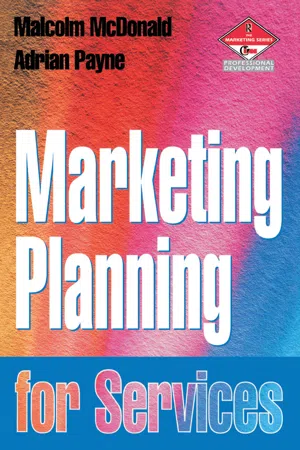
Marketing Planning for Services
About this book
Marketing Planning for Services is the answer to the challenge of creating marketing plans that produce significantly improved bottom-line results. It is written in a pragmatic, action-orientated style and each chapter has examples of marketing planning in practice. The authors highlight key misunderstandings about marketing and the nature of services and relationship marketing.
The marketer is taken step-by-step through the key phases of the marketing planning process and alerted to the barriers that can prevent a service organisation being successful in introducing marketing planning. Practical frameworks and techniques are suggested for undertaking the marketing planning process and implementing the principles covered. The world renowned authors also tackle key organisational aspects relating to marketing planning which can have a profound impact on its ultimate effectiveness. These include: marketing intelligence systems; market research; organisation development stages; marketing orientation. Marketing Planning for Services is for marketers in the service sector and students of marketing.
1 Marketing and services
The growing importance of the service sector
Since the Second World War, Western Europe has seen a steady and unrelenting decline in its traditional manufacturing industries. Their place has been taken by numerous service-based enterprises, who were quick to spot the opportunities created by both organizational needs and by the increased personal affluence and the consequent raised lifestyle expectations of the population.
So successful has been this transition from an essentially industrial society, that today, more than 60 per cent of Western economies are now in the service sector, whether measured in terms of income or numbers employed.
This shift in emphasis has been so pronounced that some observers refer to it as the ‘second industrial revolution’. As individuals spend greater proportions of their income on travel, entertainment and leisure, postal and communication services, restaurants, personal health and grooming and the like, so has the service sector responded by creating businesses and jobs. In addition, the growing complexity of banking, insurance, investment, accountancy and legal services has meant that these areas of activity showed a similar inclination to expand, in terms of their impact on the economy as a whole.
In the UK, government employment statistics (Table 1.1) provide a telling picture of this silent revolution.
Whereas employment in the service sector accounted for roughly 50 per cent of the total workforce in 1968, by 1990 this figure had increased to 70 per cent.
This pattern has been repeated in most of the developed countries, as Table 1.2 shows.
Table 1.1 Total UK employees in employment (thousands)
| Service employees | All others | Total | |
| 1968 | 11 242 | 10 944 | 22186 |
| 1975 | 12 545 | 9 668 | 22213 |
| 1980 | 13 384 | 9 074 | 22458 |
| 1985 | 13 769 | 7 151 | 20920 |
| 1990 | 15 609 | 6 771 | 22380 |
| 1995 | 15 418 | 5 616 | 21034 |
Source: Monthly Digest of Statistics and Employment Gazette, February 1991.
Table 1.2 Civilian employment by sector: international comparison, 1992 (%)
| Services | Industry | Agriculture | |
| UK | 70.7 | 27.1 | 2.3 |
| Australia | 70.1 | 23.8 | 5.2 |
| Austria | 57.4 | 35.6 | 7.1 |
| Belgium | 69.7 | 27.7 | 2.6 |
| Canada | 73.1 | 22.7 | 4.4 |
| Denmark | 67.6 | 27.4 | 5.2 |
| Finland | 63.5 | 27.9 | 8.6 |
| France | 65.8 | 28.8 | 5.2 |
| FR Germany | 58.5 | 38.3 | 3.1 |
| Irish Republic | 57.3 | 28.9 | 13.8 |
| Italy | 59.6 | 32.2 | 8.2 |
| Japan | 59.0 | 34.6 | 6.4 |
| Netherlands | 71.4 | 24.6 | 4.0 |
| Norway | 70.9 | 55.3 | 11.6 |
| Portugal | 55.3 | 33.2 | 11.6 |
| Spain | 55.7 | 32.4 | 10.1 |
| Sweden | 70.1 | 26.5 | 3.3 |
| Switzerland | 60.6 | 33.9 | 5.6 |
| United States | 72.5 | 24.6 | 2.9 |
Source: Monthly Digest of Statistics and Employment Gazette, August 1995.
Although there is a realization that it is essential for a country to have some kind of industrial base, there is little to suggest that this trend towards the service sector is slowing down.
Indeed, the manufacturing industry itself is showing a greater propensity to subcontract out a wide range of activities which at one time were carried out in-house.
For example, outsourcing is increasing in areas such as cleaning, catering, recruitment, deliveries, computer services, advertising,training, market research, and product design. These are all areas where it has been found that external specialists can provide a cost-effective alternative to a company's own staff. More and more companies are choosing to contract out for specialist services and concentrate attention on their core activities.
Service industries and marketing effectiveness
Throughout roughly the same period, business schools and consultancy firms have been emphasizing how important it is for companies to develop a marketing orientation. At first sight this message would appear to have hit home, because today many companies claim to be market-led and customer-focused. However, from our position of working with senior managers and marketing staff from a wide range of companies, we can see that this so-called ‘marketing orientation’ has, for most of them, not been accomplished.
Marketing has not yet stormed the citadels of service organizations
There is more emphasis on rhetoric than transactions. In fact, we estimate that less than one service organization in five has a marketing plan worthy of the name.
One of the major UK banks has recruited hundreds of consumer goods trained marketing personnel, yet still has no observable differential advantage in any of its operations. It is clear that such organizations have confused marketing orientation with selling and promotion. The result is that they have merely succeeded in creating a veneer and a vocabulary of marketing.
Recent research by one of the authors into the marketing effectiveness across a variety of service organizations suggested that many of the companies studied operated well below their potential marketing effectiveness.
With organizations paying only lip-service to being marketing orientated, the results suggest a dramatic need for improvement in marketing effectiveness.
What is clear is that many service companies are misdirecting their energies and resources and thereby are failing to create competitive advantage and capitalize on market opportunities.
The purpose of this book
This book sets out to demonstrate how a service organization can formulate a strategic marketing plan which contributes to the establishmentof competitive advantage. It examines the marketing planning process in some detail and shows how successful companies tackle its difficult elements. Where necessary, relevant marketing theory, techniques, and research results are introduced so that the reader can better understand the implications of taking particular actions at various stages of the process. In addition, it is important to consider the demands a new approach to planning places on the organization.
For marketing planning to take root, not only must new skills be learned, but often new attitudes have to accompany them. Indeed, many of the barriers that hamper the acceptance of marketing planning can be attributed to outmoded or inappropriate organizational behaviour.
The purpose of this opening chapter is briefly to examine the marketing concept and explore to what extent the marketing of services differs from the marketing of products. We will also look at the diverse range of services in terms of establishing some threads of ‘commonality’. In doing this, it makes it possible for the service manager to learn from other companies who may not necessarily be in the same business field.
This chapter will also develop reasons why the service marketer must formulate an enlarged and more sophisticated marketing mix than has traditionally been the case, and why focusing solely on customer markets will not prove to be enough for a guaranteed long-term marketing success.
The marketing concept
Marketing as a source of competitive advantage
The central idea of marketing is to match the organization's capabilities with the needs of customers in order to achieve the objectives of both parties. If this matching process is to be achieved, then the organization has to develop strengths, either from the nature of the services it offers or from the way it exploits these services, in order to provide customer satisfaction.
Since very few companies can be equally competent at providing a service for all types of customers, an essential part of this matching process is to identify those groups of customers whose needs are most compatible with the organization's strengths and future ambitions. It must be recognized that the limitations imposed by an organization's resources, and the unique make-up of its management skills, make it impossible to take advantage of all market opportunities with equal facility. Companies who fail to grasp this fundamental point, which lies at the heart of marketing, are courting commercial disaster.
The matching process is complicated by the ever-changing business environment
This matching process is further complicated in that it takes place in a business environment which is never stable for any length of time. External factors continue to have a major impact on the company's attempts to succeed. For example, new competitors might enter the business, existing ones may develop a better service, government legislation may change and as a result alter the trading conditions, new technology may be developed which weakens their current skills base — the possibilities are almost endless. However, not every external factor will pose a threat. Some environmental developments will undoubtedly provide opportunities.
Figure 1.1 provides a visual summary of the matching process, which is the essence of marketing. As it shows, the environment has an impact not only o...
Table of contents
- Cover
- Marketing Planning for Services
- Full Title
- Copyright
- Contents
- Preface
- The structure of the book and how to use it
- 1 Marketing and services
- 2 Marketing planning for services - the process and the problems
- 3 Marketing planning Phase One - the strategic context
- 4 Marketing planning Phase Two - the situation review
- 5 Marketing planning Phase Three marketing strategy formulation
- 6 Marketing planning Phase Four resource allocation, monitoring and detailed planning
- 7 Organizing for marketing planning
- 8 A step-by-step marketing planning system for services
- Examples of marketing plans
- Glossary of marketing planning terms
- Index
Trusted by 375,005 students
Access to over 1.5 million titles for a fair monthly price.
Study more efficiently using our study tools.
Frequently asked questions
Yes, you can cancel anytime from the Subscription tab in your account settings on the Perlego website. Your subscription will stay active until the end of your current billing period. Learn how to cancel your subscription
No, books cannot be downloaded as external files, such as PDFs, for use outside of Perlego. However, you can download books within the Perlego app for offline reading on mobile or tablet. Learn how to download books offline
Perlego offers two plans: Essential and Complete
- Essential is ideal for learners and professionals who enjoy exploring a wide range of subjects. Access the Essential Library with 800,000+ trusted titles and best-sellers across business, personal growth, and the humanities. Includes unlimited reading time and Standard Read Aloud voice.
- Complete: Perfect for advanced learners and researchers needing full, unrestricted access. Unlock 1.5M+ books across hundreds of subjects, including academic and specialized titles. The Complete Plan also includes advanced features like Premium Read Aloud and Research Assistant.
We are an online textbook subscription service, where you can get access to an entire online library for less than the price of a single book per month. With over 1.5 million books across 990+ topics, we’ve got you covered! Learn about our mission
Look out for the read-aloud symbol on your next book to see if you can listen to it. The read-aloud tool reads text aloud for you, highlighting the text as it is being read. You can pause it, speed it up and slow it down. Learn more about Read Aloud
Yes! You can use the Perlego app on both iOS and Android devices to read anytime, anywhere — even offline. Perfect for commutes or when you’re on the go.
Please note we cannot support devices running on iOS 13 and Android 7 or earlier. Learn more about using the app
Please note we cannot support devices running on iOS 13 and Android 7 or earlier. Learn more about using the app
Yes, you can access Marketing Planning for Services by Adrian Payne,Malcolm McDonald in PDF and/or ePUB format, as well as other popular books in Business & Business General. We have over 1.5 million books available in our catalogue for you to explore.