Playing Bit Parts in Shakespeare is a unique survey of the small supporting roles - such as foils, feeds, attendants and messengers - that feature in Shakespeare's plays. Exploring such issues as how bit players should conduct themselves within a scene, and how blank verse or prose may be spoken to bring out the complexities of character-definition, Playing Bit Parts in Shakespeare brings a wealth of insights to the dynamic of scenic construction in Shakespeare's dramaturgy.
M.M. Mahood explores the different functions of minimal characters, from clearing the stage to epitomizing the overall effect of the comedy or tragedy, and looks at how they can extend the audience's knowledge of the social world of the play. She goes on to describe the entire corpus of minimal roles in a selection of six plays:
* Richard III
* The Tempest
* King Lear
* Antony & Cleopatra
* Measure for Measure
* Julius Caesar
This new edition comes enhanced with a new Appendix, 'Who Says What', especially designed to aid directors in making decisions about the speaking parts of the minimal characters. It also comes complete with an index of characters (including line references) as well as a detailed general index.
An invaluable aid for directors and actors in the rehearsal room, this perceptive and informative volume is equally of interest to students studying and writing about Shakespeare's plays.
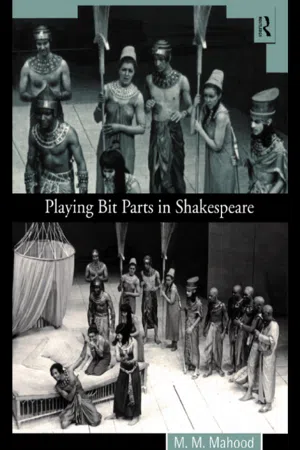
- 296 pages
- English
- ePUB (mobile friendly)
- Available on iOS & Android
eBook - ePub
Playing Bit Parts in Shakespeare
About this book
Information
1 Entities and nonentities
An American veteran of Shakespearean production once took on, in England, the task of directing Henry the Eighth with a cast of eight hundred drawn from the Women’s Institutes. I know exactly how Margaret Webster1 must have felt on the eve of that performance, for I have a cast of about the same size massed for entry into the following pages. Among them are numerous First, Second, and Third Messengers, Citizens, and Soldiers; a host of gardeners and gaolers, knights and heralds, ladies-in-waiting, murderers and mariners; the odd day-woman, haberdasher, poet, vintner, hangman, scrivener, king, cardinal and goddess; John Bates, Tom Snout, George Seacole, Simon Catling, Peter Thump, Neighbour Mugs; and four men who are all called Balthasar. These and many like them have provided me with wonderfully good company over the last few years. But the attempt to muster, within the limits of a book, so multitudinous a company of Shakespeare’s minimal characters does seem to call at the outset for at least some brief justification.
Every reader has come to value moments when Shakespeare brings his vision to bear with laser-like concentration on one or other of these bit parts: the moment when the Porter in Macbeth, say, or Richard the Second’s Groom, takes the centre of our mental stage. But in the act of reading, the mind, like a medieval painter, magnifies some figures and diminishes others, so that the stage presence of minimal characters, and especially of supernumeraries, is only too easy to forget. Indeed, some of them appear to exist on the periphery of Shakespeare’s own imagination. But their attention and responses are still part of a scene’s effect, and cumulatively may be an important part. In The Merchant of Venice, the scene in which Bassanio makes his momentous choice owes much of its spiralling exhilaration to the joy of Portia’s attendants as they realise he is going to open the right casket, as well as to the surprise and delight of his own followers when it proves to contain Portia’s picture. Though the full effect can be experienced only in the theatre, a reader who is alert to these presences can share some of their excitement.
Leonardo is one of these followers. He first appears in the previous act,where he responds to Bassanio’s orders concerning the voyage with a deferential ‘My best endeavours shall be done herein’. Then, Exit Leonardo (2.2.174)—though an encounter on his way out with Gratiano, who is in search of Bassanio, gives him the chance to add ‘Yonder, sir, he walks’.2 It is not a part to raise an actor’s spirits, and this book will have fulfilled one of its purposes if here and there its interpretations are of help to those called upon to play Leonardo and his like. Just how lost and despondent such an actor may feel, even when entrusted with a far more promising role, emerges from a diary kept in the 1960s by a small-part player at Stratford:
Four lines in which to create a character. Confused. Am told at one moment, Reynaldo’s a spy, symptomatic of general unrest in the state of Denmark; at another, he’s old; at another, he’s swift. Again, he’s slow. Am confused. Never mind. All healthy experiment. Nevertheless, producer not pleased—I don’t think.3
The producer was certainly not pleased: he cut out Reynaldo. The actor could tell himself that worse things happen at sea, but Reynaldo’s removal mutilates the play. The same actor fared much better in As You Like It, working with a director who was able to bring home to him the contribution he could make to the comedy’s effects even in a supernumerary role: ‘With nothing to say, one still has a function, or meaning, a place in the play…We provide the texture of the tapestry which throws the principal parts into relief.’4
Clearly the director is the key figure in establishing the nature and the prominence or otherwise of a bit part, and I should be very happy if the heed here paid to ‘unnecessary’ parts in Shakespeare’s plays had the effect of just now and then stopping the directorial blue pencil in mid air. A century or more ago, cuts were for the most part made with an eye to the audience’s endurance and the actors’ payroll. Today’s simpler and more fluid staging has done away with the need to allow time for scene-shifting, while the restored practice of doubling has reduced the need to cut out parts on economic grounds. When, however, John Kemble replaced several of Brutus’s friends in the last part of Julius Caesar with conspirators from the first part, he was not just being economical: he was seeking to bring the tragedy into line with the contemporary notion of a wellconstructed play. Such ‘conceptual cuts’, as they have been called,5 continue to be made, although today they are more likely to reflect the director’s idiosyncratic views than any critical consensus. Admittedly, the director sometimes is following a sound instinct in recognising that a bit part is at variance with the overall character of the play. Hecate in Macbeth is the obvious example, and in her case we have other indications that she was no part of Shakespeare’s intentions. There is no reason to think that the Senators in Cymbeline are non-Shakespearean, but with their air of having wandered in from Coriolanus, of which the original audience perhaps liked to be reminded, they have struck most directors as expendable. Hamlet without Fortinbras is, however, a different story.
If, on the one hand, this study argues the raison d’être of some small roles that are liable to be cut, it also argues for a freedom in handling and distributing bit parts such as Shakespeare bestowed upon the bookkeeper, or himself exercised in instructing the actors, long before the lines of his plays congealed into our modern standard texts. While theatrical critics still cling to the ‘authority’ of such texts, directors have for some time gone behind them to Quartos or Folio. Thus a critic is heard to declare that a certain director has split the Gardener’s assistant in Richard the Second into two; in point of fact the Folio specifies that the Gardener is to have two servants, and the undefined speech heading ‘Ser[vant]’ allows them both to speak, should the director so decide. Critics who in 1962 raised a storm of protest at Peter Brook’s ‘omission’ of the servants’ comments on the blinding of Gloucester based their idea of King Lear on modern conflations of the Quarto and Folio, whereas Brook was exercising the choice that these two texts afford between two versions of the play, and chose to follow what is probably the more mature version. Scholarship and theatrical skills here went hand in hand. The belief that they can and should do so has not, I hope, lulled me into forgetting that an actor who has lived with a bit part through weeks of rehearsal and a director who has devoted months to a play’s realisation must know more, by orders of magnitude, about that part’s theatrical possibilities than can a critic without stage experience. In other words, I have tried in the ensuing discussion to refrain from hints on egg sucking. Though this book at times recalls memorable and original interpretations, it does not presume to say what the actor ought to make of this or that small part. There is audacity enough in its main purpose, which is to try to show what Shakespeare himself made of a fair number of the minimal roles in his plays.
‘Minimal’ can mean very small indeed. The shortest scripted part in the canon is the Second Senator in Cymbeline, who says ‘Ay’. At least the brevity of this appearance allowed the actor to perform more interesting roles elsewhere in the play. His lot was therefore less unhappy than that of the two Lords who, with the voluble Boyet, attend upon the Princess of France and her ladies throughout long stretches of Love’s Labour’s Lost during which they utter in all seven words. Yet sometimes a bit part four words long can be pivotal to a play, as I hope to show happens in King Lear. Even in what may have been his first play, written when Shakespeare was still close to his own bit-part days, a character can spring to life in a single line, as Old Talbot’s servant does with his cry, ‘O my dear lord, lo where your son is borne!’ (Henry the Sixth, Part One 4.7.17).
Smaller parts still are those collective noises of assent or hostility which, like the Lion’s role in Pyramus and Thisbe as first conceived, could be extempore. Sometimes, however, Shakespeare takes advantage of the clarity that cries have on a platform stage (a problem for today’s directors: the more spontaneous a shout, the more anachronistic it is likely to sound) to specify words with a particular dramatic resonance. When the order to cut boughs as camouflage is given to the army of liberation in Macbeth, the soldiers respond with ‘It shall be done’ (5.4.7), and if the cry is taken up diminuendo behind the scenes, as if by company after company, one of the play’s most important key-words reverberates to new effect: what Macbeth has done is at last in some measure to be undone.
The number of words or lines spoken is in any case an unreliable guide to the importance of a bit part. So much can depend on what is said about the character by others and on the non-verbal responses he makes to what is said to him. The build-up of a character through others’ talk was a skill that Shakespeare mastered early in his career. Usually anticipatory, as with Romeo’s description of the Apothecary’s shop, it can also be retrospective, as when Antipholus of Ephesus complains about his treatment at the hands of ‘A needy, hollow-eyed, sharp-looking wretch,/A living dead man’ (Comedy of Errors 5.1.241–2), and so helps to fix in our memory the twelve-line part of Dr Pinch. Bit-part players rightly attach great importance to costume and make-up, knowing that half the impact of their role may be made before they have spoken a word: witness the bleeding Captain’s long stagger downstage in Macbeth 1.2; or, near the end of Love’s Labour’s Lost, the equally long entry of Marcade, whose expression, bearing, and black travelling garb so startlingly contrast with the carnival silks and satins around him:
Marcade I am sorry, madam, for the news I bring Is heavy in my tongue. The King your father—
Princess Dead, for my life!
Marcade Even so: my tale is told. (5.2.718–20)
Even without the advantages of a build-up and a good entry, many actors of Shakespeare’s minimal characters find themselves with a bonus in a part’s inherent opportunities for ‘business’ such as the Executioners’ activity around the brazier in King John. In Richard the Second 2.2, York’s servant has a few unremarkable lines as a gentle bearer of bad news, but everyone remembers his bewilderment as the Man with the Boots in 4.2, when York needs the boots in order to ride to Court with a warning of Aumerle’s plot, and the Duchess ‘is determined that he shall not have them. Comic business is very welcome to the audience at this point, and the more of it that can be sustained by the servant without his rendering his master ludicrous, the more useful he is to the actor of York, whose part disintegrates if its occasional absurdity is over-exploited. One wonders whether the original actor in this role achieved such a good comic effect that Shakespeare gave him the chance to repeat it in the first part of Henry the Fourth when the drawer, Francis, ‘stands amazed, not knowing which way to go’ (2.4.79). This at least is a possible, though not verifiable, explanation of a scene that has troubled critics by reason of Prince Hal’s apparent unkindness. Another glorious chance for stage business is granted to Mistress Ford’s two servants in The Merry Wives of Windsor. Her order to them to carry the buck basket ‘without any pause or staggering’ (3.3.12) and her exclamation ‘Look how you drumble!’ (147) are Shakespeare’s oblique directions for much staggering and drumbling when the men try to pick up the basket with Falstaff inside it. Even better is their time-honoured comic routine, in 4.2, of gritting their teeth and flexing their muscles before they again lift the basket, which this time bounces into the air.
Because body language is of such importance in a minimal role, this study makes no sharp distinction between bit and walk-on parts. In any case, the intensely aural nature of Elizabethan drama means that totally mute parts are rare. One such rarity is Antenor, the Trojan exchanged for Cressida, who does no more than literally walk through several scenes. Shakespeare may have kept him silent so that his pleasure at being back in Troy should not undermine the effect of Cressida’s distress. But even a mute can have greatness thrust upon him, as when, in the third part of Henry the Sixth, the king’s words about ‘England’s hope’ (4.6.68) shed an almost Messianic light around the head of young Richmond.
The actor of a walk-on part can comfort himself with the thought that at least he is not one of those characters whom Shakespeare, out of practical considerations, keeps behind the scenes, where their words may be supplied by any actor who happens to be in the tiring house or even by the bookkeeper. Besides several who are designated as speaking ‘within’, others are plainly meant to do so. In Julius Caesar 4.3.33–6, Brutus, at the head of his army, gives the command: ‘Stand ho! Speak the word along’, and this is followed by three unattributed cries of ‘Stand!’ Editors supply speech headings for a First, Second and Third Soldier. But though there must be a few soldiers on stage with Brutus’s drum and colours, the orders surely come from the tiring house, whence, in the manner of the soldiers’ shouts in Macbeth, each cry sounds fainter and higher than the last, to suggest the offstage presence of a whole army.
Another kind of economy is exemplified in the third act of The Comedy of Errors, at the point where Antipholus of Ephesus finds his own door barred against him by, among others, the serving-maid Luce. The people inside apparently make no attempt to look out, and for this reason most editors from Rowe onwards have indicated that Luce, although the text gives her an entrance at line 47, speaks ‘within’. This was found theatrically awkward by Dover Wilson, who wanted Luce to appear on a balcony; and the New Cambridge edition suggests other means of staging the scene which allow the audience to see both sides of the door to Antipholus’s house.6 But such devices impose upon the tireman the hard job of padding out a ‘little scrubby boy’ in order to present Luce as the mountain of flesh that Dromio of Syracuse is to describe for us in the next scene. Luce’s size is much better left to our imagination, as it can be if all of her we ever see is her head at a window or round the side of a door. The boy actor of the part has then only to change his headgear to order to come on again as the Courtesan, or perhaps as the Abbess. A similar Punch-and- Judy device is used, I believe, in a serious context, at the siege of Orleans in Henry the Sixth, Part One, when two of the four Englishmen observing the city from behind a ‘grate’ in a tower are killed by a cannon-ball. If only their heads are visible, the actors can soon reappear in other parts with the minimum change of costume.7
In a yet farther orbital of a Shakespearean play there move characters who are neither heard nor seen but who have a claim on our interest as denizens, and sometimes powerfully influential ones, of the social world the dramatist creates in each play. A few have so haunted the imaginations of directors that for centuries they have figured on stage as mutes: Jane Shore who is much talked of in Richard the Third, Romeo’s first love Rosaline, and the Indian Boy over whom Titania quarrels with Oberon.8 Others are too multitudinous to have appeared in any but the most literalminded and lavish of nineteenth-century productions, but their names alone supply a social dimension. Italian town life is evoked by Old Capulet’s invitation list of Veronese notables, and the international roll of names—Spurio, Sebastian, Corambis, Jaques and the rest—so eagerly divulged by Parolles in All’s Well that Ends Well 4.3 creates the atmosphere of a military campaign of the time, to which gentlemen adventurers would flock from all parts of Europe. The swinge-buckling companions of Shallow in his Clement’s Inn days are conjured up from an even further distance: most of them must be dead by the time Falstaff comes recruiting in Gloucestershire. But Elizabethan society was, to a far greater degree than our own, a community of the living and the dead, so that personages who are no longer alive can rightfully contribute to a play’s action and atmosphere. Duncan’s queen, ‘Oft’ner upon her knees than on her feet’ (4.3.110), adds as clear a note to the counter-theme of sanctity in Macbeth as does the unseen but still living Edward the Confessor. The Indian Boy’s mother, who ‘of that boy did die’, is made so vivid by the poetry of A Midsummer Night’s Dream that she becomes a significant part of a play which is as much concerned with the perils of marriage as it is with its joys. And in other comedies, defunct fathers, as psychologists have been pleased to note, keep a lasting ascendancy over the actions of their children.
Small parts, then, shade off at one end of the scale into unheard and even unseen figures. At the other end, they merge into minor characters, so that any attempt to designate roles as minimal in a particular play quickly brings up the problem: how big can ‘small’ be? The question cannot be settled by counting a character’s lines. The four or five subsidiary parts which an Elizabethan actor could play in an afternoon without exceeding the normal workload9 might vary considerably in length yet all be felt to be minimal. The fluidity of Shakespeare’s writing method means that sometimes a character grows and blossoms under his pen until he or she becomes much more prominent than at first intended. Characters to whom this appears to have happened include the murderers of Clarence, old Antonio when he is stung into defending the family honour in the last act of Much Ado, and Michael Williams in Henry the Fifth. But the youngest Jones remains Jones Minimus, even if he happens to outtop Jones Minor.
That there are factors more important than length to determining whether a part is more than minimal can be illustrated from Richard the Second. Besides the major roles which require nine actors, the play has a considerable number of smaller parts averaging about thirty-five lines each. Among these the Gardener speaks upward of fifty lines, while the ‘parasites’ Bushy, Green and Bagot, and Bolingbroke’s adherents Ross and Willoughby, all have fewer. Yet of those named, only the Gardener’s role would be called a bit part by most readers and actors. This suggests that one criterion we tend to apply without being aware of it is social status; traditionally a bit part is thought of as a plebeian character. Another closely linked factor also exemplified in the Gardener’s part is the centrality, or marginality, of the character to the main action. A bit part is marginal as a general rule, because one of its most important functions is to shift attention to social groups other than the central figures. The same notion of an isolated ‘turn’ links social status with another factor liable to enter any attempt to distinguish bit parts, and this is the number of times a character appears. In contrast to the garrulous Gardener, Richard’s and Bolingbroke’s supporters make repeated appearances in order to serve as dramatic reflectors of the two chief characters.10 On such a reckoning, the Gardener, although I hope in due course to show that he is pivotal to our emotional responses, is a minimal character; whereas—to instance a character with roughly the same number of lines—the Bishop of Carlisle, by virtue of his three appearances (one silent, but giving scope for the body language already discussed) and the authoritative overview which makes his outburst in the deposition scene so memorable, is a minor one. But at this point I had better admit that, although this study focuses on truly minimal characters, quite a few of the characters discussed in the following pages could be classed as mi...
Table of contents
- Cover Page
- Title Page
- Copyright Page
- Preface
- 1 Entities and nonentities
- 2 Transposers
- 3 Supporters
- 4 Stress and counterstress
- 5 Substance and shadow in Richard the Third
- 6 Friends of Brutus
- 7 Measure for Measure: or, the Way of the World
- 8 Service and servility in King Lear
- 9 The varying tide in Antony and Cleopatra
- 10 The Tempest from the forecastle
- Notes and references
- Appendix: Who says what? The definition of small roles
Trusted by 375,005 students
Access to over 1.5 million titles for a fair monthly price.
Study more efficiently using our study tools.
Frequently asked questions
Yes, you can cancel anytime from the Subscription tab in your account settings on the Perlego website. Your subscription will stay active until the end of your current billing period. Learn how to cancel your subscription
No, books cannot be downloaded as external files, such as PDFs, for use outside of Perlego. However, you can download books within the Perlego app for offline reading on mobile or tablet. Learn how to download books offline
Perlego offers two plans: Essential and Complete
- Essential is ideal for learners and professionals who enjoy exploring a wide range of subjects. Access the Essential Library with 800,000+ trusted titles and best-sellers across business, personal growth, and the humanities. Includes unlimited reading time and Standard Read Aloud voice.
- Complete: Perfect for advanced learners and researchers needing full, unrestricted access. Unlock 1.5M+ books across hundreds of subjects, including academic and specialized titles. The Complete Plan also includes advanced features like Premium Read Aloud and Research Assistant.
We are an online textbook subscription service, where you can get access to an entire online library for less than the price of a single book per month. With over 1.5 million books across 990+ topics, we’ve got you covered! Learn about our mission
Look out for the read-aloud symbol on your next book to see if you can listen to it. The read-aloud tool reads text aloud for you, highlighting the text as it is being read. You can pause it, speed it up and slow it down. Learn more about Read Aloud
Yes! You can use the Perlego app on both iOS and Android devices to read anytime, anywhere — even offline. Perfect for commutes or when you’re on the go.
Please note we cannot support devices running on iOS 13 and Android 7 or earlier. Learn more about using the app
Please note we cannot support devices running on iOS 13 and Android 7 or earlier. Learn more about using the app
Yes, you can access Playing Bit Parts in Shakespeare by M.M. Mahood,Professor M M Mahood in PDF and/or ePUB format, as well as other popular books in Literature & Literary Criticism of Shakespeare. We have over 1.5 million books available in our catalogue for you to explore.