Written by television trainers who run their own courses on Multiskilling, this book offers a comprehensive introduction to the broad range of skills and technical knowledge required in this industry. It details all the essential information you need to know, acting as an on-the-job reference source for everyday use.
For many broadcasting technicians, one of the biggest challenges in recent years has been the transition from a career working in a solo core skill such as camerawork or audio, to acquiring the experience and expertise of a range of production jobs. Many people are expected to work in a number of crafts and to equip themselves with a much wider range of television techniques than had been customary in the past.
Multiskilling has become an integral part of television culture, requiring that new entrants are competent in several specialist production skills. Multiskilling for Television Production concentrates on the techniques associated with news and magazine programme production, where most tecnhical operators are usually employed, but most techniques are shared across the whole spectrum of television and film making.
Anyone baffled by the range and scope of skills to be mastered will find this book invaluable.
- 404 pages
- English
- ePUB (mobile friendly)
- Available on iOS & Android
eBook - ePub
Multiskilling for Television Production
About this book
Information
1 Television engineering
1.1 Introduction
This section introduces the basic engineering concepts necessary for operational competence in television operations. The depth of treatment is restricted to include only that which is relevant to the role of a multiskilled operator. It is essential that all such operators have an awareness of the basic television system as it affects their operational roles.
The bibliography at the end of this book provides excellent titles for further reading in the engineering aspects of television.
1.2 The video system
The basic television system is shown in Fig. 1.1.
The ‘heart’ of the operational system is the vision mixing console, vision mixer or switcher. All the video sources making up the programme resources are connected to the input of the vision mixer. The vision mixer (operator) selects the appropriate source as required by the Director, and on cue will initiate the necessary transition between sources, i.e. cut, mix, wipe, etc. Normal practice is to include a distribution amplifier (DA) in the feed of each source to enable several isolated feeds to be derived. The extra feeds can be used for monitoring purposes, providing isolated feeds for recording purposes (ISO feeds), etc.
The output of the vision mixing console is also fed to a distribution amplifier to enable ‘programme feeds’ to be available for:
• recording
• feeding to transmission suite for ‘live’ transmission
• monitoring.
Note the abundance of ‘monitoring’ – this is vital so that the video sources can be identified (for remote sources), and checked for picture content and quality. In addition to providing picture monitoring on suitable television screens, there is also a need to check the video signal levels on a waveform monitor (oscilloscope).
The sources available on the vision mixing console may include:
• studio cameras
• caption generator (cap. gen.)
• videotape replays
• electronic slide library
• video server
• graphics
• computer-generated backgrounds
• remote cameras, i.e. remote to studios but within the studio centre complex
• remote contributing source, i.e. outside broadcast or remote studio.
1.3 The television signa
From the above overview, it can be seen that there is a need to be familiar with the television signal, so that routing procedures and monitoring of the signal can be handled with ease.
The best way to approach an understanding of the television signal is first to look at the needs of a monochrome system and then develop this to look at the colour system, i.e. in the way in which the systems have evolved.
Television is the process of transmitting moving pictures. In practice a series of still pictures is transmitted, but at a rapid enough rate to see the change from one picture to the next picture as ‘continuous’ movement. The persistence of vision (a form of image retention) of the eye/brain means that this is possible.
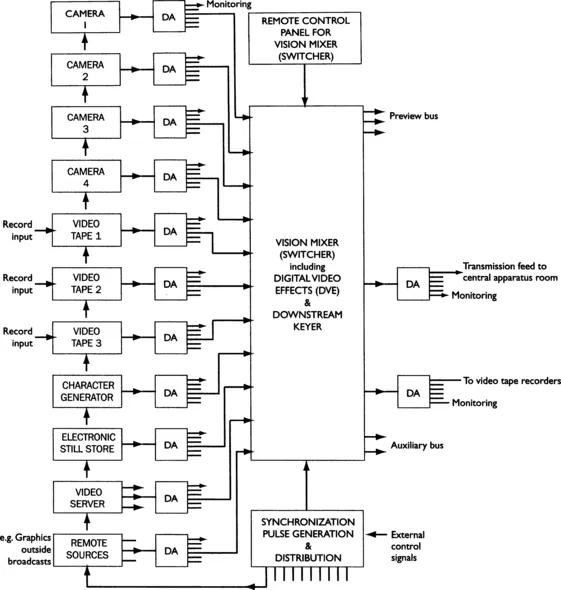
Figure 1.1 Basic television system.
This has a parallel in the film world with film shot at 24 pictures/second. Unfortunately, although a picture rate of 24 Hz is sufficient for conveying movement without ‘jerky’ transitions, the perceived picture suffers from flicker. To overcome this the picture rate needs to be above about 42 Hz. In the film world it would be expensive to shoot at 48 Hz – one would need twice as much film! The solution is a simple one: in the cinema the film projector simply displays each picture or frame twice, resulting in an effective picture rate of 48 Hz. In television the expense of a high picture rate is also prohibitive (see later note on bandwidth) – basically the more information to be transmitted in a second, the more expensive it becomes!
Having defined what is required to be done, we need to establish the basic parameters:
• aspect ratio
• scanning system
• number of lines/picture
• number of pictures/second
• interlace
• synchronization
• television signal
• bandwidth.
Aspect ratio is the ratio of picture width to picture height, the current standard of 4:3 dating back to the 1930s when early high-definition systems were developed. 4:3 was chosen as a compromise on film formats and the availability of suitable display tubes. The trend is towards 16:9 widescreen, with 14:9 as an interim measure.
The first function of the television camera is to produce an optical image of the scene to be televised and convert this to an electrical charge pattern, where the magnitude of the electrical charge is proportional to the ‘brightness’ (more strictly correct ‘luminance’) of the scene. This electrical charge pattern needs to be ‘read-off’ in a regular manner for transmission to the viewer. This is known as a scanning process and involves dividing the ‘picture’ into a number of horizontal lines, then ‘reading’ the electrical charge on each line in sequence, starting at the to...
Table of contents
- Cover
- Half Title
- Title Page
- Copyright Page
- Table of Contents
- Acknowledgements
- Introduction
- 1 Television engineering
- 2 Production methods
- 3 Safety
- 4 Lighting and vision control
- 5 Sound
- 6 Multicamera camerawork
- 7 Single-camera camerawork
- 8 Vision mixing
- 9 Television journalism and camerawork
- 10 Video recording formats
- 11 Video editing
- 12 Audio post-production
- 13 Television graphics
- Further reading
- Glossary
- Index
Trusted by 375,005 students
Access to over 1.5 million titles for a fair monthly price.
Study more efficiently using our study tools.
Frequently asked questions
Yes, you can cancel anytime from the Subscription tab in your account settings on the Perlego website. Your subscription will stay active until the end of your current billing period. Learn how to cancel your subscription
No, books cannot be downloaded as external files, such as PDFs, for use outside of Perlego. However, you can download books within the Perlego app for offline reading on mobile or tablet. Learn how to download books offline
Perlego offers two plans: Essential and Complete
- Essential is ideal for learners and professionals who enjoy exploring a wide range of subjects. Access the Essential Library with 800,000+ trusted titles and best-sellers across business, personal growth, and the humanities. Includes unlimited reading time and Standard Read Aloud voice.
- Complete: Perfect for advanced learners and researchers needing full, unrestricted access. Unlock 1.5M+ books across hundreds of subjects, including academic and specialized titles. The Complete Plan also includes advanced features like Premium Read Aloud and Research Assistant.
We are an online textbook subscription service, where you can get access to an entire online library for less than the price of a single book per month. With over 1.5 million books across 990+ topics, we’ve got you covered! Learn about our mission
Look out for the read-aloud symbol on your next book to see if you can listen to it. The read-aloud tool reads text aloud for you, highlighting the text as it is being read. You can pause it, speed it up and slow it down. Learn more about Read Aloud
Yes! You can use the Perlego app on both iOS and Android devices to read anytime, anywhere — even offline. Perfect for commutes or when you’re on the go.
Please note we cannot support devices running on iOS 13 and Android 7 or earlier. Learn more about using the app
Please note we cannot support devices running on iOS 13 and Android 7 or earlier. Learn more about using the app
Yes, you can access Multiskilling for Television Production by Peter Ward,Alan Bermingham,Chris Wherry in PDF and/or ePUB format, as well as other popular books in Media & Performing Arts & Film & Video. We have over 1.5 million books available in our catalogue for you to explore.