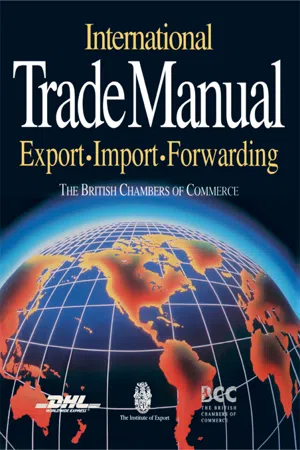
- 352 pages
- English
- ePUB (mobile friendly)
- Available on iOS & Android
eBook - ePub
International Trade Manual
About this book
The International Trade Manual is the definitive book about export, import and freightforwarding for business people and students of further and higher education. It is vital reading for anyone involved in international commerce and is the leading textbook for students taking International Trade and Services (ITAS) S/NVQ Levels 3 (supervisors) and 4 (managers) in international trade.
This comprehensive guide details exactly what you need to know if you want your business to profit from foreign trade. Endorsed by the British Chambers of Commerce and The Institute of Export, its contents include everything from customs documentation to credit risk.
Professionals working in international commerce will also find the reference sections invaluable. These contain checklists, forms, relevant legislation, regulations and a directory of further information sources.
Trainers, lecturers, students, managers and supervisors will all benefit from using this highly effective training resource.
1 How to use this book
The aim of this chapter is to explain how to use this book. This chapter is directed at all readers.
1.1 The ITAS NVQ
A competence-based National Vocational Qualification (NVQ), known in Scotland as a Scottish Vocational Qualification (SVQ), has been created for those working in the International Trade and Services (ITAS) industry. These qualifications are based on standards developed by the Lead Body for ITAS. Units have also been imported from the Administration and Customer Services Standards. The flexibility of the scheme allows candidates to demonstrate competence in a variety of environments, with evidence to support competence coming from activities at work (paid and unpaid), simulations where appropriate and prior achievements. The aim is to assess the candidate’s ability to apply knowledge and skills required in the performance of a wide range of activities normally required of those working in the ITAS industry. Candidates wishing to complete the full award must complete all mandatory units and one optional unit.
This manual covers the underpinning knowledge and range statements for those units concerned directly with international trade, as developed by the Lead Body for ITAS. It does not cover the units which have been imported from the Administration and Customer Services Standards.
This manual is also relevant to exporters, importers, freight forwarders and their office support staff, who may not be seeking an NVQ.
1.2 Chapter sequence
International trade is complex with many separate factors affecting it. The sequence of chapters in this book builds up the coverage of those factors, with particular reference to meeting the requirements of the ITAS units and elements. Each chapter covers:
2 ‘Background to international trade’: facts, figures and country statistics
3 ‘Preparation and research’: checking resources, checking demand and keeping well informed
4 ‘Arranging for delivery’: terms of delivery and managing those who provide this service
5 ‘Moving the goods’: choice of appropriate route to ensure safe delivery at the agreed price
6 ‘The role of HM Customs & Excise’: their impact on exports, imports and forwarding
7 ‘Import controls and procedures’: particular rules which affect principal import quotas
8 ‘Documentation’: the need for good documentation and how to produce it
9 ‘Payment methods’: the different methods and the effect for exporter and importer
10 ‘Trade finance and credit risk’: the main methods of trade finance and covering credit risk
11 ‘Foreign exchange’: the technicalities, analysis of risk and turning it to advantage
12 ‘Making a sales plan’: strategy and tactics for making and operating a sales plan to make money
13 ‘Pricing and promotion’: setting prices and arranging promotion and packaging
14 ‘Better exporting’: making exporters fully effective
15 ‘Better importing’: making an importing operation fully effective
16 ‘Legal issues of contract’: the legal issues and obligations in international contracts
17 ‘International distribution’: moving goods into an export market and selling them there
18 ‘Licensing and joint ventures’: formalizing and managing a licensing and joint venture partnership
19 ‘Certification services’: for staff who might wish to specialize in these services
20 ‘Electronic commerce’: an indication of the impact of this on international trade
21 ‘Sources of further information in the UK’: extensive information sources
22 ‘Document descriptions with samples’: key documents, with guidance for completing six of them
All the documents appear in Chapter 22 on pages 267. Throughout the chapters there are references to documents and some documents are referred to in more than one chapter. It is, therefore, easier for the reader to refer to documents as required when they are in the one chapter.
1.3 Chapter format
Each chapter starts with:
• A statement of the aim of the chapter
• The target readers of the chapter
• A box showing the ITAS elements covered for level 3 and/or level 4
Supervisors who are studying ITAS level 3 need not read those parts of the chapters which refer to ITAS level 4, although they may wish to do so. Managers who are studying ITAS level 4 may think it useful to refresh or update their knowledge by reading the whole book.
1.4 Chapter cross-references
There are several cross-references to other chapters and sections, or to sections within the chapter being read, and the page numbers are given.
1.5 Index
There is a comprehensive alphabetical index.
1.6 ITAS units and elements with references to chapters
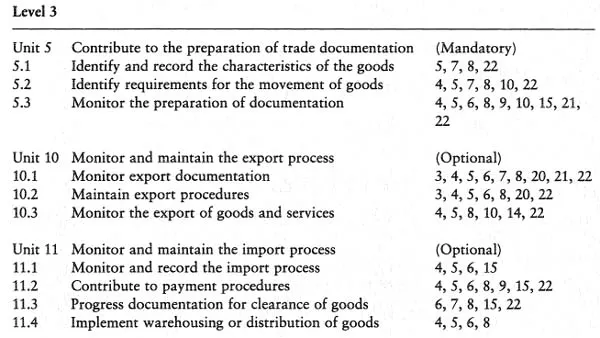
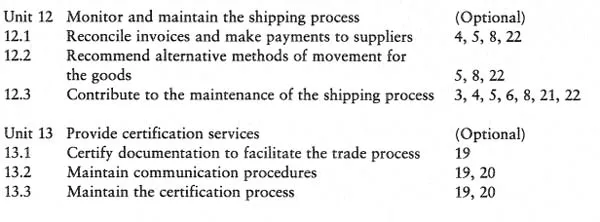
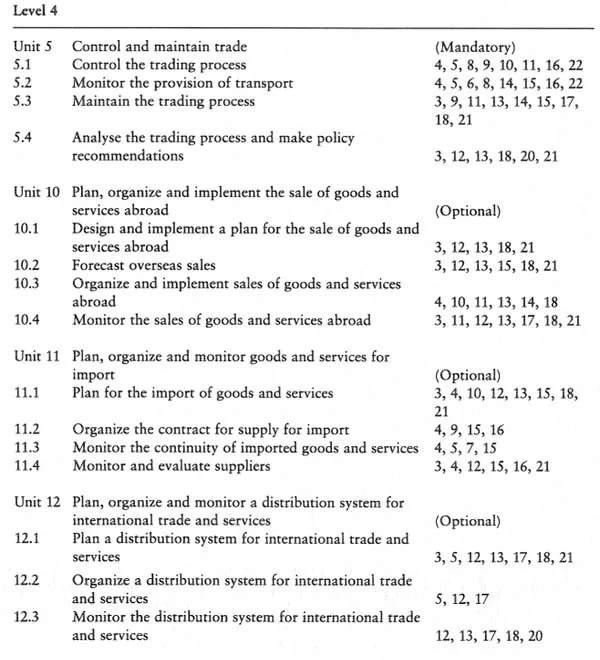
For level 3 there are five units, with one being mandatory and four being optional, and for level 4 there are four units, with one being mandatory and three being optional. Each unit is made up of three or four sub-units called elements.
The numbers at the right-hand side of each element below are the numbers of the chapters which include some reference to the range statements or underpinning knowledge for that element. Each chapter introduction itself also lists the elements to which that chapter includes some reference.
In Chapters 3, 14 and 15 the introduction specifies one particular section only in that chapter which applies to that element, e.g. Chapter 14 specifies element 10.3 (Section 14.1 only).
1.7 Definitions
Words or phrases specific to international trade are defined as they appear. They are also in the index, with the page reference of their definition. However, the definition of the difference between the EU and the EC is given here:
EU | means the European Union in the context of common policies of the Member States. |
EC | means the European Commission for e.g. regulations. But it is still correct to refer to the ‘EU’ as the ‘European Community’ or the ‘EC’. The Official Journal is ‘of the European Communities’. Customs regulations refer to the ‘EC’ as the European Community. |
In this manual, EU is used generally, except where the regulations themselves refer to the EC.
1.8 Specific cooperation between the exporter and importer
Exporters and importers should have a common aim: to combine together to sell to the ultimate users in the importer’s market, at the optimum price, on a continuing basis, so that they both go on making money. Very few exporters and importers really appreciate just how much they can improve their own performance by a better understanding of the problems and requirements of each other. Those few who do are able to use this cooperation to the benefit of the ultimate users, and so make possible optimum prices on a continuing basis in the market, with better rewards for themselves.
Areas for specific coo...
Table of contents
- Cover Page
- Epigraph
- Half Title Page
- Title Page
- Copyright Page
- Contents
- British Chambers of Commerce Foreword
- Institute of Export Foreword
- Acknowledgements
- Introduction
- 1 How to use this book
- 2 Background to international trade
- 3 Preparation and research
- 4 Arranging for delivery
- 5 Moving the goods
- 6 The role of HM Customs & Excise
- 7 Import controls and procedures
- 8 Documentation
- 9 Payment methods
- 10 Trade finance and credit risk
- 11 Foreign exchange
- 12 Making a sales plan
- 13 Pricing and promotion
- 14 Better exporting
- 15 Better importing
- 16 Legal issues of contract
- 17 International distribution
- 18 Licensing and joint ventures
- 19 Certification services
- 20 Electronic commerce
- 21 Sources of further information in the UK
- 22 Document descriptions with samples
- Index
- About the sponsors
Trusted by 375,005 students
Access to over 1.5 million titles for a fair monthly price.
Study more efficiently using our study tools.
Frequently asked questions
Yes, you can cancel anytime from the Subscription tab in your account settings on the Perlego website. Your subscription will stay active until the end of your current billing period. Learn how to cancel your subscription
No, books cannot be downloaded as external files, such as PDFs, for use outside of Perlego. However, you can download books within the Perlego app for offline reading on mobile or tablet. Learn how to download books offline
Perlego offers two plans: Essential and Complete
- Essential is ideal for learners and professionals who enjoy exploring a wide range of subjects. Access the Essential Library with 800,000+ trusted titles and best-sellers across business, personal growth, and the humanities. Includes unlimited reading time and Standard Read Aloud voice.
- Complete: Perfect for advanced learners and researchers needing full, unrestricted access. Unlock 1.5M+ books across hundreds of subjects, including academic and specialized titles. The Complete Plan also includes advanced features like Premium Read Aloud and Research Assistant.
We are an online textbook subscription service, where you can get access to an entire online library for less than the price of a single book per month. With over 1.5 million books across 990+ topics, we’ve got you covered! Learn about our mission
Look out for the read-aloud symbol on your next book to see if you can listen to it. The read-aloud tool reads text aloud for you, highlighting the text as it is being read. You can pause it, speed it up and slow it down. Learn more about Read Aloud
Yes! You can use the Perlego app on both iOS and Android devices to read anytime, anywhere — even offline. Perfect for commutes or when you’re on the go.
Please note we cannot support devices running on iOS 13 and Android 7 or earlier. Learn more about using the app
Please note we cannot support devices running on iOS 13 and Android 7 or earlier. Learn more about using the app
Yes, you can access International Trade Manual by British Chambers of Commerce in PDF and/or ePUB format, as well as other popular books in Economics & Business General. We have over 1.5 million books available in our catalogue for you to explore.