- 256 pages
- English
- ePUB (mobile friendly)
- Available on iOS & Android
eBook - ePub
About this book
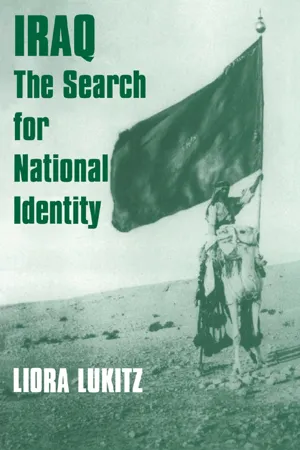
The 1990-1991 crisis in the Middle East and the disturbances that followed, threw the deep-seated divisions within the Iraqi population into focus. This book examines the complexities of the internal cultural, political and religious conflict within the modern state of Iraq.
Part I
1
Formal Independence and Informal Implications: Treaties, Agreements and State-formation
At the end of the First World War the British found themselves in possession of three former Ottoman vilayets—Baghdad, Basra and Mosul—without having a defined policy for their future.
Britain’s interests in the area went back to the eighteenth century, centring on trade from India to the Gulf and vice versa. After the First World War the need to guarantee a continued British presence in the Gulf area became imperative for two reasons: to safeguard the air route connecting the various parts of the British Empire and to retain control of the Persian oil fields and the Mosul vilayet. In both cases, strategic and economic interests were intertwined, as Mosul’s oil, although commercially unexplored, already weighed as a factor in British political considerations.
The question of how to safeguard military achievements and control the new territory (with frontiers extending 1,600 miles and a population of more than three million) remained unanswered, given Britain’s economic problems caused by heavy wartime expenses.
The decision to replace the British mandate (prescribed by the League of Nations at the San Remo Conference in 1920) with a less expensive formula that would legalize the British military presence and preserve British political and economic interests in the area was an outcome of the above impasse. This chapter describes the steps leading to a series of treaties and agreements between Britain and the new rulers of Iraq—the Emir Feisal of the Hijaz and his entourage of Sherifian officers, whose most important figures were Nuri al Sa‘id and Ja‘far al ‘Askari.
The relevance of these treaties and agreements transcends the realm of politics, as they eventually brought changes in all spheres of life. They introduced new political and administrative measures that would eventually lead to a new system of allegiances and loyalties. The institutionalization of Sunni dominance over the various ethnic, sectarian and linguistic groups populating the three geographically distinct areas artificially united after the war was meant to create a united and homogeneous society.
However, the difficulty of imposing such radical changes on a heterogeneous population was clear.1 The vilayets had developed a system of direct communication with Istanbul. By the same token the Ottoman Empire’s traditional policy of non-intervention in day-to-day life helped preserve local customs and practices as well as the social position and authority of the local leadership. The government’s intervention was sporadic at best while tribal sheikhs and Kurdish aghas remained traditional opponents to a central government that would undermine their own authority. Even the Tanzimat reforms, implemented throughout the empire during the second half of the nineteenth century, did not change this state of affairs.
Such a population, so bound by tradition, could hardly accept the imposition of a Western-style political system or the idea of a constitutional monarchy headed by a foreign king, who hailed from the Hijaz via Syria and enjoyed little support inside the country. The British attempt to impose both could not but stir discontent at all levels of society.
Emir Feisal’s arrival in 1921 turned the history of modern Iraq in a totally different direction, suiting mainly the personal perceptions of the British officials involved in the process. During the 1920s these officials—led by Percy Cox, Gertrude Bell, A.T.Wilson, Henry Dobbs and Ken Cornwallis among others—carried out Britain’s official policy on the spot, leaving their personal imprint on the country’s formative years.
The treaties engineered by these officials sought to legitimize British presence in the area and at the same time served as a means to define the country over which the new rulers would rule. In parallel with the establishment of norms between Britain and Iraq’s new rulers, there were protests from Baghdad’s more radical nationalist circles and from inhabitants of the provinces, mainly the Kurds and the Shi‘is.
The first treaty that bestowed legitimacy upon Britain’s presence in Iraq was signed in October 1922. With its ratifying protocol of June 1924, the treaty provided an option for Britain to exchange its mandatory rule— established in 1920 at the San Remo Conference— for a friendship treaty preserving nearly all the mandatory privileges, under a different cover. The duration of the treaty was 20 years, with revisions to be made every four years. The treaty was ratified by a constituent assembly elected through indirect elections after the establishment of a constitution under the Organic Law of 1924.
The British sought control on two levels: the military and the administrative. Militarily, Britain’s forces enjoyed maximum freedom of manoeuvre and facilities such as fuel storage and the use of roads, railways, waterways and ports. The 1922 treaty also permitted British control over the nascent Iraqi army by a network of British officers, supervised by a British inspector general.2
On the administrative level, a network of advisers controlled ministries and key institutions, such as the departments of irrigation and public works, land registry, police and others.
The 1922 treaty had two annexes. The first, a judicial agreement drawn up under Article 9, safeguarded the interests of foreigners, retaining in some ways the immunities and privileges they enjoyed under the Ottoman system of capitulations. To this end, British judges were invested with effective powers making it possible for foreigners to be tried by a court including at least one British judge.3
The second annex to the 1922 treaty was a financial agreement providing for the transfer to Iraq’s government of all public works built by the British, including roads, bridges and irrigation canals. The railway system and the port of Basra, considered as strategic assets, remained under British control. A joint British-Iraqi directorate was in charge of the administration of the railway and the port’s trust.4
A military agreement, also signed in 1924, forwarded responsibility for internal order and external defence to the Iraqi government in four years’ time.5 There was, however, a hidden catch in the military agreement. The need to secure the free movement of British troops and to maintain the network of communications made Britain as interested in the country’s stability as the Iraqi authorities themselves. The question of Iraq’s security was complex, as it encompassed external threats to its newly established borders (threats emanating mainly from the tribes of Nejd and from Kemalist Turkey) and internal threats (coming from the ethnic and religious groups forming the population in the provinces). The danger of dismemberment from within was far greater than any danger from outside the borders.
The Sunni government’s proposal to create an army by conscription—as a tool for defence and national sovereignty on the one hand and as a means to consolidate its own position on the other—provoked a reaction from the British, who preferred a small professional and mobile army.6 Such a reaction was caused by the certitude that conscription would lead to the mobilization of poorly trained troops,7 and also by the apprehension that Iraq could not cope with an increased military budget.8 The British wanted the funds to go to the construction of roads and railways,9 essential for the country’s development and indispensable for the mobility of their own troops in Iraq. The Sunni authorities, for their part, believed that the British position stemmed from the desire to retain control over the country and the Iraqi army, and from a basic disbelief in the government’s capacity to control the provinces.10 Such a lack of confidence in the Iraqi army was at the basis of the air force officers’ pressure to remain in Iraq for the years to come, in spite of the cost of maintaining Royal Air Force units and conciliary forces in Iraq’s territory.11
The debate over conscription aroused waves of antagonism all over the country. The Shi‘i leaders saw conscription as a threat to their position and an instrument for perpetuating Sunni domination for decades to come. This position stemmed from the belief that the illiterate Shi‘i tribesmen would remain the army’s rank and file, whereas the officer class would be drawn from the Sunnis.
The Kurds and Yazidis also opposed conscription, and for much the same reasons, whereas the Jews and the Christians considered emigration as a means to escape the draft. A good illustration of the impasse thus created is a letter written in October 1927 by E.L. Ellington, from Air Headquarters in Baghdad, to Sir Henry Dobbs, the High Commissioner: ‘In fact, the only ones who profess to be in favour of it [conscription] are those who will not be conscripted.’12
Ellington echoed here, as in other documents, the opinion of his colleagues at the Air Ministry, namely, that the country’s security should be based first and foremost on an air scheme. The air officers’ lack of confidence in Iraq’s army and its new rulers reinforced the tendency prevalent in Britain’s official circles to turn the RAF into the backbone of the country’s security system.13 This option, however, had far-reaching consequences. An air defence scheme implied secure bases, guarded by troops other than those that could be drawn from the newly formed Iraqi armed forces.
Moreover, this reliance on the air scheme undermined the necessity to conscript a large local army and implied a de facto abrogation of the controversial points in the military agreement. In effect, the air scheme, if correctly implemented, would reduce Iraq’s de jure and de facto responsibility for internal security and allow funds to be transferred to the development of the communication network so looked for by the air authorities.
As the years passed, the debate around the scheme expanded, becoming one of the main points of discussion among the air authorities, the Colonial Office, the Treasury and local nationalist circles.14 The tension thus created induced the British to divert attention to other points under discussion, among them the question of the Mosul vilayet.
THE MOSUL QUESTION
The composition of Mosul’s population (Kurds and Turkmen, mostly Sunnis) was already an important factor in former plans to annexe the former vilayet of Mosul to Iraq. This annexation would prevent the Shi‘is from constituting a majority and endangering the Sunnis’ hegemony over the country. Annexation, however, was not a simple matter. The Kurds, the main group in the area, were unwilling to be ruled by the Arabs and asked for the promises of autonomy made by Britain during and after the First World War to be honoured.
The Kurds’ second choice was to become part of Turkey. This option was supported by the Turks’ claim to Mosul on the basis of its occupation by Britain in the last days of the war, when the armistice had already taken effect. The Turks also dwelt on the legitimacy of their presence when confronted with the difficulty of the new Iraqi authorities in retaining control over Mosul without the active help of the RAF.15 In other words, the Mosul vilayet could be attached to Iraq only if a British presence was legally maintained. However, legality could be drawn only from a mandate accorded to Britain by the local population. To this end, a commission appointed by the League of Nations was sent to Mosul. Its formal mission was to inquire into the population’s wishes. Although aware of the impossibility of learning the population’s real desires, the commission’s members decided to attach Mosul to Iraq on the condition that Britain remain the country’s mandatory power for another 25 years (beginning in December 1925). However, this condition was circumvented by a later proviso stipulating that the nomination of Iraq to the League of Nations would put an end to the mandate and abrogate the treaty. This proviso implied the extension of Baghdad’s writ to Mosul in spite of the resistance of the local population. How Baghdad’s control over the provinces would come into effect, and whether Iraq was prepared for independence, remained open questions.16
Article 5 of a new treaty, signed in January 1926, granted the British sites for new air bases near Basra and west of the Euphrates and permitted them to remain in Hinaidi and Mosul for another five years.17 The terms of this article provided the answers for the above questions, without, however, referring to the controversy over the government’s ability to maintain order in the provinces. It was therefore clear that the RAF would assume a de facto responsibility for the extension of Baghdad’s authority to the provinces.
Once the maintenance of order was guaranteed and the authority of the government and the reputation of its armed forces ensured, renewed pressures were exerted on the King by the nationalist forces. The nationalists wanted the abrogation of the 1926 treaty and based their claim on the British undertaking to revise the terms of the treaty after four years. The revision of the treaty was obtained during Feisal’s visit to Europe, as a result of his refusal to return to Iraq without a trophy to ease the pressure from Baghdad’s nationalists. The British promise to support Iraq’s candidacy to the League of Nations in 1932 was thus obtained.18
The prospect of premature independence met the opposition of the Air Ministry, which wanted to retain the air bases on Iraq’s soil and have the Assyrian Levies as the guards of those bases.19 The reason for the appointment of Levies—troops recruited during the war from among the Assyrians—as guards for the British air bases was twofold: their maintenance as special troops would, on the one hand, help avoid a reliance on the Iraqi army for the defence of the bases and, on the other hand, prevent the Levies’ conscription in the Iraqi army. Even more indicative of the Air Ministry’s lack of confidence in the Iraqi army was the requirement that the Air Officer Commanding be recognized as the officer supervising any joint military ground-air action of Iraqi and British forces. These measures were intended to retain some control over the army and control of the government’s moves in the provinces.20
These conditions aroused protests in Baghdad and led to calls for the abrogation of the 1926 treaty and a return to the old treaty of 1922.21 One possible compromise—an informal extension of the status quo—met the Air Ministry’s opposition. This was because the possibility of leaving the air forces unsecured by a treaty22 was less palatable to the air authorities than to the Colonial Office.
The air authorities reiterated the importance of the RAF in face of the inability of the nascent Iraqi army to cope with insurrection. In effect the scarcity of British ground troops (two armoured sections in Baghdad, three in Basra and one in Mosul)23 induced even the Iraqi authorities to recognize the necessity of keeping the RAF as a means to preserve the government’s authority in the provinces.24
The government’s dependence on the RAF did not, however, prevent the nationalists from pressing further for the attainment of total independence.25 The complex situation thus created led to a deadlock that lasted until September 1929, when the advent of a Labour government in England brought the suspension of the 1926 treaty. This did not, however, change the situation radically, as the main problems remained unsolved. The most important one was the continuing quarrel over the nature of relations between the RAF and the Iraqi army after independence.
This impasse was finally solved by Nuri al Sa‘id’s secret proposition to Henry Dobbs, the British High Commissioner, on 27 October 1928, under which the retention of the air bases by Britain was assured,26 as was freedom of movement and action for British air forces in Iraqi territory. Accordingly the RAF would enjoy ‘all the privileges as if it were in Britain or in India’27 and be completely free of any possible int...
Table of contents
- Cover Page
- Title Page
- Copyright Page
- Abbreviations
- Preface
- Introduction
- Part I
- Part II
- Conclusion
- Afterword
- Notes
- Glossary
- Bibliography
Trusted by 375,005 students
Access to over 1.5 million titles for a fair monthly price.
Study more efficiently using our study tools.
Frequently asked questions
Yes, you can cancel anytime from the Subscription tab in your account settings on the Perlego website. Your subscription will stay active until the end of your current billing period. Learn how to cancel your subscription
No, books cannot be downloaded as external files, such as PDFs, for use outside of Perlego. However, you can download books within the Perlego app for offline reading on mobile or tablet. Learn how to download books offline
Perlego offers two plans: Essential and Complete
- Essential is ideal for learners and professionals who enjoy exploring a wide range of subjects. Access the Essential Library with 800,000+ trusted titles and best-sellers across business, personal growth, and the humanities. Includes unlimited reading time and Standard Read Aloud voice.
- Complete: Perfect for advanced learners and researchers needing full, unrestricted access. Unlock 1.5M+ books across hundreds of subjects, including academic and specialized titles. The Complete Plan also includes advanced features like Premium Read Aloud and Research Assistant.
We are an online textbook subscription service, where you can get access to an entire online library for less than the price of a single book per month. With over 1.5 million books across 990+ topics, we’ve got you covered! Learn about our mission
Look out for the read-aloud symbol on your next book to see if you can listen to it. The read-aloud tool reads text aloud for you, highlighting the text as it is being read. You can pause it, speed it up and slow it down. Learn more about Read Aloud
Yes! You can use the Perlego app on both iOS and Android devices to read anytime, anywhere — even offline. Perfect for commutes or when you’re on the go.
Please note we cannot support devices running on iOS 13 and Android 7 or earlier. Learn more about using the app
Please note we cannot support devices running on iOS 13 and Android 7 or earlier. Learn more about using the app
Yes, you can access Iraq by Liora Lukitz in PDF and/or ePUB format, as well as other popular books in History & Middle Eastern History. We have over 1.5 million books available in our catalogue for you to explore.